Growing Threat of Digital Terrorism: Insights from FATF’s 2025 Report
FATF’s 2025 Report reveals rising digital terror threats in India through crypto, VPNs, and e-commerce, urging stronger global regulations.

FATF’s 2025 Report reveals rising digital terror threats in India through crypto, VPNs, and e-commerce, urging stronger global regulations.

India’s Digital Divide reveals a shift from access to empowerment, highlighting gaps in skills, ownership, and gender-inclusive digital growth.

Ecologist Madhav Gadgil has called for a community-led conservation model for the Western Ghats, highlighting failures in forest governance and poor implementation of the Forest Rights Act (FRA), 2006.

Tawi River, originating from Kailash Kund glacier, is Jammu’s lifeline and a Chenab tributary, vital for water supply, culture, and tourism.

The UN80 Initiative aims to reform and modernize the UN system by improving efficiency, accountability, and delivery on peace, development, and human rights.

Despite 46% women in urban local bodies, technical roles in planning, engineering, and policing remain male-dominated, limiting inclusive governance.

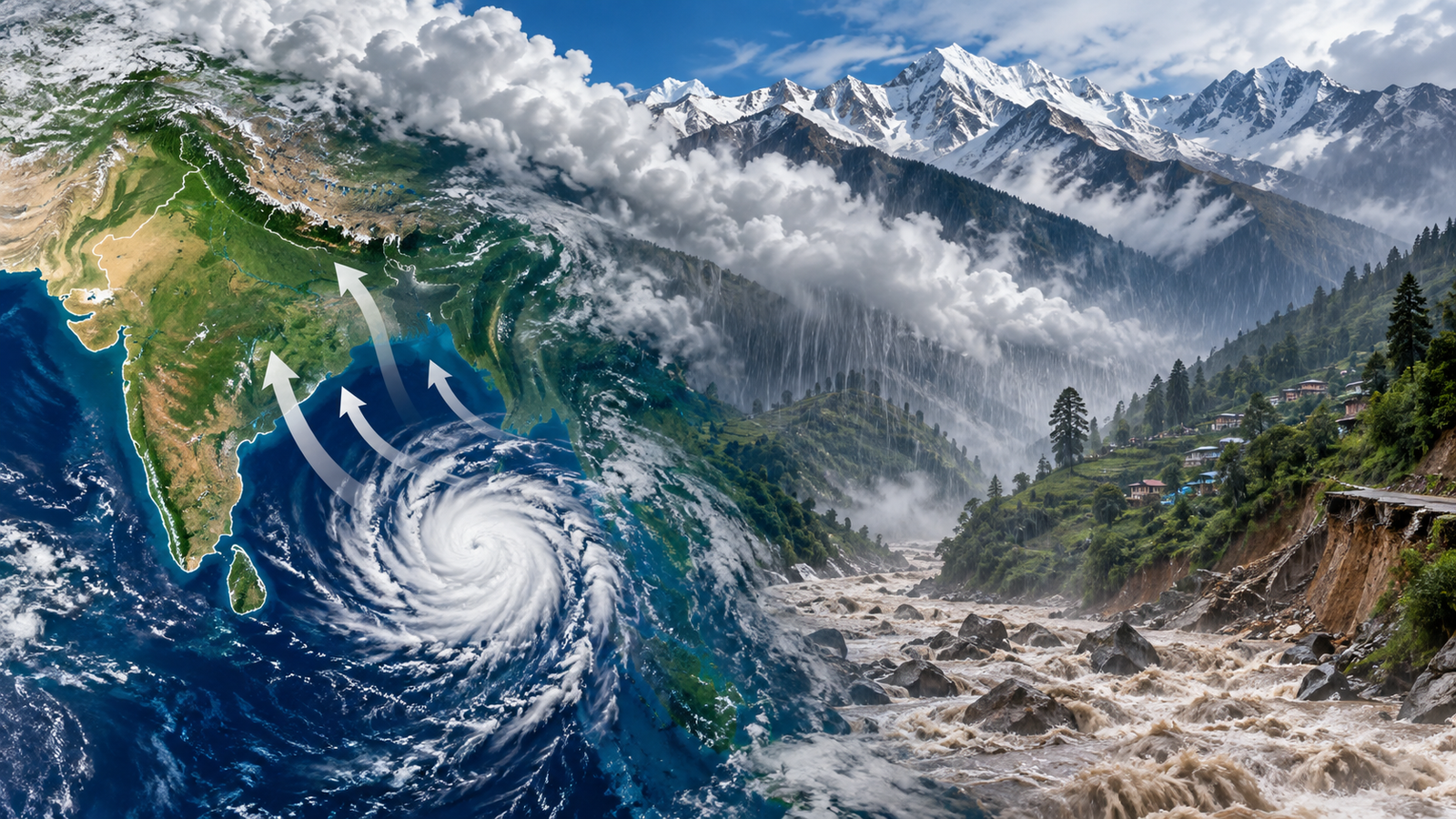
Cloudburst in Himachal Pradesh Syllabus: Geography | Disaster ManagementSource: The Indian Express Why In News: Cloudburst Recent cloudbursts in Kangra and Kullu districts of Himachal Pradesh triggered severe flash floods, resulting in two deaths and over a dozen missing. What is a Cloudburst? Conditions Favouring Cloudbursts: How Do Cloudbursts Occur? Consequences of Cloudbursts: On Disasters: On People: On the Environment: Measures to Manage Cloudburst Risks: National Guidelines: Technological Upgrades: Local Capacity Building: Climate Action: Recent Cloudburst Incidents in India Location

The Prime Ministers Museum and Library (PMML) in New Delhi has announced plans to take legal action to recover the Private Papers of Jawaharlal Nehru, which were reportedly taken by Sonia Gandhi in 2008. The institution has described these documents as a national treasure.

Half a Century Since India’s Emergency Era Source: DD NewsSyllabus: Indian Polity & Governance | Modern History Why In News: Emergency On 25th June 2025, India marks the 50th anniversary of the declaration of the Emergency (1975–1977), a critical period that significantly impacted the country’s democracy and constitutional framework. What was the Emergency? Events Leading to the Emergency: Key Developments During the Emergency: Aftermath and Reforms Post-Emergency: Conclusion: The Emergency period remains a crucial chapter in India’s democratic journey, reminding

Syllabus: Sustainable Development & Governance GS III(UPSC) Source: NDTV Why In News: India has secured a position in the Top 100 (99th rank) for the first time in the Sustainable Development Report (SDR) 2025, released by the UN Sustainable Development Solutions Network (SDSN). This marks the 10th edition of the global report. What is the Sustainable Development Report (SDR)? Global Highlights from SDR 2025: Major Concerns Highlighted in SDR 2025: India’s Performance in SDR 2025: Recommendations for Achieving SDGs: Conclusion:

A complete HPPSC-focused analysis of the Skill Development Allowance Scheme,

A complete HPPSC-focused analysis of Rajiv Gandhi Swarozgar Start-up Scheme,


The National Board for Wildlife is India’s apex body for

Himachal Pradesh hosts diverse wildlife across alpine, temperate, and subtropical

A complete HPPSC-focused analysis of Mukhya Mantri Swavalamban Yojana (2019),
Sindh is a historical and geographical region located in southeastern Pakistan, bordering India’s Rajasthan and Gujarat states. It holds immense civilizational, cultural, and strategic importance in South Asia, especially due to the Indus River system and its role in the Indus Valley Civilization.
For UPSC aspirants, Sindh is relevant under:
Sindh lies along the lower course of the Indus River, which flows from Tibet through India and Pakistan before emptying into the Arabian Sea near Karachi.
Major City:
Sindh was home to Mohenjo-daro, one of the world’s earliest urban centers (c. 2500 BCE).
Sindh became part of Pakistan in 1947 during Partition.
However, Sindh faces:
Water sharing between India and Pakistan directly impacts Sindh, as it depends on downstream Indus flows.
Sindh shares border with India’s Rajasthan and Gujarat — sensitive for security and smuggling routes.
Sindh has witnessed ethnic tensions between:
Sindh is a region where geography, history, and geopolitics intersect. From the cradle of the Indus Valley Civilization to its present role in Pakistan’s economy and water politics, Sindh remains strategically vital in South Asian affairs.
Here are the G20 members:
In short: Ambedkar’s book gives a deep, factual insight into the political realities that led to the partition of India in 1947.
(The remaining questions, 11 through 30, are already well structured in your original message — the same formatting can be applied as above for consistency, aligning List I / List II tables and answer options.)
this is a demo popup