RBI Repo Rate Hike 2026: Why RBI Raised Repo Rate to 5.5% and What It Means for Inflation, Loans and the Economy
Why in News?
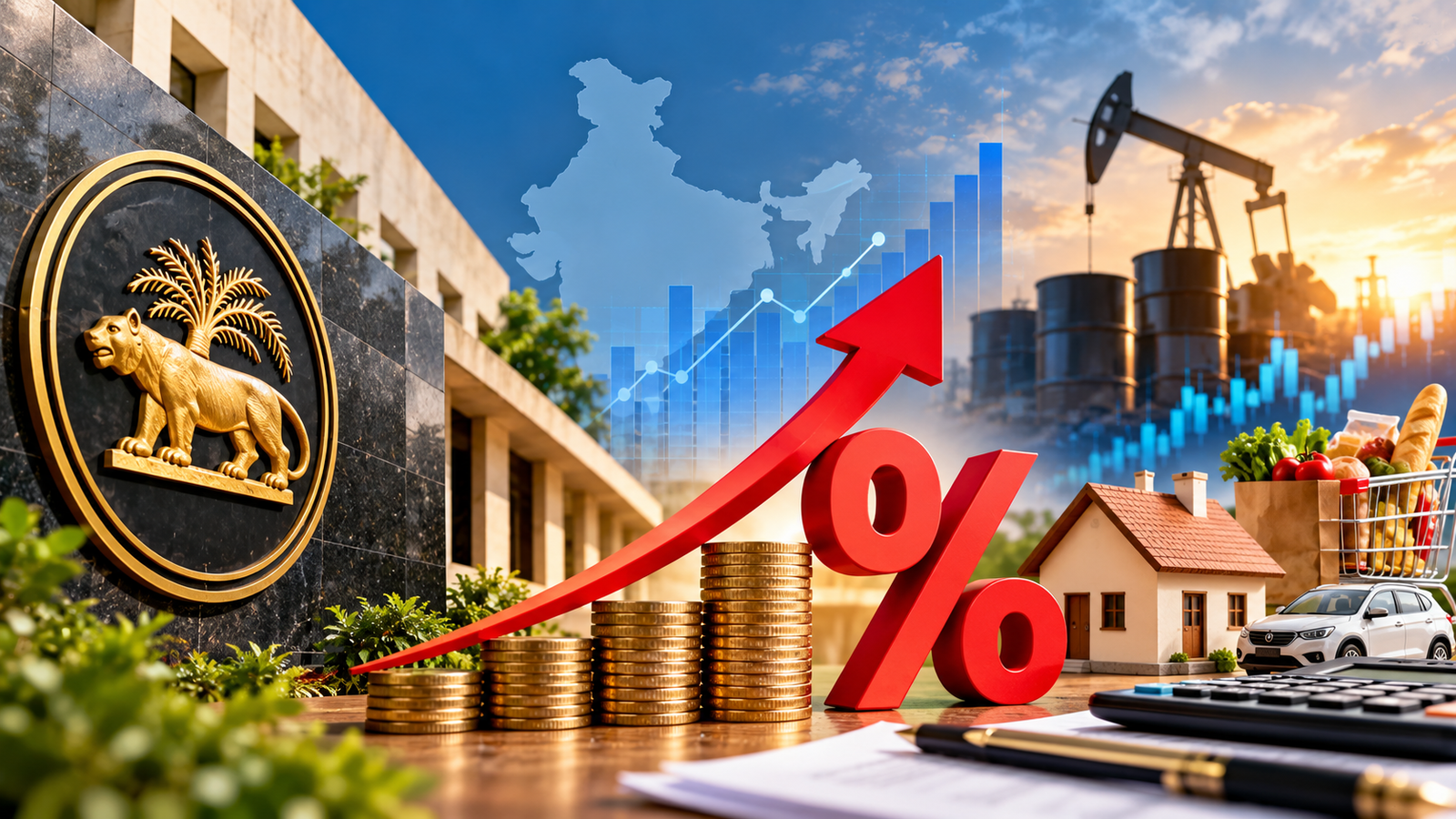
The Reserve Bank of India (RBI) has raised the repo rate by 25 basis points (bps) to 5.50% in its October 2026 Monetary Policy review.
This is the first repo-rate hike since February 2023, marking a major shift in India’s monetary-policy cycle. The RBI has also changed its policy stance from “neutral” to “calibrated tightening.”
The decision comes at a time when India is facing renewed inflationary pressures from:
- higher crude-oil prices
- geopolitical tensions
- pressure on the rupee
- weaker monsoon conditions
- global financial-market uncertainty
At the same time, India’s economic growth remains strong.
The RBI has raised its FY2026–27 GDP growth forecast to 7.1%, while increasing its inflation projection to 5.2% from 5.0%.
This creates an important policy challenge:
How can the RBI control inflation without unnecessarily weakening economic growth?
What is the Repo Rate?
Before understanding the rate hike, we need to understand the repo rate.
Simple meaning
Commercial banks sometimes need short-term funds.
They can borrow money from the RBI against eligible securities.
The interest rate charged by the RBI on such lending is called the repo rate.
English Definition
Repo rate is the policy interest rate at which the RBI lends short-term funds to commercial banks against eligible securities under the liquidity adjustment framework.
The repo rate is one of the RBI’s most important monetary-policy instruments.
What Has the RBI Changed?
The RBI has increased the repo rate:
5.25% → 5.50%
Increase:
25 basis points
Since:
1 basis point = 0.01 percentage point
Therefore:
25 bps = 0.25 percentage point
The October decision was the first increase since February 2023.
Why Did RBI Increase the Repo Rate?
The main reason is the changing inflation-growth balance.
The RBI is facing a situation where:
Growth is strong + Inflation risks are increasing
Normally, when growth is weak, a central bank may reduce interest rates to encourage borrowing.
But when inflation becomes persistent, the central bank may increase interest rates to reduce demand and prevent inflation from becoming entrenched.
Rising Inflation Pressure
India’s retail inflation increased to 4.82% in August 2026, remaining above the RBI’s medium-term target of 4% for the third consecutive month.
This does not mean inflation is extremely high.
The concern is its direction and persistence.
The RBI has therefore revised its FY2026–27 inflation forecast upward:
5.0% → 5.2%
RBI’s Inflation Target
The Government has mandated the RBI to maintain CPI inflation at 4%, with a tolerance band of:
2% to 6%
Therefore:
Target = 4%
Lower tolerance limit = 2%
Upper tolerance limit = 6%
This framework is called Flexible Inflation Targeting (FIT).
What is Flexible Inflation Targeting?
Hinglish
Flexible Inflation Targeting ka matlab hai ki RBI ka primary focus inflation ko target ke around maintain karna hai, lekin RBI economic growth ko bhi completely ignore nahi karta.
English Definition
Flexible Inflation Targeting is a monetary-policy framework in which the central bank targets inflation while also allowing consideration of economic growth and other macroeconomic conditions.
India’s framework gives the RBI a 4% CPI inflation target with a ±2 percentage-point tolerance band.
Why Are Oil Prices Important?
India imports a large share of its crude oil requirements.
Therefore:
Global crude price ↑
can lead to:
Import bill ↑ → input costs ↑ → transport costs ↑ → production costs ↑ → inflationary pressure ↑
This is particularly important in the current environment because global oil prices have been pushed higher amid geopolitical tensions in West Asia.
What is Imported Inflation?
This is an important UPSC concept.
Hinglish
Jab kisi country mein imported goods ya raw materials ke prices badhne ki wajah se domestic prices increase hote hain, usse imported inflation kehte hain.
For India, crude oil is particularly important.
English Definition
Imported inflation occurs when rising prices of imported goods, commodities or inputs increase domestic price levels.
Example:
Crude oil price ↑
↓
India’s import cost ↑
↓
Transport and production costs ↑
↓
Domestic inflationary pressure ↑
Weak Monsoon and Inflation
The RBI is also considering weather-related risks.
A weak monsoon can affect:
- agricultural production
- food supply
- food prices
- rural incomes
- consumption
The 2026 monsoon has already been weaker than normal, creating additional risks for food and agricultural prices.
Therefore, monetary policy is interacting with an important supply-side shock.
What is a Supply-Side Shock?
Hinglish
Supply-side shock tab hota hai jab production ya supply suddenly disturb ho jaye aur uske result mein prices increase ya output decrease ho.
Examples:
- poor monsoon
- war
- oil-price shock
- supply-chain disruption
- natural disaster
English Definition
A supply-side shock is a sudden disruption in production or supply that affects output, costs and prices.
This creates a difficult situation for monetary policy.
Why?
Because increasing interest rates can reduce demand, but it cannot directly produce more wheat or crude oil.
Growth Remains Strong
The RBI is not hiking rates because India’s economy has collapsed.
Quite the opposite.
The central bank has raised its FY2026–27 GDP growth forecast to 7.1% from 6.7%.
India’s April–June 2026 GDP growth was reported at 7.8%, above the RBI’s earlier forecast.
This gives the RBI some room to prioritise inflation control without necessarily creating an immediate recessionary environment.
What is Monetary Policy?
Hinglish
Monetary policy wo policy hai jiske through RBI economy mein money supply, interest rates aur liquidity ko influence karta hai.
English Definition
Monetary policy is the policy through which a central bank influences interest rates, liquidity and credit conditions to achieve macroeconomic objectives.
In India, the RBI conducts monetary policy.
Monetary Policy vs Fiscal Policy
This is a common UPSC confusion.
| Monetary Policy | Fiscal Policy |
|---|---|
| Conducted by RBI | Conducted by Government |
| Interest rates | Taxation |
| Liquidity | Government expenditure |
| Credit conditions | Borrowing |
| Money/financial conditions | Public spending |
| Inflation management | Growth + redistribution + public finance |
Therefore:
RBI → Monetary Policy
Government → Fiscal Policy
What is the Monetary Policy Committee?
The Monetary Policy Committee (MPC) is the statutory body responsible for determining the policy interest rate needed to achieve the inflation target.
It consists of six members.
The MPC considers:
- inflation
- growth
- economic conditions
- financial stability
- global developments
- supply-side factors
The October 2026 rate increase was approved unanimously, according to reports.
What Does “Calibrated Tightening” Mean?
This phrase is particularly important in the current affair.
The RBI has shifted its stance from:
Neutral → Calibrated Tightening
Hinglish
Calibrated tightening ka matlab hai RBI monetary conditions ko gradually tighter rakhne ke liye ready hai, lekin future action economic data aur inflation outlook ke according decide hoga.
It does not automatically mean that another rate hike is guaranteed.
English Definition
Calibrated tightening refers to a measured approach towards making monetary conditions less accommodative in response to persistent inflationary pressures.
The stance therefore signals a more inflation-focused policy direction.
What is a Neutral Monetary Policy Stance?
Hinglish
Neutral stance ka matlab generally ye hota hai ki RBI na toh clearly rate cuts ki direction mein committed hai aur na hi rate hikes ki direction mein.
English Definition
A neutral monetary-policy stance indicates that the central bank is not pre-committed to either easing or tightening monetary conditions and will respond to incoming economic data.
How Does a Repo Rate Hike Affect the Economy?
The transmission mechanism can be understood as:
Repo Rate ↑
↓
Banks’ funding cost and market rates may rise
↓
Loan interest rates may rise
↓
Borrowing becomes relatively expensive
↓
Credit demand may moderate
↓
Consumption and investment may slow
↓
Demand-side inflationary pressure may decline
This is called the monetary policy transmission mechanism.
Impact on Home Loans and EMIs
This is one of the most important public-interest aspects of the rate hike.
If banks increase lending rates, borrowers with certain floating-rate loans may face:
- higher EMIs
- longer repayment periods
- higher total interest burden
However, the actual impact depends on:
- type of loan
- lending benchmark
- bank’s transmission
- borrower’s existing rate
- loan tenure
- reset frequency
Therefore, a 25-bps RBI hike does not automatically mean every borrower’s EMI will immediately rise by exactly 25 bps.
Impact on Depositors
A rate-hike cycle can also benefit savers.
Banks may increase:
- deposit rates
- fixed-deposit rates
- other savings-related returns
However, transmission varies between banks and financial products.
Therefore:
Borrowers → potentially higher borrowing costs
Savers → potentially better deposit returns
Impact on Businesses
Businesses often borrow money for:
- expansion
- machinery
- working capital
- infrastructure
- inventory
Higher interest rates can increase financing costs.
This may reduce the incentive for some businesses to undertake debt-funded investment.
But the impact is not necessarily negative for all businesses.
Companies with:
- strong cash reserves
- low debt
- high pricing power
may be less affected.
Impact on Consumption
Higher borrowing costs can reduce demand for:
- houses
- cars
- consumer durables
- personal loans
This can moderate aggregate demand.
For example:
Interest rate ↑
→ Home loan cost ↑
→ Housing demand may soften
→ Construction/investment may moderate
This is one way monetary policy influences the real economy.
Impact on Inflation
The primary objective of the hike is to contain inflationary pressures.
The simplified mechanism is:
Interest rate ↑
→ Credit becomes relatively expensive
→ Borrowing ↓
→ Excess demand ↓
→ Inflationary pressure ↓
But remember:
Monetary policy is more effective against demand-side inflation than pure supply-side inflation.
This is a very important UPSC point.
Demand-Pull vs Cost-Push Inflation
Demand-Pull Inflation
Hinglish
Jab demand supply se zyada rapidly increase ho jaye, prices increase ho sakte hain.
English Definition
Demand-pull inflation occurs when aggregate demand grows faster than the economy’s ability to supply goods and services.
Monetary tightening can be relatively effective here.
Cost-Push Inflation
Hinglish
Jab production cost increase ho jaati hai, jaise oil, raw material ya transport cost badh jaaye, toh prices increase ho sakte hain.
English Definition
Cost-push inflation occurs when rising input or production costs push the general price level upward.
Interest-rate hikes cannot directly solve the underlying supply shortage.
Why RBI Faces a Difficult Balancing Act
The RBI has to balance:
Price Stability
Keep inflation under control.
Economic Growth
Avoid excessive tightening that damages investment and consumption.
Financial Stability
Prevent disorderly conditions in financial markets.
Currency Stability
Limit excessive external pressure on the rupee.
Credit Conditions
Ensure that productive sectors continue receiving adequate credit.
This is why monetary policy is often described as a balancing exercise.
What Does the Rate Hike Mean for the Rupee?
Higher domestic interest rates can potentially make rupee-denominated financial assets more attractive.
This may support capital flows and the currency.
However, exchange rates depend on many factors, including:
- US interest rates
- global risk sentiment
- crude-oil prices
- capital flows
- trade balance
- geopolitical conditions
Therefore:
Repo rate hike ≠ guaranteed rupee appreciation
The rupee remained under pressure despite the RBI move, according to market reports.
Impact on Government Borrowing
Higher interest rates can influence government bond yields and borrowing costs.
Government securities yields also responded to the RBI’s tightening signal, with the 10-year benchmark yield moving higher on 7 October.
This matters because government borrowing is a major component of India’s financial markets.
What is the Policy Repo Rate?
The policy repo rate is the key rate used by the RBI to signal the direction of monetary policy.
When the RBI raises it:
Policy becomes tighter
When the RBI reduces it:
Policy becomes more accommodative
Other Important RBI Policy Rates
For Prelims, remember the relationship.
Repo Rate
Rate at which RBI lends short-term funds to banks against eligible securities.
Standing Deposit Facility
Facility through which banks can park funds with RBI without providing collateral.
The October 2026 SDF rate is 5.25%.
Marginal Standing Facility
Emergency overnight borrowing facility available to eligible banks from RBI against specified securities.
October 2026 MSF rate:
5.75%.
Bank Rate
A broader reference rate used for certain RBI facilities and regulatory purposes.
The October 2026 bank rate was also reported at 5.75%.
Corridor of Monetary Policy
A simplified representation is:
MSF / Bank Rate: 5.75%
↓
Repo Rate: 5.50%
↓
SDF: 5.25%
This arrangement helps RBI influence short-term money-market conditions.
Why Did RBI Not Simply Wait?
A central bank sometimes acts pre-emptively.
If inflation expectations become unanchored, inflation can become more persistent.
For example:
Oil prices ↑
→ Transport costs ↑
→ Production costs ↑
→ Prices ↑
→ Workers demand higher wages
→ Businesses raise prices
→ Inflation expectations ↑
This can create a second-round effect.
Early policy action can therefore attempt to prevent temporary inflationary pressures from becoming entrenched.
What are Inflation Expectations?
Hinglish
Inflation expectations ka matlab hai log aur businesses future mein prices kitne badhne ki expectation rakhte hain.
English Definition
Inflation expectations are beliefs about the future rate of increase in prices held by households, businesses and financial-market participants.
If expectations become too high, controlling inflation becomes more difficult.
RBI’s Growth–Inflation Trade-Off
The current policy illustrates a classic macroeconomic trade-off.
Higher rates
→ Lower inflationary pressure
but potentially
→ Lower consumption and investment
Conversely:
Lower rates
→ More borrowing and demand
but potentially
→ Greater inflationary pressure
Therefore, the RBI must determine the appropriate policy mix based on prevailing conditions.
What Does This Mean for Ordinary Citizens?
Borrowers
Floating-rate borrowers may face higher borrowing costs if banks transmit the hike.
Homebuyers
New loans may become somewhat more expensive.
Vehicle buyers
Auto loans may become costlier.
Businesses
Debt financing may become more expensive.
Depositors
Deposit rates may improve depending on bank transmission.
Consumers
The long-term objective is to prevent persistent inflation from reducing purchasing power.
What Does It Mean for Investors?
A rate hike can affect:
- bonds
- equities
- bank stocks
- NBFCs
- real estate
- currency markets
Higher rates generally put pressure on valuations of some interest-sensitive assets.
However, market reaction depends on expectations.
If markets had already anticipated the hike, much of the effect may already be priced in.
This is an important economic concept:
Markets react not only to what happens, but also to how the actual decision differs from expectations.
Why is the October 2026 Decision Significant?
The decision is significant for several reasons.
First rate hike since February 2023
It marks a clear change from the earlier easing cycle.
Inflation concerns have returned
August inflation was 4.82%, above the 4% target for the third consecutive month.
Growth remains strong
The RBI has raised its FY27 growth forecast to 7.1%.
Policy stance has tightened
The stance moved from neutral to calibrated tightening.
Global environment is uncertain
Oil prices, geopolitical tensions, currencies and global financial conditions are influencing India’s inflation outlook.
Challenges Before RBI
Supply-side inflation
Interest rates cannot directly increase agricultural production or global oil supply.
Growth risks
Excessive tightening could weaken investment and consumption.
Global uncertainty
Geopolitical developments can rapidly change oil and financial-market conditions.
Currency pressure
Imported inflation can increase if the rupee weakens significantly.
Transmission delays
Monetary policy does not affect the economy immediately.
There is a time lag between:
Policy decision → financial markets → banks → borrowers → demand → inflation
Way Forward
The RBI will need to remain data-dependent.
Important indicators include:
- CPI inflation
- core inflation
- food prices
- crude oil prices
- inflation expectations
- GDP growth
- credit growth
- exchange rate
- liquidity conditions
- global interest rates
The best approach is likely to combine monetary policy with appropriate supply-side measures.
For example:
Monetary policy + food-supply management + energy security + fiscal prudence
can provide a more comprehensive response to inflation.
Important Terms for UPSC
Repo Rate
English Definition: Policy rate at which RBI lends short-term funds to banks against eligible securities.
Basis Point
English Definition: One-hundredth of a percentage point; 100 bps = 1 percentage point.
Monetary Policy
English Definition: Policy through which a central bank influences interest rates, liquidity and credit conditions.
Inflation Targeting
English Definition: Monetary-policy framework in which the central bank aims to maintain inflation around a specified target.
Calibrated Tightening
English Definition: A measured approach towards making monetary conditions less accommodative in response to inflationary risks.
Imported Inflation
English Definition: Domestic inflation caused partly by rising prices of imported goods and inputs.
Inflation Expectations
English Definition: Expectations regarding future changes in the general price level.
Monetary Transmission
English Definition: Process through which changes in policy rates affect market rates, bank lending, demand and ultimately inflation and output.
Prelims Facts
| Item | October 2026 |
|---|---|
| Repo Rate | 5.50% |
| Repo-rate change | +25 bps |
| Previous repo rate | 5.25% |
| SDF | 5.25% |
| MSF | 5.75% |
| Bank Rate | 5.75% |
| Policy stance | Calibrated Tightening |
| FY27 GDP forecast | 7.1% |
| FY27 inflation forecast | 5.2% |
| Latest August CPI inflation | 4.82% |
| Last repo-rate hike before this | February 2023 |
The rate hike was unanimous, while reports indicate the stance change was supported by a 4–2 MPC vote.
Prelims Practice Question
Consider the following statements regarding the repo rate:
- It is a monetary-policy instrument of the Reserve Bank of India.
- An increase in the repo rate generally makes borrowing conditions tighter.
- A repo-rate increase can directly increase the physical supply of crude oil in the international market.
- Repo-rate changes can influence inflation through monetary-policy transmission.
Which of the statements given above are correct?
Answer: 1, 2 and 4 only
Explanation
Statement 1 — Correct
The repo rate is a key monetary-policy instrument of the RBI.
Statement 2 — Correct
A higher repo rate can make borrowing conditions tighter.
Statement 3 — Incorrect
A repo-rate hike cannot directly increase global crude-oil supply.
Statement 4 — Correct
Changes in policy rates can influence lending rates, credit demand, aggregate demand and inflation.
UPSC Mains Connection
GS Paper III
Syllabus Linkage
- Indian Economy
- Monetary policy
- Inflation
- Growth
- Banking
- Financial markets
- Macroeconomic stability
Possible Mains Question
“The RBI’s October 2026 repo-rate hike reflects the difficult trade-off between inflation control and economic growth. Examine.”
Answer Framework
Introduction
The RBI raised the repo rate by 25 bps to 5.5%, its first hike since February 2023, while shifting its stance from neutral to calibrated tightening.
Body
Discuss:
Reasons
- inflation above target
- higher crude prices
- geopolitical uncertainty
- weak monsoon
- currency pressure
- strong domestic demand
Transmission
Repo rate ↑
→ lending rates ↑
→ credit demand ↓
→ aggregate demand moderation
→ inflationary pressure ↓
Challenges
- supply-side inflation
- growth risks
- delayed transmission
- global uncertainty
Way Forward
- data-dependent monetary policy
- food-supply management
- energy diversification
- fiscal prudence
- productivity enhancement
Conclusion
The effectiveness of monetary tightening will depend on whether inflationary pressures become persistent and how successfully India manages the supply-side factors driving prices.
HPPSC Perspective
For HPPSC, connect this topic with:
- RBI
- Monetary Policy Committee
- inflation
- repo rate
- banking
- interest rates
- agriculture and food inflation
- monsoon
- economic growth
- household borrowing
A useful Himachal-specific connection is food and agricultural inflation.
A weak monsoon or weather-related disruption can affect agricultural output, while changes in interest rates influence borrowing and investment in sectors such as agriculture, tourism, MSMEs and housing.
Geography Optional Connection
This topic can also be linked with economic geography through:
- spatial impact of inflation
- agricultural supply shocks
- energy geography
- crude-oil dependence
- regional development
- rural consumption
- infrastructure investment
A useful analytical chain is:
Climate/Monsoon → Agricultural Output → Food Prices → Inflation → Monetary Policy → Consumption & Investment
One-Page Revision
RBI OCTOBER 2026
→ Repo Rate: 5.50%
→ Hike: 25 bps
→ First hike since Feb 2023
→ Stance: Calibrated Tightening
→ August CPI: 4.82%
→ FY27 Inflation Forecast: 5.2%
→ FY27 GDP Forecast: 7.1%
WHY HIKE?
→ Inflationary pressure
→ Crude-oil prices
→ Geopolitical uncertainty
→ Weak monsoon
→ Currency pressure
→ Strong growth
TRANSMISSION
Repo ↑
→ Borrowing cost ↑
→ Credit demand ↓
→ Aggregate demand ↓
→ Inflationary pressure ↓
BUT
Supply-side inflation cannot be solved by interest rates alone.
KEY TRADE-OFF
Inflation Control vs Economic Growth
KEY TERMS
→ Repo Rate
→ Basis Point
→ Monetary Policy
→ MPC
→ Flexible Inflation Targeting
→ Imported Inflation
→ Inflation Expectations
→ Monetary Transmission
→ Calibrated Tightening
Conclusion
The RBI’s decision to raise the repo rate to 5.50% marks an important turning point in India’s monetary-policy cycle.
The decision reflects a changed macroeconomic environment: economic growth remains strong, but inflationary risks have increased because of higher energy prices, geopolitical uncertainty, weather-related pressures and currency concerns.
The central challenge now is to prevent temporary supply shocks from becoming persistent inflation while avoiding excessive damage to investment and consumption.
For UPSC, the most important takeaway is:
Monetary policy cannot directly create food or oil supply. Its primary role is to manage demand, expectations, liquidity and financial conditions so that temporary price shocks do not become entrenched inflation.
Thus, India’s response to inflation requires not only RBI monetary tightening, but also supply-side reforms, energy diversification, agricultural resilience and prudent fiscal management.