3D Concrete-Printed Rural Housing: Andhra Pradesh Launches India’s First PMAY-G Pilot
Why in News?
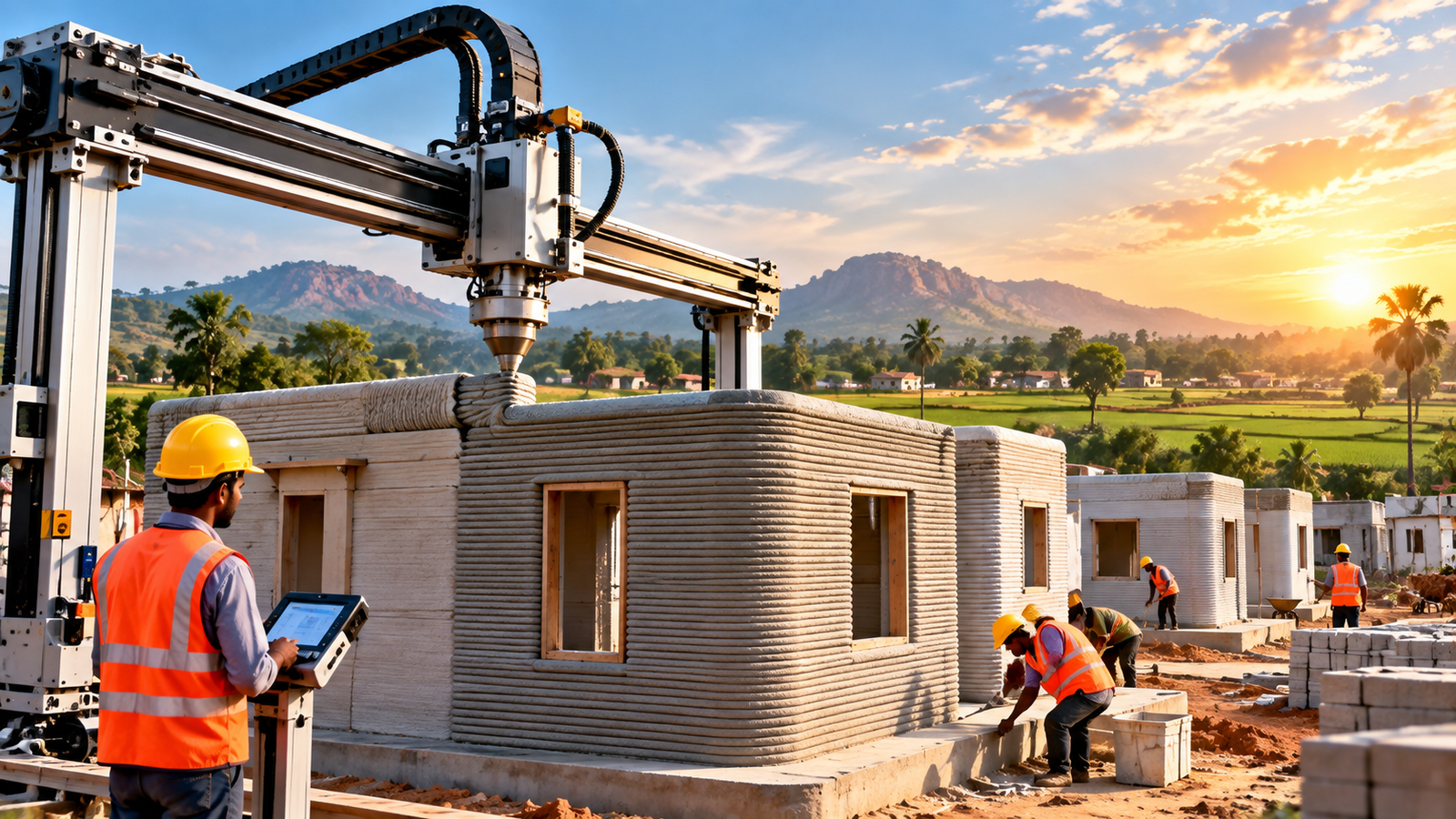
On 4 October 2026, the Union Ministry of Rural Development and the Andhra Pradesh Government launched a pilot project to construct 177 rural houses using 3D Concrete Printing technology under Pradhan Mantri Awaas Yojana–Gramin (PMAY-G) 2.0.
The project is being implemented at Burripalem and Obulnayudupalem in Guntur district, Andhra Pradesh, with an estimated cost of about ₹14 crore. The government expects the houses to be completed within six months while reducing construction time, labour requirements and costs.
The initiative is significant because it connects emerging technology with rural welfare, particularly affordable housing.
It brings together:
3D printing + construction technology + rural development + affordable housing + automation + sustainability
What is 3D Concrete Printing?
Simple meaning
Normally, ghar banane ke liye bricks, cement, sand, steel, shuttering and manual masonry work ka use hota hai.
3D Concrete Printing (3DCP) mein ek computer-controlled machine specially designed concrete mixture ko layer by layer deposit karti hai aur gradually building components, especially walls, create karti hai.
English Definition
3D Concrete Printing is an additive manufacturing technique in which a computer-controlled printer deposits cementitious material layer by layer to create building components or structures.
The technology essentially applies the principle of a conventional 3D printer to construction.
Instead of:
Plastic filament → object
it uses:
Special concrete mix → building structure
How Does 3D Concrete Printing Work?
The process can be understood in a few stages.
Digital design
The house is first designed using computer-based architectural and structural software.
The digital model provides the exact dimensions and geometry of the structure.
Slicing
The digital design is converted into a series of horizontal layers.
This is similar to how a normal 3D printer converts a digital object into printable layers.
Concrete preparation
A specially engineered concrete or cementitious mixture is prepared.
It needs to satisfy several requirements:
- sufficient flowability
- rapid setting
- adequate strength
- good bonding between layers
- ability to retain its shape after extrusion
Material extrusion
A robotic printer or gantry system moves along a predetermined path.
The concrete mixture is pushed through a nozzle.
The machine deposits the material layer by layer.
Layer-by-layer construction
The layers gradually build the wall.
This reduces dependence on conventional moulds or formwork for the printed components.
Finishing and installation
After printing, other components such as:
- doors
- windows
- electrical systems
- plumbing
- roofing
- flooring
can be installed using conventional construction methods as required.
Therefore, 3D-printed house does not necessarily mean that every component of the house is printed.
What is Additive Manufacturing?
This is an important technical term.
Hinglish
Traditional manufacturing mein material ko cut, shape ya remove kiya ja sakta hai.
Additive manufacturing mein product ko material add karke layer by layer banaya jata hai.
English Definition
Additive manufacturing is a manufacturing process in which an object is produced by adding material layer by layer from a digital model.
3D printing is one of the most important forms of additive manufacturing.
Andhra Pradesh Pilot Project
The new pilot involves:
| Feature | Details |
|---|---|
| State | Andhra Pradesh |
| District | Guntur |
| Locations | Burripalem and Obulnayudupalem |
| Houses | 177 |
| Scheme | PMAY-G 2.0 |
| Technology | 3D Concrete Printing |
| Approximate project cost | ₹14 crore |
| Target completion | 6 months |
The project is being promoted as a major step towards modernising rural housing construction. The government expects the technology to reduce construction time, cost and labour requirements while providing durable structures.
Why is This Important?
India has a huge requirement for affordable and durable housing.
Traditional construction can face problems such as:
- shortage of skilled workers
- rising construction costs
- long construction periods
- material wastage
- difficult construction conditions
- dependence on conventional construction practices
3D Concrete Printing could potentially address some of these challenges.
But an important UPSC point is:
Potential benefits are not the same as proven large-scale outcomes.
The Andhra Pradesh project is a pilot, so its actual cost-effectiveness, durability, scalability and suitability for different Indian regions need to be assessed.
Advantages of 3D Concrete Printing
Faster construction
Automation can substantially reduce the time required for certain construction activities.
The Andhra Pradesh pilot has a stated target of completing the 177 houses within six months.
Reduced labour dependence
The printing process automates parts of construction that traditionally require large numbers of workers.
This does not mean that human labour disappears.
Instead, the nature of labour changes towards:
- machine operation
- digital design
- quality control
- engineering
- maintenance
- finishing work
Material efficiency
Because the machine deposits material according to a predefined digital path, unnecessary material use can potentially be reduced.
Reduced formwork
Traditional concrete construction often requires temporary moulds or shuttering.
3D printing can reduce dependence on conventional formwork for printed components.
Design flexibility
Digital construction can create geometries that may be difficult or expensive to produce using conventional methods.
Standardisation
Computer-controlled construction can improve consistency in repeated structures, provided the design, materials and machine parameters are properly controlled.
What is Formwork?
This is an important construction term.
Hinglish
Formwork ek temporary mould ya support structure hota hai jisme concrete ko required shape dene ke liye pour kiya jata hai.
English Definition
Formwork is a temporary mould or framework used to contain and shape concrete until it gains sufficient strength.
3D concrete printing can reduce the need for conventional formwork in some applications.
India’s Earlier 3D-Printed Rural Housing Demonstration
The Andhra Pradesh project should not be confused with India’s earlier 3D-printed rural housing demonstration.
In October 2025, the CSIR-Central Building Research Institute (CSIR-CBRI), Roorkee, inaugurated India’s first 3D Concrete Printed rural house under PMAY-G.
The house demonstrated the possibility of applying 3D printing to rural housing.
The Ministry of Rural Development had also called for pilot projects involving cost-effective 3D-printed houses under PMAY-G.
Therefore, the correct chronology is:
2025 → CBRI Roorkee demonstrates India’s first 3D concrete-printed rural house
2026 → Andhra Pradesh launches a 177-house PMAY-G 2.0 pilot
This distinction is useful for Prelims.
CSIR-CBRI and Indigenous Technology
The Central Building Research Institute (CBRI), Roorkee, under the Council of Scientific and Industrial Research (CSIR), has been working on construction technologies suited to Indian conditions.
CSIR-CBRI has developed a gantry robot for 3D concrete printing.
Its work includes:
- automated construction
- specialised concrete mixes
- rural housing
- disaster-resilient housing
- construction technology
- indigenous manufacturing capabilities
CSIR’s 2026 technology publication described a 32 sq m 3D Concrete Printed PMAY-G rural house, constructed at an approximate cost of ₹1.80 lakh for the printed-house demonstration, with assembly and finishing completed on-site within five days.
This demonstrates the potential of combining:
Robotics + Material Science + Digital Design + Construction Engineering
3D Printing and Disaster-Resilient Housing
This technology is particularly relevant to India because different regions face different hazards.
India experiences:
- earthquakes
- floods
- cyclones
- landslides
- extreme heat
- coastal hazards
Therefore, rural housing should not focus only on affordability.
It should also focus on resilience.
CSIR-CBRI has been working on region-specific and disaster-resilient housing technologies.
3D Printing and Seismic Safety
This is particularly important for Himachal Pradesh and other Himalayan states.
In July 2026, CSIR-Structural Engineering Research Centre (CSIR-SERC) and Merlin Automation Solutions began a collaborative project to develop specialised concrete mixes for 3D printing and conduct seismic evaluations of G+1 3D-printed concrete buildings.
This is important because 3D printing alone does not automatically make a building earthquake-safe.
Structural safety depends on:
- material properties
- structural design
- reinforcement
- foundation
- connection details
- construction quality
- local seismic conditions
Therefore:
3D printing ≠ automatically disaster-resilient construction
The technology must be properly engineered for local hazards.
PMAY-G and 3D Printing
What is PMAY-G?
Pradhan Mantri Awaas Yojana–Gramin (PMAY-G) is the Union government’s rural housing programme aimed at providing pucca houses with basic amenities to eligible rural households.
The scheme is important from the perspective of:
- poverty reduction
- rural development
- social security
- women’s empowerment
- sanitation
- electricity
- water supply
- dignity of living
The 3D-printing initiative introduces a technological dimension into this welfare programme.
The broader idea is:
Technology-enabled welfare delivery
PMAY-G 2.0
The Andhra Pradesh project has been launched under PMAY-G 2.0.
The government has simultaneously sanctioned the first instalment for 3 lakh houses worth ₹3,600 crore for Andhra Pradesh under PMAY-G 2.0.
This provides the broader policy context for the 3D-printing pilot.
The pilot is therefore not a separate technology project alone.
It is an attempt to test whether emerging construction technology can be integrated into a large public housing programme.
Rural Housing and Sustainable Development
The technology has potential environmental benefits, but these should be evaluated carefully.
Potential benefits
- reduced material wastage
- efficient material deposition
- less formwork
- lower construction-site waste
- reduced construction time
- potential optimisation of building geometry
Concerns
Concrete itself has a significant environmental footprint, particularly because of cement production.
Therefore:
3D printing does not automatically mean green construction.
Its environmental performance depends on:
- cement content
- supplementary cementitious materials
- local sourcing
- transportation
- energy consumption
- material efficiency
- building lifespan
What are Supplementary Cementitious Materials?
Hinglish
Cement ke kuch portion ko industrial or mineral-based materials se partially replace kiya ja sakta hai, jaise fly ash ya slag.
English Definition
Supplementary Cementitious Materials (SCMs) are materials used to partially replace Portland cement and modify concrete properties while potentially reducing environmental impacts.
For future 3D concrete printing, material science will be crucial.
Major Challenges
High initial capital cost
Industrial 3D printers, robotic systems and supporting infrastructure can be expensive.
This may make the technology difficult to adopt in remote rural areas.
Specialised material requirements
Ordinary concrete cannot simply be placed into a printer.
The mixture needs carefully controlled:
- viscosity
- flowability
- setting time
- strength
- pumpability
- layer bonding
Skilled technical workforce
Although construction labour requirements may decline, demand for technically skilled workers increases.
Transportation
Large printing equipment may be difficult to transport to remote villages, particularly in mountainous terrain.
Site conditions
Uneven terrain, poor roads and inadequate infrastructure can complicate deployment.
Building codes and standards
Large-scale adoption requires appropriate standards for:
- structural safety
- fire resistance
- earthquake resistance
- durability
- quality control
- certification
Long-term durability
Pilot projects must be monitored over time to establish actual performance under Indian climatic conditions.
Relevance for Himachal Pradesh
This topic has a special relevance for Himachal Pradesh.
Himachal faces:
- difficult terrain
- landslides
- earthquakes
- snowfall in high-altitude areas
- transportation constraints
- scattered rural settlements
3D construction technology could potentially reduce some on-site construction activities.
However, the Himalayan context also creates major challenges.
Large printers and material supplies must reach remote locations.
Moreover, buildings must be adapted to:
- seismic risk
- slope stability
- snow load
- cold climate
- local building materials
- transportation constraints
Therefore, the most appropriate approach for Himachal would not necessarily be to simply copy a plains-based 3D-printing model.
Instead:
Region-specific 3D construction technology
would be more appropriate.
3D Concrete Printing vs Conventional Construction
| Parameter | Conventional Construction | 3D Concrete Printing |
|---|---|---|
| Main process | Manual/semi-mechanised | Automated |
| Material placement | Human-controlled | Computer-controlled |
| Construction pattern | Sequential | Layer-by-layer |
| Formwork | Often required | Can be reduced |
| Labour | Relatively high | Lower for printed components |
| Design flexibility | Conventional | High digital flexibility |
| Initial equipment cost | Lower | Higher |
| Skilled technical workforce | Moderate | Higher |
| Standardisation | Variable | Potentially high |
| Scalability | Established | Still being tested |
The Larger Significance
The real importance of this initiative goes beyond housing.
It represents the convergence of several major trends:
Industry 4.0
Automation, robotics and digital manufacturing are entering the construction sector.
Digital public infrastructure
Digital designs and automated systems can potentially improve standardisation and monitoring.
Affordable housing
Technology could help reduce construction time and potentially lower costs.
Atmanirbhar Bharat
Domestic development of:
- printers
- robotics
- concrete mixtures
- software
- sensors
- control systems
can strengthen India’s construction-technology ecosystem.
Employment transformation
Technology may reduce some low-skilled manual activities while increasing demand for technical skills.
Important Technical Keywords
3D Concrete Printing
English Definition: Layer-by-layer automated deposition of cementitious material to create building components.
Additive Manufacturing
English Definition: Manufacturing by adding material layer by layer from a digital model.
Digital Twin
English Definition: A digital representation of a physical object or system that can be used for monitoring, simulation and optimisation.
BIM
Building Information Modelling
English Definition: A digital process for creating and managing information about a building throughout its lifecycle.
Extrusion
English Definition: A manufacturing process in which material is pushed through a nozzle or opening to form a continuous shape.
Formwork
English Definition: Temporary mould or framework used to shape concrete.
Automation
English Definition: Use of machines and control systems to perform tasks with reduced direct human intervention.
Seismic Resilience
English Definition: The ability of a structure to withstand, absorb and recover from earthquake-related impacts.
Prelims Perspective
Remember the following:
3D Concrete Printing
→ Additive manufacturing
→ Digital design
→ Layer-by-layer material deposition
→ Specialised concrete mix
→ Robotic/gantry printing system
→ Reduced formwork potential
→ Automation
→ Construction technology
Current Affairs
→ Andhra Pradesh
→ Guntur district
→ Burripalem + Obulnayudupalem
→ 177 houses
→ PMAY-G 2.0
→ Approx. ₹14 crore
→ Target: six months
Earlier milestone
→ CSIR-CBRI, Roorkee
→ 2025
→ First 3D concrete-printed rural house under PMAY-G
Prelims Practice Question
Consider the following statements regarding 3D Concrete Printing:
- It is an example of additive manufacturing.
- It involves depositing construction material layer by layer according to a digital design.
- It completely eliminates the need for human labour in building construction.
- Specialised concrete mixtures may be required for 3D printing.
Which of the statements given above are correct?
Answer: 1, 2 and 4 only
Explanation
Statement 1 is correct.
3D printing is an additive manufacturing technology.
Statement 2 is correct.
Material is deposited layer by layer according to a computer-controlled design.
Statement 3 is incorrect.
The technology automates certain construction activities but does not eliminate human labour.
Statement 4 is correct.
3D printing requires mixtures with appropriate flowability, setting and strength characteristics.
UPSC Mains Connection
GS Paper III
Syllabus linkage:
- Science and Technology
- Technology applications in everyday life
- Infrastructure
- Investment models
- Inclusive growth
- Environmental sustainability
Possible Mains Question
“Emerging construction technologies such as 3D Concrete Printing can transform affordable housing delivery in India, but their large-scale adoption faces significant technological and institutional challenges. Discuss.”
Answer Framework
Introduction
3D Concrete Printing is an additive manufacturing technology that uses computer-controlled deposition of specialised concrete mixtures to construct building components layer by layer.
Body
Discuss:
Potential
- faster construction
- reduced labour dependence
- material efficiency
- standardisation
- design flexibility
- affordable housing
- disaster-resilient construction
Challenges
- equipment cost
- specialised materials
- technical skills
- building codes
- seismic safety
- long-term durability
- rural logistics
- environmental footprint
Way Forward
- region-specific designs
- Indian material development
- BIS standards
- seismic testing
- pilot projects
- skill development
- lifecycle assessment
- public-private partnerships
Conclusion
India should treat 3D concrete printing not as a replacement for conventional construction but as a complementary technology that can improve speed, efficiency and resilience where local conditions permit.
HPPSC Perspective
For HPPSC, this topic can be linked with:
- rural housing
- science and technology
- Himachal’s difficult terrain
- earthquake risk
- disaster-resilient infrastructure
- affordable housing
- sustainable construction
- PMAY-G
- CSIR
- construction technology
A probable HPPSC question could ask:
“Discuss the potential and challenges of 3D Concrete Printing technology for rural and disaster-resilient housing in Himachal Pradesh.”
Geography Optional Connection
This topic can also be connected with Geography Optional, particularly:
- human settlements
- rural housing
- technology and development
- hazard-resilient settlements
- earthquake-prone regions
- sustainable development
- regional planning
For Himachal, a useful conceptual link is:
Physical geography → Natural hazards → Settlement vulnerability → Building technology → Disaster resilience
This is a good example of how physical geography and human geography interact.
One-Page Revision
3D Concrete Printing
→ Additive manufacturing
→ Digital building model
→ Computer-controlled printer
→ Layer-by-layer concrete deposition
→ Specialised concrete mix
→ Reduced formwork
→ Automation
→ Faster construction
→ Potential material efficiency
Current development
→ 4 October 2026
→ Andhra Pradesh
→ Guntur district
→ Burripalem + Obulnayudupalem
→ 177 houses
→ PMAY-G 2.0
→ Approx. ₹14 crore
→ Six-month target
Earlier milestone
→ CSIR-CBRI, Roorkee
→ October 2025
→ India’s first 3D concrete-printed rural house under PMAY-G
Key institutions
→ Ministry of Rural Development
→ CSIR-CBRI
→ CSIR-SERC
Key challenges
→ Cost
→ Material science
→ Skills
→ Seismic safety
→ Building standards
→ Rural logistics
→ Environmental footprint
Core UPSC theme
Technology + Inclusive Development + Affordable Housing + Sustainability
Conclusion
The Andhra Pradesh 3D concrete-printing pilot represents an important experiment in combining advanced technology with social welfare.
Its significance lies not merely in printing houses faster, but in testing whether automation, robotics, digital design and material science can make rural housing more affordable, durable and resilient.
However, technology should not be adopted merely because it is new.
Its success must ultimately be judged through:
Cost + Safety + Durability + Sustainability + Scalability + Local suitability
If these conditions are met, 3D Concrete Printing could become an important component of India’s future housing and construction ecosystem.