National Supercomputing Mission: India Reaches 40 Systems and 68 Petaflops
Why in News?
India’s National Supercomputing Mission (NSM) has reached an important milestone.
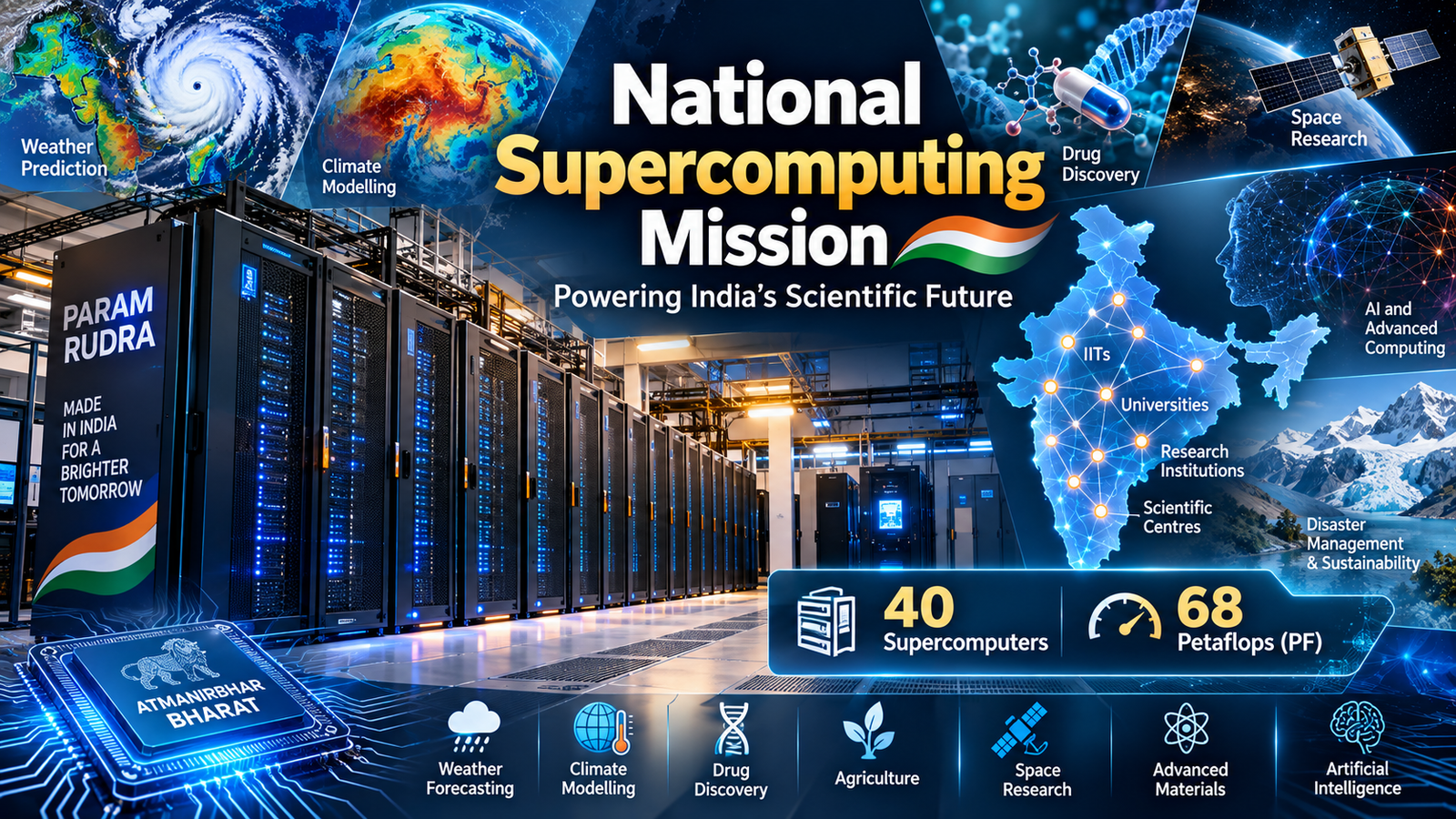
As of September 2026, India has deployed 40 supercomputers with a combined computing capacity of 68 Petaflops (PF) under the National Supercomputing Mission.
The systems have been deployed across academic institutions, research organisations and other scientific centres, expanding access to High-Performance Computing (HPC) across the country.
The latest milestone is significant because the mission is not only increasing India’s computing capacity but also developing an indigenous ecosystem covering:
- supercomputer design
- servers
- system software
- high-speed networking
- cooling technologies
- specialised applications
- skilled human resources
The mission is therefore an important part of India’s effort towards technological self-reliance in advanced computing.
What is the National Supercomputing Mission?
Simple Meaning
The National Supercomputing Mission (NSM) is a Government of India programme launched in 2015 to build India’s capability in high-performance computing and provide advanced computing infrastructure to researchers, scientists, universities and other institutions.
It aims to strengthen India’s ability to solve computationally intensive problems in areas such as:
- weather forecasting
- climate modelling
- drug discovery
- computational biology
- disaster management
- astrophysics
- materials science
- artificial intelligence
- engineering
- scientific research
English Definition
The National Supercomputing Mission is a national programme aimed at developing indigenous high-performance computing infrastructure, applications, research capabilities and skilled manpower in India.
What is a Supercomputer?
Before understanding NSM, we need to understand what a supercomputer actually is.
A normal computer performs calculations using its processor.
A supercomputer does the same basic task at a much larger scale by using a very large number of computing processors working together.
Simple Example
Suppose one person has to solve:
1,000 mathematical problems.
It may take a long time.
Now imagine:
1,000 people solving the problems simultaneously.
The work can be completed much faster.
A supercomputer uses a similar principle through parallel processing.
English Definition
A supercomputer is a high-performance computing system designed to perform extremely large numbers of calculations at very high speed using many interconnected processors.
What is High-Performance Computing?
The term High-Performance Computing (HPC) is frequently used with supercomputing.
Hinglish
HPC ka simple meaning hai aise powerful computing systems ka use karna jo extremely complex calculations ko very high speed par process kar sakein.
English Definition
High-Performance Computing refers to the use of powerful computing systems and parallel processing techniques to solve complex computational problems at very high speed.
Supercomputing is one of the most important forms of HPC.
Why Does India Need Supercomputers?
Modern science increasingly depends on computation.
Many scientific problems cannot be solved efficiently through ordinary computers because they require:
- huge datasets
- millions or billions of calculations
- complex simulations
- repeated modelling
- real-time or near-real-time analysis
For example, predicting tomorrow’s weather involves analysing enormous quantities of atmospheric data.
Similarly, climate models simulate interactions between:
Atmosphere + Ocean + Land + Ice + Radiation
This requires enormous computing power.
Therefore:
Scientific research → Data → Simulation → Computing power
Supercomputers provide that computing power.
What is Parallel Processing?
This is one of the most important technical concepts.
Hinglish
Parallel processing ka matlab hai ek large computational problem ko smaller tasks mein divide karke multiple processors ko simultaneously kaam karwana.
English Definition
Parallel processing is a computing technique in which multiple processors work simultaneously on different parts of a computational problem.
This allows complex calculations to be completed much faster.
How Does a Supercomputer Work?
A simplified structure is:
Large problem
↓
Problem divided into smaller tasks
↓
Multiple processors work simultaneously
↓
High-speed communication between processors
↓
Results combined
↓
Final output
This is why a supercomputer is not simply a “very fast computer.”
It is an entire high-performance computing ecosystem.
What is a FLOP?
Supercomputer performance is commonly measured using FLOPS.
FLOPS means:
Floating Point Operations Per Second
Hinglish
FLOPS batata hai ki computer ek second mein kitni mathematical floating-point calculations perform kar sakta hai.
English Definition
FLOPS is a measure of the number of floating-point calculations a computing system can perform per second.
Important units are:
1 TFLOPS = 10¹² FLOPS
1 PFLOPS = 10¹⁵ FLOPS
1 EFLOPS = 10¹⁸ FLOPS
What is a Petaflop?
The latest NSM milestone is:
68 Petaflops
One petaflop means:
1,000,000,000,000,000 floating-point operations per second
or:
10¹⁵ operations per second
Therefore:
68 PF = 68 × 10¹⁵ floating-point operations per second
This represents the combined computing capacity of the 40 systems deployed under the mission.
Petaflops vs Exaflops
Remember this sequence:
Teraflop → 10¹²
Petaflop → 10¹⁵
Exaflop → 10¹⁸
Therefore:
1 Exaflop = 1,000 Petaflops
The global supercomputing industry is now entering the exascale computing era.
India’s Journey: From PARAM 8000 to Modern Supercomputers
India’s supercomputing journey began with the PARAM 8000.
It was developed by the Centre for Development of Advanced Computing (C-DAC) and unveiled in 1991.
Its performance was around:
1 gigaflop
This was a major achievement for India at a time when access to advanced computing technology was strategically sensitive.
The PARAM series subsequently evolved into more powerful systems.
The journey can broadly be represented as:
PARAM 8000
↓
PARAM series
↓
Petascale computing
↓
PARAM Rudra
↓
Future exascale capability
This evolution demonstrates India’s gradual movement from acquiring computing capability to developing an indigenous ecosystem.
What is PARAM?
PARAM is the name associated with India’s indigenous supercomputer series developed by C-DAC.
The PARAM family includes several generations of systems designed for high-performance scientific computing.
The series has played an important role in India’s supercomputing development.
PARAM Rudra
One of the most important recent developments is the PARAM Rudra series.
PARAM Rudra systems use:
- indigenously designed and manufactured HPC servers
- locally developed system software
- high-performance computing architecture
This is important because India is attempting to move beyond simply purchasing foreign supercomputers.
The objective is to develop capabilities across the technology stack.
What is Technological Self-Reliance?
Hinglish
Technological self-reliance ka matlab hai critical technologies ke liye completely external suppliers par dependent na rehna aur domestic design, development, manufacturing aur skills ko strengthen karna.
English Definition
Technological self-reliance is the development of domestic capabilities to design, develop, manufacture and operate strategically important technologies.
For supercomputing, this includes:
Hardware + Software + Networking + Cooling + Applications + Human Resources
Why is Indigenous Supercomputing Important?
Supercomputing has strategic importance.
It supports:
- defence research
- weather prediction
- climate modelling
- space research
- nuclear research
- biotechnology
- artificial intelligence
- advanced manufacturing
- scientific discovery
Dependence on foreign computing infrastructure can create:
- technology dependence
- supply-chain vulnerabilities
- data-security concerns
- strategic limitations
Therefore, indigenous HPC capability contributes to technological sovereignty.
Who Implements the National Supercomputing Mission?
The mission is jointly implemented by:
Ministry of Electronics and Information Technology (MeitY)
and
Department of Science and Technology (DST)
The major executing institutions include:
C-DAC, Pune
and
Indian Institute of Science (IISc), Bengaluru
This creates an important Prelims fact:
NSM is jointly led by MeitY and DST, with C-DAC and IISc playing key implementation roles.
Major Components of NSM
The mission is not limited to purchasing supercomputers.
Its ecosystem includes:
Supercomputing Infrastructure
Development and deployment of high-performance computing systems.
Applications
Development of specialised applications for scientific and engineering problems.
Research and Development
Development of new HPC technologies.
Human Resources
Training researchers, scientists, engineers and technical professionals.
Indigenous Technologies
Development of:
- servers
- software
- networking
- cooling
- system architecture
This makes NSM a complete HPC ecosystem-building programme.
40 Supercomputers and 68 Petaflops: What Does the Latest Milestone Mean?
As of September 2026:
40 supercomputers
with a combined capacity of:
68 PF
have been deployed.
Their distribution by performance category includes:
13 high-end systems
→ More than 1 PF each
12 mid-range systems
→ 500 TF to 1 PF
15 systems
→ Below 500 TF
This demonstrates that India’s HPC network is not concentrated in a single giant machine.
Instead, it is a distributed national computing ecosystem.
Why Distributed Supercomputing Matters
Suppose all computing capacity were concentrated in one location.
Researchers in other parts of India would face:
- access problems
- network delays
- institutional barriers
- geographical concentration
A distributed network allows advanced computing facilities to be available across multiple institutions.
This supports:
- regional research
- universities
- Tier-II and Tier-III institutions
- startups
- national laboratories
Thus, NSM also has an important democratisation of scientific computing dimension.
Applications of Supercomputing
Supercomputing is not just about theoretical physics.
It has direct applications in everyday life.
Weather Forecasting
Supercomputers process atmospheric data and run numerical weather models.
This helps forecast:
- rainfall
- cyclones
- heat waves
- storms
- extreme weather
Climate Modelling
Climate models simulate long-term interactions between:
- atmosphere
- oceans
- land
- ice
- greenhouse gases
- radiation
This helps scientists understand climate change and project future conditions.
For India, this has major implications for:
- monsoon
- agriculture
- water resources
- coastal areas
- Himalayan ecosystems
Disaster Management
Supercomputing can help model:
- floods
- cyclones
- landslides
- extreme rainfall
- disaster-risk scenarios
For example:
Rainfall data
↓
Hydrological model
↓
River-flow simulation
↓
Flood-risk prediction
↓
Early warning
This can support disaster preparedness.
Supercomputing and Agriculture
Supercomputers can process large datasets related to:
- weather
- soil
- crops
- water
- disease
- satellite observations
This can support:
- crop-yield prediction
- drought assessment
- agricultural planning
- climate-resilient farming
Supercomputing and Healthcare
High-performance computing can support:
- drug discovery
- molecular modelling
- genomic research
- disease modelling
- computational biology
Drug discovery is particularly computationally intensive because researchers may need to simulate interactions between large numbers of molecules.
Supercomputing and Artificial Intelligence
AI systems require enormous computing power, especially during model training.
Supercomputing can support:
- AI model training
- large-scale simulations
- scientific machine learning
- image analysis
- language models
- climate AI
- healthcare AI
However, it is important to understand:
Supercomputing and AI computing are related but not identical.
Traditional HPC focuses heavily on scientific and engineering computation, while modern AI often relies extensively on GPUs and specialised accelerators.
The two are increasingly converging.
CPU vs GPU
This distinction is useful for understanding modern computing.
CPU
Central Processing Unit
Designed for general-purpose sequential and parallel computing.
GPU
Graphics Processing Unit
Contains many smaller processing units and is particularly efficient for highly parallel workloads.
Modern AI systems rely heavily on GPUs and other accelerators.
Supercomputers can combine CPUs, GPUs and other specialised processors depending on the workload.
Supercomputing and Space Research
Space science involves extremely complex calculations.
Applications include:
- spacecraft trajectory modelling
- astrophysical simulations
- atmospheric modelling
- satellite data processing
- fluid dynamics
- planetary science
Supercomputing therefore complements India’s expanding space programme.
What is Computational Fluid Dynamics?
This is an important application.
Hinglish
Computational Fluid Dynamics, ya CFD, computers ki help se fluids—jaise air aur water—ke movement ko mathematically model aur simulate karne ki technique hai.
English Definition
Computational Fluid Dynamics is the numerical simulation of fluid flow and related physical processes using computational methods.
Applications include:
- aircraft design
- rocket design
- weather modelling
- automobile engineering
- industrial processes
Supercomputing and Scientific Research
Many modern scientific questions involve simulations that cannot be conducted physically.
For example:
Scientists cannot create a miniature galaxy in a laboratory.
Instead, they use mathematical models and supercomputers to simulate:
Gravity + Matter + Energy + Time
Similarly, researchers can simulate:
- atomic interactions
- materials
- chemical reactions
- galaxies
- climate systems
This is why supercomputers are sometimes described as virtual laboratories.
What is a Simulation?
Hinglish
Simulation ka matlab hai real-world system ka mathematical ya computational model banana aur uske behaviour ko computer par study karna.
English Definition
A simulation is a computational representation of a real-world system or process used to study its behaviour under specified conditions.
NSM and Atmanirbhar Bharat
The National Supercomputing Mission strongly supports the objective of Atmanirbhar Bharat in advanced computing.
The objective is to develop domestic capability across:
Design
↓
Development
↓
Manufacturing
↓
Deployment
↓
Applications
↓
Human Resources
This reduces dependence on imported high-end computing technologies.
From Assembly to Indigenous Design
India’s supercomputing strategy has evolved progressively.
The broad development pathway has been:
Assembly in India
↓
Manufacturing of subsystems in India
↓
Design and manufacturing of indigenous systems
This represents a gradual movement up the technology value chain.
Indigenous HPC Technologies
The Indian HPC ecosystem has developed capabilities in areas including:
- servers
- high-speed interconnects
- system software
- direct-to-chip liquid cooling
- computing architecture
- specialised applications
This is important because a supercomputer is not simply a collection of processors.
The supporting technologies are equally important.
What is Direct-to-Chip Liquid Cooling?
High-performance processors generate enormous amounts of heat.
Traditional air cooling becomes less efficient at very high computing densities.
Direct-to-Chip Liquid Cooling (DCLC) places liquid cooling close to the heat-generating processor components.
English Definition
Direct-to-chip liquid cooling is a cooling technology in which liquid coolant is brought directly to heat-generating computing components to efficiently remove thermal energy.
This is increasingly important for high-density HPC systems.
NSM and Human Resource Development
Supercomputers are useful only when researchers know how to use them.
Therefore, NSM also focuses on:
- HPC training
- scientific computing
- system administration
- application development
- AI
- parallel programming
The mission has helped create a growing community of researchers and HPC professionals.
This connects supercomputing with India’s broader Skill Development agenda.
Supercomputing and Tier-II/Tier-III Cities
An important feature of India’s supercomputing strategy is expanding access beyond a few major metropolitan research centres.
Systems have been deployed in institutions across the country, including institutions outside the traditional concentration of elite research infrastructure.
This can:
- reduce geographical inequality
- expand research opportunities
- support local universities
- develop regional talent
- encourage scientific innovation
Thus, supercomputing has a regional development dimension.
NSM and India’s Strategic Autonomy
Advanced computing is increasingly a strategic technology.
It is relevant to:
- defence
- cybersecurity
- AI
- space
- biotechnology
- climate science
- advanced manufacturing
Therefore:
Supercomputing capability
→ Scientific capability
→ Technological capability
→ Strategic capability
This is why countries compete to develop increasingly powerful computing systems.
India’s Position in Global Supercomputing
The global supercomputing race has moved from:
Petascale
to
Exascale
systems.
The world’s fastest systems now operate at exascale levels.
India’s NSM is therefore not simply about building more machines.
It is about developing the domestic technological base required to eventually participate in the next generation of high-performance computing.
NSM and Exascale Computing
What is Exascale Computing?
Exascale computing refers to computing systems capable of performing approximately:
10¹⁸ floating-point operations per second
or:
1 exaflop
This is:
1,000 petaflops
Exascale computing can enable much more detailed simulations and larger scientific models.
India’s NSM explicitly aims to build readiness for future exascale computing.
Future Target of NSM
The current mission plan envisages establishing:
50 supercomputers
with cumulative capacity exceeding:
123 Petaflops
across academic and research institutions.
The September 2026 status:
40 systems → 68 PF
Therefore, the mission still has further expansion planned in terms of both the number of systems and total computing capacity.
Major Challenges
High Cost
Supercomputers require significant investment in:
- processors
- networking
- cooling
- electricity
- infrastructure
- maintenance
Energy Consumption
High-performance computing consumes substantial electricity.
Therefore, energy-efficient computing and cooling technologies are increasingly important.
Technology Dependence
Some advanced processors and components remain globally concentrated.
Complete technological self-reliance is therefore a long-term challenge.
Skilled Manpower
Advanced HPC systems require highly trained:
- engineers
- programmers
- researchers
- system administrators
Software Ecosystem
Hardware alone is not enough.
Researchers need specialised applications optimised for parallel computing.
Rapid Technological Change
Computing technologies evolve quickly.
A system considered cutting-edge today may become relatively outdated after several years.
Way Forward
India’s supercomputing strategy should focus on five broad areas.
Indigenous Hardware
Increase domestic development of processors, servers and specialised accelerators.
Software
Develop high-performance scientific applications and parallel programming capabilities.
AI-HPC Integration
Combine conventional HPC with AI accelerators.
Energy Efficiency
Invest in advanced cooling and low-power computing technologies.
Human Resources
Expand HPC education, training and research programmes.
The ultimate objective should be:
From importing computing power to designing, manufacturing and innovating in computing technology.
Why This Topic Matters for UPSC
The topic covers multiple UPSC dimensions.
GS Paper III
- Science and Technology
- IT and computing
- indigenous technology
- research and development
- AI
- disaster management
- climate modelling
- biotechnology
GS Paper III — Disaster Management
Supercomputing supports:
- flood modelling
- cyclone forecasting
- extreme-weather prediction
- disaster-risk assessment
GS Paper III — Environment
It supports:
- climate modelling
- monsoon prediction
- climate-impact assessment
GS Paper III — Economy
It contributes to:
- advanced manufacturing
- innovation
- productivity
- technological competitiveness
HPPSC Perspective
For HPPSC, connect NSM with:
- Himachal Pradesh’s disaster vulnerability
- landslides
- cloudbursts
- flash floods
- hydrology
- Himalayan climate
- weather forecasting
- agriculture
- hydropower
Supercomputing can help build better models for:
Extreme rainfall
↓
Runoff
↓
River discharge
↓
Flood risk
↓
Early warning
This makes advanced computing relevant to Himachal’s disaster-management needs.
Geography Optional Connection
Supercomputing has a strong Geography connection through geospatial modelling.
It can process:
- satellite imagery
- GIS datasets
- climate data
- terrain models
- hydrological information
Applications include:
Himalayan Hazard Mapping
Modelling landslide and flood risks.
Climate Modelling
Understanding changing temperature and precipitation patterns.
Urban Geography
Simulating traffic and urban growth.
Agricultural Geography
Modelling crop productivity and water availability.
Disaster Geography
Identifying vulnerable populations and areas.
A useful analytical chain is:
Satellite/GIS Data
↓
Supercomputing
↓
Simulation
↓
Risk Mapping
↓
Policy & Disaster Management
Important Keywords for UPSC
Supercomputer
English Definition: A high-performance computing system capable of performing extremely large numbers of calculations at very high speed.
High-Performance Computing
English Definition: Use of powerful computing systems and parallel processing to solve complex computational problems.
Parallel Processing
English Definition: Simultaneous execution of different parts of a computational problem using multiple processors.
FLOPS
English Definition: Floating Point Operations Per Second, a measure of computational performance.
Petaflop
English Definition: One quadrillion floating-point operations per second, equal to 10¹⁵ FLOPS.
Exaflop
English Definition: One quintillion floating-point operations per second, equal to 10¹⁸ FLOPS.
Simulation
English Definition: Computational modelling of a real-world system or process.
Computational Fluid Dynamics
English Definition: Numerical simulation of fluid flow using computational methods.
High-Speed Interconnect
English Definition: High-bandwidth networking technology that enables rapid communication between computing nodes.
Technological Sovereignty
English Definition: The ability of a country to develop and control strategically important technologies with reduced external dependence.
Prelims Facts
| Feature | National Supercomputing Mission |
|---|---|
| Launched | 2015 |
| Initial outlay | ₹4,500 crore |
| Latest systems deployed | 40 |
| Latest combined capacity | 68 PF |
| Status | September 2026 |
| High-end systems | 13 above 1 PF |
| Mid-range systems | 12 between 500 TF and 1 PF |
| Other systems | 15 below 500 TF |
| Major institutions | C-DAC, IISc, IITs, research institutions |
| Key indigenous series | PARAM Rudra |
| Main focus | HPC ecosystem |
| Implementing ministries | MeitY + DST |
| Executing organisations | C-DAC + IISc |
| Planned systems | 50 |
| Planned cumulative capacity | >123 PF |
Prelims Practice Question
Consider the following statements regarding India’s National Supercomputing Mission:
- It was launched in 2015.
- It is jointly implemented by the Ministry of Electronics and Information Technology and the Department of Science and Technology.
- PARAM Rudra is associated with India’s indigenous high-performance computing ecosystem.
- One Petaflop represents one billion floating-point operations per second.
Which of the statements given above are correct?
Answer: 1, 2 and 3 only
Explanation
Statement 1 — Correct
NSM was launched in 2015.
Statement 2 — Correct
The mission is jointly implemented by MeitY and DST.
Statement 3 — Correct
PARAM Rudra is an important indigenous HPC system series.
Statement 4 — Incorrect
One petaflop equals:
10¹⁵ floating-point operations per second
not one billion.
One billion = 10⁹.
UPSC Mains Connection
GS Paper III
Possible Question
“High-performance computing has become an important component of technological sovereignty and scientific competitiveness. Discuss India’s progress under the National Supercomputing Mission.”
Answer Framework
Introduction
India launched the National Supercomputing Mission in 2015 to develop indigenous high-performance computing capabilities and provide advanced computing infrastructure to researchers.
Body
Achievements
- 40 systems
- 68 PF capacity
- indigenous PARAM Rudra
- HPC ecosystem
- research access
- application development
- human-resource development
Applications
- weather forecasting
- climate modelling
- disaster management
- healthcare
- drug discovery
- astrophysics
- AI
- advanced engineering
Strategic Importance
- technological sovereignty
- scientific competitiveness
- strategic autonomy
- indigenous hardware/software
- reduced external dependence
Challenges
- energy consumption
- component dependence
- skilled manpower
- software ecosystem
- rapid technological change
Way Forward
- indigenous processors
- AI-HPC integration
- energy-efficient systems
- advanced cooling
- research partnerships
- skilled manpower
Conclusion
India’s supercomputing strategy must evolve from capacity creation towards a complete indigenous ecosystem capable of supporting exascale and next-generation scientific computing.
One-Page Revision Notes
NATIONAL SUPERCOMPUTING MISSION
Launched: 2015
Initial Outlay: ₹4,500 crore
LATEST
40 Supercomputers
↓
68 Petaflops
↓
September 2026
IMPLEMENTATION
MeitY + DST
↓
C-DAC + IISc
INDIGENOUS TECHNOLOGY
PARAM Series
↓
PARAM Rudra
↓
Servers + Software + Networking + Cooling
WHAT IS SUPERCOMPUTING?
Large Problem
↓
Parallel Processing
↓
Multiple Processors
↓
Huge Computing Power
UNITS
1 TF = 10¹² FLOPS
1 PF = 10¹⁵ FLOPS
1 EF = 10¹⁸ FLOPS
1 EF = 1,000 PF
APPLICATIONS
→ Weather
→ Climate
→ Agriculture
→ Disaster Management
→ Drug Discovery
→ Healthcare
→ AI
→ Space
→ Astrophysics
→ Advanced Manufacturing
STRATEGIC VALUE
Supercomputing
↓
Scientific Capability
↓
Technological Capability
↓
Strategic Autonomy
FUTURE
50 Systems
>123 PF planned capacity
Exascale readiness
Conclusion
The National Supercomputing Mission represents much more than an effort to install increasingly powerful computers.
India’s progress from PARAM 8000 in 1991 to 40 supercomputers delivering 68 Petaflops by September 2026 reflects the gradual development of a domestic high-performance computing ecosystem.
The importance of this ecosystem extends across weather forecasting, climate modelling, disaster management, healthcare, agriculture, artificial intelligence, space research and advanced scientific discovery.
The mission is also strategically important because modern computing has become a foundation for technological sovereignty.
India’s long-term challenge is therefore not simply:
“How many supercomputers can India build?”
but:
“Can India develop the complete technology stack—processors, servers, networking, software, cooling, applications and skilled manpower—needed to compete in the exascale era?”
The NSM’s latest milestone shows significant progress in that direction.
For UPSC, remember:
PARAM 8000 → NSM → PARAM Rudra → 40 systems → 68 PF → HPC ecosystem → Scientific Applications → Technological Sovereignty → Exascale Readiness