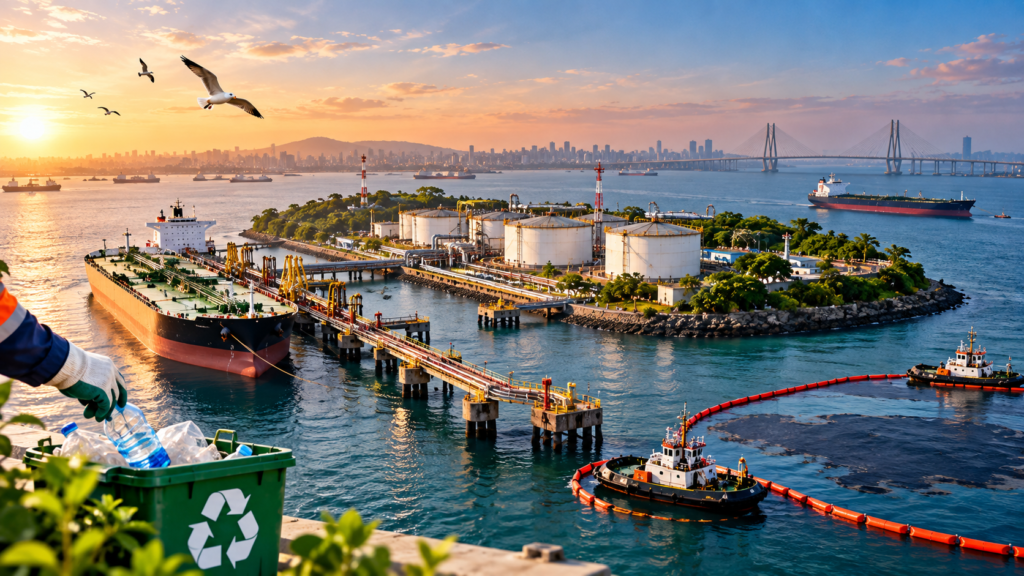
Jawahar Dweep Becomes India’s First Plastic-Free Oil Terminal
Why in News?
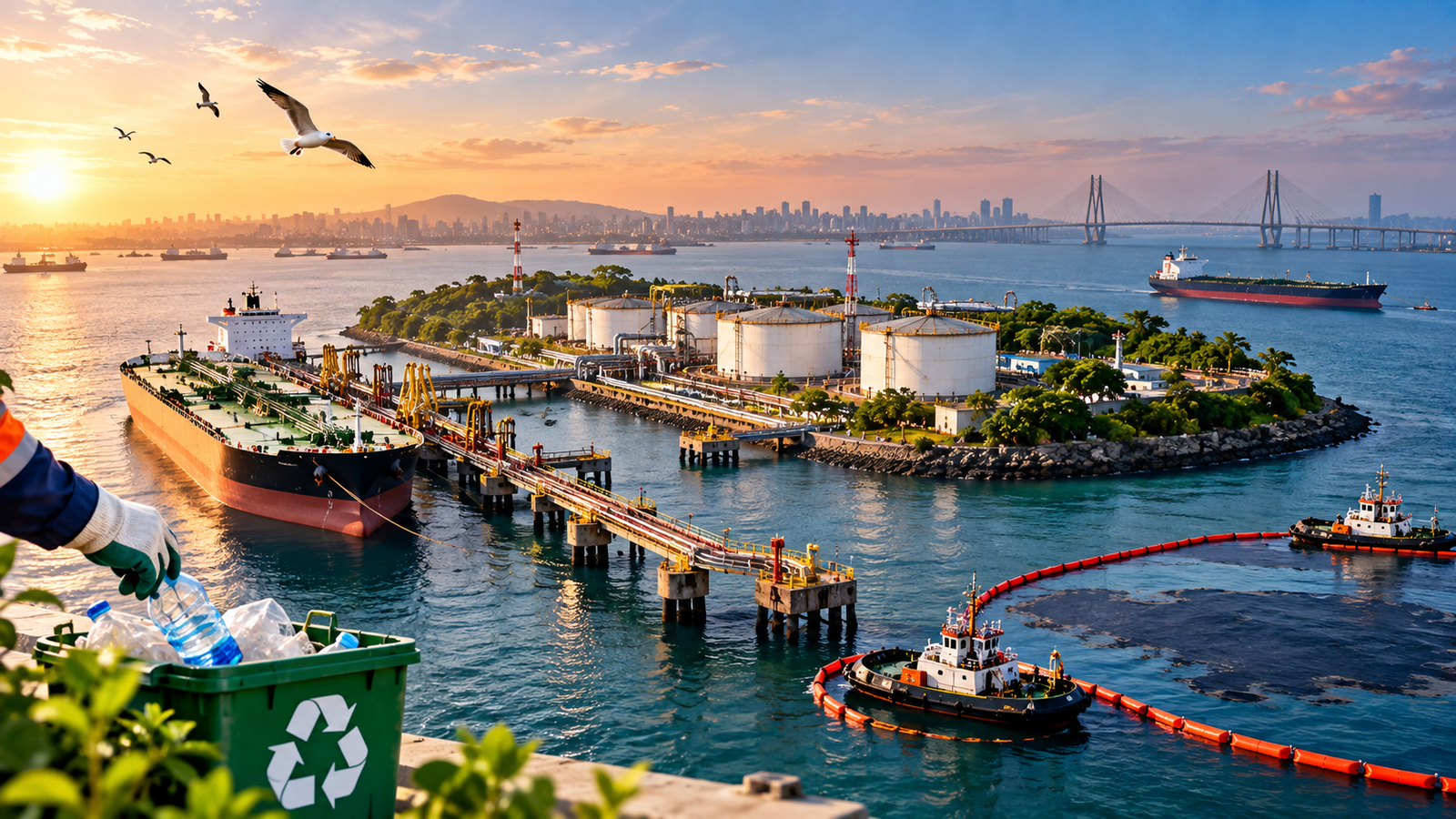
On 2 October 2026, the Mumbai Port Authority (MbPA) declared the Jawahar Dweep Marine Oil Terminal plastic-free, making it India’s first oil terminal to eliminate single-use plastics. The announcement was made during Swachhata Abhiyan 2026 at Mumbai Port on the occasion of Gandhi Jayanti.
The event also marked the dedication of the port’s Oil Spill Response (OSR) facilities to the nation.
The development is important for UPSC because it connects:
Maritime geography + ports + petroleum infrastructure + marine pollution + plastic pollution + oil-spill management + sustainable port operations
What is Jawahar Dweep?
Jawahar Dweep is an offshore island-based marine oil terminal associated with the Mumbai Port.
It was formerly known as Butcher Island.
The Mumbai Port Authority records that the Marine Oil Terminal at Butcher Island was commissioned during 1954–56 with three jetties for handling large crude-oil and petroleum-product tankers. The island was renamed Jawahar Dweep on 5 April 1989.
Today, the terminal has five berths and handles crude oil and petroleum products.
Why is Jawahar Dweep Geographically Important?
Jawahar Dweep is located within the Mumbai Harbour region and forms an important part of Mumbai’s petroleum-handling infrastructure.
Its location as an offshore terminal provides space for handling large petroleum vessels away from the densely developed mainland areas.
The Mumbai Port’s own historical account notes that the island’s location was suitable for a Marine Oil Terminal because it lies away from much of the city’s other shipping activity and is relatively protected from the direct impact of the southwest monsoon.
This makes Jawahar Dweep an excellent example of the relationship between:
Physical geography → harbour conditions → port location → industrial infrastructure
Jawahar Dweep and Mumbai Port
Mumbai Port is one of India’s historic major ports on the Arabian Sea.
Its harbour has supported India’s maritime trade for centuries.
Within the port complex, different facilities specialise in different types of cargo.
For example:
- Jawahar Dweep → crude oil and petroleum products
- Pir Pau → chemicals and petroleum-related products
- Indira Dock → general and project cargo
- Sassoon Dock → fish-related activities
The Mumbai Port Authority’s infrastructure records show five Jawahar Dweep berths for petroleum handling.
What Does the Jawahar Dweep Oil Terminal Handle?
The terminal handles:
Crude Oil
Crude oil is the unrefined petroleum extracted from underground reservoirs.
Petroleum Products
These include products obtained after refining crude oil, such as various fuels and petroleum-derived products.
The five Jawahar Dweep berths have different dimensions and cargo-handling specifications. The port authority lists JD-1, JD-2, JD-3, JD-4 and JD-5 for crude oil and petroleum-product handling.
JD-5 is particularly important for large crude-oil vessels. The Mumbai Port Authority states that the berth is 470 metres long and was completed in December 2020.
What Does “Plastic-Free” Mean Here?
The plastic-free declaration primarily concerns the elimination of single-use plastics from the terminal’s operations.
Single-use plastic
Hinglish:
Aise plastic products jo generally ek baar ya bahut short period ke liye use karke discard kar diye jaate hain.
English Definition:
Single-use plastics are plastic products designed or intended to be used once, or for a very short period, before disposal.
Examples include:
- disposable plastic bags
- plastic cups
- certain food packaging
- disposable cutlery
- plastic bottles and similar items
The Mumbai Port Authority’s initiative forms part of a broader effort to reduce single-use plastics across its operations.
Why is Plastic Pollution Serious in Marine Areas?
Plastic pollution becomes particularly dangerous when waste enters rivers, estuaries, coastal waters and oceans.
Unlike many organic materials, conventional plastics degrade very slowly.
They can therefore remain in the environment for long periods.
Marine plastic pollution can cause:
- ingestion by marine animals
- entanglement
- habitat degradation
- microplastic formation
- contamination of coastal ecosystems
- economic losses to fisheries and tourism
This makes plastic reduction at ports particularly important.
Ports are located at the interface between:
Land + sea + industry + transport
Therefore, poor waste management at ports can directly affect marine ecosystems.
What are Microplastics?
Hinglish
Jab larger plastic products time ke saath breakdown hote hain, toh bahut chhote plastic particles ban sakte hain.
English Definition
Microplastics are very small plastic particles, generally less than 5 mm in size, that can persist in aquatic and terrestrial environments.
They can enter:
Plastic waste → fragmentation → microplastics → aquatic ecosystem → food chain
This makes prevention of plastic leakage more effective than simply trying to remove plastic after it enters the sea.
Why is Plastic-Free Operation Important at an Oil Terminal?
At first glance, plastic pollution and oil pollution may appear to be separate issues.
But an oil terminal is a sensitive marine-industrial environment.
It handles:
- petroleum cargo
- tankers
- pipelines
- storage and transfer systems
- maintenance activities
- workers
- packaging and operational materials
Therefore, effective waste management is necessary to prevent multiple forms of marine pollution.
The Jawahar Dweep initiative represents an attempt to combine:
Industrial activity + environmental responsibility
Oil Spill Response
Another major development on 2 October was the dedication of Oil Spill Response (OSR) facilities at Mumbai Port.
This is especially significant because Jawahar Dweep handles crude oil and petroleum products.
What is an oil spill?
Hinglish:
Jab oil ya petroleum product accidentally sea, river ya kisi water body mein release ho jata hai, usse oil spill kehte hain.
English Definition:
An oil spill is the accidental or uncontrolled release of petroleum or petroleum products into the environment, particularly aquatic environments.
Why are Oil Spills Dangerous?
Oil can spread rapidly over the surface of water.
A thin oil layer can interfere with the interaction between the atmosphere and water surface and can coat organisms, beaches and coastal habitats.
Major impacts may include:
- mortality of marine organisms
- damage to mangroves
- contamination of beaches
- harm to seabirds
- disruption of fisheries
- economic losses
- long-term ecosystem damage
Therefore, preparedness is as important as response.
What is Oil Spill Response?
Hinglish
Oil spill response ka objective hai spilled oil ko quickly contain, recover, remove aur safely manage karna so that environmental damage minimum ho.
English Definition
Oil Spill Response is the set of preparedness, containment, recovery, treatment and monitoring measures used to manage marine oil pollution incidents.
Common response techniques include:
- containment booms
- skimmers
- absorbent materials
- temporary storage
- shoreline cleanup
- specialised vessels
- monitoring and surveillance
Containment Boom
This is an important Prelims term.
Hinglish
Boom ek floating barrier hota hai jo water surface par oil ko spread hone se rokne ya slow karne ke liye use kiya jata hai.
English Definition
A containment boom is a floating barrier used to contain or divert oil on the surface of water.
Simplified sequence:
Oil spill → Boom → Containment → Skimming/recovery → Treatment/disposal
Skimmer
Hinglish
Skimmer ek equipment hota hai jo water surface se oil ko collect/recover karne mein help karta hai.
English Definition
A skimmer is a device used to recover oil from the surface of water.
Thus:
Boom = contain
Skimmer = recover
This distinction can be useful in Prelims.
Mumbai Port’s Broader Environmental Approach
The plastic-free declaration at Jawahar Dweep is not an isolated cleanliness activity.
The Mumbai Port Authority has indicated that similar plastic-reduction efforts will continue across:
- docks
- residential colonies
- coastal areas
- other port facilities
The authority has linked the initiative with broader waste-management and sustainability efforts.
This reflects an important shift in port management:
Port efficiency alone → Port efficiency + environmental sustainability
Sustainable Ports
A sustainable port attempts to balance three objectives:
Economic efficiency
Efficient cargo handling and maritime trade.
Environmental protection
Reducing pollution and ecological damage.
Social responsibility
Worker welfare, public health and community interests.
Therefore:
Sustainable Port = Economic Growth + Environmental Protection + Social Responsibility
Blue Economy Connection
The topic can also be linked with the Blue Economy.
Hinglish
Blue Economy ka matlab broadly oceans, seas and coastal resources ka sustainable economic use hai while protecting marine ecosystems.
English Definition
The Blue Economy refers to sustainable economic activities and development associated with oceans, seas and coastal resources.
Examples include:
- fisheries
- shipping
- ports
- marine tourism
- offshore renewable energy
- marine biotechnology
The key word is:
Sustainable
Economic activity should not destroy the marine ecosystem on which future economic activity depends.
Maritime Transport and Environment
Ports are essential for India’s external trade.
But ports can also generate environmental pressures through:
- ship emissions
- oil spills
- plastic waste
- sewage
- dredging
- ballast water
- coastal habitat disturbance
- hazardous cargo
Therefore, India’s maritime growth must increasingly follow an:
Environmentally responsible port-development model.
Why Mumbai Harbour is Important for UPSC Geography
Mumbai Harbour is an important example of a natural harbour that helped Mumbai develop as a major maritime and commercial centre.
Its geographical advantages include:
- sheltered waters
- location on the Arabian Sea
- proximity to major industrial and commercial areas
- historical maritime connectivity
- access to hinterland markets
- integration with petroleum and industrial infrastructure
However, modern port development also faces challenges such as:
- congestion
- coastal pollution
- urbanisation
- ecological pressure
- competing land uses
Mumbai Port and Jawaharlal Nehru Port: Do Not Confuse
This is a useful UPSC distinction.
Mumbai Port
Located on the eastern side of Mumbai’s harbour system and historically important for bulk and conventional cargo.
Jawaharlal Nehru Port
Located across the harbour near Nhava Sheva and developed primarily as a major container port.
Therefore:
Jawahar Dweep ≠ Jawaharlal Nehru Port
This can easily become a Prelims trap.
Jawahar Dweep vs Jawaharlal Nehru Port
| Feature | Jawahar Dweep | Jawaharlal Nehru Port |
|---|---|---|
| Location | Mumbai Harbour | Nhava Sheva/Navi Mumbai region |
| Nature | Offshore oil terminal | Major port |
| Major cargo | Crude oil and petroleum products | Particularly containerised cargo |
| Associated authority | Mumbai Port Authority | Jawaharlal Nehru Port Authority |
| Key current affairs | India’s first plastic-free oil terminal | Major container port |
Why is Plastic Reduction at Ports Difficult?
Ports are large operational environments.
They involve:
- ships
- contractors
- workers
- cargo operators
- warehouses
- transport vehicles
- maintenance operations
- food services
- residential areas
Therefore, eliminating single-use plastics requires more than simply issuing a ban.
It requires:
Policy + enforcement + alternatives + waste segregation + monitoring + behavioural change
Alternatives to Single-Use Plastic
A successful plastic-reduction strategy requires suitable alternatives.
Possible alternatives include:
- reusable containers
- metal utensils
- cloth bags
- paper-based packaging where appropriate
- reusable bottles
- durable industrial packaging
- refill systems
But substitution must also be evaluated through life-cycle assessment.
For example, replacing plastic with another material does not automatically guarantee lower environmental impact.
Life-Cycle Assessment
Hinglish
Kisi product ko sirf uske use phase se judge nahi karte. Raw material se lekar manufacturing, transportation, use aur disposal tak ka complete environmental impact dekha jata hai.
English Definition
Life-Cycle Assessment (LCA) evaluates the environmental impacts of a product or system throughout its entire life cycle, from raw-material extraction to disposal.
This is important when comparing:
Plastic vs paper vs reusable alternatives
Importance for India’s Maritime Sector
India has a long coastline and a large maritime economic system.
Therefore, environmental management at ports has national significance.
India’s coastal economy supports:
- ports
- shipping
- fisheries
- tourism
- coastal industries
- offshore energy
- shipbuilding and repair
Marine pollution can therefore affect both:
ecological security + economic security
Link with SDGs
The issue can be connected particularly with:
SDG 6
Clean Water and Sanitation
Reduction of pollution entering water bodies.
SDG 12
Responsible Consumption and Production
Reduction of waste and unsustainable consumption.
SDG 13
Climate Action
Although plastic pollution is not identical to climate change, sustainable resource management contributes to broader environmental action.
SDG 14
Life Below Water
The strongest direct connection.
SDG 14 focuses on conserving and sustainably using oceans, seas and marine resources.
India and Marine Plastic Pollution
Marine plastic pollution is a transboundary environmental problem.
Plastic entering one country’s river system can eventually reach international waters.
Therefore, solutions require:
- domestic waste-management reforms
- river pollution control
- coastal management
- port-level action
- international cooperation
- circular economy approaches
The Jawahar Dweep initiative therefore has significance beyond the terminal itself.
Circular Economy Connection
Hinglish
Linear economy mein model hota hai:
Take → Make → Use → Dispose
Circular economy ka objective hai:
Reduce → Reuse → Repair → Recycle → Recover
English Definition
A circular economy aims to minimise waste by keeping materials and products in use for as long as possible and recovering their value at the end of their useful life.
Plastic reduction at ports can contribute to this transition.
Challenges Ahead
Maintaining the plastic-free status
A declaration is only the beginning.
Continuous monitoring is required.
Availability of alternatives
Alternatives must be practical, affordable and safe.
Contractor compliance
Large ports involve multiple contractors and service providers.
Marine waste beyond port boundaries
Plastic can enter harbour waters from outside the terminal.
Therefore, terminal-level action alone cannot solve marine plastic pollution.
Oil pollution risk
Plastic-free operations do not eliminate the separate risk of petroleum pollution.
Both issues require dedicated management.
Way Forward
Zero-waste port systems
Ports can gradually move towards integrated waste-management systems.
Plastic segregation
Waste should be segregated at source.
Circular procurement
Ports can prioritise reusable and recyclable materials during procurement.
Digital monitoring
Digital tracking can help monitor waste generation and disposal.
Strong oil-spill preparedness
Regular drills and adequate OSR equipment should be maintained.
Coastal ecosystem restoration
Mangroves, mudflats and other coastal ecosystems should be protected because they provide ecological and economic services.
Port-community partnership
Local communities, sanitation workers, fishing communities and port operators should participate in environmental management.
Prelims Facts to Remember
- Jawahar Dweep → Offshore marine oil terminal associated with Mumbai Port
- Former name → Butcher Island
- Renamed Jawahar Dweep → 5 April 1989
- Marine Oil Terminal commissioned → 1954–56
- Current berths → 5
- Major cargo → Crude oil and petroleum products
- JD-5 → 470-metre berth for crude-oil vessels
- Plastic-free declaration → 2 October 2026
- Declared by → Mumbai Port Authority
- Distinction → India’s first plastic-free oil terminal
- Programme → Swachhata Abhiyan 2026
- Additional development → Oil Spill Response facilities dedicated to the nation
- Geography → Mumbai Harbour, Arabian Sea
- Blue Economy → Sustainable use of marine resources
Prelims Practice Question
Consider the following statements:
- Jawahar Dweep is associated with Mumbai Port.
- It is primarily a marine oil terminal handling crude oil and petroleum products.
- Jawahar Dweep was formerly known as Butcher Island.
- Jawahar Dweep and Jawaharlal Nehru Port are different facilities.
Which of the statements given above are correct?
Answer: 1, 2, 3 and 4
Explanation
All four statements are correct.
Jawahar Dweep is an offshore marine oil terminal associated with Mumbai Port. It was formerly known as Butcher Island and handles crude oil and petroleum products. Jawaharlal Nehru Port is a separate major port located in the Nhava Sheva area.
UPSC Mains Connection
GS Paper I
Indian Geography
- Natural harbours
- Coastal geography
- Mumbai Harbour
- Arabian Sea
- Coastal infrastructure
- Human–environment interaction
GS Paper III
Environment and Infrastructure
- Marine pollution
- Plastic pollution
- Oil spills
- Sustainable ports
- Blue Economy
- Waste management
- Maritime infrastructure
Possible Mains Question
“Indian ports are critical to economic growth but also face growing environmental pressures. Discuss the measures required to develop sustainable and environmentally responsible port infrastructure.”
Answer Framework
Introduction
Ports are critical nodes of India’s maritime economy but their operations can generate plastic waste, oil pollution, emissions and pressure on coastal ecosystems.
Body
Discuss:
Environmental challenges
- plastic waste
- oil spills
- sewage
- ship emissions
- dredging
- coastal habitat disturbance
Solutions
- plastic-free port operations
- waste segregation
- circular economy
- OSR facilities
- green port technologies
- renewable energy
- cleaner fuels
- digital monitoring
- coastal ecosystem restoration
- stronger enforcement
Case study
Jawahar Dweep’s plastic-free declaration can be cited as an example of sustainable port operations.
Conclusion
India’s maritime expansion should follow the principle of “growth with ecological responsibility”, ensuring that ports remain economically productive without degrading coastal ecosystems.
HPPSC Perspective
Although Jawahar Dweep is located in Maharashtra, the issue is relevant to HPPSC because the examination can test broader themes such as:
- environmental pollution
- sustainable development
- plastic pollution
- disaster management
- infrastructure
- geography of ports
- Blue Economy
- coastal ecosystems
For Himachal Pradesh, the direct connection is through the broader principle of solid-waste management and environmental sustainability.
The geography differs, but the underlying governance principle is similar:
Prevent pollution at source + manage waste scientifically + protect ecosystems
Geography Optional Connection
This topic is particularly useful for Geography Optional under:
Human Geography
- industrial location
- transport infrastructure
- port development
- urbanisation
Economic Geography
- petroleum infrastructure
- maritime trade
- resource transportation
- industrial networks
Indian Geography
- western coast
- Mumbai Harbour
- natural harbours
- coastal infrastructure
Environmental Geography
- marine pollution
- plastic pollution
- coastal ecosystem management
- oil spills
- sustainable development
Important Keywords
Marine Oil Terminal
English Definition: A port facility designed for loading, unloading and handling crude oil and petroleum products from marine vessels.
Single-Use Plastic
English Definition: Plastic products intended for one-time or very short-term use before disposal.
Marine Pollution
English Definition: Introduction of harmful substances or energy into the marine environment causing adverse ecological effects.
Oil Spill
English Definition: Accidental or uncontrolled release of petroleum or petroleum products into the environment.
Oil Spill Response
English Definition: Measures used to contain, recover, treat and manage oil released into the marine environment.
Blue Economy
English Definition: Sustainable economic use of oceanic, marine and coastal resources.
Circular Economy
English Definition: An economic model that minimises waste by keeping materials and products in use and recovering their value.
Natural Harbour
English Definition: A naturally sheltered coastal water body suitable for anchorage and port development.
One-Page Revision
JAWAHAR DWEEP
→ Mumbai Harbour
→ Arabian Sea
→ Formerly Butcher Island
→ Renamed in 1989
→ Marine Oil Terminal
→ 5 berths
→ Crude oil + petroleum products
→ Mumbai Port Authority
CURRENT AFFAIRS
→ 2 October 2026
→ Declared plastic-free
→ India’s first plastic-free oil terminal
→ Single-use plastics eliminated from terminal operations
→ Swachhata Abhiyan 2026
→ OSR facilities dedicated
ENVIRONMENT
→ Plastic pollution
→ Marine pollution
→ Oil spills
→ Waste management
→ Circular economy
→ Coastal ecosystem protection
UPSC CONNECTION
→ GS I: Coastal Geography + Ports
→ GS III: Environment + Infrastructure
→ Blue Economy
→ Sustainable Development
KEY DISTINCTION
Jawahar Dweep ≠ Jawaharlal Nehru Port
Conclusion
The declaration of Jawahar Dweep as India’s first plastic-free oil terminal is more than a cleanliness milestone.
It demonstrates how critical infrastructure can integrate environmental management into everyday operations.
For India, the larger challenge is to ensure that the rapid expansion of ports, shipping and the Blue Economy does not come at the cost of marine ecosystems.
The way forward is therefore not to choose between:
Economic growth vs Environment
but to build:
Sustainable maritime infrastructure = Economic efficiency + Pollution control + Coastal ecosystem protection
Jawahar Dweep provides a useful case study of this approach.