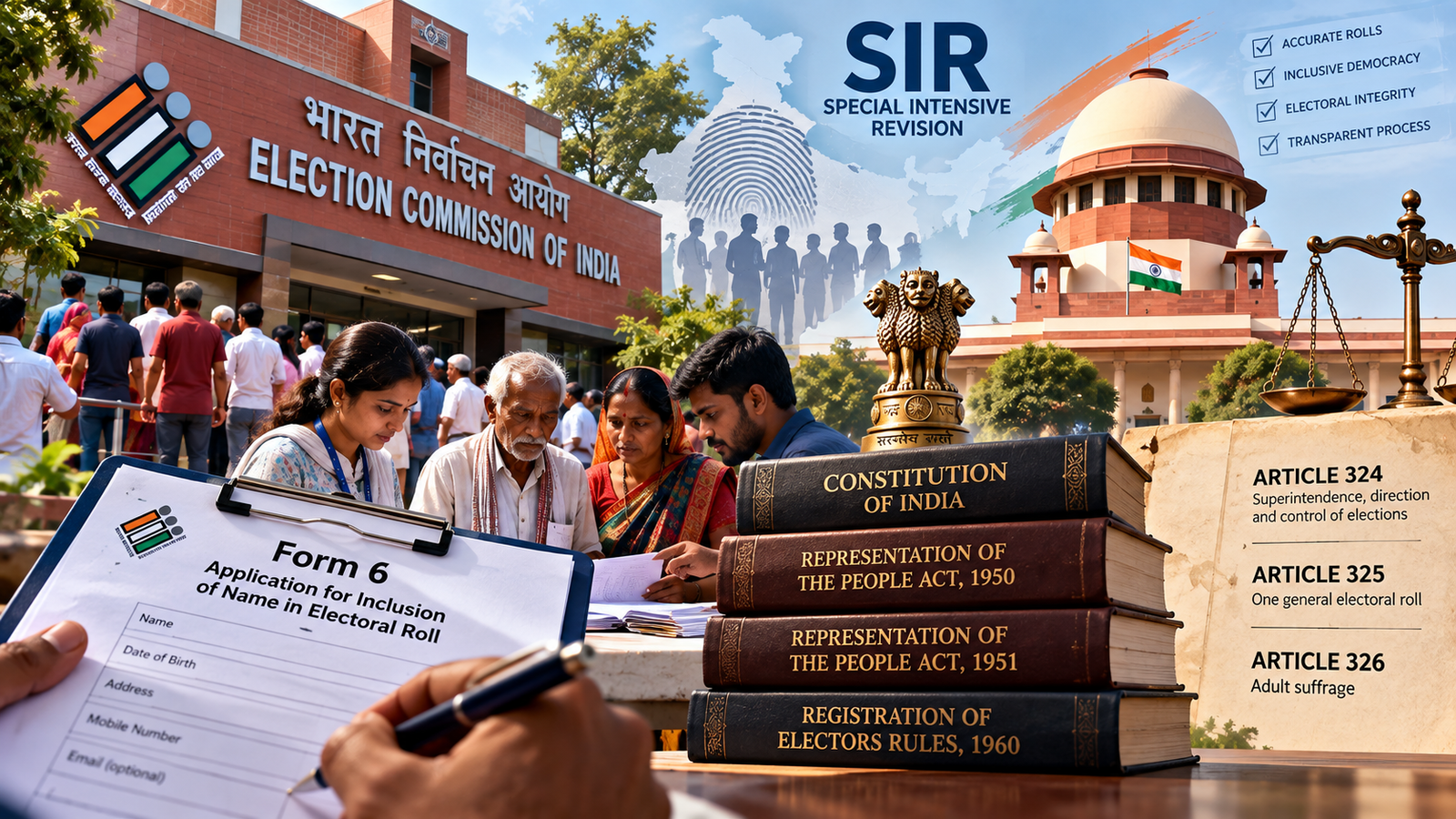
Electoral Roll Revision and Election Commission Independence: SIR, Article 324 and Voter Rights
Why in News?
India’s electoral system is facing renewed scrutiny over the Special Intensive Revision (SIR) of electoral rolls and the manner in which decisions are being taken by the Election Commission of India (ECI).
On 5 October 2026, the Supreme Court sought records from the Election Commission regarding alleged modifications to Form 6, the statutory form used for new voter registration. Chief Justice of India Surya Kant clarified that the Supreme Court had not approved the modifications to Form 6 and said the Court would examine who authorised them.
The controversy has also raised a broader constitutional question: How should the independence, accountability and collective functioning of the Election Commission be balanced?
This makes the issue important for UPSC GS Paper II, Polity, Governance, Constitutional Bodies and Electoral Reforms, as well as HPPSC.
What is an Electoral Roll?
An electoral roll is the official list of people who are registered to vote in a particular constituency.
Simple meaning
Agar kisi citizen ka naam electoral roll mein hai aur woh legally eligible hai, tab woh election mein vote kar sakta hai.
English Definition:
An electoral roll is the official register of eligible electors for a constituency.
The accuracy of electoral rolls is essential because both inclusion and exclusion affect the credibility of elections.
A defective roll may contain:
- duplicate entries
- names of deceased persons
- people who have shifted permanently
- ineligible persons
- incorrect addresses
But excessive or wrongful deletion can also result in disenfranchisement.
Disenfranchisement
Hinglish:
Disenfranchisement ka matlab hai kisi eligible citizen ka voting right practically exercise na kar paana, for example because their name is wrongly removed from the electoral roll.
English Definition:
Disenfranchisement is the deprivation or denial of a person’s ability to exercise the right to vote.
Therefore, electoral-roll revision has to maintain a balance:
Clean electoral roll + maximum inclusion of eligible voters
What is Special Intensive Revision?
Special Intensive Revision (SIR) is a detailed exercise for revising electoral rolls.
It is different from the normal periodic updating of electoral rolls because it involves a more comprehensive verification process.
The Election Commission has stated that SIR is intended to ensure that electoral rolls are:
- accurate
- updated
- free from duplicate entries
- free from ineligible entries
- inclusive of eligible voters
The ECI’s citizen portal currently provides specific facilities for SIR 2026, including enumeration forms, searching names in earlier SIR rolls and submitting documents against notices.
How does SIR work?
The broad process involves several stages.
House-to-house verification
Booth Level Officers (BLOs) undertake verification and enumeration.
Enumeration forms
Electors are required to provide relevant information through the prescribed process.
Draft electoral roll
A draft roll is published after the initial exercise.
Claims and objections
Citizens can challenge wrongful inclusion or exclusion.
Verification
Election officials examine claims and objections.
Final electoral roll
After the process is completed, the final electoral roll is published.
The ECI has stated that safeguards include multiple attempts by BLOs to contact electors, recording reasons before deletion, publication of draft rolls, claims and objections, appeals and participation of Booth Level Agents nominated by political parties.
Why has SIR become controversial?
The controversy is not simply about whether electoral rolls should be revised.
The central issue is:
How can electoral rolls be cleaned without accidentally excluding genuine voters?
Reports have highlighted concerns regarding large-scale deletions during the revision process and the difficulty some citizens may face in proving eligibility or getting their names restored.
The Election Commission, on the other hand, maintains that revision is necessary to remove duplicate, deceased and otherwise ineligible entries and has pointed to safeguards built into the process.
This distinction is important for UPSC:
Allegation ≠ established fact.
The examination perspective should focus on the constitutional and institutional issues rather than adopting the position of any political party.
The Supreme Court and SIR
The Supreme Court’s May 2026 judgment is particularly important.
The Court upheld the legality of the Bihar SIR and held that the exercise could be traced to Section 21(3) of the Representation of the People Act, 1950, read with Article 324 of the Constitution.
The Court also held that the Election Commission has power to conduct a limited inquiry concerning citizenship for determining eligibility for inclusion in electoral rolls.
At the same time, the Court emphasised procedural safeguards and proportionality.
Important constitutional principle
The Court treated Articles 324 and 327 as complementary rather than competing sources of power.
This is an important conceptual point.
Article 324: Gives the Election Commission constitutional authority over elections and electoral rolls.
Article 327: Gives Parliament power to make laws regarding elections.
Therefore:
Parliament makes electoral laws + ECI administers elections within the constitutional and statutory framework.
Article 324: The Constitutional Foundation
Article 324 is the most important constitutional provision for understanding the Election Commission.
It provides that the:
“superintendence, direction and control”
of the preparation of electoral rolls and conduct of elections is vested in the Election Commission.
This covers elections to:
- Lok Sabha
- State Legislative Assemblies
- President
- Vice-President
The Constitution also provides that the Election Commission consists of the Chief Election Commissioner (CEC) and such number of other Election Commissioners as the President may fix. When other Election Commissioners are appointed, the CEC acts as Chairman.
Is the CEC the Election Commission?
This is an important UPSC conceptual trap.
No.
The CEC is the Chairman of the Election Commission, but the constitutional body is the Election Commission of India.
Article 324 creates the Commission as a constitutional institution.
Therefore, the distinction is:
Election Commission → Constitutional body
CEC → Head/Chairman of the Commission
This distinction has become particularly important in the current debate over whether decisions concerning SIR were taken collectively.
The Debate Over Collective Decision-Making
Recent litigation has raised questions about whether certain decisions concerning SIR and electoral-roll management were taken with the concurrence of all Election Commissioners.
The Supreme Court has issued notice to the Centre and the Election Commission on petitions alleging unilateral decision-making by the CEC in matters related to SIR. The petitions rely, among other things, on Article 324(3), which makes the CEC the Chairman when other Election Commissioners are appointed.
Reports have also highlighted formal objections allegedly recorded by two other Election Commissioners regarding several decisions connected with electoral-roll management.
The legal question is therefore not merely:
“Who is the CEC?”
It is:
“What is the constitutional meaning of a multi-member Election Commission and how should its statutory business be transacted?”
This remains a matter before the courts and should not be treated as finally settled.
Form 6 Controversy
Form 6 is the application used for inclusion of a person’s name in the electoral roll as a new elector.
The current controversy concerns additional requirements appearing in the online process during SIR.
On 5 October 2026, the Supreme Court clarified that it had not approved the modification of Form 6 and sought records to determine who authorised the modification.
This issue is important because voter registration must satisfy two competing objectives:
Electoral integrity
Preventing fraudulent, duplicate or ineligible entries.
Electoral inclusion
Ensuring that genuine eligible citizens are not prevented from registering.
A sound electoral system needs both.
Election Commission Independence
The Election Commission is designed as an independent constitutional authority.
Why is independence necessary?
Because elections determine who exercises political power.
If the body conducting elections is perceived to favour the government or opposition, public confidence in the democratic process can decline.
Meaning of institutional independence
Hinglish:
Institutional independence ka matlab hai ki constitutional body apne functions ko political pressure ya improper external influence ke bina perform kare.
English Definition:
Institutional independence means the ability of a constitutional institution to perform its functions impartially and without improper external influence.
But independence does not mean absence of accountability.
The ideal principle is:
Independence + Transparency + Accountability + Judicial Review
Appointment of Election Commissioners
The appointment mechanism was changed through the Chief Election Commissioner and Other Election Commissioners (Appointment, Conditions of Service and Term of Office) Act, 2023.
The Act provides the statutory framework for:
- appointment
- service conditions
- tenure
- transaction of business
- related matters concerning the Election Commission.
This is relevant to the larger debate about the institutional design of the Election Commission.
For UPSC, remember the distinction:
Constitutional foundation → Article 324
Statutory appointment framework → 2023 Act
Why Electoral-Roll Accuracy Matters
An election is only as credible as the electoral process supporting it.
The electoral roll is the first major stage.
A simplified chain is:
Citizenship/eligibility → Electoral roll → Candidate nomination → Polling → Counting → Result
If eligible citizens are wrongly excluded at the first stage, they may never reach the polling stage.
Similarly, if ineligible or duplicate entries remain, the integrity of the electoral process can be questioned.
Therefore, electoral-roll management is not a technical administrative exercise alone.
It is a constitutional governance issue.
Voting Right in India
Another important UPSC point is the legal nature of the right to vote.
The right to vote in India is not a Fundamental Right.
It is primarily a constitutional/statutory right within the electoral framework.
The Supreme Court’s 2026 SIR judgment also emphasised that the right to vote, while constitutional in character, is subject to the legal framework governing electoral eligibility and periodic revision.
Common confusion
Right to vote ≠ Fundamental Right under Part III
Do not write in the examination that the right to vote is a Fundamental Right.
Electoral Roll and Citizenship
This is another area where students often get confused.
Citizenship
Citizenship determines whether a person is legally a citizen of India.
Electoral eligibility
Electoral laws determine whether an eligible citizen can be registered as an elector for a constituency.
Electoral roll
The roll records eligible electors.
The Supreme Court’s 2026 judgment recognised that the ECI may undertake a limited inquiry into citizenship for the purpose of determining eligibility for electoral-roll inclusion.
This does not mean that the Election Commission becomes the general authority for determining every question of citizenship.
That distinction is important.
SIR and Federalism
Elections to State Legislative Assemblies are conducted under the constitutional authority of the Election Commission of India.
Therefore, electoral-roll revision can involve:
Union constitutional institution + State election machinery + District administration + BLOs + political parties + citizens
This makes electoral administration an important example of cooperative institutional functioning.
Why the Issue Matters for Democracy
A democratic election requires more than simply holding polling on a particular day.
It requires:
- accurate electoral rolls
- universal and non-discriminatory voter access
- secret ballot
- impartial election administration
- transparent procedures
- effective grievance redressal
- credible counting
- public confidence
Thus:
Electoral integrity = procedural accuracy + voter inclusion + institutional impartiality + public trust
Key Challenges
Risk of wrongful exclusion
A genuine voter may be removed because of migration, documentation problems, data errors or inability to respond within the prescribed period.
Documentation burden
Poor, elderly, migrant and marginalised citizens may face greater difficulty in producing historical records.
Digital divide
Online systems may improve efficiency but can disadvantage citizens with limited digital access.
Data protection
Large-scale electoral databases contain sensitive personal information.
Therefore, cybersecurity and data protection are increasingly important.
Institutional trust
Even technically correct decisions can become politically controversial if the public perceives insufficient transparency.
Internal institutional disagreement
Differences among Election Commissioners can raise questions about collective decision-making and institutional functioning.
Way Forward
India needs an electoral-roll system that simultaneously protects accuracy and inclusion.
Transparent revision
The ECI should provide clear information regarding the reasons for deletion and restoration of names.
Strong grievance redressal
Citizens should have simple and accessible mechanisms to challenge wrongful deletion.
Human verification
Automated or software-based processes should not replace meaningful human verification in sensitive cases.
Political-party participation
Recognised political parties and their Booth Level Agents can contribute to identifying errors.
Independent audits
Periodic independent technical and procedural audits can strengthen public confidence.
Data protection
Electoral databases should follow strong cybersecurity and privacy safeguards.
Institutional transparency
Where a constitutional body is multi-member, decision-making procedures should be transparent and consistent with the governing legal framework.
Current Constitutional Issue: Independence vs Accountability
This entire controversy can be understood through one UPSC framework:
Independence
The ECI must be free from political pressure.
Accountability
The ECI must explain and justify its actions.
Transparency
Electoral procedures and changes to electoral rolls should be understandable and verifiable.
Judicial review
Courts can examine whether constitutional and statutory requirements have been followed.
Institutional collegiality
A multi-member constitutional commission must function according to the applicable rules governing collective decision-making.
Therefore:
A strong Election Commission is not merely an independent Election Commission.
It is an independent, accountable, transparent and constitutionally compliant institution.
Important Constitutional and Legal Provisions
| Provision/Law | Importance |
|---|---|
| Article 324 | Superintendence, direction and control of elections vested in ECI |
| Article 325 | One general electoral roll; no exclusion on grounds of religion, race, caste or sex |
| Article 326 | Elections to Lok Sabha and State Assemblies based on adult suffrage |
| Article 327 | Parliament’s power to make electoral laws |
| Article 328 | State Legislature’s power regarding elections to State Legislature, subject to Parliament’s law |
| Article 329 | Bar to judicial interference in electoral matters in certain circumstances |
| Representation of the People Act, 1950 | Electoral rolls and related matters |
| Representation of the People Act, 1951 | Conduct of elections and related matters |
| Registration of Electors Rules, 1960 | Rules concerning preparation and revision of electoral rolls |
| CEC and ECs Act, 2023 | Appointment, service conditions, tenure and transaction of business |
Article 324’s constitutional text specifically vests control over the preparation of electoral rolls and conduct of elections in the Election Commission.
Prelims Facts to Remember
- Article 324 → Election Commission
- Article 325 → One general electoral roll
- Article 326 → Adult suffrage
- Article 327 → Parliament’s power regarding elections
- Article 328 → State Legislature’s power regarding elections
- Article 329 → Judicial interference in electoral matters
- Form 6 → Inclusion of name in electoral roll
- Form 7 → Deletion/objection regarding electoral roll
- Form 8 → Correction/shifting-related electoral-roll services
- BLO → Booth Level Officer
- SIR → Special Intensive Revision
- CEC → Chairman of ECI when other Election Commissioners are appointed
- Right to vote → Not a Fundamental Right
- ECI → Constitutional body
The ECI’s citizen portal currently lists Form 6 for new voter registration and Form 7 for deletion-related applications.
Prelims Practice Question
Consider the following statements:
- Article 324 vests the superintendence, direction and control of electoral rolls and elections in the Election Commission of India.
- The right to vote in India is a Fundamental Right.
- The Chief Election Commissioner is the Chairman of the Election Commission when other Election Commissioners are appointed.
Which of the statements given above is/are correct?
Answer: 1 and 3 only
Explanation
Statement 1 is correct. Article 324 provides the constitutional foundation of the ECI.
Statement 2 is incorrect. The right to vote is not a Fundamental Right under Part III.
Statement 3 is correct. Article 324(3) provides that when other Election Commissioners are appointed, the CEC acts as Chairman.
UPSC Mains Connection
GS Paper II – Indian Polity and Governance
Syllabus linkage:
- Indian Constitution
- Constitutional bodies
- Election Commission
- Electoral reforms
- Governance and transparency
- Democratic institutions
- Separation of powers and institutional accountability
Possible Mains Question
“Electoral-roll accuracy and voter inclusion are two sides of the same democratic principle. Discuss in the context of the Special Intensive Revision of electoral rolls.”
Answer Framework
Introduction
Electoral rolls form the foundation of representative democracy because only registered eligible electors can exercise the electoral franchise.
Body
Explain:
- need for periodic revision
- constitutional basis under Article 324
- statutory framework
- SIR
- need to remove duplicate/ineligible entries
- risk of wrongful exclusion
- documentation and digital divide
- institutional transparency
- grievance redressal
- judicial review
- Election Commission independence
Conclusion
India needs electoral reforms that combine clean electoral rolls with maximum inclusion, supported by transparent procedures, strong safeguards and institutional accountability.
UPSC Geography Optional Connection
This topic also has a limited Geography Optional linkage through:
- population registration
- migration
- urbanisation
- electoral geography
- spatial distribution of population
- demographic mobility
- rural–urban migration
For example, migration can create challenges for electoral-roll management because a person’s physical residence may change while administrative records remain linked to an earlier location.
HPPSC Perspective
For HPPSC, connect this topic with:
- Election Commission of India
- Himachal Pradesh Legislative Assembly elections
- Chief Electoral Officer, Himachal Pradesh
- electoral rolls
- Booth Level Officers
- adult suffrage
- constitutional bodies
- Representation of the People Acts
- electoral reforms
- Article 324–329
A possible HPPSC Prelims question could test the difference between:
CEC, Election Commissioners, Chief Electoral Officer and State Election Commission.
Do not confuse the Election Commission of India with the State Election Commission.
The ECI conducts elections to Parliament, State Legislatures, President and Vice-President, whereas State Election Commissions conduct elections to Panchayats and Municipalities under Articles 243K and 243ZA.
Common Confusions
SIR vs SSR
SIR: Special Intensive Revision — comprehensive verification exercise.
SSR: Special Summary Revision — regular electoral-roll revision process.
Do not treat them as identical.
ECI vs State Election Commission
ECI: Parliament, State Legislatures, President and Vice-President.
State Election Commission: Panchayats and Municipalities.
CEC vs ECI
CEC: Chairman of the Commission when other Election Commissioners are appointed.
ECI: The constitutional body itself.
Right to vote vs Fundamental Right
The right to vote is not a Fundamental Right.
Citizenship vs voter registration
Citizenship and electoral registration are related but legally distinct questions.
Electoral roll vs voter ID
An electoral roll is the official register of electors.
A voter ID card is an identification document associated with electoral registration.
One-Page Revision
SIR 2026
→ Special Intensive Revision of electoral rolls
→ Objective: accurate + updated + inclusive electoral rolls
→ Constitutional basis: Article 324
→ Statutory framework: Representation of the People Act, 1950 + Registration of Electors Rules, 1960
→ ECI safeguards: BLO verification + draft roll + claims/objections + appeals
→ Supreme Court, May 2026: Bihar SIR upheld
→ Key principle: Articles 324 and 327 are complementary
→ Current controversy: alleged wrongful exclusions + institutional decision-making + Form 6 modifications
→ 5 October 2026: Supreme Court clarified it had not approved modified Form 6 and sought records
→ Larger issue: electoral integrity vs voter inclusion
→ Core constitutional principle:
Independent Election Commission + Transparent Process + Voter Inclusion + Accountability
Core Takeaway
The current debate over electoral-roll revision should not be reduced to a simple question of whether SIR is good or bad.
The deeper constitutional question is:
How can India maintain accurate and credible electoral rolls while ensuring that no eligible citizen is wrongly deprived of the opportunity to vote?
For UPSC, the issue connects Article 324, constitutional bodies, electoral reforms, democratic accountability, judicial review, citizenship, voter rights and institutional independence.
The ideal electoral system must achieve both:
“No ineligible voter should improperly enter the roll”
and
“No eligible voter should be wrongly excluded.”
That balance is central to the credibility of Indian democracy.