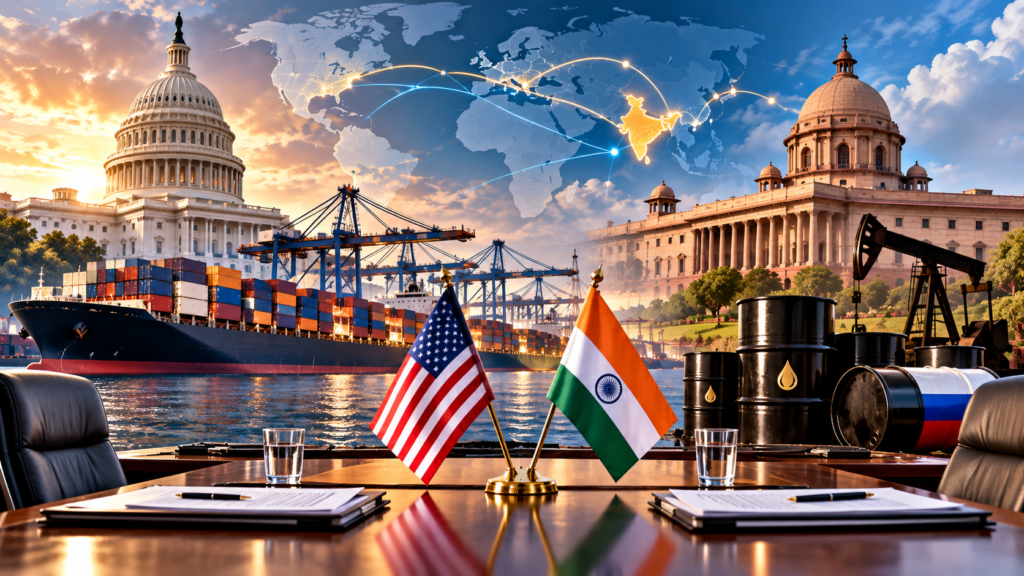
India–US Trade Talks Hit a Plateau: Tariffs, Russian Oil and Strategic Autonomy
Category: International Relations | Indian Economy | International Trade
UPSC GS: GS Paper II + GS Paper III
HPPSC: International Relations | Economy | Current Affairs
Key Themes: Tariffs, Bilateral Trade, Trade Deficit, Market Access, WTO, Russian Oil, Strategic Autonomy, Supply Chains
Why in News?
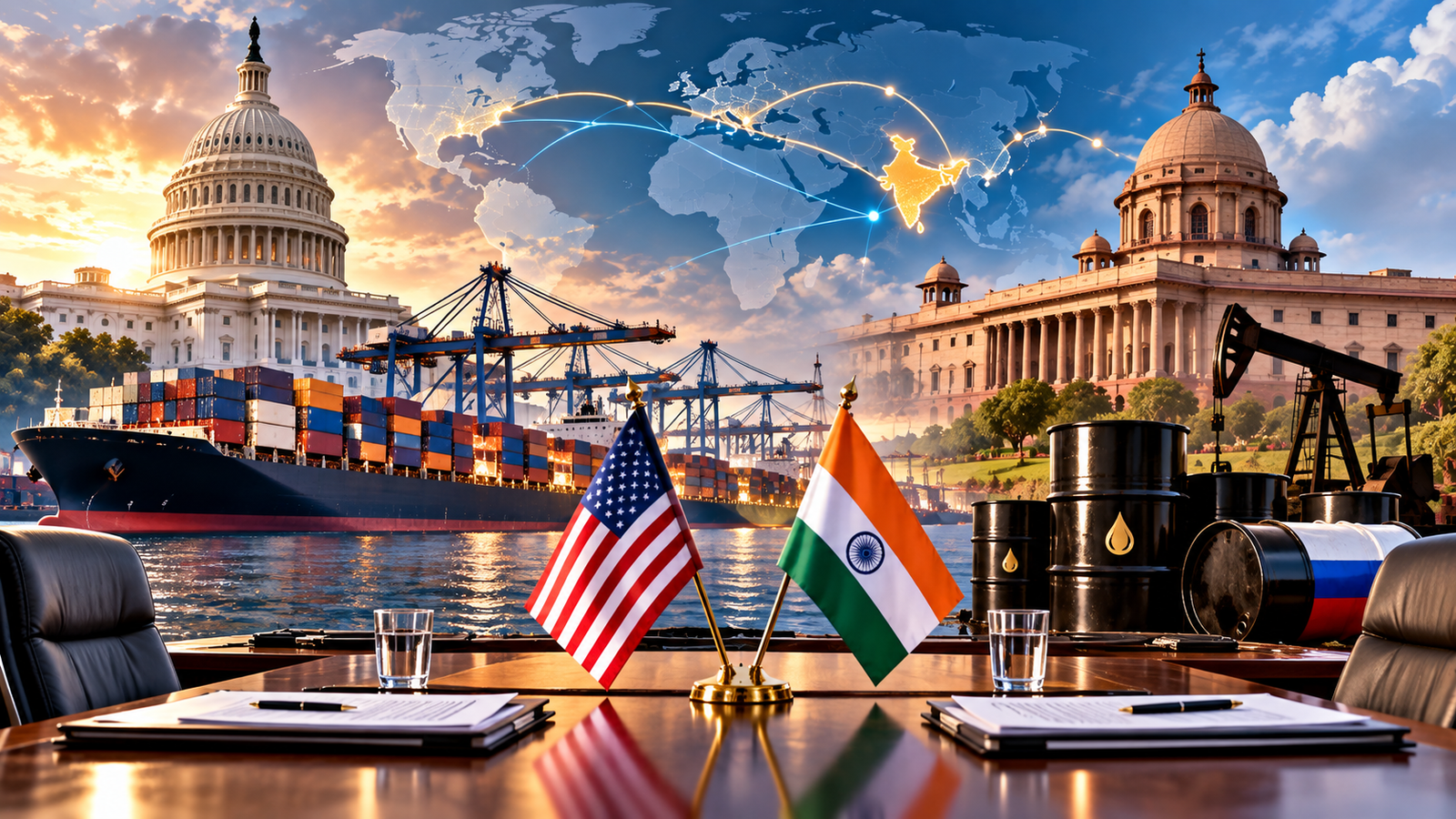
India–US negotiations for a broader bilateral trade agreement have reached a “plateau”, according to Union Finance Minister Nirmala Sitharaman on 5 October 2026.
She indicated that after extensive negotiations, there is now limited room for either side to offer further concessions, although negotiations themselves have not formally ended. US Trade Representative Jamieson Greer had also indicated that an agreement was not imminent after recent discussions with Commerce and Industry Minister Piyush Goyal.
The negotiations have become complicated by differences over:
- Tariffs
- Market access
- Trade imbalance
- Agriculture
- Digital trade
- Non-tariff measures
- Economic-security issues
- India’s purchase of Russian oil
This makes the issue highly relevant for understanding the changing nature of geoeconomics.
First Understand: What is a Trade Agreement?
A trade agreement is an arrangement between countries that establishes rules governing trade in goods, services and sometimes investment and other economic issues.
English Definition:
A trade agreement is an arrangement between countries that establishes mutually agreed rules for international trade and economic exchange.
Trade agreements may reduce:
- Import tariffs
- Quotas
- Regulatory barriers
- Customs barriers
and may improve:
- Market access
- Investment
- Supply-chain integration
- Trade predictability
The India–US negotiations are broader than simply reducing tariffs.
India–US Bilateral Trade Agreement
The two countries launched negotiations for a broader Bilateral Trade Agreement (BTA) in February 2025.
The objective is to expand bilateral trade and address long-standing issues relating to:
- Market access
- Tariffs
- Non-tariff barriers
- Customs
- Investment
- Digital trade
- Economic security
In February 2026, India and the US announced a framework for an Interim Agreement, while reaffirming their commitment to the broader BTA negotiations.
Therefore, understand the structure as:
Broader BTA
↓
Interim Agreement framework
↓
Detailed negotiations
↓
Final implementation
The present “plateau” relates to the difficulty in taking the negotiations further.
What Was Agreed in February 2026?
The February 2026 framework proposed significant tariff changes.
Under the framework:
- India agreed to eliminate or reduce tariffs on US industrial goods and a wide range of US agricultural and food products.
- The US proposed an 18% reciprocal tariff rate on originating Indian goods covered by the arrangement.
- Certain products could receive additional tariff relief subject to successful conclusion of the Interim Agreement.
The framework also sought stronger cooperation in:
- Supply chains
- Investment
- Technology
- Trade facilitation
- Economic security
The important point is that the February framework was part of a broader negotiating process rather than the end of all bilateral trade discussions.
What Does “Plateau” Mean?
This is the key current-affairs term.
Plateau
In negotiations, a plateau means that discussions have progressed to a point where further movement has become difficult.
English Definition:
A negotiation plateau is a stage where substantial progress has been achieved but further compromise becomes difficult because major differences remain.
In this case:
Negotiations → Progress → Major issues remain → Limited room for concessions → Plateau
This does not automatically mean negotiations have collapsed.
Why Are the Negotiations Difficult?
Several issues have become interconnected.
Tariffs
A major issue is the level and structure of tariffs imposed by both countries.
What is a Tariff?
A tariff is a tax imposed on imported goods.
English Definition:
A tariff is a government-imposed tax on imported goods.
Example:
If an imported product worth ₹100 faces a 20% tariff:
Import value = ₹100
Tariff = ₹20
Pre-tax import cost = ₹120
Tariffs affect the competitiveness of imported and domestic products.
Why Does the US Want Lower Indian Tariffs?
The United States has long argued that Indian tariffs on several products are relatively high and that greater market access would benefit American exporters.
The US also focuses heavily on its trade balance with India.
Finance Minister Sitharaman noted on 5 October that the bilateral trade balance currently favours India, meaning the US runs a goods trade deficit with India.
What is a Trade Deficit?
A trade deficit occurs when a country imports more goods than it exports.
English Definition:
A trade deficit occurs when the value of a country’s merchandise imports exceeds the value of its merchandise exports.
For example:
Exports = $80 billion
Imports = $100 billion
Therefore:
Trade deficit = $20 billion
The US wants to reduce its trade deficit with India.
However, India’s position is that trade balances are influenced by many factors and cannot simply be corrected through tariffs.
Why India Is Cautious About Further Concessions
India has to balance increased access to the US market against protection of sensitive domestic sectors.
Particularly sensitive areas include:
- Agriculture
- Dairy
- Food products
- Small businesses
- Labour-intensive manufacturing
- Domestic industry
A trade agreement that provides greater export access but creates excessive pressure on vulnerable domestic sectors could have distributional consequences.
Therefore:
Market Access ↔ Domestic Protection
is a major negotiating trade-off.
Agriculture: A Sensitive Area
Agriculture is particularly important for India.
Reducing tariffs on agricultural imports can benefit consumers through:
- Greater choice
- Lower prices
- More competition
But it can also expose domestic farmers to competition from imported products.
Therefore India has historically treated several agricultural sectors as sensitive.
This creates a policy dilemma:
Consumer interest + Export opportunities
versus
Farmer protection + Food security + Domestic production
This is a useful UPSC framework.
What are Non-Tariff Barriers?
Not every trade barrier is a tariff.
A country can restrict imports through:
- Product standards
- Sanitary and phytosanitary requirements
- Licensing
- Labelling rules
- Testing requirements
- Certification
- Quotas
- Administrative procedures
These are broadly referred to as non-tariff measures/barriers.
English Definition:
Non-tariff measures are regulatory or administrative measures other than tariffs that can affect international trade.
The India–US negotiations have therefore included both:
Tariff barriers
and
Non-tariff measures
The Indian and US negotiating teams have discussed market access, non-tariff measures, technical barriers, customs and trade facilitation.
The Russian Oil Factor
One of the most important geopolitical dimensions of the negotiations is India’s purchase of Russian crude oil.
India has continued to purchase Russian oil because it has been commercially attractive and important for maintaining energy security.
The US has increasingly used tariffs and sanctions-related pressure in response to countries purchasing Russian energy.
Recent US legislative action has increased the potential tariff pressure on countries purchasing significant quantities of Russian oil, adding another layer of difficulty to India–US negotiations.
This creates a three-way policy dilemma:
Affordable Energy
↕
Foreign Policy Autonomy
↕
Access to the US Market
Why Does India Buy Russian Oil?
India’s oil imports are driven primarily by:
- Price competitiveness
- Supply availability
- Refining economics
- Energy security
- Diversification of suppliers
India is a major oil-importing economy.
Therefore, crude oil availability and price directly affect:
- Inflation
- Current account
- Transport costs
- Industrial costs
- Fiscal pressures
A sudden reduction in a major source of relatively competitive crude could have economic consequences.
Energy Security and Foreign Policy
This creates an important UPSC concept:
Energy Geopolitics
Energy is not merely an economic commodity.
Oil and gas can influence:
- Foreign policy
- Strategic partnerships
- National security
- Trade relations
- Global power equations
India’s Russian oil purchases therefore illustrate the intersection of:
Energy Security + Foreign Policy + Geoeconomics
What is Strategic Autonomy?
Strategic Autonomy
Strategic autonomy means maintaining the ability to make independent decisions in accordance with national interests while cooperating with different countries.
English Definition:
Strategic autonomy is the ability of a state to pursue independent policy choices while maintaining relationships with multiple international partners.
India’s position can be understood through:
US partnership
Russia relationship
Europe
West Asia
Global South
India seeks to avoid excessive dependence on any single major power.
Trade as an Instrument of Geopolitics
Traditionally, trade was largely viewed through an economic lens.
Today, trade is increasingly connected with:
- National security
- Technology
- Supply chains
- Critical minerals
- Energy
- Foreign policy
This is called:
Geoeconomics
English Definition:
Geoeconomics refers to the use of economic instruments to pursue geopolitical and strategic objectives.
Examples include:
- Tariffs
- Sanctions
- Export controls
- Investment restrictions
- Supply-chain policies
- Technology restrictions
The India–US trade negotiations are an important contemporary example of geoeconomics.
Trade and National Security
The US increasingly links trade with national security.
Issues such as:
- Semiconductors
- Critical minerals
- Artificial intelligence
- Defence technologies
- Energy
- Supply chains
are no longer treated as purely commercial matters.
This trend is sometimes described as:
Economic Security
Economic Security
English Definition:
Economic security refers to protecting a country’s economic capabilities, critical supply chains and strategic resources from external vulnerabilities.
Section 301: Important for UPSC
Another important term in the current India–US trade context is:
Section 301
Section 301 of the US Trade Act of 1974 provides the US government with a mechanism to investigate and respond to what it considers unfair foreign trade practices.
In June 2026, the US Trade Representative said investigations involving India and several other economies had been completed and proposed additional tariff action, while noting that the proposals were not yet final at that stage. India said it would continue engaging with the US on the matter while also pursuing the bilateral trade framework.
Why is this important?
Section 301 raises questions about:
- Unilateral trade action
- WTO compatibility
- Trade disputes
- Market access
- Sovereignty in trade policy
WTO vs Unilateral Tariffs
This is an important conceptual distinction.
WTO Approach
The WTO provides a multilateral framework for international trade.
Countries agree to rules relating to:
- Tariffs
- Subsidies
- Discrimination
- Market access
- Dispute settlement
Unilateral Tariff Action
A country may impose tariffs based on its own domestic legal framework.
This can create tension between:
Multilateral Trade Rules
and
Domestic Trade/Strategic Policy
This is one reason the increasing use of tariffs has wider implications for the global trading system.
Bilateralism vs Multilateralism
The India–US negotiations also highlight a broader trend.
Multilateralism
Many countries negotiate under a common institutional framework.
Example:
WTO
Bilateralism
Two countries negotiate directly.
Example:
India–US trade agreement
Why are bilateral agreements increasing?
Because multilateral negotiations can be slow and difficult.
Countries increasingly use:
- FTAs
- CEPAs
- Bilateral agreements
- Regional agreements
to secure market access.
However, excessive fragmentation can make global trade rules more complex.
Supply Chains
Another important dimension is supply-chain resilience.
India and the US want to strengthen trusted supply chains in areas such as:
- Technology
- Pharmaceuticals
- Critical minerals
- Electronics
- Defence
- Manufacturing
The February 2026 framework explicitly highlighted resilient and trusted supply chains.
Supply-Chain Resilience
English Definition:
Supply-chain resilience is the ability of production and distribution networks to withstand, adapt to and recover from disruptions.
India’s Export Interests
The US is a major market for Indian exports.
Important Indian export sectors include:
- Textiles
- Apparel
- Pharmaceuticals
- Engineering goods
- Gems and jewellery
- Chemicals
- Electronics
- Agricultural products
- IT and business services
Therefore, predictable access to the US market is important for India’s:
- Employment
- Manufacturing
- MSMEs
- Foreign exchange earnings
- Export diversification
Why the US Market Matters to India
The US is not merely another trading partner.
It is important because of:
Large consumer market
High purchasing power
Technology
Investment
Services trade
Strategic partnership
Therefore, stable trade relations can support India’s broader economic transformation.
India–US Trade: Beyond Goods
Trade between India and the US is not limited to physical products.
It includes:
Goods
- Pharmaceuticals
- Textiles
- Engineering products
- Electronics
- Gems and jewellery
Services
- IT services
- Business services
- Professional services
- Financial services
Investment
US companies are important investors in India.
Technology
The relationship increasingly includes:
- AI
- Semiconductors
- Defence technology
- Digital infrastructure
- Critical technologies
Therefore, the bilateral economic relationship is much broader than tariffs alone.
Why a Trade Deal Matters for India
A successful agreement could:
- Increase export opportunities
- Reduce tariff uncertainty
- Attract investment
- Integrate India into global value chains
- Improve supply-chain resilience
- Increase manufacturing competitiveness
- Expand opportunities for MSMEs
But India also needs to ensure that:
- Sensitive sectors are protected
- Farmers are not disproportionately affected
- Domestic industry remains competitive
- Policy autonomy is preserved
Why a Trade Deal Matters for the US
The US wants:
- Greater access to the Indian market
- Lower tariffs
- Reduced trade imbalance
- Greater market access for American companies
- Stronger economic-security cooperation
- More predictable regulatory conditions
Therefore, the interests of both countries overlap in some areas but diverge in others.
The Central Negotiating Dilemma
The negotiations can be understood through four major trade-offs:
Market Access vs Domestic Protection
India wants greater export access while protecting sensitive domestic sectors.
Energy Security vs External Pressure
India wants reliable and affordable energy while facing pressure over Russian oil purchases.
Strategic Partnership vs Strategic Autonomy
India wants deeper US cooperation without sacrificing independent foreign-policy choices.
Free Trade vs Economic Security
Both countries want trade expansion but increasingly view trade through a national-security lens.
Significance for India
A stable India–US trade framework could strengthen:
Manufacturing
Greater access to the US market can support labour-intensive manufacturing.
MSMEs
Small exporters can benefit from predictable market access.
Employment
Export-oriented sectors can generate jobs.
Investment
Greater certainty can encourage investment.
Technology
Trade negotiations can facilitate technology partnerships.
Supply Chains
India can become a more important alternative manufacturing and supply-chain hub.
Challenges for India
Pressure on Agriculture
Greater agricultural market access could expose domestic farmers to competition.
Tariff Uncertainty
Frequent changes in US tariff policy can affect exporters.
Geopolitical Linkages
Trade is increasingly linked with foreign-policy issues.
Standards and Regulations
Non-tariff barriers can remain even after tariff reductions.
Policy Autonomy
India must avoid commitments that unnecessarily restrict future policy choices.
China Factor
India must simultaneously manage:
US economic partnership
and
China-related economic dependence and competition
Way Forward
India should pursue a balanced strategy.
Diversify Export Markets
India should continue expanding trade with:
- EU
- ASEAN
- UK
- Middle East
- Africa
- Latin America
- Indo-Pacific economies
This reduces excessive dependence on a single market.
Improve Domestic Competitiveness
Instead of relying only on tariff protection, India should improve:
- Logistics
- Infrastructure
- Skills
- Productivity
- R&D
- Ease of doing business
Strengthen Negotiating Capacity
India should negotiate sector-by-sector based on:
- Comparative advantage
- Employment
- Food security
- Strategic importance
Protect Sensitive Sectors
Agriculture and vulnerable domestic industries require carefully designed safeguards.
Maintain Strategic Autonomy
India should deepen the US relationship while maintaining diversified international partnerships.
Strengthen Multilateral Trade Rules
India should continue supporting a predictable and rules-based global trading system through the WTO.
India–US Trade Negotiations: Timeline
| Period | Development |
|---|---|
| February 2025 | India–US BTA negotiations launched |
| February 2026 | Framework for Interim Agreement announced |
| April 2026 | Indian delegation held negotiations in Washington |
| June 2026 | Further US–India discussions on market access, NTMs, customs, investment and economic security |
| September 2026 | Piyush Goyal scheduled US visit for further negotiations |
| 30 September 2026 | PM Modi and President Trump discussed bilateral issues |
| 5 October 2026 | Finance Minister Sitharaman described talks as having reached a “plateau” |
The negotiations therefore remain a work in progress, rather than a formally abandoned process.
UPSC Prelims Perspective
Important Facts
India–US BTA: Bilateral Trade Agreement
Negotiations launched: February 2025
Interim Agreement framework: February 2026
Key negotiating areas:
- Market access
- Tariffs
- Non-tariff measures
- Technical barriers
- Customs
- Trade facilitation
- Investment
- Digital trade
- Economic security
Current status: Negotiations have reached a plateau, but talks continue.
Prelims Practice Question
Q. Consider the following statements regarding India–US trade negotiations:
- The negotiations cover only tariffs on merchandise trade.
- Market access and non-tariff measures are among the issues discussed by India and the US.
- Economic security and digital trade have also featured in the negotiations.
- The present “plateau” means that India and the US have formally terminated negotiations.
Which of the statements given above is/are correct?
Answer: 2 and 3 only
Explanation
The negotiations cover a much wider range of issues than tariffs.
Also, a plateau does not mean formal termination of negotiations.
UPSC Mains Connection
GS Paper II
International Relations
- India–US relations
- Strategic partnership
- Economic diplomacy
- Strategic autonomy
- Globalisation
- Geopolitics
GS Paper III
Indian Economy
- International trade
- Tariffs
- Trade deficit
- Export competitiveness
- Manufacturing
- Supply chains
- Energy security
Possible Mains Question
“India–US economic relations increasingly reflect the intersection of trade, technology, energy and geopolitics. Discuss the major challenges in concluding a stable bilateral trade agreement.”
Answer Framework
Introduction
India and the US are major economic and strategic partners, but differences over tariffs, market access, trade imbalance and economic-security issues have complicated negotiations.
Body
Economic Issues
- Tariffs
- Market access
- Trade imbalance
- Agriculture
- Non-tariff barriers
Geopolitical Issues
- Russian oil
- Sanctions pressure
- Strategic autonomy
- Economic security
Structural Issues
- Supply chains
- Technology
- Digital trade
- Investment
- WTO framework
Way Forward
- Balanced tariff concessions
- Protection for sensitive sectors
- Greater export competitiveness
- Diversification of markets
- Stronger supply chains
- Continued strategic dialogue
- WTO-compatible trade rules
Conclusion
India should seek a trade agreement that expands market access without compromising food security, domestic competitiveness or strategic autonomy.
Geography Optional Connection
This topic can also be used in Geography Optional under:
Economic Geography
- International trade
- Global value chains
- Trade corridors
- Market access
Industrial Geography
- Manufacturing relocation
- Supply-chain diversification
- Industrial clusters
Geopolitical Geography
- Economic power
- Strategic trade routes
- Energy geopolitics
- Global economic blocs
Important Keywords
Tariff
Hinglish: Imported goods par lagaya gaya tax.
English Definition:
A tax imposed by a government on imported goods.
Trade Deficit
Hinglish: Jab imports ki value exports se zyada ho.
English Definition:
A situation where the value of imports exceeds the value of exports.
Market Access
Hinglish: Foreign companies/products ko kisi country’s market mein enter karne ka opportunity.
English Definition:
The conditions under which foreign goods, services or firms can enter a domestic market.
Non-Tariff Measures
Hinglish: Tariff ke alawa regulatory ya administrative measures jo trade ko affect karte hain.
English Definition:
Regulatory or administrative measures other than tariffs that affect international trade.
Geoeconomics
Hinglish: Economic tools ka use geopolitical objectives ke liye karna.
English Definition:
The use of economic instruments to achieve geopolitical objectives.
Economic Security
Hinglish: Economy ke critical resources, technologies aur supply chains ko external vulnerabilities se protect karna.
English Definition:
Protection of critical economic capabilities, resources and supply chains from external vulnerabilities.
Strategic Autonomy
Hinglish: National interest ke according independent foreign-policy decisions lene ki capacity.
English Definition:
The ability of a state to pursue independent policy choices while maintaining international partnerships.
Supply-Chain Resilience
Hinglish: Supply chain ka disruption ke baad survive aur recover karne ki ability.
English Definition:
The ability of supply networks to withstand, adapt to and recover from disruptions.
One-Page Revision
India–US Trade Talks 2026
BTA negotiations
↓
February 2026 Interim Framework
↓
Tariff + Market Access
↓
Agriculture + Non-Tariff Measures
↓
Digital Trade + Investment
↓
Economic Security
↓
Russian Oil Issue
↓
Strategic Autonomy
↓
5 October 2026
Negotiations reach “Plateau”
↓
Further concessions difficult
↓
But negotiations continue
Core UPSC Takeaway
The India–US trade issue should not be studied merely as a tariff dispute.
It represents a much larger transformation:
Trade
↓
Geoeconomics
↓
Energy Security
↓
Technology
↓
Supply Chains
↓
National Security
↓
Strategic Autonomy
This is why the issue is important for both GS Paper II and GS Paper III.
Conclusion
The current India–US trade negotiations demonstrate how international commerce is increasingly intertwined with geopolitics, energy security, technology and national security.
The present “plateau” does not necessarily mean the end of negotiations. Rather, it indicates that the two sides have reached a difficult stage where additional concessions are politically and economically sensitive.
For India, the challenge is to obtain greater and predictable access to the US market while protecting sensitive domestic sectors, maintaining energy security and preserving strategic autonomy.
The best long-term approach is therefore neither isolation nor excessive dependence on a single partner, but:
“Diversified global integration with strategic autonomy.”