Property and Inheritance Rights of Persons with Disabilities in India
Why in News?
The legal rights of Persons with Disabilities (PwDs) in relation to property, inheritance, financial decisions and legal capacity remain an important issue of social justice and constitutional equality.
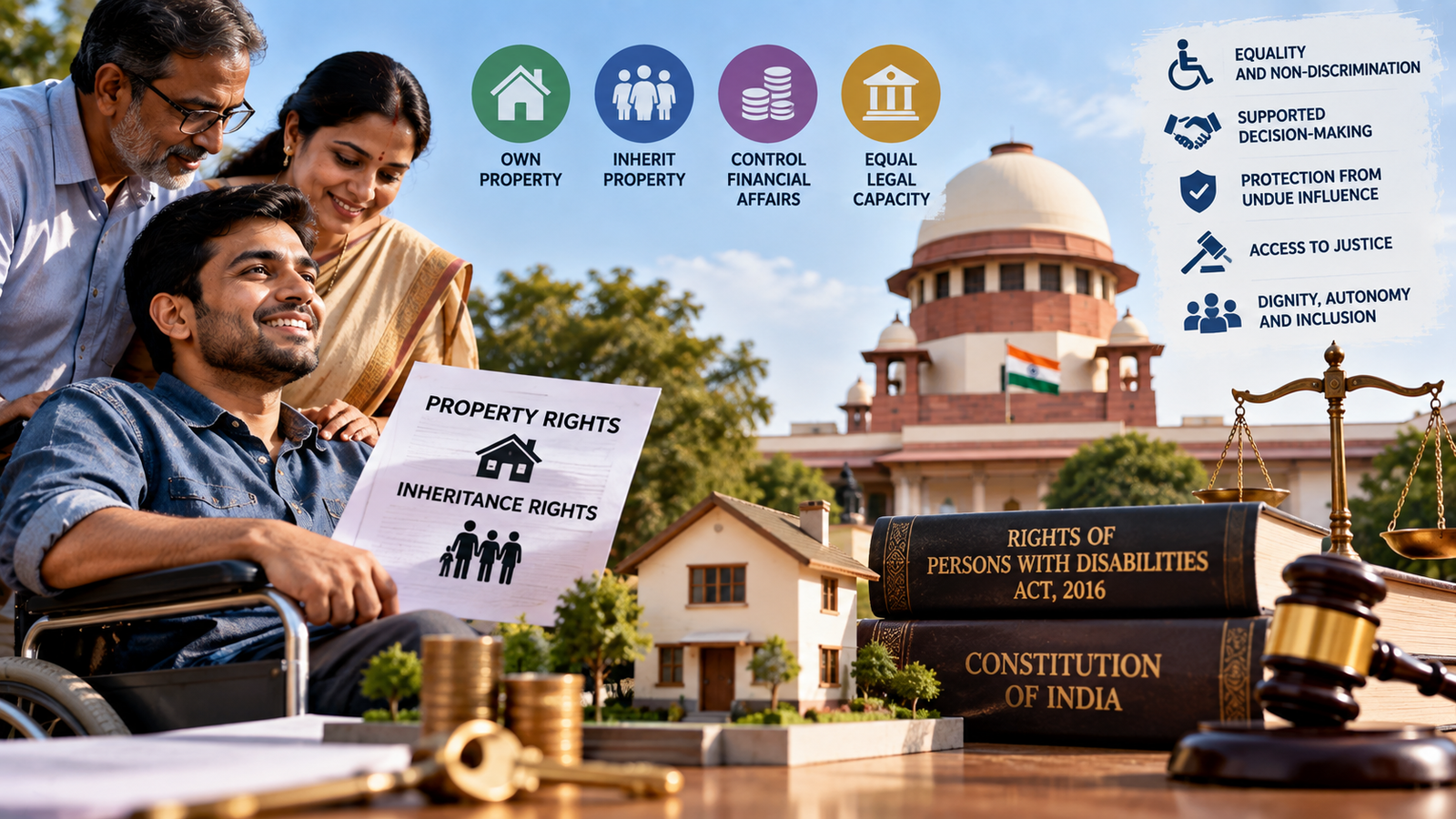
India’s Rights of Persons with Disabilities Act, 2016 (RPwD Act) specifically recognises that persons with disabilities have the right, on an equal basis with others, to own and inherit movable and immovable property and control their financial affairs. This is provided under Section 13 of the Act.
The issue is important for UPSC because it connects:
Disability rights + Equality + Legal capacity + Property rights + Inheritance + Access to justice + Constitutional morality
The Supreme Court has also increasingly emphasised that disability cannot be used as a basis for denying equal legal rights. In a 2025 judgment, the Court described the RPwD Act as having acquired a “super-statute” character because of its broad constitutional and social significance.
Who are Persons with Disabilities?
The RPwD Act, 2016 defines a person with disability as a person with a long-term physical, mental, intellectual or sensory impairment which, in interaction with barriers, hinders their full and effective participation in society equally with others.
This reflects an important change in understanding disability.
Earlier approaches often viewed disability primarily as an individual medical problem.
Modern disability law increasingly recognises the role of social and environmental barriers.
Medical Model vs Social Model of Disability
Medical Model
Hinglish
Medical model disability ko mainly individual ki physical ya mental impairment ke roop mein dekhta hai.
English Definition
The medical model primarily views disability as a condition arising from an individual’s impairment that requires treatment, rehabilitation or assistance.
Social Model
Hinglish
Social model ke according problem sirf impairment nahi hai. Society mein existing barriers bhi disability ko create ya worsen karte hain.
For example:
- inaccessible buildings
- lack of ramps
- inaccessible websites
- communication barriers
- discrimination
- lack of reasonable accommodation
English Definition
The social model understands disability as arising significantly from the interaction between an individual’s impairment and barriers in society.
This approach is reflected strongly in the philosophy of the RPwD Act.
What is Legal Capacity?
This is the most important concept in this topic.
Hinglish
Legal capacity ka matlab hai ki kisi person ko law ke saamne khud rights hold karne aur legally relevant decisions lene ki capacity recognise ki jaye.
For example, a person should be able to:
- own property
- inherit property
- enter into lawful transactions
- control financial affairs
- access banking facilities
- make decisions regarding their property
English Definition
Legal capacity is the recognition of a person’s ability to hold rights and exercise those rights in legal matters on an equal basis with others.
Section 13(2) of the RPwD Act requires that persons with disabilities enjoy legal capacity on an equal basis with others and receive equal recognition before the law.
Section 13: The Core Provision
Section 13 of the Rights of Persons with Disabilities Act, 2016 is central to property and inheritance rights.
It provides that persons with disabilities have the right, equally with others, to:
- own property
- inherit property
- own movable property
- own immovable property
- control financial affairs
- access bank loans
- access mortgages
- access other forms of financial credit
The provision therefore directly addresses a historical problem where disability could be wrongly treated as a reason to restrict a person’s control over property or finances.
Movable vs Immovable Property
Another basic distinction useful for Prelims is between movable and immovable property.
Movable Property
Examples include:
- money
- jewellery
- vehicles
- shares
- certain financial assets
- personal belongings
English Definition:
Movable property is property that can generally be moved from one place to another.
Immovable Property
Examples include:
- land
- houses
- buildings
- certain interests attached to land
English Definition:
Immovable property generally refers to land and things permanently attached to or associated with land.
Section 13 expressly covers both movable and immovable property.
Does Disability Take Away the Right to Inherit?
No.
A person does not lose the right to inherit property merely because they have a disability.
This is a crucial exam point.
The RPwD Act requires equality in the right to own and inherit property.
Therefore:
Disability ≠ disqualification from inheritance
A person’s inheritance rights will still depend on the applicable succession law, such as:
- Hindu Succession Act
- Indian Succession Act
- Muslim personal law
- other applicable personal or statutory laws
But disability itself cannot be treated as an automatic ground for denying inheritance.
RPwD Act and Personal Laws
This distinction is important.
The RPwD Act establishes a broad equality and non-discrimination framework.
However, questions concerning who inherits how much property may be governed by the applicable succession law.
Therefore:
RPwD Act → protects equality and legal capacity
while
Succession law → determines the rules of inheritance applicable to the person
The two should not be confused.
What is Supported Decision-Making?
The modern disability-rights framework increasingly prefers support over unnecessary substitution of decision-making.
Hinglish
Agar kisi person ko decision lene mein assistance ki zarurat hai, toh objective yeh hona chahiye ki us person ko decision samajhne aur khud express karne mein support diya jaye, na ki automatically koi aur person uski jagah decision le.
English Definition
Supported decision-making provides assistance to persons with disabilities while preserving their autonomy, will and preferences in making legally relevant decisions.
This is an important shift from the traditional idea that disability automatically means inability to make decisions.
Limited Guardianship
Section 14 of the RPwD Act deals with guardianship.
The Act provides for a system of limited guardianship where a person with disability, despite adequate and appropriate support, is unable to take legally binding decisions.
The concept is based on:
- joint decision-making
- mutual understanding
- trust
- limited duration
- specific decisions
- respect for the person’s will
The law therefore does not make guardianship an automatic consequence of disability.
Limited Guardianship vs Plenary Guardianship
This distinction is important.
Limited Guardianship
The guardian provides support for:
- a specific decision
- a specific situation
- a specific period
The person’s autonomy remains central.
Plenary Guardianship
A traditional plenary model gives a guardian much broader authority to make decisions on behalf of another person.
The RPwD Act’s emphasis on limited guardianship reflects a move towards supported decision-making and autonomy rather than blanket substitution of decision-making.
Why is Legal Capacity Important?
Legal capacity is not merely a technical legal concept.
It determines whether a person can practically exercise their rights.
Imagine a person has legally inherited a house.
If that person cannot:
- access the property records
- operate a bank account
- execute lawful transactions
- obtain legal assistance
- make decisions about the property
then formal recognition of inheritance alone may not provide meaningful equality.
Therefore:
Legal right + ability to exercise the right = meaningful empowerment
Section 13 and Financial Affairs
Section 13 also recognises the right of persons with disabilities to control their financial affairs.
This includes the broader principle that disability should not automatically result in another person controlling the individual’s money.
The law also provides safeguards where a person is providing support.
If a conflict of interest arises between the person with disability and the person providing support in a financial or property transaction, the supporting person must abstain from providing support for that transaction.
What is Conflict of Interest?
Hinglish
Conflict of interest tab hota hai jab support provide karne wale person ka apna personal interest, person with disability ke interest se clash kare.
Example:
A person is helping a disabled family member manage property.
If the helper themselves wants to purchase that property at an unfair price, there is a potential conflict of interest.
English Definition
A conflict of interest occurs when a person’s personal interests may improperly influence their duties or decisions affecting another person’s interests.
The RPwD Act specifically addresses such situations in financial and property transactions.
Protection Against Undue Influence
Section 13 also provides that persons providing support should not exercise undue influence.
Hinglish
Undue influence ka matlab hai kisi vulnerable person par excessive pressure ya influence use karke usse aisa decision karwana jo genuinely uski free will ko represent nahi karta.
English Definition
Undue influence occurs when improper pressure or domination affects a person’s free and independent decision-making.
The RPwD Act requires supporters to respect the person’s:
- autonomy
- dignity
- privacy
Why Property Rights Matter for PwDs
Property ownership is closely linked with:
- economic independence
- social security
- dignity
- housing security
- family autonomy
- financial stability
For many people with disabilities, inheritance may be an important source of economic security.
If property rights are denied or controlled unfairly, the person may become dependent on family members or institutions.
Therefore:
Property rights are also empowerment rights.
Constitutional Foundation
Although the Constitution does not contain a separate Fundamental Right titled “Right of Persons with Disabilities to Inherit Property”, several constitutional principles support disability equality.
Article 14
Equality before law and equal protection of laws.
This provides the broad constitutional foundation for equality.
Article 15
Prohibits discrimination on specified grounds.
The RPwD framework supplements constitutional equality by specifically addressing disability-based discrimination.
Article 21
Protection of life and personal liberty.
The Supreme Court has interpreted Article 21 broadly to include dignity and meaningful participation in society.
Article 41
Directive Principle relating to the State’s responsibility to make effective provisions for:
- work
- education
- public assistance
in cases including disability.
Article 41: Why Important?
Article 41 is part of the Directive Principles of State Policy (DPSP).
It directs the State, within its economic capacity and development, to make effective provision for securing the right to work, education and public assistance in cases of:
- unemployment
- old age
- sickness
- disablement
- other cases of undeserved want.
Thus:
Article 14 → Equality
Article 21 → Dignity and liberty
Article 41 → State responsibility regarding disability and social assistance
Together, these provide an important constitutional background for disability rights.
International Convention Behind the RPwD Act
India is a party to the United Nations Convention on the Rights of Persons with Disabilities (UNCRPD).
The RPwD Act was enacted to give effect to India’s obligations under the Convention. India Code describes the Act as legislation intended to give effect to the UN Convention on the Rights of Persons with Disabilities.
The UNCRPD promotes principles including:
- inherent dignity
- individual autonomy
- non-discrimination
- participation
- inclusion
- equality of opportunity
- accessibility
- equality between men and women
- respect for children with disabilities
Article 12 of UNCRPD: Equal Recognition Before the Law
One particularly important international principle concerns equal recognition before the law.
This is closely connected with legal capacity.
The principle is that persons with disabilities should enjoy legal capacity on an equal basis with others.
India’s Section 13 reflects this approach.
Therefore, a useful conceptual chain is:
UNCRPD → Legal capacity → RPwD Act → Equal recognition before law → Property and financial rights
RPwD Act as a “Super-Statute”
A significant judicial development came from the Supreme Court’s 2025 judgment concerning the rights of persons with disabilities.
The Court observed that the RPwD Act had acquired the status of a “super-statute”, meaning its normative and institutional significance extends beyond that of an ordinary statute.
What does “super-statute” mean?
It does not mean that the Act is literally superior to the Constitution.
Instead, it refers to an ordinary statute that acquires exceptional normative importance and significantly shapes public institutions and legal culture.
English Definition
A super-statute is an ordinary statute with unusually broad and enduring influence on legal and institutional norms.
For UPSC, remember:
RPwD Act → ordinary statute in formal hierarchy → exceptionally important normative framework in disability rights
Disability Rights and Access to Justice
Property disputes involving persons with disabilities can become particularly difficult because of:
- inaccessible courts
- communication barriers
- lack of legal awareness
- financial dependence
- family pressure
- inability to access documents
- difficulty obtaining legal assistance
Therefore, property rights must be accompanied by access to justice.
Section 12 of the RPwD Act addresses access to justice and requires measures to ensure accessibility in judicial and administrative proceedings.
Reasonable Accommodation
This is another major disability-rights concept.
Hinglish
Reasonable accommodation ka matlab hai kisi person ko equal participation dene ke liye necessary and appropriate changes karna, jab tak woh disproportionate ya undue burden na create kare.
English Definition
Reasonable accommodation means necessary and appropriate modifications or adjustments that enable persons with disabilities to enjoy rights and participate equally with others.
Examples in legal/property matters may include:
- accessible documents
- sign-language interpretation
- accessible buildings
- communication support
- assistance in understanding legal procedures
Equality Does Not Always Mean Identical Treatment
This is a very important UPSC concept.
Suppose two citizens have the same legal right.
One citizen can access an online property portal independently.
Another citizen may require an accessibility feature.
Providing the second person with an accessible interface is not discrimination.
It can actually be necessary to achieve substantive equality.
Therefore:
Formal equality = treating everyone the same
Substantive equality = removing barriers so everyone can meaningfully exercise rights
Formal Equality vs Substantive Equality
| Formal Equality | Substantive Equality |
|---|---|
| Same legal rule | Equal ability to exercise rights |
| Focuses on identical treatment | Focuses on removing barriers |
| “Treat everyone the same” | “Ensure meaningful equality” |
| May overlook disability-related barriers | Recognises reasonable accommodation |
This distinction is highly useful in GS Paper II answers.
Major Challenges
Social stigma
Families may wrongly assume that a person with disability cannot manage property independently.
Financial dependence
Economic dependence can increase vulnerability to exploitation.
Lack of legal awareness
People may not know that disability does not automatically remove inheritance rights.
Family pressure
Property disputes can become particularly difficult where the person depends on relatives for everyday support.
Accessibility barriers
Legal and administrative procedures may not always be accessible.
Digital exclusion
Increasing digitisation of land and financial records can create barriers if systems are not designed inclusively.
Misuse of guardianship
Guardianship or support arrangements can potentially become mechanisms for restricting autonomy if adequate safeguards are absent.
Weak enforcement
Having rights in legislation is not enough unless institutions effectively implement them.
Property Rights and Gender
Disability can intersect with other forms of vulnerability.
For example, a woman with disability may face both:
Gender-based disadvantage + Disability-based disadvantage
This is known as an intersectional perspective.
English Definition
Intersectionality refers to the way multiple social identities or forms of disadvantage can interact and produce distinct experiences of inequality.
Therefore, policies should consider:
- women with disabilities
- children with disabilities
- elderly persons with disabilities
- persons with high support needs
- persons in rural areas
Rural Dimension
The issue is particularly relevant in rural India because land and property are often central to household livelihoods.
Challenges may include:
- dependence on family members
- limited legal awareness
- inaccessible government offices
- lack of digital connectivity
- informal property arrangements
- difficulty accessing legal aid
Therefore, implementation at the district and local-government level is important.
Role of Local Administration
District-level institutions can help by ensuring:
- accessible documentation
- legal awareness
- grievance redressal
- accessible registration offices
- support services
- coordination with disability authorities
- legal-aid access
This makes disability rights a governance issue, not merely a welfare issue.
Way Forward
Strengthen legal awareness
Persons with disabilities and their families should be informed about their property and inheritance rights.
Accessible legal services
Courts, registration offices and legal-aid institutions should follow accessibility standards.
Supported decision-making
Support should help persons exercise their own choices rather than automatically replacing their decisions.
Strong safeguards
Conflict-of-interest and undue-influence safeguards should be effectively implemented.
Digital accessibility
Land records, property portals and banking systems should comply with accessibility requirements.
Legal aid
Persons with disabilities should have meaningful access to free or affordable legal assistance.
Capacity building
Judges, lawyers, government officials, bank personnel and registration officials should receive disability-rights training.
Better implementation
The success of the RPwD Act ultimately depends on implementation rather than legislation alone.
Important Legal Provisions
| Provision | Importance |
|---|---|
| Article 14 | Equality before law |
| Article 21 | Life, liberty and dignity |
| Article 41 | State responsibility regarding disablement and social assistance |
| RPwD Act, Section 3 | Equality and non-discrimination |
| Section 11 | Accessibility in voting |
| Section 12 | Access to justice |
| Section 13 | Legal capacity; ownership and inheritance of property |
| Section 14 | Limited guardianship |
| Section 15 | Authorities to support persons with disabilities |
| UNCRPD Article 12 | Equal recognition before law |
The RPwD Act’s Section 13 specifically guarantees equal rights to own and inherit property and control financial affairs.
Prelims Facts to Remember
- RPwD Act → 2016
- Act No. → 49 of 2016
- Enactment date → 27 December 2016
- Came into force → 19 April 2017
- Ministry → Ministry of Social Justice and Empowerment
- Main purpose → Give effect to UNCRPD
- Section 13 → Legal capacity
- Section 13 → Right to own/inherit property
- Section 13 → Control financial affairs
- Section 14 → Limited guardianship
- Section 12 → Access to justice
- Article 14 → Equality
- Article 21 → Life and personal liberty
- Article 41 → Public assistance including in cases of disablement
- UNCRPD → United Nations Convention on the Rights of Persons with Disabilities
Prelims Practice Question
Consider the following statements regarding the Rights of Persons with Disabilities Act, 2016:
- It recognises the right of persons with disabilities to own and inherit movable and immovable property.
- It requires persons with disabilities to surrender control over their financial affairs to a guardian.
- It provides for limited guardianship based on specific decisions and situations.
- The Act was enacted to give effect to India’s obligations under the UN Convention on the Rights of Persons with Disabilities.
Which of the statements given above are correct?
Answer: 1, 3 and 4 only
Explanation
Statement 1 — Correct
Section 13 recognises the right to own and inherit movable and immovable property.
Statement 2 — Incorrect
The Act recognises the right of persons with disabilities to control their financial affairs.
Statement 3 — Correct
Section 14 provides for limited guardianship in specified circumstances.
Statement 4 — Correct
The Act was enacted to give effect to the UNCRPD.
UPSC Mains Connection
GS Paper II
Syllabus linkage
- Indian Constitution
- Fundamental Rights
- Social justice
- Vulnerable sections
- Government policies and interventions
- Legal and institutional mechanisms
- Rights-based welfare
Possible Mains Question
“The recognition of legal capacity is essential for meaningful empowerment of persons with disabilities. Discuss in the context of property and inheritance rights under the Rights of Persons with Disabilities Act, 2016.”
Answer Framework
Introduction
The RPwD Act, 2016 marks a shift from a welfare-oriented approach towards a rights-based and autonomy-centred approach to disability.
Body
Discuss:
Legal capacity
- equal recognition before law
- property ownership
- inheritance
- financial control
Safeguards
- limited guardianship
- conflict-of-interest provisions
- protection from undue influence
Constitutional basis
- Article 14
- Article 21
- Article 41
Challenges
- stigma
- family dependence
- inaccessible institutions
- lack of awareness
- digital barriers
- misuse of support arrangements
Way forward
- supported decision-making
- accessible justice
- legal aid
- digital accessibility
- institutional training
- stronger implementation
Conclusion
Disability rights require moving from merely protecting persons with disabilities to enabling them to exercise autonomy and legal rights on an equal basis with others.
HPPSC Perspective
For HPPSC, this topic can be linked with:
- social justice
- vulnerable sections
- disability rights
- constitutional provisions
- welfare legislation
- Himachal’s social-security framework
- access to justice
- Panchayati Raj and local governance
- rural property and land administration
A probable HPPSC question could ask:
“Explain the major legal safeguards available to persons with disabilities regarding property ownership, inheritance and financial affairs in India.”
For Himachal Pradesh, connect the topic with the practical importance of:
land records + inheritance + accessible administration + legal aid + rural governance
Geography Optional Connection
The topic has a limited but useful connection with Geography Optional through:
- social geography
- vulnerable populations
- rural society
- accessibility
- spatial inequality
- inclusive development
- population composition
A useful conceptual chain is:
Disability → Social barriers → Spatial accessibility → Economic participation → Inclusive development
For example, inaccessible government offices in remote mountainous areas can create greater barriers for persons with disabilities than in well-connected urban areas.
Important Keywords
Legal Capacity
English Definition: The ability to hold and exercise legal rights on an equal basis with others.
Supported Decision-Making
English Definition: Assistance that enables a person with disability to make their own decisions while respecting their autonomy.
Limited Guardianship
English Definition: A time-bound and decision-specific support arrangement for legally binding decisions.
Reasonable Accommodation
English Definition: Necessary and appropriate adjustments that enable persons with disabilities to participate equally.
Undue Influence
English Definition: Improper pressure or domination that interferes with a person’s free and independent decision-making.
Substantive Equality
English Definition: Equality that focuses on removing barriers and achieving meaningful equal participation rather than merely identical treatment.
Intersectionality
English Definition: The interaction of multiple forms of identity or disadvantage that can produce distinct experiences of inequality.
One-Page Revision
PERSONS WITH DISABILITIES + PROPERTY RIGHTS
→ RPwD Act, 2016
→ Act No. 49 of 2016
→ UNCRPD implementation
SECTION 13
→ Legal capacity
→ Own property
→ Inherit property
→ Movable property
→ Immovable property
→ Control financial affairs
→ Bank loans
→ Mortgages
SECTION 14
→ Limited guardianship
→ Specific decision
→ Specific situation
→ Limited duration
→ Joint decision-making
SAFEGUARDS
→ Conflict of interest
→ No undue influence
→ Autonomy
→ Dignity
→ Privacy
CONSTITUTION
→ Article 14: Equality
→ Article 21: Life + liberty + dignity
→ Article 41: Disablement + public assistance
CORE IDEA
Disability does not remove legal capacity or inheritance rights.
BIGGER SHIFT
Welfare approach → Rights-based approach → Autonomy + Inclusion + Empowerment
Conclusion
The property and inheritance rights of persons with disabilities represent a larger transformation in India’s approach to disability.
The central principle is simple:
A disability should not automatically make a person legally dependent on another individual.
The RPwD Act, 2016 therefore moves beyond welfare by recognising legal capacity, property ownership, inheritance, financial control and autonomy.
The real challenge now is implementation.
India needs institutions in which persons with disabilities can not only possess rights on paper, but can also exercise those rights independently, safely and with dignity.
That is the essence of substantive equality and inclusive justice.