Sarnath Becomes India’s 45th UNESCO World Heritage Site: History, Art, Buddhism, Constitution and UPSC Analysis
Why is Sarnath in News?
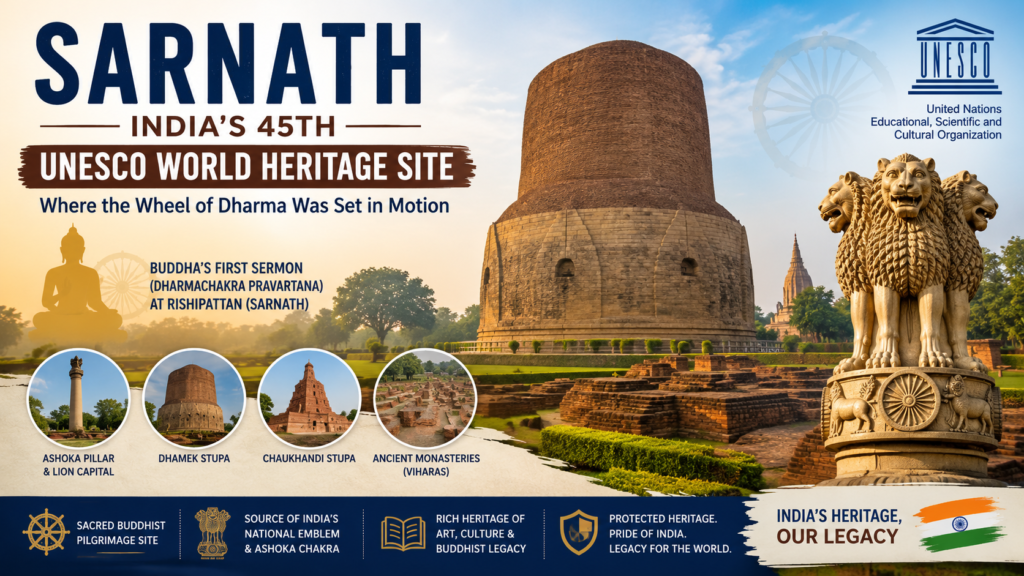
Sarnath, one of the holiest places in Buddhism, has officially been inscribed on the UNESCO World Heritage List during the 48th Session of the UNESCO World Heritage Committee held in Busan, South Korea.
With this recognition, Sarnath becomes India’s 45th UNESCO World Heritage Site and the fourth UNESCO World Heritage Site in Uttar Pradesh.
The inscription is a major milestone for India’s cultural diplomacy, heritage conservation, Buddhist tourism, and global recognition of its ancient civilizational legacy.
What is Sarnath?


Sarnath is one of the most sacred pilgrimage centres of Buddhism. It is located about 10 km from Varanasi (Uttar Pradesh) and is historically known by two ancient names:
- Rishipattana (Isipatana) – meaning “Place of the Sages”
- Mrigadava (Deer Park) – referring to the forest where deer freely roamed.
Why is Sarnath important?
After attaining enlightenment under the Bodhi Tree at Bodh Gaya, Gautama Buddha travelled to Sarnath and delivered his first sermon to his five former companions.
This event is known as:
- Dharmachakra Pravartana
- Turning of the Wheel of Dharma (Law)
It marks:
- Beginning of Buddha’s public teaching
- Birth of the Buddhist Sangha (community of monks)
- Formal spread of Buddhism throughout Asia.
For this reason, Sarnath occupies a central place in Buddhist history.
UNESCO Recognition of Sarnath
Sarnath has now been included as a Cultural Property under the 1972 UNESCO World Heritage Convention.
This inscription acknowledges:
- Outstanding Universal Value (OUV)
- Exceptional Buddhist archaeological remains
- Outstanding Gupta art and sculpture
- Continuous historical significance from the Mauryan period onwards.
Archaeological Importance of Sarnath
The protected archaeological area includes several monuments representing different historical periods.
Dhamek Stupa


The Dhamek Stupa is the most prominent monument in Sarnath.
Features
- Built on the site of Buddha’s First Sermon
- Originally commissioned by Emperor Ashoka
- Later enlarged during the Gupta period
- Cylindrical structure made of stone and bricks
- Decorated with beautiful floral and geometric carvings
Today it remains one of the finest surviving Buddhist stupas in India.
Chaukhandi Stupa
This stupa commemorates the place where Buddha first met his five disciples before delivering the First Sermon.
The present octagonal tower was added during the Mughal period in memory of Emperor Humayun’s visit.
Ashoka Pillar
One of Emperor Ashoka’s most celebrated pillars was erected at Sarnath during the 3rd century BCE.
Although the pillar stands broken today, its capital has become one of India’s greatest national symbols.
Ancient Monasteries (Viharas)
Excavations at Sarnath have revealed:
- Monastic complexes
- Meditation halls
- Prayer chambers
- Courtyards
- Residential cells for monks
These remains show that Sarnath was once a major international Buddhist learning centre.
Emperor Ashoka and Sarnath


After embracing Buddhism following the Kalinga War, Emperor Ashoka visited Sarnath.
He constructed:
- Ashoka Pillar
- Stupas
- Monasteries
- Buddhist establishments
His patronage transformed Sarnath into one of the greatest Buddhist centres in Asia.
Lion Capital of Ashoka: India’s National Emblem
The Lion Capital of Ashoka found at Sarnath was adopted as the National Emblem of India on 26 January 1950.
Features
- Four Asiatic lions standing back to back
- Symbol of courage, strength and confidence
- Circular abacus decorated with:
- Elephant
- Horse
- Bull
- Lion
- Between them appears the 24-spoked Dharma Chakra
The motto below the emblem,
“Satyameva Jayate”
is taken from the Mundaka Upanishad.
Dharma Chakra and the Indian National Flag
The 24-spoked Dharma Chakra from the Sarnath Lion Capital was adopted as the centre of the Indian National Flag.
Symbolism
It represents:
- Righteousness
- Justice
- Moral governance
- Continuous movement
- Progress
- Duty
For UPSC, students should remember that both the National Emblem and the Ashoka Chakra originate from Sarnath.
Constitutional Significance
Sarnath is also linked with important constitutional provisions concerning cultural heritage.
Article 49
Article 49 directs the State to protect monuments and places of artistic or historic importance from destruction, damage or neglect.
It forms part of the Directive Principles related to preservation of national heritage.
Article 51A(f)
Article 51A(f) makes it the Fundamental Duty of every citizen:
To value and preserve the rich heritage of India’s composite culture.
Sarnath perfectly reflects this constitutional obligation.
Legal Protection
The site enjoys multiple levels of protection.
Protected under
- Ancient Monuments and Archaeological Sites and Remains (AMASR) Act, 1958
- Archaeological Survey of India (ASI)
Following UNESCO inscription, international conservation standards will also apply.
Buffer Zone
The UNESCO nomination includes:
- Core archaeological zone
- Protected buffer zone
The buffer zone prevents:
- Illegal construction
- Urban encroachment
- Environmental degradation
- Visual pollution
This helps preserve the authenticity of the ancient remains.
Sarnath School of Art
One of India’s greatest artistic traditions flourished here during the Gupta Period (4th–6th Century CE).
This artistic tradition is called the Sarnath School of Art.
Characteristics
- Extremely smooth sandstone finish
- Transparent robes
- Calm and spiritual facial expressions
- Beautiful halos
- Perfect body proportions
- Minimal ornamentation
- Divine serenity
Historians regard it as the highest achievement of classical Indian sculpture.
Dharmachakra Pravartana Buddha
The most famous sculpture produced at Sarnath depicts Buddha seated in the Dharmachakra Pravartana Mudra.
It is carved from Chunar Sandstone.
Its features include:
- Graceful posture
- Delicate modelling
- Spiritual expression
- Symbolic wheel gesture
Art historians consider it among the greatest sculptures ever produced in ancient India.
Four Sacred Buddhist Pilgrimage Sites


Buddhism recognises four principal pilgrimage sites associated with the life of Buddha.
| Sacred Site | Importance | Major Monument |
|---|---|---|
| Lumbini (Nepal) | Birth of Buddha | Mayadevi Temple, Ashokan Pillar |
| Bodh Gaya (Bihar) | Enlightenment | Mahabodhi Temple |
| Sarnath (Uttar Pradesh) | First Sermon | Dhamek Stupa |
| Kushinagar (Uttar Pradesh) | Mahaparinirvana | Parinirvana Temple |
These four locations collectively narrate the complete spiritual journey of Buddha.
India’s UNESCO World Heritage Sites
With Sarnath’s inclusion:
- Total UNESCO World Heritage Sites = 45
- Cultural Sites = 37
- Natural Sites = 7
- Mixed Site = 1 (Khangchendzonga National Park)
This further strengthens India’s position as one of the world’s richest cultural civilizations.
UNESCO Sites in Uttar Pradesh
Sarnath becomes the fourth UNESCO World Heritage Site in Uttar Pradesh.
They are:
| Site | Category |
|---|---|
| Taj Mahal | Cultural |
| Agra Fort | Cultural |
| Fatehpur Sikri | Cultural |
| Sarnath | Cultural |
This expands Uttar Pradesh’s heritage recognition beyond the Agra region into the globally significant Buddhist Circuit.
Why UNESCO Recognition Matters
The inscription offers multiple benefits.
Cultural Benefits
- International recognition of India’s Buddhist heritage
- Greater awareness of ancient Indian civilization
- Preservation of invaluable archaeological remains
Economic Benefits
- Increase in international tourism
- Employment generation
- Development of local infrastructure
- Growth of the Buddhist pilgrimage circuit
Diplomatic Benefits
Buddhism serves as an important pillar of India’s cultural diplomacy with countries such as:
- Sri Lanka
- Thailand
- Myanmar
- Japan
- Vietnam
- South Korea
- Mongolia
- Cambodia
Significance for UPSC
Prelims Perspective
Remember:
- Sarnath = First Sermon
- Dharmachakra Pravartana
- Ashoka Lion Capital
- National Emblem
- Ashoka Chakra
- Gupta School of Art
- UNESCO World Heritage Site
- Article 49
- Article 51A(f)
- AMASR Act
- Buddhist Circuit
Mains Perspective
Possible themes:
- India’s cultural diplomacy through Buddhism
- Heritage conservation challenges
- UNESCO World Heritage and sustainable tourism
- Constitutional protection of cultural heritage
- Ashoka’s role in spreading Buddhism
- Gupta art as the classical age of Indian sculpture
Previous Year Questions
UPSC Mains (2020)
Question
Pala period is the most significant phase in the history of Buddhism in India. Enumerate. (150 words, 10 Marks)
Relevance
Understanding Sarnath helps explain:
- Growth of Buddhist institutions
- Evolution of Buddhist art
- Monastic universities
- Spread of Buddhism across Asia
UPSC Prelims (2020)
Question
With reference to the cultural history of India, consider the following pairs:
- Parivrajaka — Renunciant and Wanderer
- Shramana — Priest with a high status
- Upasaka — Lay follower of Buddhism
Correct Answer: (b) 1 and 3 only
Challenges in Conservation
Despite UNESCO recognition, Sarnath faces several challenges:
- Rapid urbanisation around the heritage zone
- Tourist pressure
- Pollution
- Groundwater-related deterioration
- Need for scientific conservation
- Balancing religious activities with archaeological preservation
Addressing these issues will require coordinated efforts by the Archaeological Survey of India, state authorities, UNESCO, and local communities.
Way Forward
To ensure the long-term preservation of Sarnath:
- Strengthen heritage management plans.
- Enforce buffer zone regulations to curb illegal construction.
- Promote sustainable and responsible tourism.
- Encourage digital documentation and scientific conservation.
- Integrate local communities into heritage protection efforts.
- Develop the Buddhist Circuit with improved infrastructure while preserving the site’s authenticity.
Conclusion
The inscription of Sarnath as India’s 45th UNESCO World Heritage Site is more than a recognition of an ancient archaeological complex—it is a celebration of India’s enduring civilizational values of peace, compassion, wisdom, and cultural continuity. As the place where the Buddha first set the Wheel of Dharma in motion, Sarnath symbolizes the global spread of Indian philosophical thought. For UPSC aspirants, the topic holds multidimensional importance across History, Art & Culture, Polity, International Relations, and Current Affairs, making it an essential area for both Prelims and Mains preparation.