
UNESCO Expands World Heritage List: New Cultural, Natural and Mixed Sites Added in 2026 | Complete UPSC Analysis
Why is this in News?
The UNESCO World Heritage Committee has inscribed several new Cultural, Natural, and Mixed World Heritage Sites during its latest session. The newly recognized sites include:
- Normandy D-Day Landing Beaches (France)
- Mount Olympus (Greece)
- Asuka–Fujiwara Archaeological Sites (Japan)
- Boma–Badingilo Migratory Landscape (South Sudan)
These inscriptions reinforce UNESCO’s mission of preserving humanity’s shared cultural and natural heritage while promoting sustainable conservation, education, and international cooperation.
For UPSC and State PSC aspirants, this topic is important under Art & Culture, Environment & Ecology, International Relations, International Organizations, World Geography, and Current Affairs.
What is a UNESCO World Heritage Site?


A UNESCO World Heritage Site is a place recognized for possessing Outstanding Universal Value (OUV) to humanity. These sites may represent exceptional achievements in culture, history, architecture, archaeology, biodiversity, geology, or ecology.
They are protected under the Convention Concerning the Protection of the World Cultural and Natural Heritage (1972).
Objectives of the Convention
- Protect cultural and natural heritage of global importance.
- Promote international cooperation in conservation.
- Encourage sustainable heritage management.
- Preserve heritage for future generations.
- Strengthen awareness about humanity’s shared legacy.
What is Outstanding Universal Value (OUV)?
A site is inscribed on the World Heritage List only if it demonstrates Outstanding Universal Value, meaning it has exceptional importance that transcends national boundaries and is valuable for all humanity.
To qualify, a property must satisfy UNESCO’s selection criteria while maintaining:
- Authenticity
- Integrity
- Long-term conservation measures
- Effective management system
UNESCO World Heritage Committee
The World Heritage List is maintained by the UNESCO World Heritage Committee, which consists of elected member states responsible for evaluating nominations and making final decisions.
Advisory Bodies
| Organization | Function |
|---|---|
| ICOMOS | Evaluates Cultural Heritage Sites |
| IUCN (International Union for Conservation of Nature) | Evaluates Natural Heritage Sites |
| ICCROM | Provides scientific conservation and restoration expertise |
World Heritage Site Nomination Process


Every World Heritage inscription follows a structured process.
Tentative List
Each country prepares a list of potential heritage sites.
Nomination Dossier
A detailed proposal is submitted including:
- Historical significance
- Maps
- Conservation status
- Management plan
- Outstanding Universal Value
Technical Evaluation
Experts from ICOMOS and IUCN inspect the site and evaluate its suitability.
Committee Decision
The World Heritage Committee may:
- Inscribe the site
- Refer the nomination
- Defer it for additional work
- Reject the proposal
Important Facts for UPSC
Remember:
- UNESCO does not own World Heritage Sites.
- Territorial sovereignty remains with the respective country.
- UNESCO provides international recognition and conservation standards.
- Management responsibility remains with the State Party.
Categories of World Heritage Sites
UNESCO recognizes three categories.
| Category | Description |
|---|---|
| Cultural | Monuments, temples, forts, archaeological sites, historic cities |
| Natural | Forests, mountains, wildlife habitats, ecosystems |
| Mixed | Possessing both cultural and natural significance |
Newly Inscribed UNESCO World Heritage Sites
Normandy D-Day Landing Beaches (France)


The Normandy D-Day Landing Beaches commemorate one of the most significant military operations in modern history.
Historical Background
On 6 June 1944 (D-Day), Allied forces launched the largest amphibious invasion ever undertaken, beginning the liberation of Western Europe from Nazi occupation during the Second World War.
Included Sites
- Omaha Beach
- Utah Beach
- Gold Beach
- Juno Beach
- Sword Beach
- Pointe du Hoc
The inscription also preserves:
- German fortifications
- Coastal bunkers
- Artificial Mulberry Harbours
- Sunken naval vessels
UNESCO Significance
The site symbolizes:
- Peace
- International cooperation
- Human sacrifice
- Collective memory of World War II
Mount Olympus (Greece)


Mount Olympus has been inscribed as a Mixed World Heritage Site because of its extraordinary combination of cultural mythology and ecological richness.
Cultural Importance
According to Greek mythology, Mount Olympus was regarded as:
- Home of Zeus
- Residence of the Twelve Olympian Gods
It remains one of the most influential symbols of Western civilization.
Natural Importance
- Highest mountain in Greece
- Height: 2,918 metres
- Alpine ecosystems
- Rich biodiversity
- High endemic species diversity
- Diverse climatic zones
Asuka–Fujiwara Archaeological Sites (Japan)


Located in Nara Prefecture, these archaeological remains represent the emergence of Japan’s earliest centralized political system during the 6th–8th centuries CE.
Major Features
The complex preserves:
- Royal palaces
- Administrative offices
- Early Buddhist temples
- Imperial tombs
These settlements later influenced the urban planning of Nara and Kyoto, shaping Japanese civilization for centuries.
Boma–Badingilo Migratory Landscape (South Sudan)


This landscape has become South Sudan’s first UNESCO World Heritage Site.
Ecological Importance
It protects one of the world’s largest terrestrial mammal migrations.
Important Species
- White-eared Kob
- Tiang
- Mongalla Gazelle
Millions of animals migrate seasonally across grasslands and wetlands, making this one of Africa’s most spectacular ecological phenomena.
India’s Role in the World Heritage Programme


India actively participates in UNESCO’s heritage conservation programme.
Nodal Agency
The Archaeological Survey of India (ASI) under the Ministry of Culture is responsible for:
- Preparing nominations
- Coordinating with UNESCO
- Conserving World Heritage Sites
- Monitoring heritage management
India’s UNESCO World Heritage Profile
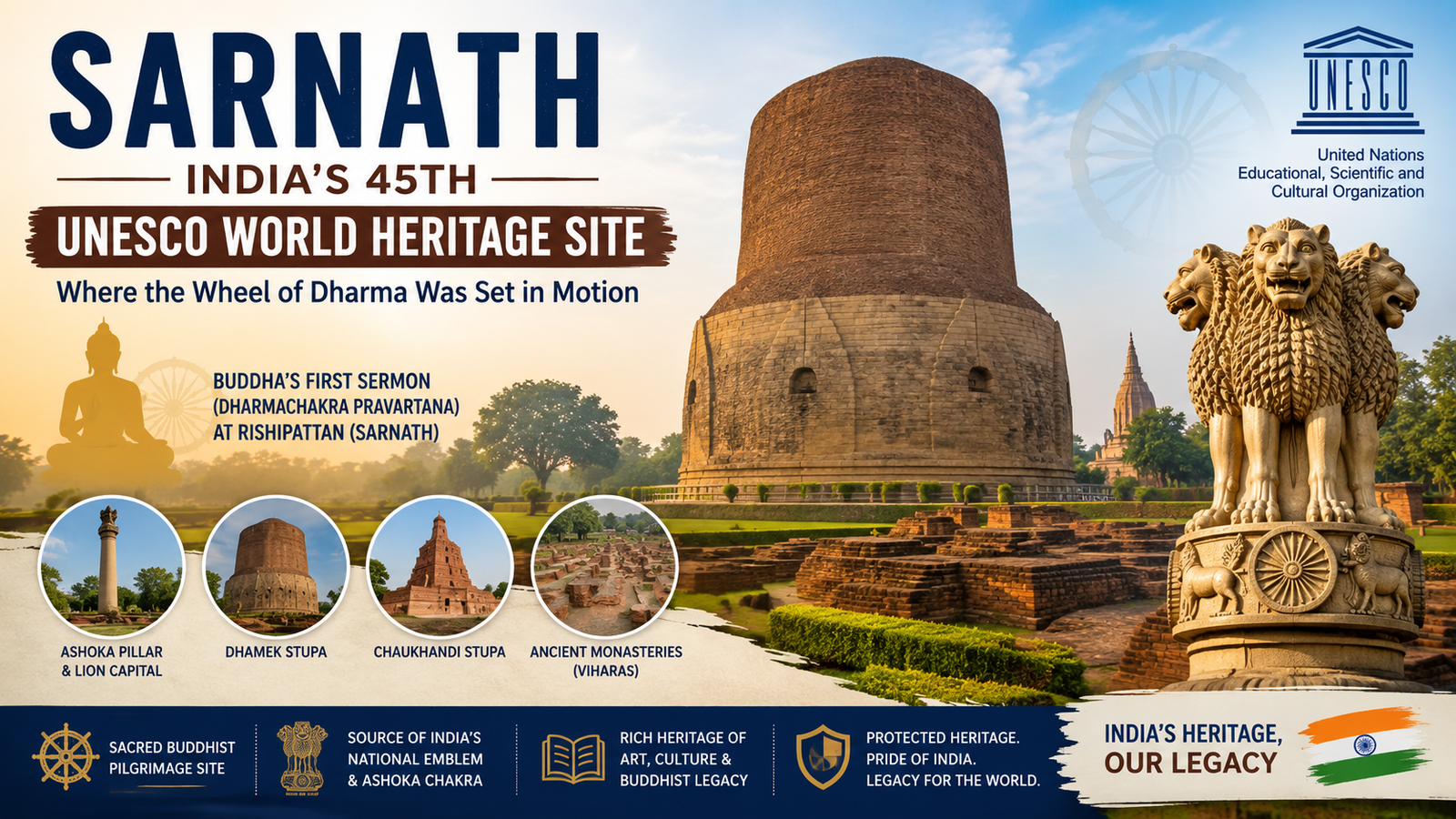
Following the inscription of Sarnath, India now has:
- 45 World Heritage Sites
- 37 Cultural Sites
- 7 Natural Sites
- 1 Mixed Site (Khangchendzonga National Park)
India ranks among the countries with the largest number of UNESCO World Heritage Sites.
Why World Heritage Recognition Matters
Cultural Importance
- Protects ancient civilizations
- Preserves monuments
- Promotes cultural identity
Environmental Importance
- Conserves biodiversity
- Protects ecosystems
- Safeguards wildlife habitats
Economic Importance
- Boosts tourism
- Creates employment
- Promotes local livelihoods
Diplomatic Importance
World Heritage recognition strengthens:
- Cultural diplomacy
- International cooperation
- Soft power
- Global cultural exchange
Challenges in Heritage Conservation
Despite international recognition, many World Heritage Sites face serious threats.
Major challenges include:
- Climate change
- Rapid urbanisation
- Pollution
- Illegal construction
- Armed conflicts
- Overtourism
- Natural disasters
- Lack of financial resources
Way Forward
To strengthen heritage conservation globally:
- Promote sustainable tourism.
- Increase scientific conservation efforts.
- Encourage local community participation.
- Strengthen climate resilience.
- Improve digital documentation and GIS mapping.
- Enhance international cooperation through UNESCO.
- Increase investment in conservation and disaster preparedness.
Significance for UPSC
Prelims Perspective
Remember these keywords:
- UNESCO
- World Heritage Convention, 1972
- Outstanding Universal Value (OUV)
- ICOMOS
- IUCN
- ICCROM
- Cultural Site
- Natural Site
- Mixed Site
- ASI
- Mount Olympus
- Normandy Beaches
- Asuka–Fujiwara
- Boma–Badingilo
Mains Perspective
Possible questions include:
- Discuss the significance of UNESCO World Heritage Sites in preserving global cultural and natural heritage.
- Examine the role of UNESCO in promoting sustainable conservation.
- “World Heritage Sites are instruments of both conservation and cultural diplomacy.” Discuss.
- Evaluate the challenges in conserving World Heritage Sites in the age of climate change.
Previous Year Question
UPSC Prelims (2024)
Question
Consider the following properties included in the World Heritage List released by UNESCO:
- Shantiniketan
- Rani-ki-Vav
- Sacred Ensembles of the Hoysalas
- Mahabodhi Temple Complex at Bodhgaya
How many of the above properties were included in 2023?
Answer: (b) Only two
Practice Questions
Question 1
Which organization evaluates Cultural Heritage Sites before UNESCO World Heritage inscription?
(a) UNEP
(b) ICOMOS
(c) WWF
(d) ICCROM
Answer: (b) ICOMOS
Question 2
With reference to UNESCO World Heritage Sites, consider the following statements:
- UNESCO acquires ownership of a site after inscription.
- World Heritage Sites may be Cultural, Natural, or Mixed.
- The Archaeological Survey of India is the nodal agency for India’s World Heritage nominations.
Which of the statements given above is/are correct?
(a) 1 only
(b) 2 only
(c) 2 and 3 only
(d) 1, 2 and 3
Answer: (c) 2 and 3 only
Conclusion
The latest expansion of the UNESCO World Heritage List reflects the world’s commitment to safeguarding places of exceptional cultural, historical, and ecological importance. From the Normandy D-Day Landing Beaches, which symbolize peace and sacrifice, to the mythological and biodiverse Mount Olympus, the ancient Asuka–Fujiwara capitals, and the wildlife-rich Boma–Badingilo Migratory Landscape, these inscriptions celebrate humanity’s shared heritage. For UPSC aspirants, the topic offers a multidisciplinary perspective connecting History, Art & Culture, Environment, Geography, International Relations, and Current Affairs, making it highly relevant for both Prelims and Mains.