Nobel Prize in Chemistry 2026: Kagan, Soai, Chirality and Homochirality Explained
Why in News?
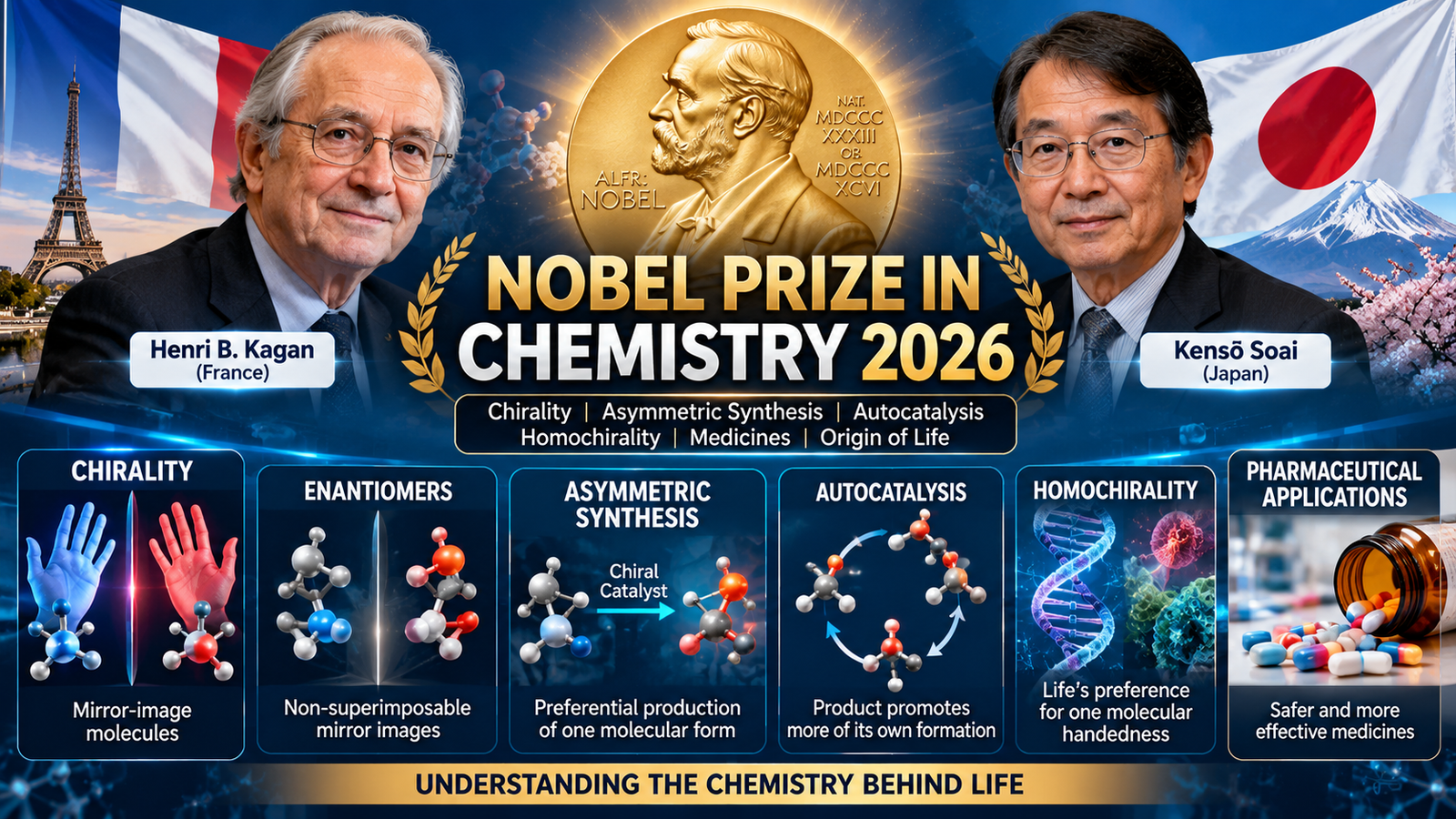
The 2026 Nobel Prize in Chemistry has been awarded to Henri B. Kagan of France and Kensō Soai of Japan for their work on non-linear effects and autocatalysis in asymmetric organic synthesis.
Their research helped scientists understand and control an important chemical phenomenon known as chirality, in which molecules can exist in two mirror-image forms.
Their work is particularly important because living systems often use only one of these molecular forms. This phenomenon is called homochirality.
The research has major applications in pharmaceutical chemistry, organic synthesis and the understanding of the chemical origins of life.
Nobel Prize in Chemistry 2026: Key Facts
| Aspect | Details |
|---|---|
| Award | Nobel Prize in Chemistry 2026 |
| Laureates | Henri B. Kagan and Kensō Soai |
| Countries | France and Japan |
| Field | Organic chemistry |
| Nobel citation | Discovery of non-linear effects and autocatalysis in asymmetric organic synthesis |
| Major concept | Chirality and homochirality |
| Major application | Pharmaceutical and chemical synthesis |
| Related concept | Asymmetric synthesis |
| Prize significance | Controlling which mirror-image form of a molecule is produced |
First Understand the Basic Concept: What Is Chirality?
Before understanding the Nobel-winning research, we need to understand chirality.
The word chirality comes from the Greek word kheir, meaning hand.
Think about your left and right hands.
They look like mirror images of each other.
However, you cannot perfectly superimpose your left hand on your right hand.
The same idea applies to certain molecules.
A molecule is called chiral when it and its mirror image cannot be perfectly superimposed.
Simple example
Think of:
Left hand → mirror image → Right hand
Similarly:
Chiral molecule → mirror image → another molecular form
These two forms may have the same atoms and chemical formula but different three-dimensional arrangements.
What Are Enantiomers?
The two non-superimposable mirror-image forms of a chiral molecule are called enantiomers.
Simple definition
Enantiomers are stereoisomers that are non-superimposable mirror images of each other.
In simple language:
They are two molecular forms that are like the left and right hands of the same person.
They generally have very similar chemical properties in ordinary environments, but they can behave very differently when interacting with biological systems.
This is extremely important in medicine.
Why Does Chirality Matter in the Human Body?
The human body is itself highly organised at the molecular level.
Many biological molecules have a particular three-dimensional structure.
For example:
- Amino acids are building blocks of proteins.
- Sugars are important components of nucleic acids and metabolism.
- Enzymes have highly specific molecular shapes.
- Drug molecules interact with biological targets through molecular recognition.
Therefore, the biological system may recognise one molecular form differently from its mirror image.
A useful analogy is a lock and key.
If a drug molecule has the correct three-dimensional shape, it may fit the biological target.
Its mirror-image form may:
- work less effectively,
- have a different biological effect,
- have little effect,
- or in some cases produce harmful effects.
This is why controlling molecular handedness is important in pharmaceutical chemistry.
What Is Homochirality?
One of the biggest mysteries in chemistry and biology is that life strongly favours one molecular form over its mirror image.
This phenomenon is known as homochirality.
English Definition
Homochirality is the predominance or exclusive use of one enantiomeric form of chiral molecules in a biological system.
For example, biological systems predominantly use particular forms of amino acids and sugars.
The important question is:
Why did life choose one molecular handedness instead of using both equally?
This question has fascinated scientists for more than a century.
The work of Kagan and Soai provides important insight into how such molecular asymmetry can arise through chemical processes.
What Is Asymmetric Synthesis?
Now we come to one of the most important terms in the Nobel Prize.
Asymmetric synthesis is a chemical method designed to preferentially produce one enantiomer rather than producing equal amounts of both.
Simple example
Suppose a chemical reaction can produce:
Molecule A — 50%
Mirror-image Molecule B — 50%
This is not very useful when we specifically need A.
Asymmetric synthesis attempts to shift the reaction:
A — much more
B — much less
The goal is therefore to obtain a high proportion of the desired molecular form.
Why Is Asymmetric Synthesis Important for Medicines?
Drug molecules often need to interact with specific biological targets.
Because biological systems are three-dimensional, the exact molecular shape matters.
Therefore, pharmaceutical companies may need to produce a specific enantiomer with high purity.
This can improve:
- therapeutic effectiveness,
- safety,
- selectivity,
- manufacturing efficiency,
- and control over unwanted effects.
This is one reason why asymmetric synthesis has become an important part of modern pharmaceutical chemistry.
What Did Henri Kagan Contribute?
Henri B. Kagan made major contributions to the field of asymmetric synthesis.
One important discovery associated with his work is the non-linear effect.
To understand this, first understand a simple assumption.
Suppose a catalyst contains:
- 60% of one molecular form
- 40% of its mirror image
One might expect the final chemical product to have approximately the same 60:40 distribution.
But Kagan’s research showed that chemical reactions can sometimes produce a much stronger preference for one molecular form than would be expected from the composition of the catalyst.
This is called a non-linear effect.
What Is a Non-Linear Effect?
Simple definition
A non-linear effect occurs when a small imbalance in the molecular handedness of a catalyst produces a disproportionately large imbalance in the handedness of the products.
In simple language:
A small molecular advantage can become a much larger molecular advantage during a chemical reaction.
This is important because it provides a mechanism through which molecular asymmetry can be amplified.
What Did Kensō Soai Contribute?
Kensō Soai took this field further through his work on asymmetric autocatalysis.
This is one of the most important concepts associated with the 2026 Chemistry Nobel.
What Is Autocatalysis?
Normally, a catalyst helps a chemical reaction occur faster without being consumed in the overall reaction.
In autocatalysis, the product of a reaction itself acts as a catalyst for producing more of that product.
So the process becomes self-reinforcing.
Simple analogy
Imagine one person teaching another person how to make copies of themselves.
The first product helps create more of the same product.
Then those new products help create even more.
This creates a form of chemical amplification.
What Is Asymmetric Autocatalysis?
Now combine two concepts:
Asymmetry + Autocatalysis
In asymmetric autocatalysis, one molecular form can promote the formation of more of the same molecular form.
For example:
Small initial imbalance
↓
One molecular form becomes slightly dominant
↓
That form promotes its own formation
↓
Its proportion increases further
↓
A strong molecular preference develops
This provides an important chemical mechanism for understanding how homochirality might emerge.
Kagan + Soai: The Scientific Connection
The work of the two scientists can therefore be understood through a chain:
Chirality
↓
Asymmetric synthesis
↓
Non-linear effects
↓
Autocatalysis
↓
Amplification of molecular asymmetry
↓
Homochirality
This is the central conceptual chain that UPSC aspirants should remember.
Why Is Homochirality Important for the Origin of Life?
One of the major scientific questions concerning the origin of life is:
How did biological systems develop a preference for one molecular handedness?
Life is not simply a random collection of molecules.
It contains highly organised molecular systems.
Proteins, nucleic acids, sugars and other biomolecules have specific three-dimensional structures.
If both mirror-image forms were always produced in equal amounts, establishing the highly organised chemistry of life could be much more complicated.
The work recognised by the Nobel Prize provides an important example of how chemical reactions can amplify a small asymmetry.
However, it is important to remember:
This does not mean that Kagan and Soai completely solved the origin-of-life problem.
Their work provides an important chemical mechanism relevant to understanding how homochirality can emerge.
Connection with the Thalidomide Tragedy
The importance of molecular handedness can be understood through the famous thalidomide case.
Thalidomide was used as a drug in the late 1950s and early 1960s.
The tragedy demonstrated the importance of molecular structure and stereochemistry in drug action and safety.
Different molecular forms can interact differently with biological systems.
This became an important lesson for pharmaceutical science:
Producing the correct molecular form can be crucial for drug safety and effectiveness.
Therefore, the ability to control chirality is not merely an academic issue.
It has direct implications for medicine.
Chirality, Enantiomers and Stereochemistry: Do Not Confuse Them
These terms are closely related but are not identical.
Stereochemistry
The study of the three-dimensional arrangement of atoms in molecules.
Chirality
A property of a molecule or object whose mirror image cannot be superimposed on it.
Enantiomers
The two non-superimposable mirror-image forms of a chiral molecule.
Homochirality
The predominance of one molecular handedness in a biological system.
Asymmetric synthesis
A method designed to preferentially produce one enantiomer.
Autocatalysis
A reaction in which the product helps catalyse the formation of more product.
Why Is the Nobel Research Important?
The research has significance at several levels.
Pharmaceutical Industry
Controlled asymmetric synthesis can help manufacture specific molecular forms of drugs.
Chemical Manufacturing
Chemists can design reactions that produce desired molecular structures more selectively.
Understanding Life
The research provides clues about how molecular asymmetry may emerge in chemical systems.
Origin of Biological Homochirality
Autocatalytic amplification provides a possible pathway for a small initial asymmetry to become dominant.
Fundamental Organic Chemistry
The research improves our understanding of how molecular handedness can be generated and amplified.
UPSC Connection: Science and Technology
This topic is highly relevant to UPSC GS Paper III – Science and Technology.
UPSC syllabus linkage
Science and Technology — developments and their applications and effects in everyday life.
It can also be linked with:
- biotechnology,
- pharmaceuticals,
- medical science,
- basic chemistry,
- origin of life,
- scientific research,
- emerging technologies.
Prelims Perspective
UPSC may not necessarily ask:
Who won the Nobel Prize in Chemistry 2026?
It may instead ask about the concept behind the award.
Important terms to remember:
| Term | Meaning |
|---|---|
| Chirality | Property of an object/molecule that cannot be superimposed on its mirror image |
| Enantiomers | Non-superimposable mirror-image molecular forms |
| Homochirality | Preference for one molecular handedness in biological systems |
| Asymmetric synthesis | Preferential production of one enantiomer |
| Autocatalysis | Product promotes formation of more product |
| Non-linear effect | Output asymmetry can be disproportionately larger than input asymmetry |
| Stereochemistry | Study of three-dimensional molecular arrangement |
Prelims MCQ
Consider the following statements regarding the 2026 Nobel Prize in Chemistry:
- Chirality refers to a property in which a molecule cannot be superimposed on its mirror image.
- Enantiomers are non-superimposable mirror images of each other.
- Autocatalysis refers to a process in which a product can promote the formation of more of that product.
- Homochirality refers to the equal presence of both mirror-image forms in biological systems.
Which of the statements given above are correct?
A. 1 and 2 only
B. 1, 2 and 3 only
C. 2, 3 and 4 only
D. 1, 2, 3 and 4
Answer: B
Statement 4 is incorrect.
Homochirality means the predominance or exclusive use of one molecular handedness, not equal presence of both forms.
Mains Perspective
Possible UPSC Mains Question
“The 2026 Nobel Prize in Chemistry highlights the importance of molecular chirality and autocatalysis in understanding both pharmaceutical chemistry and the possible emergence of biological homochirality. Explain.”
Answer Framework
Introduction
Define chirality and explain that certain molecules exist as non-superimposable mirror-image forms.
Body
Explain:
- chirality and enantiomers,
- asymmetric synthesis,
- Kagan’s non-linear effects,
- Soai’s asymmetric autocatalysis,
- amplification of molecular asymmetry,
- homochirality in biological systems,
- pharmaceutical applications,
- relevance to origin-of-life studies.
Conclusion
The research demonstrates how fundamental chemistry can help explain important biological phenomena while also enabling greater control over the synthesis of medicines and other useful compounds.
Key Takeaways for Revision
Remember this chain:
Chirality → Enantiomers → Asymmetric Synthesis → Non-linear Effects → Autocatalysis → Molecular Amplification → Homochirality
And remember:
Kagan → Non-linear effects
Soai → Asymmetric autocatalysis
Homochirality → Life’s preference for one molecular handedness
Asymmetric synthesis → Production of one desired molecular form
One-Minute Revision
- 2026 Nobel Prize in Chemistry → Henri B. Kagan + Kensō Soai
- Field → Asymmetric organic synthesis
- Nobel-recognised work → Non-linear effects + autocatalysis
- Chirality → Molecular “handedness”
- Enantiomers → Non-superimposable mirror images
- Asymmetric synthesis → Preferential production of one enantiomer
- Non-linear effect → Small input asymmetry can produce larger output asymmetry
- Autocatalysis → Product helps produce more product
- Homochirality → Preference for one molecular form in biological systems
- Major application → Pharmaceutical chemistry
- Broader significance → Understanding molecular origins of biological asymmetry
Conclusion
The 2026 Nobel Prize in Chemistry brings attention to a fascinating intersection of organic chemistry, biology, medicine and the origin of life.
Henri Kagan’s work on non-linear effects and Kensō Soai’s work on asymmetric autocatalysis helped show how chemical systems can amplify molecular asymmetry and favour one molecular handedness.
For UPSC aspirants, the most important lesson is not merely the names of the Nobel laureates. The real exam value lies in understanding the chain:
Chirality → Asymmetric Synthesis → Non-linear Effects → Autocatalysis → Homochirality → Pharmaceutical Applications
This makes the 2026 Chemistry Nobel an important current-affairs topic for Science & Technology, pharmaceuticals, biotechnology and the origin of life.