Supreme Court on Indefinite Hunger Strike: Understanding the State’s Constitutional Duty to Preserve Life
Why is it in News?
The issue has come into the spotlight after education reformer and environmental activist Sonam Wangchuk continued his indefinite hunger strike at Jantar Mantar, New Delhi, demanding constitutional safeguards and environmental protection for Ladakh.
As his health deteriorated, the matter reached the Delhi High Court, which referred to several landmark judgments of the Supreme Court of India. The Court reiterated that the State has a constitutional duty to protect the life of every individual, even if that person is voluntarily undertaking an indefinite hunger strike.
The issue raises an important constitutional question:
Can a person continue an indefinite fast until death, or does the State have a legal obligation to intervene and save the person’s life?
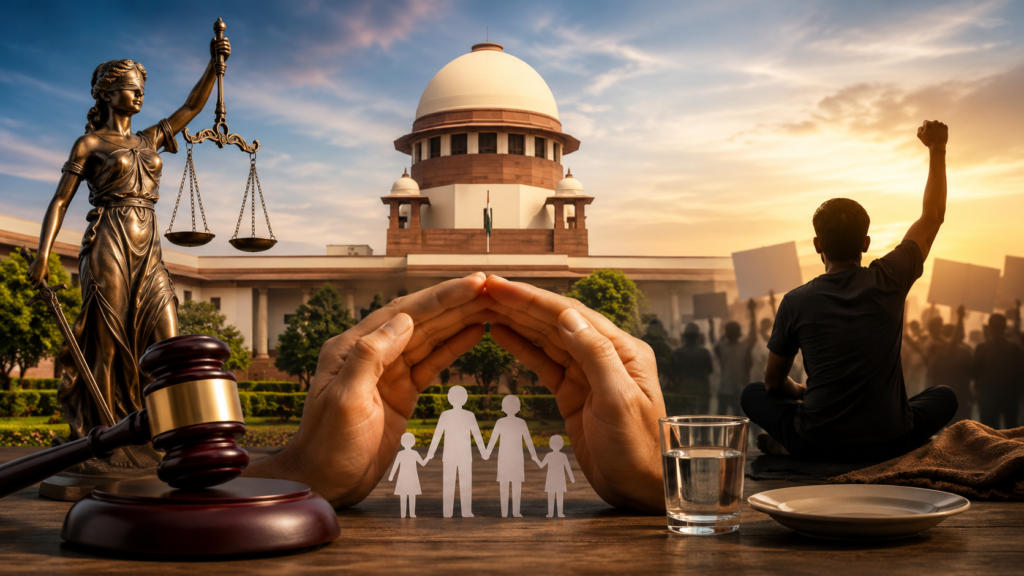
This debate involves the balance between the Right to Protest and the Right to Life under the Constitution.
Who is Sonam Wangchuk?
Sonam Wangchuk is an Indian engineer, innovator, education reformer, and environmental activist from Ladakh.
He is widely known for:
- Founding the Students’ Educational and Cultural Movement of Ladakh (SECMOL).
- Promoting innovative educational reforms in Ladakh.
- Developing the Ice Stupa technology for water conservation.
- Advocating for sustainable development and environmental protection in the Himalayan region.
Recently, he has been leading protests demanding stronger constitutional safeguards and environmental protection for Ladakh.
What is an Indefinite Hunger Strike?
A hunger strike is a peaceful form of protest in which a person voluntarily refuses to eat food to draw attention to a cause or demand.
An indefinite hunger strike means the person does not specify an end date and continues fasting until the demands are accepted or the protest is voluntarily withdrawn.
Unlike violent demonstrations, a hunger strike relies on moral pressure and self-sacrifice rather than physical force.
Throughout history, hunger strikes have been used to highlight issues of public importance and influence government policy.
Is a Hunger Strike Illegal in India?
No.
There is no law in India that generally prohibits a peaceful hunger strike.
Citizens enjoy the right to express dissent and protest peacefully under the Constitution.
However, this right is not absolute.
The State can regulate protests to ensure:
- Public order
- Public safety
- Smooth movement of traffic
- Protection of the rights of other citizens
Therefore, while a peaceful hunger strike is legal, authorities may impose reasonable restrictions on its time, place, and manner.
Constitutional Basis of the Right to Protest
The Constitution does not explicitly mention the “Right to Protest.”
However, it is derived from several Fundamental Rights under Article 19, including:
- Freedom of Speech and Expression
- Right to Assemble Peacefully
- Right to Form Associations
These rights allow citizens to express disagreement with government policies through peaceful and democratic means.
The Supreme Court has repeatedly recognized that peaceful protest is an essential feature of a democratic society.
However, these freedoms are subject to reasonable restrictions in the interest of:
- Sovereignty and integrity of India
- Public order
- Security of the State
- Decency and morality
Article 21 and the Right to Life
The central constitutional provision involved in this issue is Article 21.
Article 21 states:
“No person shall be deprived of his life or personal liberty except according to procedure established by law.”
Over the years, the Supreme Court has interpreted Article 21 very broadly.
It now includes several rights such as:
- Right to live with dignity
- Right to health
- Right to medical care
- Right to a clean environment
- Right to privacy
- Right to legal aid
- Right to shelter
- Right to livelihood
The Court has consistently held that the State has a positive obligation to protect the life of every individual.
Why Does the State Have a Duty to Preserve Life?
The Constitution not only protects individual rights but also imposes responsibilities upon the State.
Whenever the life of a person is in serious danger, the government cannot simply remain a passive observer.
The Supreme Court has repeatedly observed that the protection of human life is one of the highest constitutional responsibilities of the State.
Therefore, if an individual undertaking an indefinite hunger strike reaches a critical medical condition, authorities are expected to:
- Monitor the person’s health.
- Provide timely medical assistance.
- Take appropriate steps to prevent avoidable loss of life.
The objective is not to suppress the protest but to fulfil the constitutional obligation of protecting life.
Supreme Court’s View on Hunger Strikes
Several judicial decisions have clarified that hunger strikes are neither unconstitutional nor expressly prohibited under Indian law.
At the same time, the Supreme Court has consistently emphasized that the State cannot ignore a situation where a person’s life is at imminent risk.
The judiciary has recognized two important constitutional principles:
- Citizens have the democratic right to protest peacefully.
- The State has a constitutional duty to preserve human life.
The challenge lies in maintaining a balance between these two principles.
Balancing the Right to Protest and the Right to Life
The present issue highlights a delicate constitutional balance.
On one hand, citizens have the freedom to peacefully express dissent and demand accountability from the government.
On the other hand, the State cannot permit a situation where a citizen loses life when preventive medical intervention is possible.
The constitutional approach adopted by Indian courts seeks to preserve both:
- Democratic freedoms.
- Human life and dignity.
Rather than treating these rights as conflicting, courts have attempted to harmonize them.
Important Hunger Strikes in Indian History
India has witnessed several significant hunger strikes that shaped public policy and constitutional debates.
Mahatma Gandhi
Gandhi frequently used fasting as a tool of non-violent resistance against British rule and to promote communal harmony.
Potti Sriramulu
His prolonged hunger strike demanding a separate Telugu-speaking state ultimately led to the creation of Andhra State in 1953 and influenced the linguistic reorganization of states.
Irom Sharmila
Known as the “Iron Lady of Manipur,” she carried out one of the world’s longest hunger strikes demanding the repeal of the Armed Forces (Special Powers) Act (AFSPA).
She was medically sustained through force-feeding under judicial supervision.
Anna Hazare
Anna Hazare’s anti-corruption movement used hunger strikes to demand the establishment of a stronger Lokpal institution.
Sonam Wangchuk
His ongoing hunger strike has revived constitutional discussions regarding the extent of the State’s responsibility in protecting the life of peaceful protesters.
Constitutional Significance
The present issue is important because it touches upon several constitutional principles simultaneously.
These include:
- Article 19 – Freedom of Speech and Peaceful Assembly.
- Article 21 – Right to Life and Personal Liberty.
- Rule of Law.
- Democratic Accountability.
- Human Dignity.
- State Responsibility.
- Peaceful Civil Resistance.
The debate also illustrates how courts balance individual autonomy with constitutional obligations.
Why is this Issue Important?
This issue has implications beyond a single protest.
It raises broader questions such as:
- Should the government intervene when a citizen voluntarily refuses food?
- Can the State allow a person to fast until death?
- How should democratic governments balance civil liberties with the protection of life?
- What are the limits of peaceful protest in a constitutional democracy?
These questions are likely to remain relevant in future constitutional and governance debates.
UPSC & HPPSC Examination Relevance
UPSC Prelims
Important topics for revision:
- Article 19
- Article 21
- Fundamental Rights
- Right to Protest
- Right to Life
- Supreme Court
- Hunger Strike
- Public Order
- Reasonable Restrictions
UPSC Mains (GS Paper II)
Topics Covered
- Fundamental Rights
- Constitutional Morality
- Democratic Rights
- Judicial Interpretation
- Rule of Law
- Human Rights
- State Responsibility
- Civil Society
- Governance
- Peaceful Protest
Conclusion
The Supreme Court’s observations regarding indefinite hunger strikes reinforce an important constitutional principle: the protection of human life remains one of the foremost responsibilities of the State.
While peaceful protest is an essential democratic right protected under the Constitution, it cannot be viewed in isolation from the equally important constitutional guarantee of the Right to Life under Article 21.
The challenge before the State is not to choose between liberty and life but to protect both simultaneously. A mature constitutional democracy must safeguard the citizens’ right to dissent while ensuring that no life is lost due to avoidable circumstances. The ongoing debate surrounding Sonam Wangchuk’s hunger strike once again highlights the judiciary’s role in maintaining this delicate constitutional balance.
UPSC GS Paper Mapping
- GS Paper II: Constitution, Fundamental Rights, Judiciary, Governance, Civil Society, Democratic Rights
- GS Paper IV: Ethics in Public Administration, Human Dignity, Constitutional Values
- Current Affairs Theme: Right to Protest, Article 21, Judicial Review, State Responsibility