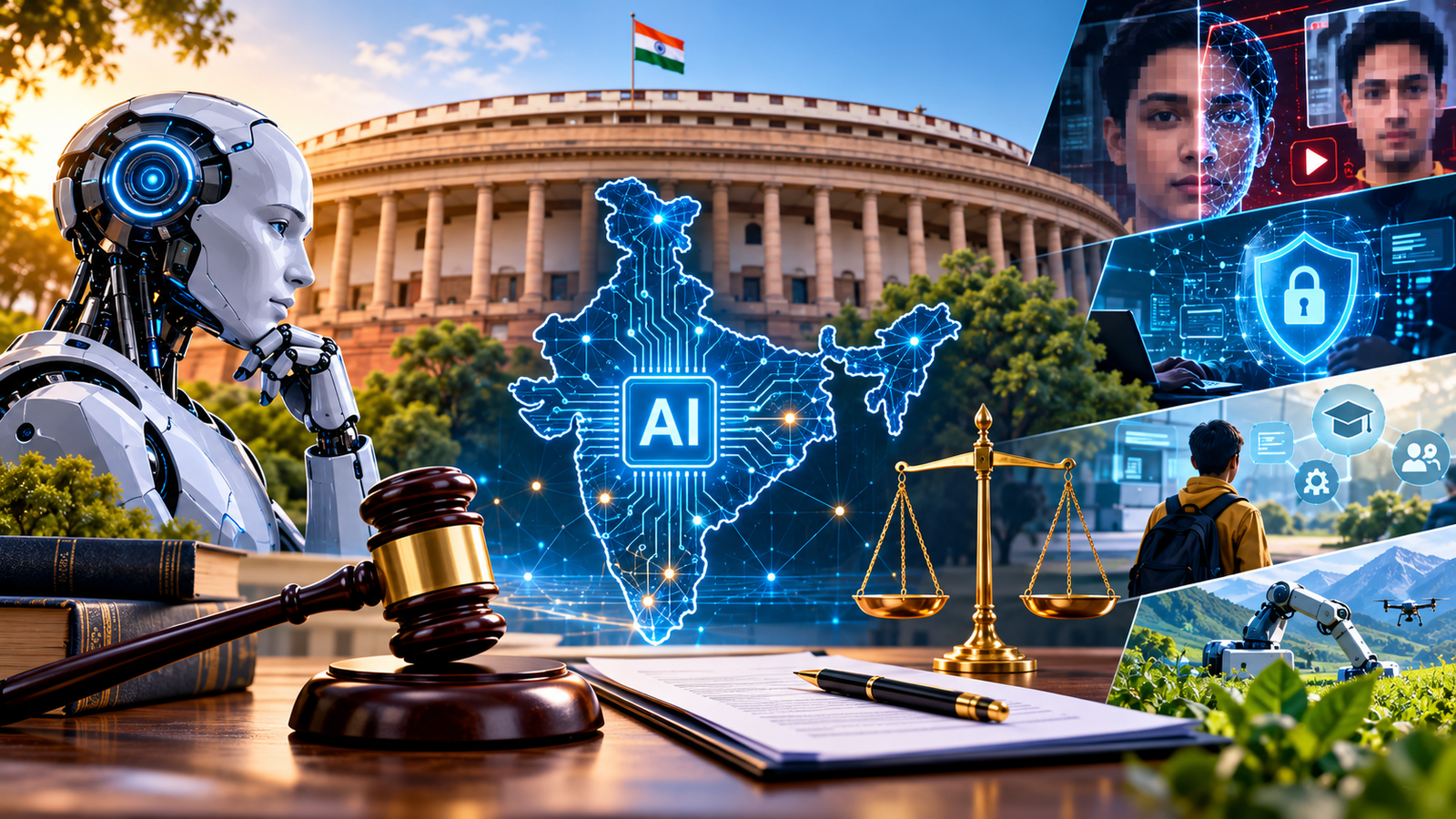
India AI Regulation 2026: New AI Rules, Deepfakes, AI Safety and Government Framework Explained
Why in News?
The Government of India is preparing a new regulatory framework for Artificial Intelligence (AI).
On 8 October 2026, Union Electronics and Information Technology Minister Ashwini Vaishnaw said that the government will release a consultation paper on AI regulation within a month.
The proposed consultation will focus on:
- AI safety
- Deepfakes and synthetic content
- Cybersecurity
- AI-related harms
- Human-centric AI
- Industry responsibility
- Skilling
- Inclusive access to AI
- Risks associated with increasingly autonomous AI systems
The government has also indicated that India will follow a techno-legal approach, combining legal rules with technological safeguards rather than relying only on legislation.
This development is important because AI is rapidly expanding into areas such as healthcare, education, finance, agriculture, governance, media and employment.
For UPSC aspirants, the issue connects GS Paper II, GS Paper III, governance, fundamental rights, privacy, cybersecurity, technology, employment and ethical use of AI.
What Is AI Regulation?
AI regulation refers to laws, rules, standards and institutional mechanisms designed to ensure that Artificial Intelligence is developed and used safely, fairly and responsibly.
Simple meaning
AI regulation tries to answer questions such as:
- What should AI systems be allowed to do?
- Who is responsible when an AI system causes harm?
- How should deepfakes be controlled?
- How should personal data be protected?
- Should high-risk AI systems require additional safeguards?
- How much autonomy should an AI system have?
- How can innovation continue without compromising public safety?
The challenge is to find a balance between:
AI Innovation + Economic Growth
and
Safety + Rights + Accountability
What Has India Done So Far?
India’s AI regulatory approach has been evolving gradually rather than through one comprehensive AI law.
The government has been developing a principle-based and risk-based governance framework, while using existing laws and targeted interventions.
Important developments include:
IndiaAI Mission
The IndiaAI Mission is India’s broader national programme to build an AI ecosystem covering areas such as computing infrastructure, datasets, skills, innovation and safe and trusted AI.
India AI Governance Guidelines
India released its India AI Governance Guidelines in 2025, followed by further institutional and policy developments.
The framework promotes:
- Safe AI
- Responsible AI
- Inclusive AI
- Human-centric AI
- Innovation
- Accountability
- Risk management
The guidelines favour an approach that can adapt as AI technology evolves.
AI Governance and Economic Group
In April 2026, the government constituted the AI Governance and Economic Group (AIGEG).
It is a high-level inter-ministerial mechanism intended to coordinate India’s national AI governance strategy.
AI Safety Institute
India is also developing an AI Safety Institute to strengthen research, testing, standards and evaluation related to AI safety.
These developments show that India’s AI governance system is gradually moving from broad principles towards stronger institutional mechanisms.
What Has Changed in October 2026?
The latest announcement is significant because the government has now indicated that a new consultation process specifically focused on AI regulation will begin.
The consultation paper is expected to seek views from stakeholders before the government moves towards the next stage of regulation.
This means:
Consultation Paper
↓
Stakeholder Feedback
↓
Assessment of Risks and Regulatory Gaps
↓
Possible Regulatory Measures
The exact final form of the regulatory framework is therefore not yet settled.
This distinction is important.
India has not yet enacted a comprehensive horizontal AI law merely because the consultation paper has been announced.
Why Does AI Need Regulation?
AI provides major benefits, but increasingly powerful AI systems can also create new risks.
Deepfakes
A deepfake is synthetic or manipulated audio, video or image content generated or altered using AI.
For example, AI can be used to make it appear that a person:
- said something they never said,
- performed an action they never performed,
- appeared at a place where they were never present.
The problem becomes more serious as synthetic media becomes increasingly realistic.
Deepfakes can affect:
- elections and democratic processes,
- reputation,
- public trust,
- financial security,
- social harmony,
- personal privacy.
AI and Misinformation
Generative AI can produce text, images, audio and videos at very large scale.
This can make the production and distribution of false information much easier.
The challenge is therefore shifting from:
Can false content be created?
to:
Can society identify and respond to large-scale synthetic content quickly enough?
This creates a major governance challenge.
AI and Cybersecurity
AI can be used for both:
Cyber defence
and
Cyber attacks
Attackers can potentially use AI to automate phishing, social engineering, vulnerability discovery and other malicious activities.
At the same time, cybersecurity agencies can use AI for:
- threat detection,
- anomaly detection,
- malware analysis,
- incident response,
- fraud detection.
Therefore, AI governance must consider both the risks and the defensive benefits of AI.
What Is AI Safety?
AI safety refers to efforts to ensure that AI systems operate reliably and do not cause unacceptable harm to people or society.
AI safety can involve:
- testing,
- monitoring,
- risk assessment,
- human oversight,
- transparency,
- security,
- incident reporting,
- safeguards against harmful outputs.
As AI systems become more capable and autonomous, safety becomes increasingly important.
What Is Agentic AI?
One emerging concern is agentic AI.
Simple Definition
Agentic AI refers to AI systems capable of independently planning and executing multiple steps to achieve a given goal, often using external tools with limited human supervision.
A conventional chatbot may answer:
“Here is how you can complete a task.”
An agentic AI system could potentially:
Understand goal → Plan → Use tools → Take actions → Evaluate result → Adjust strategy
This creates a new regulatory question:
How much autonomy should an AI system be allowed to have?
For example:
- Should an AI agent be allowed to make financial transactions?
- Should it be allowed to send messages automatically?
- Should it be allowed to access sensitive databases?
- Should it be allowed to make high-impact decisions?
- Who is responsible if it causes harm?
These questions are becoming increasingly important for AI governance.
The Question of AI Liability
One of the most difficult regulatory questions is:
Who should be responsible when an AI system causes harm?
Consider a situation where an AI system generates:
- defamatory content,
- harmful medical advice,
- fraudulent information,
- discriminatory decisions,
- manipulated media.
Possible stakeholders include:
- AI developer,
- model provider,
- application developer,
- deploying company,
- platform,
- user.
Determining responsibility becomes difficult because modern AI systems can involve several layers of technology.
This is why AI liability is expected to be an important part of future regulatory discussions.
AI and Safe Harbour
Another important issue is the concept of safe harbour.
Simple Definition
Safe harbour refers to legal protection provided to certain online intermediaries from liability for user-generated content, subject to specified conditions.
Traditional social media platforms generally host content created by users.
AI systems are different in an important way.
A generative AI system may itself produce an answer or piece of content in response to a user’s prompt.
This creates a difficult question:
Should AI providers receive the same liability protections as conventional online intermediaries?
The answer has significant implications for innovation, accountability and consumer protection.
Techno-Legal Approach
One of the most important keywords in India’s AI governance debate is:
Techno-Legal Regulation
Meaning
A techno-legal approach combines legal rules with technological mechanisms to manage risks.
Instead of depending only on legislation, regulators can also use technology itself to improve compliance and safety.
Examples include:
- AI-generated content detection,
- watermarking,
- content authentication,
- privacy-enhancing technologies,
- algorithmic auditing,
- automated bias detection,
- model testing,
- risk assessment tools.
Therefore:
Law + Technology + Standards + Institutional Oversight
can together form a techno-legal governance system.
Why Not Regulate AI Through Law Alone?
AI changes very quickly.
A law written for a specific technology may become outdated as new AI capabilities emerge.
For example:
Generative AI
↓
Multimodal AI
↓
Agentic AI
↓
More autonomous systems
The technology can evolve faster than traditional legislative processes.
Therefore, India is considering an approach that combines:
- principle-based regulation,
- technology standards,
- regulatory sandboxes,
- existing laws,
- sectoral regulation,
- institutional oversight,
- continuous review.
This can make regulation more adaptable.
Risk-Based AI Regulation
Another important concept is risk-based regulation.
Not every AI system creates the same level of risk.
For example:
Low-risk AI
An AI system that recommends study material may have relatively limited consequences.
Medium-risk AI
An AI system used for certain commercial or administrative decisions may require additional safeguards.
High-risk AI
AI used in areas such as:
- healthcare,
- critical infrastructure,
- financial decisions,
- law enforcement,
- employment,
- essential public services
can have significant consequences for individuals.
Therefore, a risk-based framework may impose stronger safeguards on high-risk applications.
AI and Fundamental Rights
AI regulation is not only a technology issue.
It is also a constitutional and governance issue.
AI can affect several rights and democratic values.
Right to Privacy
AI systems often require large amounts of data.
This raises questions about:
- consent,
- data collection,
- data minimisation,
- purpose limitation,
- data security.
Equality and Non-Discrimination
AI systems trained on biased data can reproduce or amplify existing social biases.
For example, an algorithm used for recruitment or lending may produce discriminatory outcomes.
Therefore:
Algorithmic fairness becomes important.
Freedom of Speech
Deepfakes and misinformation create a difficult balance.
Excessive regulation can affect legitimate expression, while inadequate safeguards can allow harmful manipulation.
Right to Life and Personal Liberty
High-impact automated decisions can potentially affect individuals in serious ways.
Therefore, human oversight may be essential in sensitive applications.
AI and the Digital Personal Data Protection Framework
AI and data protection are closely connected.
AI systems often require large datasets for:
- training,
- testing,
- fine-tuning,
- inference.
India’s Digital Personal Data Protection Act, 2023 provides a framework for processing digital personal data.
Important concepts include:
- consent,
- purpose limitation,
- data minimisation,
- rights of individuals,
- obligations of data fiduciaries,
- protection of personal data.
Therefore, AI governance and data protection cannot be treated as completely separate policy areas.
AI and Copyright
Generative AI has also created major copyright questions.
AI models can be trained using large amounts of existing content.
This raises questions such as:
- Can copyrighted material be used to train AI models?
- Should creators receive compensation?
- Who owns AI-generated content?
- How should copyrighted works be protected?
- Can AI outputs reproduce protected material?
India will need to balance:
Innovation
with
Creators’ Rights
and
Intellectual Property Protection.
AI and Employment
AI can increase productivity but may also change the nature of employment.
Potential effects include:
Job displacement
Some repetitive tasks may increasingly be automated.
Job transformation
Existing jobs may remain but require new skills.
New employment
AI can also create new roles in:
- AI engineering,
- data science,
- cybersecurity,
- AI auditing,
- AI safety,
- prompt and workflow design,
- AI governance.
Therefore, AI policy cannot focus only on regulation.
It must also include:
Skilling + Reskilling + Upskilling
The government’s latest consultation approach specifically highlights skilling and the need to ensure that sections of society are not left behind.
Human-First AI
A major principle emerging from India’s approach is human-centric or human-first AI.
Meaning
Human-first AI means that technological development should ultimately serve human welfare, dignity, safety and inclusion.
The basic principle is:
Technology should serve people, not replace human responsibility in critical decisions.
This becomes particularly important when AI is used in:
- healthcare,
- education,
- justice,
- welfare delivery,
- employment,
- finance,
- public administration.
Industry Responsibility
The latest government announcement places significant responsibility on the technology industry.
This means AI developers and companies may increasingly be expected to:
- identify risks,
- conduct testing,
- improve cybersecurity,
- prevent harmful uses,
- provide safeguards,
- address deepfakes,
- protect users,
- report incidents,
- maintain responsible development practices.
This reflects the principle of shared responsibility.
Government cannot regulate every technical decision alone.
AI developers, platforms, researchers and users all have roles to play.
Regulatory Sandboxes
A regulatory sandbox is a controlled environment where innovative technologies can be tested under regulatory supervision.
Why are sandboxes useful for AI?
They allow regulators to understand:
- how a technology works,
- what risks it creates,
- what safeguards are effective,
- whether existing regulations are sufficient.
This is particularly useful for rapidly evolving technologies.
Instead of immediately imposing rigid rules, regulators can first gather evidence through controlled experimentation.
India’s AI Governance Architecture
India’s emerging AI governance ecosystem can be understood through several components:
IndiaAI Mission
→ AI infrastructure, innovation, skills and safe AI
AI Governance Guidelines
→ Principles and governance framework
AIGEG
→ Inter-ministerial coordination
Technology and Policy Expert Committee
→ Technical and policy expertise
AI Safety Institute
→ Safety research, testing and standards
Sectoral Regulators
→ Sector-specific implementation
Existing Laws
→ Data protection, IT, consumer protection and other applicable legal frameworks
This creates a multi-layered governance model rather than relying on a single regulator.
India vs the European Union: Different Regulatory Approaches
The European Union AI Act follows a relatively detailed, risk-based regulatory approach.
It categorises AI applications according to risk and imposes different obligations.
India’s approach has so far been more:
- principle-based,
- flexible,
- innovation-oriented,
- techno-legal,
- dependent on existing laws and sectoral regulation.
The comparison is important for UPSC because it demonstrates that countries are experimenting with different models of AI governance.
India’s challenge is to create safeguards without unnecessarily restricting technological innovation.
India’s AI Regulation Challenge
India faces several competing objectives.
Innovation vs Regulation
Too little regulation can increase risks.
Too much rigid regulation can increase compliance costs and potentially slow innovation.
Safety vs Openness
AI systems need testing and safeguards, but excessive restrictions may reduce access to technology.
Privacy vs Data for AI
AI requires data, while citizens need strong protection of personal information.
Free Speech vs Deepfake Control
Governments need to address harmful synthetic media without unnecessarily restricting legitimate expression.
Automation vs Employment
AI can increase productivity but also disrupt existing jobs.
National Security vs Open Innovation
AI has applications in both civilian and strategic domains.
Way Forward for India
India’s AI governance framework should focus on the following areas.
Risk-Based Regulation
Rules should be proportional to the potential harm created by an AI application.
Strong AI Testing
High-risk AI systems should undergo rigorous testing before deployment.
Transparency
Users should know when they are interacting with AI or consuming AI-generated content where appropriate.
Human Oversight
Critical decisions should retain meaningful human supervision.
Deepfake Detection
India should strengthen indigenous tools for detecting synthetic media.
Algorithmic Auditing
High-impact AI systems should be assessed for:
- bias,
- fairness,
- security,
- reliability,
- explainability.
Data Protection
AI development should comply with India’s data protection framework.
Skilling
India needs large-scale AI literacy, reskilling and technical training.
Industry Accountability
Companies should take responsibility for foreseeable risks associated with their systems.
Regulatory Sandboxes
New AI technologies should be tested in controlled environments before large-scale deployment.
International Cooperation
AI is a global technology.
India needs cooperation on:
- AI safety,
- standards,
- cybersecurity,
- cross-border data issues,
- deepfakes,
- intellectual property,
- responsible AI.
AI Regulation and UPSC Syllabus
UPSC GS Paper II
Relevant themes include:
- Government policies and interventions
- Governance
- E-governance
- Fundamental Rights
- Right to Privacy
- Institutional mechanisms
- Regulation
- Accountability
UPSC GS Paper III
Relevant themes include:
- Science and Technology
- Artificial Intelligence
- Cybersecurity
- Information technology
- Technological development
- Intellectual Property Rights
- Economic impact of technology
Ethics Paper
AI regulation can also be connected with:
- ethics in technology,
- accountability,
- transparency,
- fairness,
- human dignity,
- responsible innovation.
HPPSC Relevance
For HPPSC/HPAS, AI regulation can be connected with:
- e-governance in Himachal Pradesh,
- digital public services,
- cybersecurity,
- education technology,
- healthcare technology,
- disaster management,
- tourism technology,
- agricultural technology,
- responsible use of AI in administration.
For Himachal Pradesh, AI can potentially support:
- weather forecasting,
- landslide and disaster-risk assessment,
- agriculture and horticulture,
- tourism management,
- traffic management,
- healthcare delivery in remote areas,
- education in geographically difficult regions.
Therefore, AI governance is relevant not only at the Union level but also for state-level governance and public administration.
Important Keywords for UPSC
Artificial Intelligence
Technology that enables machines or computer systems to perform tasks associated with human intelligence.
Generative AI
AI capable of generating new content such as text, images, audio, video or code.
Deepfake
AI-generated or AI-manipulated media designed to realistically imitate people, events or voices.
Agentic AI
AI capable of planning and executing multiple actions to achieve a goal with limited human supervision.
AI Safety
Measures designed to prevent AI systems from causing unacceptable harm.
Algorithmic Bias
Systematic and unfair outcomes produced by an algorithm because of biased data, design or implementation.
Algorithmic Auditing
Systematic examination of an algorithm to assess issues such as fairness, accuracy, security and compliance.
AI Liability
Determining who is legally responsible when an AI system causes harm.
Techno-Legal Approach
Combining legal regulation with technological safeguards.
Regulatory Sandbox
Controlled environment where innovative technologies can be tested under regulatory supervision.
Human-Centric AI
AI development and deployment focused on human welfare, dignity, safety and rights.
Prelims Quick Revision
| Topic | Key Point |
|---|---|
| AI Regulation | Rules and mechanisms governing safe and responsible AI |
| Deepfake | AI-generated/manipulated synthetic media |
| Agentic AI | AI capable of autonomous multi-step action |
| AI Safety | Prevention and mitigation of AI-related harms |
| Techno-Legal Approach | Technology + law |
| Regulatory Sandbox | Controlled testing environment |
| Algorithmic Bias | Unfair systematic algorithmic outcome |
| AI Liability | Responsibility for AI-caused harm |
| AIGEG | Inter-ministerial AI governance mechanism |
| AI Safety Institute | Focus on AI safety research, testing and standards |
| DPDP Act | Framework for digital personal data protection |
Prelims MCQ
Consider the following statements regarding India’s AI governance approach:
- India has already enacted a comprehensive standalone law regulating all forms of Artificial Intelligence.
- India’s emerging AI governance framework includes a techno-legal approach.
- Regulatory sandboxes can be used to test emerging AI technologies in controlled environments.
- AI regulation is relevant only to the Science and Technology domain and has no connection with fundamental rights.
Which of the statements given above are correct?
A. 2 and 3 only
B. 1 and 4 only
C. 1, 2 and 3 only
D. 2, 3 and 4 only
Answer: A
Explanation:
Statement 1 is incorrect because India is currently developing its regulatory framework and has announced a consultation process; it has not enacted a comprehensive standalone law covering all AI systems.
Statement 2 is correct.
Statement 3 is correct.
Statement 4 is incorrect because AI can affect privacy, equality, freedom of expression, dignity and other rights.
Mains Question
“Artificial Intelligence presents a governance dilemma between technological innovation and protection of individual rights. Discuss India’s emerging approach to AI regulation.”
Answer Framework
Introduction
Define AI and explain its growing importance in governance, economy and society.
Body
Discuss:
- Benefits of AI
- Deepfakes and misinformation
- Privacy concerns
- Algorithmic bias
- Cybersecurity
- AI liability
- Agentic AI
- Employment disruption
- India’s AI Governance Guidelines
- AIGEG
- AI Safety Institute
- Techno-legal approach
- Regulatory sandboxes
- Industry responsibility
Way Forward
- Risk-based regulation
- Human oversight
- Strong testing and auditing
- Data protection
- Deepfake detection
- AI literacy
- Skilling
- Industry accountability
- International cooperation
Conclusion
India should pursue a flexible and risk-based AI governance framework that protects citizens while preserving the country’s ability to innovate and benefit from AI.
One-Page Revision Notes
India AI Regulation 2026
Latest development
→ Consultation paper expected within a month
Main focus
→ AI safety
→ Deepfakes
→ Cybersecurity
→ AI harms
→ Human-first approach
→ Skilling
→ Inclusion
→ Industry responsibility
Major concerns
→ Privacy
→ Bias
→ Misinformation
→ Deepfakes
→ Cybersecurity
→ Liability
→ Autonomous AI
→ Employment
India’s approach
→ Principle-based
→ Risk-based
→ Techno-legal
→ Innovation-oriented
→ Human-centric
Institutions
→ MeitY
→ IndiaAI Mission
→ AIGEG
→ Technology and Policy Expert Committee
→ AI Safety Institute
→ Sectoral regulators
Important laws/frameworks
→ Digital Personal Data Protection Act, 2023
→ IT-related legal framework
→ Consumer protection framework
→ India AI Governance Guidelines
Key concepts
→ AI Safety
→ Agentic AI
→ Deepfake
→ Algorithmic Bias
→ AI Liability
→ Regulatory Sandbox
→ Algorithmic Auditing
→ Techno-Legal Regulation
UPSC
→ GS II: Governance, Fundamental Rights, Privacy
→ GS III: Science & Technology, AI, Cybersecurity
→ Ethics: Accountability, transparency, fairness and human dignity
Conclusion
Artificial Intelligence is moving from being a purely technological subject to becoming a major governance, economic and constitutional issue.
India’s latest decision to initiate a consultation process on AI regulation marks an important stage in this evolution. The focus on AI safety, deepfakes, cybersecurity, human welfare, skilling and industry responsibility reflects the growing need to manage both the opportunities and risks of AI.
The key challenge for India will be to create a framework that is neither innovation-blind nor regulation-heavy.
A successful approach will need to combine:
Innovation + Safety + Accountability + Privacy + Inclusion + Human Oversight
For UPSC aspirants, AI regulation is therefore an important interdisciplinary topic connecting Science & Technology, Governance, Fundamental Rights, Cybersecurity, Economy, Employment and Ethics.