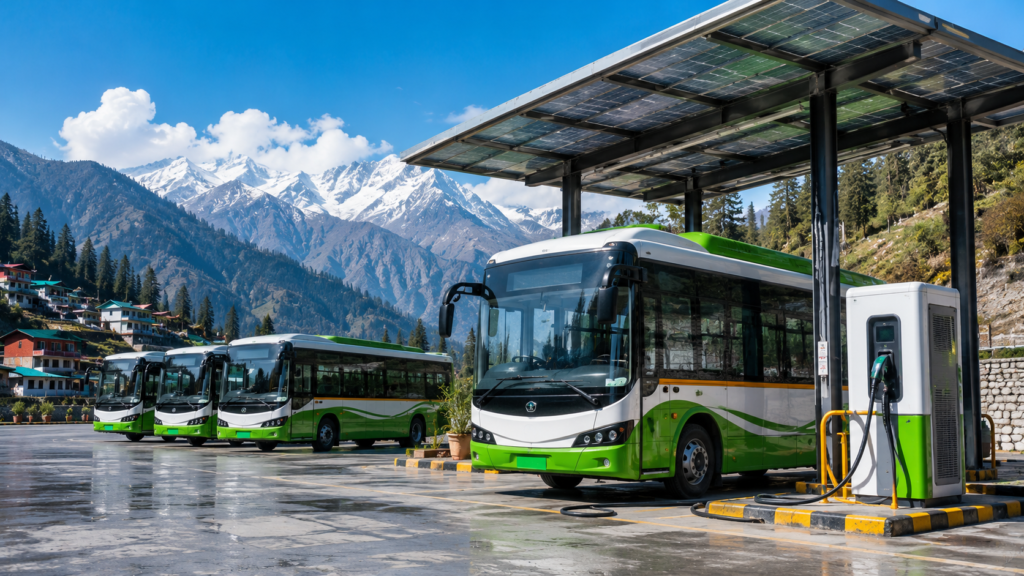
Himachal Pradesh Expands E-Bus Charging Infrastructure to 80 Locations: A Major Push for Green Public Transport
Why is it in News?
Himachal Pradesh is rapidly expanding its electric-bus charging infrastructure, with the Himachal Road Transport Corporation (HRTC) establishing charging stations at 80 locations across the State at an estimated cost of ₹122 crore.
The initiative is intended to support the growing deployment of electric buses and create a reliable charging network across both major towns and smaller locations. According to the latest review by Deputy Chief Minister Mukesh Agnihotri, charging stations have already been installed at 34 locations, work at another 21 locations is expected to be completed within a month, while the remaining 25 locations are under implementation.
The development is significant for Himachal Pradesh because its difficult mountainous terrain, long-distance bus routes and dependence on road transport make clean, reliable and economically efficient public transportation particularly important.
Himachal Pradesh’s E-Bus Transition
Himachal Pradesh has been increasingly focusing on electric mobility as part of its broader strategy for clean and sustainable transportation.
The State Budget 2026-27 identified clean, green and modern public transport as a government priority. The budget also provided for the procurement of 297 electric buses and initiated the process of developing charging stations at 80 locations across the State. It further stated that 1,000 Type-II electric buses would be purchased in a phased manner.
The latest charging infrastructure expansion therefore represents an important step in creating the physical infrastructure required for this transition.
Key Features of the Charging Infrastructure
The project has several important components.
1. Charging Stations at 80 Locations
HRTC is establishing charging facilities at 80 locations across Himachal Pradesh.
These are being developed primarily at:
- HRTC bus stands
- HRTC workshops
- Other strategically important operational locations
The objective is to ensure that electric buses can operate efficiently across different routes without being constrained by inadequate charging facilities.
2. 99 Charging Points
Across the 80 locations, a total of 99 charging points are being established.
The network is therefore not restricted to a single charging facility at each location; certain locations will have multiple charging points depending on operational requirements.
3. Fast CCS-2 Chargers
The charging network will use 180-kilowatt fast CCS-2 chargers.
CCS-2 (Combined Charging System Type 2) is a widely used fast-charging standard for electric vehicles, particularly in India.
The deployment of high-capacity chargers is important for public buses because buses have:
- Large battery packs
- High daily utilisation
- Fixed schedules
- Limited time available for charging
Therefore, faster charging can reduce vehicle downtime and improve fleet utilisation.
Current Status of the Project
The charging infrastructure is being implemented in phases.
| Status | Locations |
|---|---|
| Charging stations already installed | 34 |
| Expected to be completed within one month | 21 |
| Work underway at remaining locations | 25 |
| Total | 80 |
The project therefore represents a statewide rather than purely urban intervention.
Recent government tender documents also show charging-infrastructure works being taken up at locations such as Chowari, Bhanjraru, Santoshgarh, Shahpur, Janjehli, Sandhol, Patlikhul, Keylong, Baroh and Sansarpur Terrace, besides workshops at Chamba and Dehra. This demonstrates the effort to extend the charging network beyond the major urban centres.
Why Charging Infrastructure Matters for Electric Buses
Introducing electric buses without adequate charging infrastructure can create a major operational bottleneck.
The transition requires an integrated system:
Electric buses → Charging stations → Reliable electricity supply → Route planning → Fleet management → Maintenance infrastructure
Therefore, charging infrastructure is not merely an accessory to e-mobility; it is the backbone of an electric public-transport system.
For Himachal Pradesh, this is particularly important because buses frequently operate across mountainous terrain where:
- Routes are longer and winding
- Elevation changes significantly
- Weather conditions can be difficult
- Charging opportunities may be limited
- Recovery and replacement of vehicles can be challenging
A distributed charging network can therefore make electric buses more operationally viable.
Economic Benefits for HRTC
Electric buses can provide significant savings in operating costs because they eliminate conventional diesel consumption.
According to the latest review, HRTC’s electric buses are helping the corporation save approximately ₹15–16 per kilometre in diesel expenditure.
For a bus travelling thousands of kilometres every month, such savings can become substantial.
The economic logic is:
Higher upfront investment
↓
Lower fuel and operating expenditure
↓
Reduced dependence on diesel
↓
Lower long-term operating costs
Thus, electrification can potentially improve the financial sustainability of public transport over the long term.
Electric Buses and Long-Distance Himalayan Routes
One of the important aspects of Himachal’s e-bus transition is the increasing use of electric buses on longer routes.
An electric bus generally has a range of around 180 km on a single charge, according to the latest state-level review. However, some buses have demonstrated longer operational capability under favourable conditions. For example, an electric bus has reportedly covered the approximately 270-km Haroli–Chandigarh route on a single charge.
Similarly, on the approximately 250-km Shimla–Chandigarh–Shimla route, an electric bus has reportedly completed the journey with around 25% battery charge remaining.
This is significant because it demonstrates that electric buses are not necessarily limited to short urban routes.
Environmental Significance
Transportation is an important source of greenhouse-gas emissions and urban air pollution.
Replacing diesel buses with electric buses can help reduce:
- Direct tailpipe emissions
- Carbon emissions associated with diesel consumption
- Local air pollution
- Noise pollution
For a State such as Himachal Pradesh, where tourism and ecological sustainability are closely interconnected, cleaner public transportation can contribute to a more sustainable development model.
Electric mobility can support:
Cleaner transport
→ Lower local pollution
→ Reduced fossil-fuel dependence
→ Lower transport-sector carbon footprint
→ Greener tourism and urban mobility
However, the overall climate benefit also depends on the source of electricity used for charging. Greater integration of renewable electricity can further improve the environmental performance of electric buses.
Importance for Himachal Pradesh
The initiative has significance beyond merely replacing diesel buses.
1. Sustainable Mountain Transport
Himachal’s geography makes road transportation indispensable. Electrification can make this essential transport system more environmentally sustainable.
2. Reduced Fossil-Fuel Dependence
Electric buses reduce direct dependence on diesel, improving energy security and reducing exposure to fluctuations in fossil-fuel prices.
3. Lower Operational Costs
Reduced fuel expenditure can help HRTC manage its operating costs.
4. Cleaner Tourist Destinations
Many of Himachal’s major towns and tourist destinations face pressure from increasing vehicular traffic. Cleaner buses can help reduce pollution in such areas.
5. Modernisation of HRTC
The charging infrastructure is part of a broader effort to modernise HRTC’s fleet, depots and operational systems.
Challenges Ahead
Despite the advantages, Himachal Pradesh’s transition to electric buses faces several challenges.
1. High Initial Capital Cost
Electric buses and charging infrastructure require substantial upfront investment.
Although operating costs can be lower, governments and transport corporations must manage the initial financial burden.
2. Grid Infrastructure
Large-scale charging stations can place substantial demand on the electricity network.
Therefore, expansion of e-bus fleets must be accompanied by:
- Adequate transformer capacity
- Grid upgrades
- Reliable electricity supply
- Smart charging systems
- Load management
3. Mountainous Terrain
Electric buses operating on steep gradients can consume more energy than those operating on relatively flat terrain.
Therefore, route planning should consider:
- Elevation gain
- Road gradient
- Weather
- Passenger load
- Battery state of charge
4. Battery Performance in Cold Conditions
High-altitude areas of Himachal Pradesh experience very low temperatures.
Extreme cold can affect:
- Battery efficiency
- Charging speed
- Driving range
- Battery life
Consequently, specialised thermal-management systems and appropriate operational planning may be required in high-altitude regions.
5. Charging Time and Fleet Scheduling
Even fast charging requires operational planning.
Charging schedules must be coordinated with:
- Bus arrival and departure times
- Route lengths
- Peak passenger demand
- Battery state
- Charger availability
Poor scheduling could result in buses spending excessive time at depots.
Need for a Statewide E-Mobility Strategy
The creation of 80 charging locations is an important beginning, but infrastructure development should be accompanied by a broader State Electric Mobility Strategy.
Such a strategy should integrate:
Charging Infrastructure
A network of strategically located fast-charging stations.
Renewable Energy
Greater use of solar, hydro and other renewable electricity for charging.
Battery Management
Systems for monitoring battery health, safety and lifecycle.
Smart Charging
Charging during periods of lower grid demand wherever operationally feasible.
Route Optimisation
Matching electric buses with routes based on range, gradients and passenger demand.
Recycling
Development of systems for responsible management and recycling of used batteries.
Himachal’s Opportunity: Linking E-Mobility with Green Energy
Himachal Pradesh has significant potential for renewable electricity, particularly hydropower.
This creates an opportunity to develop a cleaner transport-energy ecosystem:
Renewable electricity
↓
Electric charging infrastructure
↓
Electric public transport
↓
Reduced fossil-fuel dependence
↓
Lower transport emissions
This could make Himachal an important example of how clean electricity and clean mobility can be integrated at the State level.
Way Forward
1. Complete the 80-Location Network
The immediate priority should be timely completion of the remaining charging stations.
2. Prioritise Strategic Routes
Charging infrastructure should be placed according to route length, traffic density, elevation and passenger demand rather than simply geographical distribution.
3. Strengthen Electricity Infrastructure
Distribution networks should be upgraded in areas expected to experience high charging loads.
4. Integrate Renewable Energy
Solar installations at bus stands and workshops could partially meet charging requirements and reduce grid dependence.
5. Develop Battery-Specific Policies
The State should establish systems for battery health monitoring, second-life applications and end-of-life recycling.
6. Build Technical Capacity
HRTC personnel will require specialised training in:
- High-voltage systems
- Battery management
- EV diagnostics
- Charging equipment
- Electrical safety
7. Maintain Financial Sustainability
The transition should balance environmental objectives with the financial health of HRTC through careful route planning, energy management and lifecycle-cost assessment.
Conclusion
Himachal Pradesh’s decision to establish 99 charging points across 80 locations at a cost of ₹122 crore represents a significant step towards transforming the State’s public transportation system. With 297 electric buses already part of the HRTC fleet and further electric-bus procurement planned, charging infrastructure has become essential for scaling up clean mobility.
The initiative is important not only from the perspective of electric mobility, but also for energy security, environmental sustainability, public-transport modernisation and reduction of operating costs.
For a mountainous and tourism-dependent State like Himachal Pradesh, the long-term objective should be to create an integrated system where clean electricity, electric buses, efficient charging infrastructure and sustainable public transport reinforce one another.
Core takeaway: Himachal Pradesh’s 80-location charging network can provide the infrastructure backbone required for the State’s transition from diesel-dependent public transport towards cleaner and more sustainable electric mobility.
HPAS/UPSC Keywords
HRTC | Electric Mobility | E-Buses | EV Charging Infrastructure | CCS-2 Chargers | 180 kW Fast Charging | Green Transport | Sustainable Mobility | Energy Security | Decarbonisation | Renewable Energy | Himachal Pradesh | Clean Public Transport | Sustainable Tourism