Pakistan–Afghanistan Border Tensions: Understanding the Kunar, Khost and Paktika Conflict
Why is it in News?
Pakistan recently carried out what it described as “precise and calibrated” air strikes against alleged hideouts of the Tehreek-e-Taliban Pakistan (TTP) in eastern Afghanistan. The operation targeted locations in the provinces of Kunar, Khost, and Paktika, reportedly causing casualties and triggering strong reactions from Afghanistan’s Taliban administration.
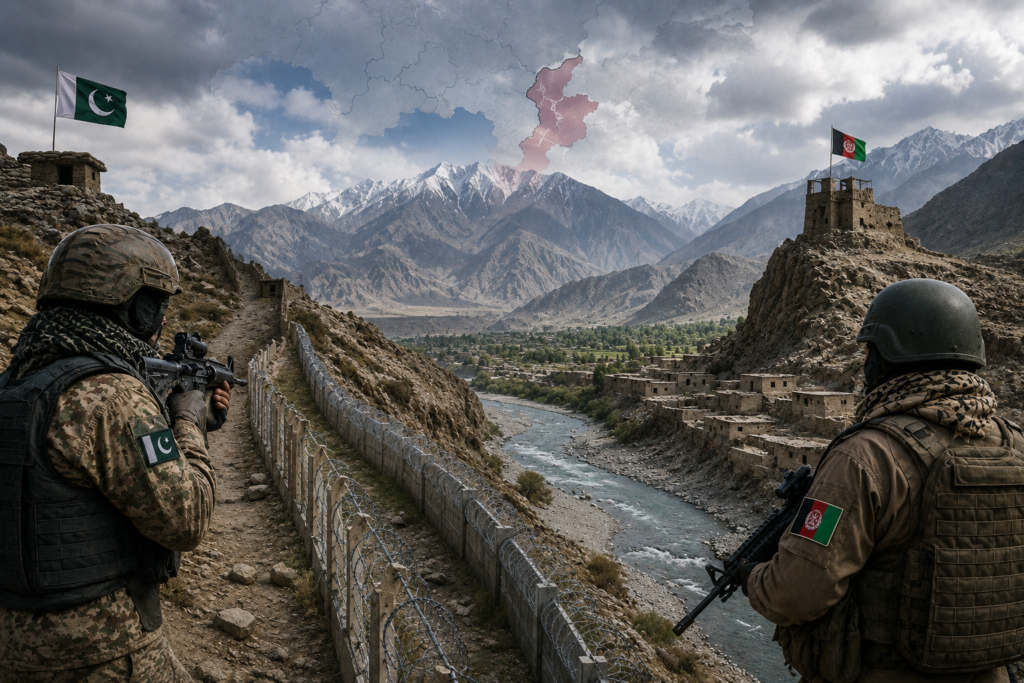
The incident has once again highlighted the complex security challenges surrounding the Durand Line, the disputed Afghanistan–Pakistan border, and the broader issue of cross-border militancy in South Asia.
For UPSC aspirants, this topic is important under International Relations, Border Disputes, Regional Security, Geopolitics, and India’s Neighbourhood Policy.
Geographical Profile of Kunar, Khost and Paktika
These provinces are located in Eastern and Southeastern Afghanistan along the border with Pakistan.
Their strategic location makes them one of the most sensitive security zones in South Asia.
Location
- Eastern Afghanistan
- Southeastern Afghanistan
- Along the Afghanistan–Pakistan frontier
Bordering Regions
International Border
These provinces directly border Pakistan across the:
Durand Line
which serves as the de facto boundary between the two countries.
Pakistani Counterparts
The provinces face Pakistan’s:
Khyber Pakhtunkhwa
including areas such as:
- North Waziristan
- Kurram
- Bajaur
These regions have historically witnessed insurgent activity and cross-border movement.
Major Geographical Features
Kunar River
The:
Kunar River
originates in the Hindu Kush mountains and flows through eastern Afghanistan before joining larger river systems.
The river valley has historically served as a major movement corridor.
Spin Ghar (White Mountains)
The:
Spin Ghar
form a rugged mountain barrier along parts of the Afghanistan–Pakistan border.
The difficult terrain complicates border management and counter-insurgency operations.
Khyber Pass
One of the most famous mountain passes in the world:
Khyber Pass
has historically connected Central Asia with the Indian subcontinent.
For centuries it served as:
- A trade route
- A migration corridor
- A military invasion route
Gomal Pass
Another important historic route is the:
Gomal Pass
which facilitated commercial and cultural exchanges across the region.
Understanding the Tehreek-e-Taliban Pakistan (TTP)
The central issue behind the recent strikes is Pakistan’s conflict with the:
Tehreek-e-Taliban Pakistan
commonly known as the Pakistani Taliban.
What is TTP?
TTP is a militant organization established in 2007.
Its primary objective is to challenge the Pakistani state and impose its interpretation of Islamic governance.
Difference Between TTP and Afghan Taliban
Although both groups share ideological similarities, they are separate organizations.
Afghan Taliban
Controls Afghanistan.
TTP
Operates primarily against Pakistan.
Pakistan has repeatedly accused TTP militants of using Afghan territory as safe havens.
Why are Kunar, Khost and Paktika Important?
These provinces have long been associated with:
- Difficult mountainous terrain
- Weak border control
- Tribal networks
- Cross-border movement
Their geography makes them ideal locations for insurgent groups seeking refuge.
The Durand Line Dispute
The deeper issue underlying border tensions is the unresolved status of the Durand Line.
What is the Durand Line?
The Durand Line was established in:
1893
through an agreement between:
- British India
- Afghanistan
It was named after:
Sir Mortimer Durand
Length
Approximately:
2,640 Kilometres
Why is it Controversial?
Pakistan recognizes the Durand Line as the international border.
However, successive Afghan governments have questioned its legitimacy.
The dispute stems from the fact that the border divides:
- Pashtun tribal populations
- Ethnic communities
- Traditional socio-cultural networks
across both sides.
Strategic Significance of the Region
The Afghanistan–Pakistan frontier is among the most strategically sensitive borders in the world.
Security Significance
The region serves as a focal point for:
- Counter-terrorism operations
- Border management
- Intelligence cooperation
Geopolitical Importance
The area connects:
- South Asia
- Central Asia
- West Asia
making it strategically important for regional stability.
Economic Importance
Border routes facilitate:
- Trade
- Transit connectivity
- Regional economic integration
Why Does This Matter for Regional Stability?
Cross-border military operations often create diplomatic tensions.
Potential consequences include:
Escalation of Conflict
Military actions may trigger retaliatory responses.
Humanitarian Concerns
Civilian populations often bear the consequences of border violence.
Refugee Flows
Instability can increase migration pressures.
Regional Security Risks
Militant groups may exploit instability to strengthen their presence.
India’s Perspective
India closely monitors developments in Afghanistan due to:
Regional Security Interests
Instability can affect South Asian security dynamics.
Counter-Terrorism Concerns
Terror networks operating in the region have broader implications.
Connectivity Projects
A stable Afghanistan is important for regional connectivity initiatives linking South Asia and Central Asia.
Colonial Borders and Modern Conflicts
The Durand Line is often cited as an example of how colonial-era boundaries continue to influence modern geopolitical tensions.
Many such borders:
- Divided ethnic groups.
- Ignored local realities.
- Created long-term disputes.
Similar examples can be observed across:
- Africa
- West Asia
- South Asia
Key Challenges
Porous Borders
Mountainous terrain makes surveillance difficult.
Militant Safe Havens
Non-state actors often exploit governance gaps.
Weak Institutional Cooperation
Trust deficits hinder effective security coordination.
Historical Disputes
The unresolved status of the Durand Line complicates bilateral relations.
Way Forward
To ensure long-term stability, both countries should focus on:
Enhanced Border Cooperation
Improved intelligence sharing and coordination.
Counter-Terrorism Collaboration
Joint efforts against non-state actors.
Diplomatic Engagement
Reducing tensions through dialogue.
Regional Connectivity
Promoting trade and economic integration.
Humanitarian Safeguards
Protecting civilian populations during security operations.
Significance for UPSC
This issue links several important UPSC themes:
- Afghanistan–Pakistan Relations
- Border Disputes
- Regional Security
- Terrorism and Insurgency
- Geopolitics of South Asia
- Colonial Boundaries and State Formation
UPSC Prelims Focus
Important Facts
| Feature | Details |
|---|---|
| Provinces in News | Kunar, Khost, Paktika |
| Border | Durand Line |
| Neighboring Pakistani Province | Khyber Pakhtunkhwa |
| Major River | Kunar River |
| Mountain Range | Spin Ghar (White Mountains) |
| Key Militant Group | Tehreek-e-Taliban Pakistan (TTP) |
Previous Year Question (UPSC Prelims 2023)
Consider the following pairs of regions in the news and the country they belong to:
- Donbas — Ukraine
- Kachin — Myanmar
- Tigray — Yemen
Correct Answer:
(b) Only two pairs
(Tigray is in Ethiopia, not Yemen.)
Exam Keywords
- Durand Line
- Kunar Province
- Khost Province
- Paktika Province
- Afghanistan–Pakistan Relations
- TTP
- Tehreek-e-Taliban Pakistan
- Border Security
- Khyber Pass
- Spin Ghar
- Regional Security
- Cross-Border Militancy
- South Asian Geopolitics
UPSC Syllabus Reference
GS Paper II – International Relations, India’s Neighbourhood, Regional Security, Border Management, and Geopolitical Developments in South Asia.