JAIN PHILOSOPHY: THE SOUL, KARMA AND THE PATH TO LIBERATION | Part 2
Introduction
The true identity of Jainism lies not merely in its history or the lives of the Tirthankaras, but in its profound philosophical system. Jain philosophy attempts to answer some of the oldest questions of human existence:
- What is life?
- What is the soul?
- Why do living beings suffer?
- Why do birth and death continue?
- Can suffering end permanently?
- What is liberation?
- How can liberation be attained?
Unlike many religious traditions that attribute the destiny of human beings to divine will, Jainism maintains that every soul is independent, eternal, and personally responsible for its condition. Neither God nor fate determines the future of an individual. Every action performed by a living being produces consequences that bind the soul. Liberation is achieved only when these karmic bonds are completely destroyed.
The philosophical system of Jainism is therefore centred on three interconnected ideas:
- the nature of the soul (Jīva),
- the operation of karma, and
- the process of attaining Moksha.
The Jain View of Reality
According to Jain philosophy, the universe is:
- eternal,
- uncreated,
- indestructible,
- self-regulating.
It has neither a beginning nor an end.
Unlike the Abrahamic religions, Jainism does not believe that the universe was created by God.
Unlike some schools of Hindu philosophy, it also rejects the idea that a supreme divine being governs every event.
Instead, the universe functions according to natural laws.
Every event has a cause.
Every action produces consequences.
This principle is expressed through the doctrine of karma.
The Universe According to Jainism
Everything that exists in the universe belongs to one of two fundamental categories:
- Jīva (Living Substance)
- Ajīva (Non-living Substance)
This division forms the foundation of Jain metaphysics.
Jīva (Soul)
The concept of Jīva is the most important doctrine of Jain philosophy.
The Sanskrit word Jīva means:
That which lives.
It refers to the conscious principle present in every living being.
Every:
- human,
- animal,
- bird,
- insect,
- fish,
- plant,
- microorganism
possesses a soul.
The soul is:
- eternal,
- indestructible,
- conscious,
- capable of infinite knowledge,
- capable of infinite bliss.
However, in ordinary life these qualities remain hidden because the soul is covered by karma.
Characteristics of Jīva
According to Jain philosophy, every soul possesses four infinite qualities in its pure state:
Infinite Knowledge (Ananta Jñāna)
A liberated soul knows everything directly.
There is no ignorance.
Infinite Perception (Ananta Darśana)
The soul possesses perfect perception of reality.
Nothing remains hidden.
Infinite Bliss (Ananta Sukha)
There is no pain, sorrow or suffering.
Only perfect happiness exists.
Infinite Energy (Ananta Vīrya)
The soul possesses limitless spiritual power.
Why do we not experience these qualities?
Because the soul is covered by karmic matter.
This is one of the most unique ideas of Jainism.
In Jain philosophy,
karma is not merely a moral law.
It is considered a subtle material substance that actually attaches itself to the soul.
This concept distinguishes Jainism from almost every other Indian philosophical school.
Ajīva (Non-Living Reality)
Everything that does not possess consciousness is called Ajīva.
Ajīva includes all non-living substances that make the universe possible.
Unlike Jīva, Ajīva has no consciousness.
The Six Dravyas (Six Fundamental Substances)
Jain philosophy explains the universe through six eternal substances called Dravyas.
These six substances have always existed and will always exist.
Nothing can be created out of nothing.
Nothing can be completely destroyed.
Only transformations occur.
The six Dravyas are:
- Jīva
- Pudgala
- Dharma
- Adharma
- Ākāśa
- Kāla
1. Jīva
Already discussed.
Conscious substance.
Living beings.
2. Pudgala (Matter)
The word Pudgala refers to matter.
Everything material belongs to this category.
Examples:
- earth,
- water,
- fire,
- air,
- human body,
- plants,
- mountains,
- stars.
Even karmic particles are considered an extremely subtle form of Pudgala.
3. Dharma Dravya
This is one of the most misunderstood concepts.
Here,
Dharma does not mean religion.
It means:
The principle that enables motion.
A simple analogy:
Water allows fish to swim.
Similarly,
Dharma Dravya allows movement to occur.
It does not cause movement.
It only makes movement possible.
4. Adharma Dravya
Again,
Adharma here does not mean sin.
It means:
The principle that enables rest.
Example:
The earth allows a person to stand still.
Similarly,
Adharma Dravya provides the condition necessary for rest.
5. Ākāśa (Space)
Space provides room for all substances to exist.
Without space,
nothing could occupy a position.
Jain philosophy divides space into:
- Lokākāśa (inhabited universe)
- Alokākāśa (empty infinite space beyond the universe)
6. Kāla (Time)
Time makes change possible.
Without time,
there would be:
- no birth,
- no death,
- no growth,
- no decay.
Time is therefore accepted as the sixth eternal substance.
Summary of Six Dravyas
| Dravya | Meaning |
|---|---|
| Jīva | Soul |
| Pudgala | Matter |
| Dharma | Medium of Motion |
| Adharma | Medium of Rest |
| Ākāśa | Space |
| Kāla | Time |
Karma Theory
The doctrine of karma is the central pillar of Jain philosophy.
Every thought,
every word,
every action
creates karma.
Unlike many religions,
Jainism considers karma to be real material particles.
Whenever a person acts under the influence of:
- anger,
- greed,
- attachment,
- pride,
- ignorance,
subtle karmic particles enter the soul.
These karmas cover the natural qualities of the soul.
As long as karma remains,
the soul continues to take birth.
The Process of Bondage
The process may be understood as follows:
Wrong Belief
↓
Passions
↓
Actions
↓
Influx of Karma
↓
Bondage
↓
Birth
↓
Death
↓
Rebirth
↓
Again Karma
This cycle continues endlessly.
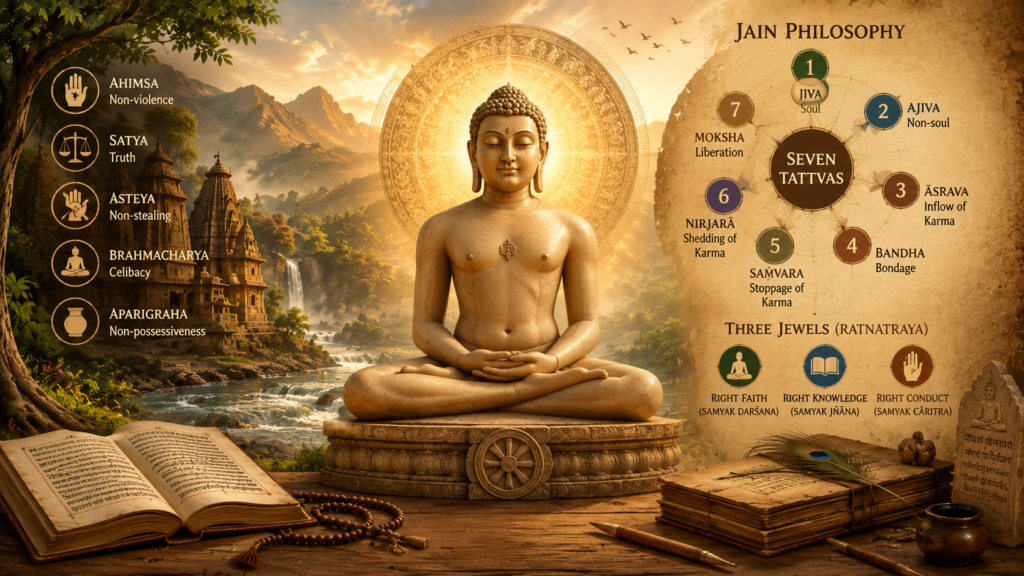
The Seven Tattvas
To explain this entire process, Jain philosophy describes Seven Tattvas.
The word Tattva means:
Fundamental Principle.
These seven principles explain the complete journey of the soul.
1. Jīva
The living soul.
2. Ajīva
Non-living substances.
3. Āsrava
Literally means:
Inflow.
It refers to the inflow of karmic particles into the soul.
4. Bandha
Means:
Bondage.
After entering,
karma binds itself to the soul.
5. Saṃvara
Means:
Stoppage.
The process of preventing new karma from entering the soul.
This is achieved through:
- discipline,
- meditation,
- self-control,
- ethical conduct.
6. Nirjarā
Means:
Shedding.
Old karmas are gradually destroyed through:
- austerities,
- meditation,
- repentance,
- discipline.
7. Moksha
When all karmas disappear completely,
the soul becomes liberated forever.
Flow of Liberation
The Seven Tattvas can be visualised as:
Soul
↓
Karma enters (Āsrava)
↓
Karma binds (Bandha)
↓
Stop new Karma (Saṃvara)
↓
Destroy old Karma (Nirjarā)
↓
Moksha
Four Gatis (Four States of Existence)
According to Jainism,
after death,
every soul is reborn in one of four Gatis.
These are:
- Deva (Heavenly beings)
- Manushya (Humans)
- Tiryancha (Animals and Plants)
- Naraka (Hell beings)
The destination depends entirely upon karma.
This concept formed the basis of the UPSC Civil Services Preliminary Examination question asked in 2026.
Ratnatraya (The Three Jewels)
Liberation is achieved through the Three Jewels.
These are:
Right Faith (Samyak Darśana)
Correct understanding of reality.
Right Knowledge (Samyak Jñāna)
Correct knowledge free from doubt and ignorance.
Right Conduct (Samyak Cāritra)
Living according to ethical principles.
These three together constitute the path to liberation.
The Five Great Vows (Mahāvratas)
Mahavira prescribed five great vows for monks.
They are:
- Ahimsa
- Satya
- Asteya
- Brahmacharya
- Aparigraha
These vows represent the highest standards of ethical discipline in Jainism.
Ahimsa
Non-violence in thought,
speech
and action.
This is the supreme principle of Jain ethics.
Satya
Truthfulness.
Asteya
Not taking anything that has not been willingly given.
Brahmacharya
Complete control over sensual desires.
Aparigraha
Non-possession.
Freedom from attachment to wealth and material objects.
Sallekhanā
One of the most debated Jain practices is Sallekhanā.
It refers to the voluntary and gradual reduction of food and bodily attachments at the end of life under strict spiritual discipline.
According to Jain philosophy,
it is not considered suicide,
because its objective is spiritual purification rather than escape from suffering.
The practice continues to be discussed in ethical and legal debates in modern India.
Conclusion
Jain philosophy presents one of the most systematic analyses of the relationship between the soul, karma and liberation found in Indian thought. By explaining the universe through the concepts of Jīva, Ajīva, Six Dravyas, Seven Tattvas, Karma, Four Gatis, Ratnatraya and the Five Great Vows, it establishes a complete ethical and metaphysical framework in which every individual is responsible for his or her own spiritual destiny.
Unlike systems that rely upon divine grace, Jainism insists that liberation is achieved solely through knowledge, self-discipline, non-violence and the gradual destruction of karmic bondage.