India’s Free Trade Agreements (FTAs): Opportunities, Challenges and the Road Ahead
Why is it in News?
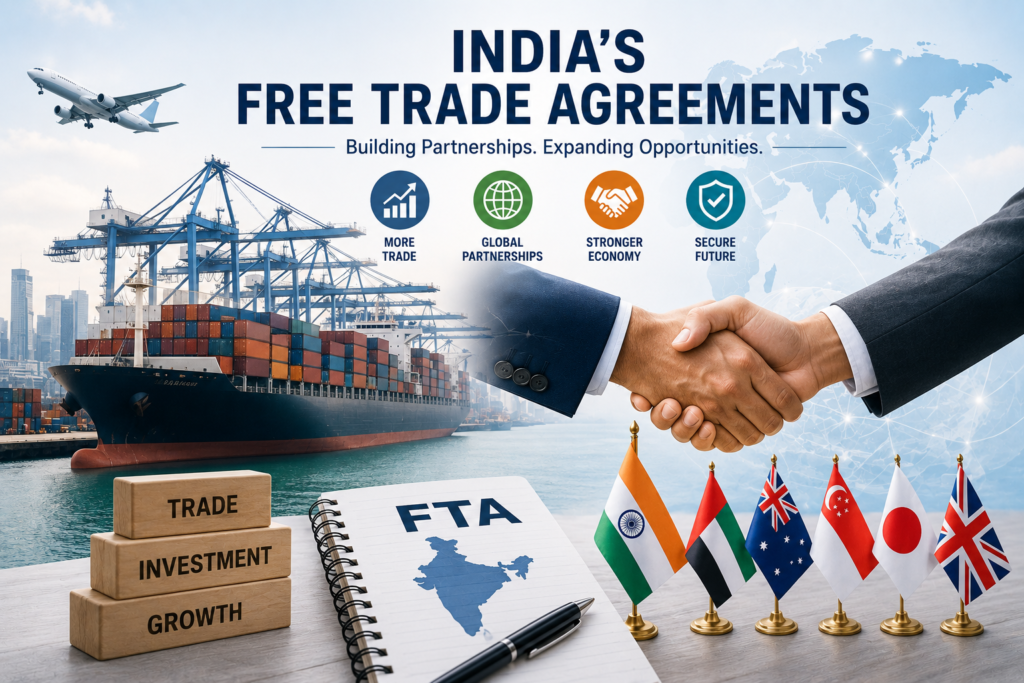
On 1 June 2026, the India–Oman Free Trade Agreement (FTA) officially came into force, further expanding India’s network of international trade partnerships. With this addition, India now has 15 active Free Trade Agreements covering 27 countries, while negotiations for several new agreements remain underway.
The rapid expansion of India’s FTA architecture has renewed debate over key issues such as trade deficits, export competitiveness, manufacturing relocation, utilization rates of trade agreements, and the long-term impact of free trade on India’s economic growth.
For UPSC aspirants, this topic is important under International Trade, Economic Diplomacy, Globalization, Foreign Trade Policy, and Economic Development.
What is a Free Trade Agreement (FTA)?
A Free Trade Agreement (FTA) is an arrangement between two or more countries to reduce or eliminate trade barriers and promote the free flow of goods, services, investments, and technology.
The objective is to increase economic integration and enhance mutual trade benefits.
Definition
An FTA is an international agreement under which participating countries agree to:
- Reduce or eliminate tariffs.
- Remove quotas and restrictions.
- Facilitate market access.
- Encourage investment flows.
- Improve economic cooperation.
By lowering barriers, FTAs make imported and exported goods more competitive.
Institutional Framework in India
Nodal Ministry
The implementation and negotiation of FTAs are handled by:
Department of Commerce
under the Ministry of Commerce and Industry.
Legal Status
FTAs are international treaties concluded under the executive powers of the Government of India.
Where necessary, amendments are made under:
Customs Tariff Act, 1975
to implement tariff concessions.
Core Pillars of Free Trade Agreements
Modern FTAs extend far beyond tariff reductions.
1. Tariff Elimination
The primary objective is reducing or eliminating customs duties on goods traded between partner countries.
Benefits include:
- Lower prices
- Greater competitiveness
- Increased trade volumes
2. Reduction of Non-Tariff Barriers (NTBs)
Trade can be restricted through:
- Licensing requirements
- Technical standards
- Administrative procedures
- Import restrictions
FTAs seek to simplify these processes.
3. Market Access for Services
Modern agreements increasingly cover services such as:
- Information Technology
- Banking
- Insurance
- Tourism
- Healthcare
- Professional services
This is particularly important for India because services constitute a major strength of its economy.
4. Investment Protection
FTAs often include provisions that:
- Protect foreign investments.
- Improve investor confidence.
- Facilitate capital flows.
Such provisions encourage Foreign Direct Investment (FDI).
5. Rules of Origin (RoO)
Rules of Origin determine whether a product genuinely originates from a partner country.
They prevent:
Trade Deflection
where third countries attempt to route products through FTA partners to gain tariff benefits.
Evolution of Economic Integration
Trade agreements vary in depth and complexity.
1. Preferential Trade Agreement (PTA)
The most basic form of economic integration.
Features
- Reduced tariffs on selected products.
- Limited coverage.
Example:
Trade concessions on specific categories of goods.
2. Free Trade Agreement (FTA)
A deeper form of integration.
Features
- Elimination of tariffs on substantial trade.
- Independent external tariffs maintained for non-members.
This is the most common type of trade agreement.
3. Comprehensive Economic Partnership Agreement (CEPA)
A broader and more advanced arrangement.
Coverage
- Goods
- Services
- Investment
- Intellectual Property Rights (IPR)
- Economic cooperation
CEPAs are more comprehensive than traditional FTAs.
4. Customs Union
A higher level of economic integration.
Features
- Internal free trade.
- Common external tariff for non-member countries.
Example:
European Union Customs Union
India’s Expanding FTA Network
India has actively pursued trade agreements to improve global market access.
The strategy aligns with:
- Export promotion
- Supply chain diversification
- Economic diplomacy
- Integration into global value chains
Benefits of FTAs for India
1. Export Expansion
Reduced tariffs provide Indian exporters easier access to foreign markets.
Sectors benefiting include:
- Pharmaceuticals
- Textiles
- Engineering goods
- IT services
2. Increased Investment
FTAs improve investor confidence and attract foreign capital.
Benefits include:
- Technology transfer
- Employment generation
- Industrial development
3. Diversification of Markets
Trade agreements reduce overdependence on a limited number of export destinations.
4. Integration into Global Value Chains
FTAs help Indian firms become part of international manufacturing and supply networks.
5. Strategic Diplomacy
Trade agreements strengthen broader geopolitical and economic partnerships.
Challenges Emerging from India’s FTAs
Despite their advantages, several structural concerns have emerged.
1. Rising Trade Deficits
One major criticism is that imports often grow faster than exports.
This can widen India’s:
Trade Deficit
particularly with manufacturing-intensive economies.
2. Low Utilization Rates
Many Indian exporters fail to fully utilize FTA benefits.
Reasons include:
- Lack of awareness.
- Complex compliance requirements.
- Documentation challenges.
As a result, tariff concessions often remain underutilized.
3. Inverted Duty Structure
An inverted duty structure occurs when:
Duties on Raw Materials > Duties on Finished Products
This can make domestic manufacturing less competitive.
Example
If imported finished goods face lower duties than imported components, domestic producers may struggle to compete.
4. Manufacturing Relocation
Some industries may shift production to countries offering:
- Lower labor costs.
- Better infrastructure.
- Favorable trade agreements.
This can affect domestic industrial growth.
The India–Oman FTA: Strategic Importance
The India–Oman FTA is significant because Oman serves as:
- A gateway to West Asia.
- A strategic maritime partner.
- An important energy supplier.
The agreement is expected to strengthen:
- Bilateral trade.
- Investments.
- Logistics connectivity.
- Energy cooperation.
Why FTAs Matter in the Modern Economy
Global trade is increasingly shaped by:
- Bilateral agreements.
- Regional trade blocs.
- Supply chain partnerships.
As protectionism rises in some parts of the world, countries are increasingly using FTAs to secure market access.
Concerns for India
While FTAs create opportunities, India faces several structural challenges:
Export Competitiveness
Indian manufacturing must become globally competitive.
Logistics Costs
High transportation and logistics costs reduce competitiveness.
Compliance Standards
Meeting international quality and sustainability standards remains challenging.
Trade Facilitation
Customs and regulatory procedures need further simplification.
Way Forward
To maximize benefits from FTAs, India should focus on:
Enhancing Manufacturing Competitiveness
Strengthen initiatives such as:
- Make in India
- Production Linked Incentive (PLI) Schemes
- Industrial Corridors
Improving Export Readiness
Support exporters through:
- Skill development
- Market intelligence
- Trade facilitation
Increasing FTA Utilization
Raise awareness among businesses regarding:
- Tariff benefits
- Rules of Origin
- Documentation procedures
Correcting Inverted Duty Structures
Align tariff policies to support domestic value addition.
Strengthening Global Value Chain Integration
Encourage Indian firms to participate in international production networks.
Conclusion
Free Trade Agreements remain a critical component of India’s economic diplomacy and growth strategy. They provide opportunities for export expansion, investment inflows, and deeper integration with global markets.
However, the true success of FTAs depends not merely on signing agreements but on improving domestic competitiveness, enhancing manufacturing capabilities, and ensuring that Indian businesses can effectively utilize the opportunities created by these trade partnerships.
UPSC Prelims Focus
Important Facts
| Feature | Details |
|---|---|
| Nodal Ministry | Ministry of Commerce & Industry |
| Main Objective | Promote Free Trade |
| Key Provision | Tariff Reduction |
| Advanced Form | CEPA |
| Higher Integration Level | Customs Union |
| Important Safeguard | Rules of Origin (RoO) |
Previous Year Question (UPSC Prelims 2020)
Consider the following statements:
- “Textiles and textile articles” constitute an important item of trade between India and Bangladesh.
Correct Answer:
(b) 2 only
Exam Keywords
- Free Trade Agreement (FTA)
- CEPA
- PTA
- Customs Union
- Rules of Origin
- Trade Deficit
- Export Competitiveness
- Market Access
- Economic Integration
- Global Value Chains
- India–Oman FTA
- Foreign Trade Policy
- Trade Facilitation
- Economic Diplomacy
UPSC Syllabus Reference
GS Paper III – Indian Economy, International Trade, Globalization, Economic Development, External Sector, and Trade Policy.