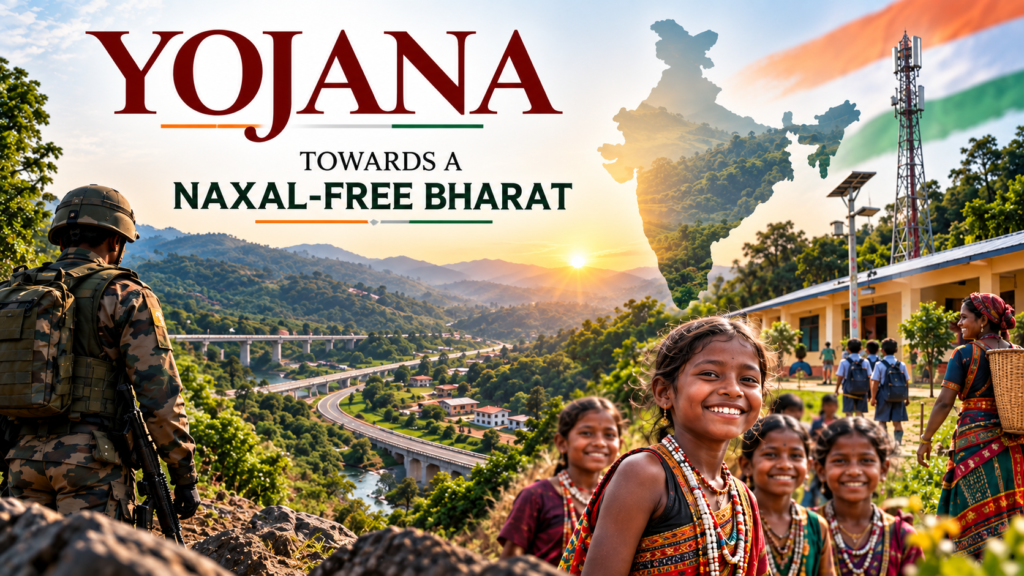
Yojana June 2026: Naxal-Free Bharat — Security, Development, Tribal Empowerment and the Road to Inclusive Governance
Introduction
The June 2026 issue of Yojana is centred on a major transformation in India’s Left-Wing Extremism (LWE)-affected regions, particularly Bastar and other parts of Chhattisgarh. The issue presents the achievement of a “Naxal-free India” not merely as a law-and-order success, but as the outcome of a whole-of-government approach combining security operations with infrastructure development, education, healthcare, connectivity, rehabilitation, livelihood opportunities, cultural assertion and democratic participation.
For UPSC aspirants, this issue is particularly important because LWE is not an isolated Internal Security topic. It connects with:
- GS Paper I: Tribal issues, social change and culture
- GS Paper II: Governance, welfare schemes, local democracy and constitutional rights
- GS Paper III: Internal security, LWE, infrastructure and development
- GS Paper IV: Trust, ethical governance and citizen-centric administration
- Essay: Development vs security, inclusive growth, tribal empowerment and national integration
- HPAS: Tribal development, governance, internal security and regional disparities
The central lesson emerging from the issue is:
Security can create the conditions for development, but sustainable peace requires development, justice, trust and democratic participation.
1. Understanding Left-Wing Extremism: Beyond the Security Narrative
Left-Wing Extremism (LWE), commonly associated with Naxalism or Maoism, has historically emerged as a challenge involving ideology, governance deficits, socio-economic grievances, geographical isolation and armed violence.
The magazine strongly challenges the simplistic interpretation that Naxalism is merely a problem of poverty. The article “Naxal-Free India: A Historic Achievement” argues that Naxalism cannot be understood simply through the lens of poverty or lack of development. Its ideological roots and armed mobilisation have played a crucial role.
The important conceptual distinction
Poverty ≠ Naxalism
English Definition:
Naxalism is an organised form of Left-Wing Extremism involving revolutionary ideology, armed mobilisation and attempts to challenge the authority of the Indian state.
Therefore, a successful response requires more than welfare spending.
It requires:
Security → Governance → Development → Trust → Democratic Integration
2. From the “Red Corridor” to a Naxal-Free Bharat
One of the most important concepts discussed in the issue is the historical expansion of the Red Corridor.
The magazine describes how LWE violence once affected a large geographical area and created significant challenges for governance, infrastructure and democratic institutions. It also discusses the transformation achieved through sustained counter-insurgency and development measures.
The issue presents the decline of LWE violence as a long-term process rather than the result of a single operation.
Important exam perspective
The transformation should be understood through three stages:
Stage 1 — Conflict
- Armed insurgency
- Attacks on security forces
- Destruction of infrastructure
- Fear among civilians
- Parallel/extortion-based structures
- Weak state presence in remote regions
Stage 2 — State Reassertion
- Security forces
- Intelligence coordination
- Central Armed Police Forces
- State police
- fortified security camps
- road and communication networks
- targeted operations
Stage 3 — Peace and Integration
- Schools
- Hospitals
- roads
- electricity
- telecom connectivity
- banking
- postal services
- livelihood opportunities
- tribal cultural recognition
- rehabilitation
- democratic participation
This third stage is particularly important because military success alone cannot guarantee permanent peace.
3. Why Bastar Became the Centre of the Transformation
The magazine places Bastar at the centre of India’s Naxal-free transformation.
Bastar is important because it combines:
- dense forests
- difficult terrain
- dispersed settlements
- substantial tribal population
- historical administrative isolation
- limited connectivity
- security challenges
- rich indigenous culture
This combination historically created favourable conditions for insurgent activity.
The magazine therefore presents Bastar as a classic example of the relationship between geography, governance and internal security.
UPSC Concept
Governance Vacuum
English Definition:
A governance vacuum occurs when state institutions and public services have inadequate presence or effectiveness in a geographical or social space, allowing alternative power structures to emerge.
In LWE-affected areas, governance vacuum can be exploited by extremist organisations.
Hence:
The objective is not merely to eliminate extremists; it is to eliminate the conditions that allow extremism to regenerate.
4. Security Strategy: From Conventional Counter-Insurgency to Integrated Operations
The article “Naxal-Mukt Bharat: A Strategic Turnaround” explains that the transformation involved a combination of political will, institutional coordination, professional security operations and development interventions.
The magazine highlights the importance of:
- Central Armed Police Forces (CAPFs)
- State police
- intelligence agencies
- intelligence sharing
- modern technology
- drones
- surveillance
- specialised forces
- fortified operating bases
- inter-state coordination
- financial disruption
- development initiatives
The SAMADHAN framework is especially important for Prelims and Mains.
5. SAMADHAN Framework
The magazine presents the MHA’s SAMADHAN framework for dealing with LWE:
| Letter | Component |
|---|---|
| S | Smart Leadership |
| A | Aggressive Strategy |
| M | Motivation and Training |
| A | Actionable Intelligence |
| D | Dashboard-based KPIs and KRAs |
| H | Harnessing Technology |
| A | Action Plan for Each Theatre |
| N | No Access to Financing |
The framework is illustrated directly in the magazine on page 43.
Why is this important?
It demonstrates the evolution from a purely military response towards intelligence-led, technology-enabled and institutionally coordinated counter-insurgency.
6. Intelligence-Led Counter-Insurgency
A major lesson from the magazine is that modern internal security increasingly depends on intelligence superiority.
The strategy includes:
- human intelligence
- technical intelligence
- surveillance
- drone technology
- data analysis
- inter-agency coordination
- real-time information sharing
This is important because insurgency operates through:
- difficult terrain
- small mobile groups
- local networks
- concealed logistics
- intelligence gathering
- support structures
Therefore, conventional large-scale military deployment alone may be inefficient.
UPSC takeaway
Modern counter-insurgency is increasingly intelligence-driven rather than manpower-driven.
7. The Whole-of-Government Approach
Perhaps the most important conceptual contribution of this Yojana issue is the idea of the:
Whole-of-Government Approach
English Definition:
A whole-of-government approach involves coordinated action by multiple government ministries, agencies and levels of government to address a complex problem rather than allowing each institution to work in isolation.
The article “Whole-of-Government Approach for LWE Eradication” argues that LWE cannot be addressed through security measures alone. It requires coordination between the Union, States, security agencies and development institutions.
Why?
Because LWE has multiple dimensions:
Security problem
↓
Governance problem
↓
Development problem
↓
Connectivity problem
↓
Social integration problem
Therefore:
Complex problems require coordinated institutions.
8. Centre-State Coordination and Cooperative Federalism
LWE is an excellent example of cooperative federalism in internal security.
Although “Police” and “Public Order” are State subjects, the Union Government plays an important supporting role through:
- CAPFs
- intelligence support
- financial assistance
- infrastructure
- coordination
- specialised forces
- technology
- development programmes
The magazine highlights the importance of Centre-State coordination and operational cooperation.
Mains Angle
A good answer should avoid presenting internal security as exclusively a central responsibility.
Instead:
LWE requires cooperative federalism because security, governance and development functions are distributed across different levels of government.
9. National Policy and Action Plan to Address LWE — 2015
The magazine discusses the National Policy and Action Plan to Address LWE – 2015 and presents it as an integrated framework.
Its broad dimensions include:
1. Security Measures
- security force deployment
- intelligence
- operational coordination
2. Development Measures
- roads
- infrastructure
- education
- healthcare
- livelihood
3. Rights and Entitlements
Ensuring that communities receive the benefits and rights guaranteed to them.
4. Improving Governance
Strengthening the state’s institutional presence.
5. Managing Perception
Countering extremist narratives and improving communication with local populations.
The diagram on page 23 visually represents these interconnected pillars.
10. Development as an Instrument of Internal Security
This is one of the most important UPSC concepts from the issue.
Traditionally, development and internal security are often studied separately.
The Yojana issue shows why they should be studied together.
Poor connectivity can create:
- administrative isolation
- economic exclusion
- limited access to healthcare
- limited access to education
- information gaps
- dependence on informal power structures
Therefore:
Development → State Presence → Citizen Trust → Reduced Space for Extremism
The magazine reports improvements in roads, telecommunications, electricity, banking, healthcare and educational infrastructure in affected areas.
11. Infrastructure as a Security Multiplier
Roads and infrastructure have a dual role.
Development Role
They facilitate:
- market access
- education
- healthcare
- employment
- mobility
- tourism
Security Role
They facilitate:
- movement of security forces
- emergency response
- administrative access
- communication
- surveillance
- rapid deployment
Thus:
Infrastructure is not merely an economic asset; in conflict-affected regions, it can become a strategic security multiplier.
12. Telecom Connectivity: From Isolation to Integration
The article “The Telecom Trajectory of a Naxal-Free India” provides one of the strongest examples of the connection between connectivity and security.
Telecommunication expansion helps in:
- access to information
- digital payments
- banking
- education
- healthcare
- governance
- entrepreneurship
- emergency communication
- market integration
The magazine discusses mobile towers and connectivity expansion in LWE-affected regions, including the use of schemes such as Digital Bharat Nidhi and other government interventions.
Important concept
Digital Inclusion
English Definition:
Digital inclusion means ensuring that individuals and communities have meaningful access to digital infrastructure, devices, connectivity, skills and services.
For remote tribal regions, digital inclusion becomes an instrument of social and economic integration.
13. India Post: From Isolation to Integration
One of the most interesting articles in the issue is:
“From Isolation to Integration: India Post in LWE-Affected Regions”
The article explains how India Post has a unique role because of its extensive grassroots network.
Postal infrastructure can provide:
- access to financial services
- banking
- savings
- pension-related services
- government payments
- communication
- citizen services
The magazine discusses the expansion of Branch Post Offices in LWE-affected districts and presents postal services as an instrument for overcoming last-mile exclusion.
UPSC Concept
Last-Mile Connectivity
English Definition:
Last-mile connectivity refers to the final stage of delivering infrastructure, services or networks to individuals and communities located far from major service centres.
14. Financial Inclusion as a Counter-Insurgency Tool
Financial exclusion can reinforce dependence on informal economic networks.
Therefore, expanding:
- banking
- post offices
- digital payments
- financial services
- DBT
can strengthen the formal economy.
This creates:
Formal Financial System → Economic Independence → Reduced Dependence → Stronger State-Citizen Linkages
The magazine also discusses the importance of cutting extremist financing under the broader SAMADHAN approach.
15. Education: The Long-Term Weapon Against Extremism
The article on Eklavya Model Residential Schools (EMRS) is particularly important for understanding the social dimension of LWE eradication.
The central argument is simple:
Education expands opportunities and weakens the social conditions that allow extremism to reproduce itself.
Education can contribute through:
- critical thinking
- employment opportunities
- social mobility
- awareness of rights
- digital literacy
- exposure to alternative career paths
- integration with mainstream institutions
16. Eklavya Model Residential Schools
What are EMRS?
Eklavya Model Residential Schools are residential schools aimed at providing quality education to Scheduled Tribe students, particularly in areas with significant tribal populations.
The magazine highlights their role in:
- quality education
- residential learning
- modern infrastructure
- digital empowerment
- sports
- cultural development
- career opportunities
Why residential education matters in remote tribal areas?
It can overcome:
- geographical isolation
- lack of nearby quality schools
- teacher shortages
- limited digital facilities
- discontinuity in education
17. Education and Counter-Radicalisation
The magazine makes a broader argument:
Lack of opportunities
↓
Alienation
↓
Vulnerability to extremist narratives
Whereas:
Education
↓
Skills + Awareness + Opportunities
↓
Greater social mobility
↓
Reduced vulnerability to extremist recruitment
This should not be interpreted as meaning that poverty automatically produces extremism.
Rather:
Inclusive education can reduce the structural vulnerabilities that extremist organisations may exploit.
18. Bastar Olympics: Sports as an Instrument of Peace
One of the most distinctive initiatives discussed in the issue is the:
Bastar Olympics
The article “Bastar Olympics: A Catalyst for Peace, Inclusion, and Transformational Change in Bastar” presents sports as a tool for social integration.
The initiative aims to provide young people with:
- participation
- recognition
- discipline
- teamwork
- aspirations
- social interaction
- alternative identity formation
19. Sports and Peacebuilding
The significance of Bastar Olympics goes beyond athletics.
Sports can create:
Individual-level benefits
- confidence
- discipline
- physical fitness
- leadership
Community-level benefits
- collective participation
- social interaction
- reduced alienation
- inter-community engagement
Governance-level benefits
- state-citizen interaction
- identification of talent
- institutional trust
The magazine describes the initiative as a mechanism for transforming youth participation and identity in the region.
20. Breaking the Cycle of Extremism
The Bastar Olympics article introduces an important concept:
Alternative Identity Formation
When young people are provided with constructive avenues for:
- achievement
- recognition
- social mobility
- leadership
the attractiveness of extremist identity can potentially decline.
Therefore:
Counter-radicalisation is not only about defeating an ideology; it is also about creating better alternatives.
This is a powerful GS-III + Essay point.
21. Tribal Culture as a Tool of Integration
Another major theme of the issue is that development should not mean cultural homogenisation.
The magazine gives substantial importance to:
- Bastar Pandum
- tribal traditions
- indigenous art
- tribal museums
- traditional food
- handicrafts
- cultural festivals
The Bastar Pandum article describes the festival as an assertion of tribal identity and a counter-narrative to decades of alienation and conflict.
22. Bastar Pandum: Cultural Assertion and Consolidation
Bastar Pandum represents:
Culture + Identity + Community + Development
The festival provides a platform for:
- traditional arts
- music
- dance
- food
- handicrafts
- indigenous practices
- community participation
The magazine describes its growing scale and institutionalisation and links it with developmental interventions.
UPSC Insight
Development should not require communities to abandon their cultural identity.
Instead:
Inclusive development seeks to integrate communities into national development while preserving their cultural distinctiveness.
23. Cultural Diplomacy Within the Country
Bastar’s cultural traditions are presented not merely as heritage but as an instrument of national integration.
This creates an important distinction:
Assimilation
“Become like the mainstream.”
Integration
“Participate equally while retaining legitimate cultural identity.”
For tribal development, the second approach is more consistent with constitutional pluralism.
24. Rehabilitation and Surrender Policy
The magazine also discusses rehabilitation of surrendered cadres.
A successful counter-insurgency strategy cannot depend exclusively on eliminating armed cadres.
It must also provide pathways for reintegration.
Possible components include:
- surrender
- rehabilitation
- financial assistance
- livelihood support
- skill development
- social reintegration
- psychological support
The Bastar-focused articles discuss rehabilitation and surrender programmes alongside development initiatives.
25. From Guns to Governance
This is arguably the central transformation described throughout the issue.
Earlier:
Gun → Fear → Parallel Authority
Now the desired model is:
School + Hospital + Road + Mobile Tower + Post Office + Bank + Panchayat → State Presence
The article on democracy in formerly LWE-affected areas particularly emphasises the transition from fear and coercion towards democratic participation and constitutional governance.
26. Democracy in Formerly LWE Regions
The article:
“Securing Democracy in Formerly LWE Regions: Territory, Trust, Transition”
adds an essential GS-II dimension.
The restoration of peace is not complete until citizens can:
- vote freely
- access institutions
- participate in local governance
- exercise constitutional rights
- access welfare schemes
- interact with administration without fear
The magazine therefore presents Naxal-free regions as a process of restoring constitutional democracy and state legitimacy.
27. State Legitimacy: The Ultimate Objective
State Legitimacy
English Definition:
State legitimacy is the public acceptance of governmental authority as lawful, justified and responsive to citizens’ rights and needs.
Counter-insurgency becomes sustainable when citizens begin to view the state as:
- protector rather than oppressor
- service provider rather than distant authority
- guarantor of rights
- source of opportunities
- institution of justice
Hence:
The ultimate victory over insurgency is not merely territorial control; it is the restoration of legitimate democratic authority.
28. Trust as a Security Asset
The magazine repeatedly connects development with trust.
If citizens see:
- roads being built
- schools functioning
- hospitals accessible
- telecom connectivity expanding
- banking services reaching villages
- cultural identity receiving recognition
then their relationship with the state changes.
Thus:
Service Delivery → Trust → Legitimacy → Stability
This is an excellent GS-II governance framework.
29. The Role of Local Youth
The issue highlights the importance of involving local youth in security and development processes.
Local youth can provide:
- knowledge of terrain
- language familiarity
- cultural understanding
- local intelligence
- community trust
At the same time, employment and participation can provide young people with a stake in peace.
This is why local recruitment and community-oriented policing can become important components of counter-insurgency.
30. Women and Social Transformation
The magazine also brings attention to women and children affected by conflict and the role of rehabilitation.
A sustainable peace process must therefore address:
- women’s safety
- education of girls
- livelihood opportunities
- healthcare
- rehabilitation
- social reintegration
The broader lesson is:
Internal security must be gender-sensitive because conflict affects men and women differently.
31. Governance Delivery in Remote Areas
A major challenge in LWE regions is that even well-designed schemes may fail if the state cannot deliver them effectively.
Hence, governance must focus on:
Accessibility
Can people reach the service?
Availability
Does the service actually exist?
Affordability
Can people use it?
Quality
Is the service meaningful?
Accountability
Can citizens demand better delivery?
This is where last-mile governance becomes critical.
32. The Five-Decade Insurgency: What Changed?
The article “The Approach that Ended a Five-Decade Insurgency” places the transformation in a longer historical context.
The magazine presents the current phase as the culmination of sustained institutional efforts rather than a sudden development.
The transformation involved:
- stronger intelligence
- security coordination
- technology
- infrastructure
- development
- administrative expansion
- surrender and rehabilitation
- community engagement
The key shift was from a fragmented response to an integrated strategy.
33. Technology in Internal Security
Technology is increasingly central to modern counter-insurgency.
The issue refers to technologies and capabilities such as:
- drones
- surveillance
- communication systems
- GIS
- intelligence databases
- data analysis
- digital monitoring
Why technology matters in difficult terrain?
Dense forests and rugged terrain make conventional surveillance difficult.
Technology can improve:
Detection → Identification → Decision → Response
This is increasingly relevant for India’s broader internal security architecture.
34. Security Expenditure vs Development Expenditure
A sophisticated UPSC answer should avoid presenting security and development as competing priorities.
Instead:
Security spending
Creates a secure environment.
Development spending
Creates a stable socio-economic environment.
Governance
Converts both into citizen trust.
Therefore:
Security is a necessary condition for development in conflict zones, while development is necessary for the sustainability of security.
35. From “Hard State” to “Smart State”
The June issue shows an evolution in the nature of state response.
Hard State
- force
- coercion
- military operations
Smart State
- intelligence
- technology
- targeted operations
- development
- communication
- rehabilitation
- governance
- community participation
The modern counter-insurgency model attempts to combine both.
36. The Development-Security Nexus
The entire issue can ultimately be understood through one framework:
Development–Security Nexus
English Definition:
The development-security nexus refers to the mutually reinforcing relationship in which security enables development while inclusive development reduces conditions that may generate insecurity.
In LWE regions:
Security
↓
Connectivity
↓
Public services
↓
Livelihoods
↓
Education
↓
Trust
↓
Democratic participation
↓
Long-term peace
This is perhaps the single most important conceptual takeaway from the magazine.
37. What the Magazine Says About “Naxal-Free Bharat”
The editorial argues that declaring an area Naxal-free should not be interpreted only as the elimination of armed groups. It connects the achievement with restoration of:
- administrative presence
- development
- public services
- democratic institutions
- social trust
- economic opportunities
Therefore, the phrase Naxal-Free Bharat should be understood at multiple levels.
Security level
No significant armed insurgent presence.
Governance level
Effective state institutions.
Development level
Access to basic infrastructure and services.
Social level
Reduced alienation.
Democratic level
Restored political participation.
Economic level
Integration with formal markets.
Cultural level
Recognition of tribal identity.
38. Important Data and Evidence from the Issue
The magazine includes several quantitative comparisons that can strengthen Mains answers.
The LWE Violence Comparison 2014 vs 2025 graphic on page 24 shows a sharp decline across several indicators. According to the magazine’s presentation:
| Indicator | 2014 | 2025 |
|---|---|---|
| LWE Violence | 870 | 234 |
| Civilians Killed | 222 | 64 |
| Security Force Deaths | 88 | 36 |
| Naxals Killed | 63 | 364 |
| Arms Recovered | 548 | 1,190 |
Exam caution: These figures should be attributed to the Yojana issue when used in an answer rather than presented as independently verified statistics.
39. The Decline in LWE Violence
Another graphic in the magazine compares violent incidents and civilian/security personnel deaths over time and presents a substantial decline between 2010 and 2025.
This is useful in Mains because it converts a qualitative statement—“LWE has declined”—into an evidence-based argument.
40. What Remains Important Even After Naxalism Declines?
A very important analytical point is that elimination of armed insurgency does not automatically eliminate all underlying governance challenges.
Post-conflict regions still require:
- employment
- quality education
- healthcare
- infrastructure maintenance
- democratic institutions
- environmental protection
- cultural preservation
- local participation
- accountable administration
Therefore:
Post-conflict governance is as important as counter-insurgency.
41. Tourism as a Peace Dividend
The magazine discusses the potential of Bastar’s cultural and natural resources for tourism.
This includes:
- tribal culture
- festivals
- handicrafts
- forests
- local traditions
- ecological landscapes
Tourism can generate:
- employment
- entrepreneurship
- local revenue
- cultural visibility
- external connectivity
But tourism must be community-led and sustainable.
42. Livelihoods and Local Economic Development
Security cannot remain sustainable without economic opportunities.
The issue discusses livelihood-oriented interventions including:
- self-help groups
- local entrepreneurship
- handicrafts
- agricultural opportunities
- skill development
- market access
- tourism
The larger objective is to create a peace economy.
Peace Economy
English Definition:
A peace economy is an economic environment in which livelihoods, investment, public services and markets reinforce stability rather than conflict.
43. Community Participation
The issue repeatedly highlights the importance of community participation.
A top-down model can produce:
State → Community
But a sustainable model seeks:
State ↔ Community
This means:
- consultation
- participation
- local institutions
- community ownership
- cultural sensitivity
- responsive governance
44. Why Tribal Empowerment Matters
Tribal communities should not be treated merely as beneficiaries of welfare programmes.
They should be seen as:
- rights-holders
- citizens
- cultural stakeholders
- economic participants
- political participants
- partners in governance
This approach is more consistent with the constitutional framework for Scheduled Tribes and democratic decentralisation.
45. Bastar as a Case Study of “Inclusive Development”
The entire issue can be converted into a case study:
Problem
Remote tribal region + geographical isolation + insurgency + weak state presence.
Intervention
Security + roads + telecom + education + healthcare + banking + postal services + rehabilitation + cultural initiatives.
Outcome claimed by the issue
Decline in violence + restoration of administration + greater connectivity + increased opportunities + cultural assertion.
Lesson
Inclusive development can convert conflict-affected regions into integrated regions when accompanied by legitimate governance and security.
46. Yoga: The Magazine’s Broader Social Dimension
The final substantive section shifts from internal security to Yoga and mental well-being.
The article “A Peaceful Mind for a Peaceful Society: Mindful Living Through the Yogi Way of Life” connects individual mental well-being with social harmony.
The argument is that social peace cannot be built entirely through:
- laws
- institutions
- economic progress
It also requires psychologically healthy individuals and communities.
47. Yoga and Mental Well-being
The article connects Yoga with:
- mental balance
- emotional regulation
- mindfulness
- self-discipline
- stress management
- inner peace
It also draws from classical yogic concepts such as:
“Samatvam Yoga Uchyate”
meaning equanimity or balance.
UPSC relevance
This can be connected to:
- GS-IV: emotional intelligence
- Ethics: self-regulation
- Essay: individual and social well-being
- Governance: mentally healthy citizens
- Society: social harmony
48. Individual Peace → Social Peace
The magazine’s final conceptual message can be expressed as:
Individual emotional balance
↓
Better interpersonal behaviour
↓
Reduced conflict
↓
Social harmony
↓
Peaceful society
This complements the central theme of the issue.
The magazine therefore moves from:
Peace through security
to
Peace through development
and finally
Peace through individual and social well-being.
49. Complete Conceptual Framework of Yojana June 2026
The entire issue can be condensed into the following framework:
                    NAXAL-FREE BHARAT
                           │
          ┌────────────────┼────────────────┐
          │                │                │
       SECURITY        DEVELOPMENT       GOVERNANCE
          │                │                │
    Intelligence        Roads           State Presence
    CAPFs               Telecom         Service Delivery
    Police              Electricity     Institutions
    Technology          Banking         Democracy
    SAMADHAN            Education       Trust
          │                │                │
          └────────────────┼────────────────┘
                           │
                  TRIBAL EMPOWERMENT
                           │
          ┌────────────────┼────────────────┐
          │                │                │
       Education        Livelihood        Culture
          │                │                │
        EMRS         Entrepreneurship   Bastar Pandum
          │                │                │
          └────────────────┼────────────────┘
                           │
                    SOCIAL INTEGRATION
                           │
                    LONG-TERM PEACE
This is the core framework you should remember for UPSC Mains.
50. Critical Analysis: What Makes the Approach Sustainable?
The Yojana issue presents the transformation largely from the perspective of governmental achievements. For an analytical UPSC answer, however, the approach can be evaluated through broader governance principles.
Strengths
1. Integrated approach
Security is combined with development.
2. Intelligence-driven operations
Greater reliance on intelligence and technology.
3. Infrastructure expansion
Improves both development and security access.
4. Tribal-focused education
Creates long-term opportunities.
5. Rehabilitation
Provides an exit pathway from insurgency.
6. Cultural recognition
Strengthens identity and inclusion.
7. Democratic restoration
Moves beyond territorial control towards constitutional governance.
51. Challenges Ahead
Even after significant improvement, the long-term agenda should focus on:
1. Preventing resurgence
Security vacuum should not re-emerge.
2. Maintaining infrastructure
Building roads and schools is not enough; their quality and functioning must be maintained.
3. Quality of governance
State presence should mean effective and accountable governance.
4. Employment
Youth require sustainable livelihood opportunities.
5. Tribal rights
Development must remain compatible with tribal rights and constitutional protections.
6. Environmental sustainability
Infrastructure development in forested regions must balance ecological concerns.
7. Democratic participation
Local communities should have meaningful participation in decision-making.
8. Avoiding over-securitisation
Peace should not mean permanent dependence on coercive mechanisms.
52. The Most Important UPSC Keywords from the Magazine
For revision, remember these terms:
Internal Security
- Left-Wing Extremism
- Naxalism
- Counter-insurgency
- Intelligence-led operations
- SAMADHAN
- Whole-of-Government Approach
- Centre-State Coordination
- Security-Development Nexus
- Intelligence Sharing
- Technology-enabled Security
Governance
- State Legitimacy
- Citizen Trust
- Last-Mile Delivery
- Service Delivery
- Cooperative Federalism
- Inclusive Governance
- Participatory Governance
Tribal Development
- Tribal Empowerment
- EMRS
- Cultural Assertion
- Indigenous Identity
- Community Participation
- Livelihood Security
Social Development
- Digital Inclusion
- Financial Inclusion
- Youth Empowerment
- Sports Diplomacy
- Rehabilitation
- Social Integration
53. GS Paper-wise Mapping
| Yojana Theme | UPSC GS |
|---|---|
| LWE/Naxalism | GS-III |
| Counter-insurgency | GS-III |
| SAMADHAN | GS-III |
| Centre-State coordination | GS-II |
| Tribal development | GS-I + GS-II |
| EMRS | GS-II |
| Infrastructure | GS-III |
| Telecom connectivity | GS-III |
| India Post & financial inclusion | GS-II + GS-III |
| Bastar Olympics | GS-I + GS-II |
| Bastar Pandum | GS-I |
| Cultural integration | GS-I + GS-II |
| Rehabilitation | GS-III + GS-II |
| Democracy in former LWE areas | GS-II |
| Yoga & mental well-being | GS-IV + Essay |
54. How to Use This Issue in a UPSC Mains Answer
Suppose the question is:
“LWE cannot be eliminated through security measures alone. Discuss.”
A strong answer can use this structure:
Introduction
Define LWE and mention its multidimensional nature.
Body
Security
- intelligence-led operations
- CAPFs
- technology
- SAMADHAN
Development
- roads
- telecom
- electricity
- healthcare
- banking
Human Development
- EMRS
- education
- youth
- livelihoods
Governance
- state presence
- last-mile delivery
- Centre-State coordination
- democratic participation
Social Integration
- cultural recognition
- Bastar Pandum
- sports
- community participation
Rehabilitation
- surrender policy
- livelihood
- reintegration
Conclusion
Sustainable counter-insurgency requires converting a security-centric response into a comprehensive process of constitutional integration, inclusive development and citizen-centric governance.
This would be much stronger than writing only about military operations.
55. Essay Themes You Can Extract
This single Yojana issue can support multiple UPSC essays:
Essay 1
“Peace is not merely the absence of conflict but the presence of justice, opportunity and dignity.”
Essay 2
“Development is the strongest foundation of internal security.”
Essay 3
“The state wins a conflict when it wins the trust of its citizens.”
Essay 4
“Inclusive development is the bridge between security and democracy.”
Essay 5
“Technology can connect territories, but trust connects societies.”
Essay 6
“Cultural identity and national integration are complementary, not contradictory.”
56. Prelims Facts to Remember
SAMADHAN
S – Smart Leadership
A – Aggressive Strategy
M – Motivation & Training
A – Actionable Intelligence
D – Dashboard-based KPIs & KRAs
H – Harnessing Technology
A – Action Plan for Each Theatre
N – No Access to Financing
The framework is explicitly reproduced in the magazine.
Other important terms
- Left-Wing Extremism
- Red Corridor
- Whole-of-Government Approach
- EMRS
- Bastar Olympics
- Bastar Pandum
- Digital connectivity in LWE areas
- India Post’s last-mile role
- Rehabilitation and surrender
- National Policy and Action Plan to Address LWE
57. 10 Possible UPSC/HPAS Mains Questions
Q1.
“Left-Wing Extremism is as much a governance challenge as an internal security challenge.” Discuss.
Q2.
Explain the significance of the Whole-of-Government approach in combating Left-Wing Extremism in India.
Q3.
How can infrastructure development contribute to both economic development and internal security in LWE-affected regions?
Q4.
Discuss the role of education in countering radicalisation and promoting tribal empowerment.
Q5.
Examine the role of telecommunications and digital connectivity in integrating remote tribal regions with the national mainstream.
Q6.
“Sustainable peace requires the restoration of state legitimacy rather than merely territorial control.” Discuss.
Q7.
How can sports and cultural initiatives contribute to peacebuilding in conflict-affected regions?
Q8.
Discuss the significance of rehabilitation and livelihood generation in post-conflict stabilisation.
Q9.
Analyse the relationship between tribal cultural identity and national integration.
Q10.
“Security and development are mutually reinforcing rather than competing objectives.” Examine in the context of LWE.
58. One-Page Revision Sheet
Yojana June 2026 — Naxal-Free Bharat
Problem
LWE → Violence + Governance Vacuum + Isolation + Alienation
Security Response
CAPFs + Police + Intelligence + Technology + SAMADHAN
Governance Response
Whole-of-Government + Centre-State Coordination
Development Response
Roads + Electricity + Healthcare + Education + Banking
Connectivity Response
Telecom + Digital Inclusion + India Post
Human Capital Response
EMRS + Skills + Youth + Sports
Economic Response
Livelihoods + Entrepreneurship + Tourism + Financial Inclusion
Social Response
Community Participation + Trust + Rehabilitation
Cultural Response
Bastar Pandum + Tribal Identity + Indigenous Culture
Democratic Response
Elections + Constitutional Rights + State Legitimacy
Final Objective
Security → Development → Trust → Democracy → Sustainable Peace
Conclusion
The deepest message of Yojana June 2026 is that the idea of a “Naxal-Free Bharat” should not be reduced to the decline of armed insurgency. The magazine presents it as a broader transformation in which the state re-enters previously isolated spaces through security, infrastructure, education, healthcare, connectivity, financial inclusion, rehabilitation, culture and democratic institutions.
The transformation of Bastar, as presented throughout the issue, therefore offers a valuable governance model:
Secure the territory → Reach the people → Deliver services → Create opportunities → Respect identity → Build trust → Restore democracy → Sustain peace.
For UPSC/HPAS preparation, this issue should consequently be studied not as a simple “Naxalism current-affairs topic”, but as a comprehensive case study of the Security–Development–Governance–Tribal Empowerment nexus.
The final Yoga section reinforces the issue’s broader philosophical conclusion: sustainable peace operates at two levels—the external level of secure and just institutions, and the internal level of balanced and peaceful individuals.
The one line to remember
“Naxal-free” is the security objective; “integrated, empowered and democratic” is the sustainable outcome.