HPAS/HPPSC Current Affairs: 5 High-Yield Topics for GS Prelims | 2 September 2026
HPAS/HPPSC GS Prelims mein Current Affairs ko sirf daily news ke roop mein padhna effective strategy nahi hai. Examiner aksar ek current development ko Himachal Pradesh GK, geography, environment, government schemes, science & technology, international organisations, agriculture aur static concepts ke saath combine karta hai.
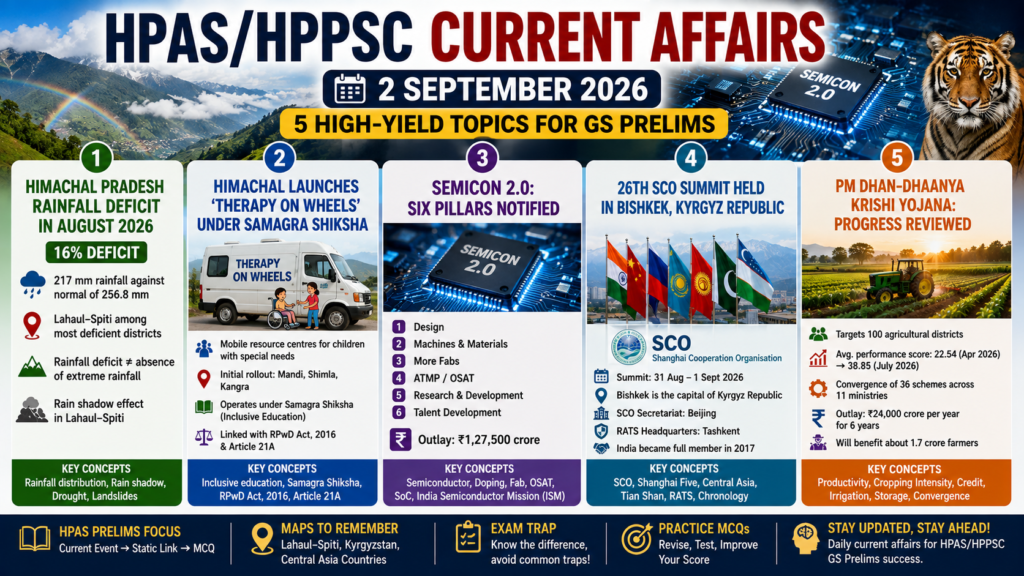
2 September 2026 ke current-affairs pool mein se five developments particularly important hain:
- Himachal Pradesh records 16% rainfall deficit in August 2026
- Himachal launches “Therapy on Wheels” under Samagra Shiksha
- Government notifies six pillars of Semicon 2.0
- 26th SCO Summit held in Bishkek, Kyrgyz Republic
- PM Dhan-Dhaanya Krishi Yojana: progress of 100 agricultural districts reviewed
In topics ko hum exam-oriented chain ke through understand karenge:
Current Event → Static Concept → Institution → Map/Location → Examiner Trap → Probable MCQ
1. Himachal Pradesh Records 16% Rainfall Deficit in August 2026
Priority: VERY HIGH
Himachal Pradesh recorded approximately 16% rainfall deficit during August 2026.
The state received around:
217 mm rainfall
against the normal rainfall of approximately:
256.8 mm
during the month.
Among the districts showing significant deficiency, Lahaul-Spiti was particularly important.
At first glance, this appears to be a simple rainfall-data question. But for HPAS it creates a much larger geography and disaster-management package:
Rainfall Deficit → Rainfall Distribution → Lahaul-Spiti → Rain Shadow → Western Himalaya → Landslides → Flash Floods → Monsoon
What Does a 16% Rainfall Deficit Mean?
Rainfall deficit is calculated by comparing actual rainfall with the climatological normal rainfall for the corresponding period.
Conceptually:
Rainfall Departure (%) = [(Actual Rainfall − Normal Rainfall) ÷ Normal Rainfall] × 100
If actual rainfall is lower than normal, the departure becomes negative.
But an important point is:
A state-wide rainfall deficit does not mean that every district received exactly the same percentage deficit.
Some locations may receive:
- deficient rainfall,
- normal rainfall,
- excess rainfall,
- or even extreme short-duration rainfall.
Rainfall Amount vs Rainfall Distribution
For agriculture and disasters, total monthly rainfall is not enough.
Three things matter:
1. Total rainfall
How much rain fell?
2. Spatial distribution
Where did the rain fall?
3. Temporal distribution
When and how rapidly did it fall?
Suppose a region receives below-normal rainfall over an entire month, but a very large amount falls within only a few hours.
That short-duration event can still produce:
- Flash floods
- Debris flows
- Landslides
- River surges
- Road damage
Therefore:
Rainfall deficit ≠ Absence of extreme rainfall
This is one of the most important examiner traps from this topic.
Does Rainfall Deficit Mean Drought?
Not automatically.
A meteorological rainfall deficit is only one component of drought assessment.
Drought may be classified in several ways:
Meteorological Drought
Persistent rainfall deficiency.
Agricultural Drought
Insufficient soil moisture for crops.
Hydrological Drought
Reduced streamflow, reservoir storage or groundwater availability.
Therefore:
Rainfall deficit and drought are related but are not synonymous.
Why is Lahaul-Spiti Relatively Dry?
Lahaul-Spiti lies in a high-altitude Himalayan environment and large parts of the district experience a rain-shadow effect.
Rain Shadow
When moisture-bearing winds encounter a mountain barrier:
Windward side → Air rises → Cools → Condensation → Rainfall
After crossing the mountain:
Leeward side → Air descends → Warms → Becomes relatively dry
The dry leeward region is called a:
Rain Shadow Region
Large parts of Lahaul-Spiti therefore have a cold-arid or dry temperate environment.
Lahaul-Spiti Geography Revision
Important places and features:
- Keylong — district headquarters
- Spiti River
- Chandra River
- Bhaga River
- Tandi — Chandra and Bhaga meet
- Chenab River — formed after their confluence
- Kunzum Pass
- Rohtang Pass
- Chandra Tal
- Cold desert landscape
Golden River Chain
Chandra + Bhaga → Tandi → Chenab
Rainfall and Landslides
Heavy rainfall may increase:
Pore-water pressure
inside soil or fractured rocks.
This can reduce effective frictional resistance and destabilise slopes.
Simplified process:
Heavy Rain → Infiltration → Saturation → Higher Pore Pressure → Reduced Slope Stability → Landslide
But rainfall is not the only landslide trigger.
Other causes include:
- Earthquakes
- Road cutting
- River undercutting
- Blasting
- Deforestation
- Weak geology
Examiner Traps
- State rainfall deficit does not imply every district was deficient.
- Rainfall-deficit month can still experience flash floods.
- Rainfall deficit does not automatically equal drought.
- Lahaul-Spiti has strong rain-shadow characteristics.
- Flash flood and cloudburst are not synonymous.
- Every landslide is not caused by rainfall.
Probable MCQ
Consider the following statements:
- Himachal Pradesh recorded approximately 16% rainfall deficit during August 2026.
- A rainfall-deficit month cannot experience extreme short-duration precipitation.
- Lahaul-Spiti includes regions influenced by the Himalayan rain-shadow effect.
- Spatial rainfall distribution may differ considerably from state-level averages.
Which statements are correct?
Answer: 1, 3 and 4 only
2. Himachal Pradesh Launches “Therapy on Wheels”
Priority: VERY HIGH
Himachal Pradesh launched mobile resource centre vehicles under an initiative called:
Therapy on Wheels
The programme operates within the:
Inclusive Education component of Samagra Shiksha
Initially, the mobile resource centres are being deployed in:
- Mandi
- Shimla
- Kangra
The purpose is to take specialised services closer to children with special educational and therapeutic needs, particularly in difficult and remote Himalayan areas.
Why Does Himachal Need Mobile Therapy Centres?
Mountainous states face particular accessibility challenges:
Difficult terrain + Dispersed population + Long travel distances + Limited specialised institutions
Families living in remote areas may find it difficult to regularly access:
- physiotherapists,
- occupational therapists,
- speech therapists,
- special educators,
- rehabilitation professionals.
Therapy on Wheels therefore takes specialised services closer to communities.
Services Provided
The mobile centres may provide support such as:
- Physiotherapy
- Occupational therapy
- Speech and language therapy
- Special education
- Assessment
- Counselling
- Rehabilitation support
- Parent guidance
Physiotherapy vs Occupational Therapy
This is a good statement-based MCQ branch.
Physiotherapy
Focuses primarily on:
- movement,
- mobility,
- strength,
- balance,
- physical functioning.
Occupational Therapy
Helps individuals perform activities required for daily living and functional independence.
Examples:
- dressing,
- writing,
- eating,
- school activities,
- fine motor tasks.
Speech and Language Therapy
Focuses on:
- speech,
- language,
- communication,
- voice,
- associated communication disorders.
Samagra Shiksha
The biggest static linkage is:
Samagra Shiksha
It is an integrated school-education programme under the:
Ministry of Education
specifically the:
Department of School Education & Literacy
It covers the school-education continuum broadly from:
Pre-school to Class XII
Earlier Schemes Integrated into Samagra Shiksha
Samagra Shiksha integrated major earlier school-education programmes such as:
- Sarva Shiksha Abhiyan
- Rashtriya Madhyamik Shiksha Abhiyan
- Teacher Education
Therefore it should not be understood as a programme restricted only to primary education.
What is Inclusive Education?
Inclusive education seeks to ensure that children with diverse needs, including children with disabilities, can participate meaningfully in the education system with necessary support.
The central philosophy is:
Adapt the education system to learner diversity rather than automatically segregating the learner from the mainstream system.
Rights of Persons with Disabilities Act
An important legal linkage is:
Rights of Persons with Disabilities Act, 2016
Common abbreviation:
RPwD Act, 2016
Do not confuse it with the earlier:
Persons with Disabilities Act, 1995
The 2016 law expanded the recognised disability framework and strengthened rights-based provisions.
Article 21A
Another relevant constitutional provision:
Article 21A
provides the Right to Education for children between:
6 and 14 years
as provided by law.
The Constitution was amended through the:
86th Constitutional Amendment Act, 2002
Initial Himachal Districts
Remember:
Mandi + Shimla + Kangra
These are the initial districts.
Important examiner trap:
Initial rollout in three districts does not mean that the scheme is permanently restricted only to these districts.
Master Memory Chain
Therapy on Wheels → Himachal → Mandi + Shimla + Kangra → Samagra Shiksha → Inclusive Education → Ministry of Education → RPwD Act 2016 → Article 21A
Probable MCQ
Consider the following statements regarding Himachal Pradesh’s Therapy on Wheels initiative:
- It operates under Samagra Shiksha.
- Initial implementation includes Mandi, Shimla and Kangra.
- It is concerned exclusively with speech therapy.
- It seeks to improve access to specialised services in remote areas.
Answer: 1, 2 and 4 only
3. Semicon 2.0: Six Pillars of India’s Semiconductor Strategy
Priority: VERY HIGH
The Government has notified the six pillars of India’s expanded:
Semicon 2.0 Programme
The programme has an approved outlay of approximately:
₹1,27,500 crore
Semicon 2.0 seeks to strengthen the semiconductor ecosystem across the entire value chain rather than focusing only on chip fabrication.
Six Pillars of Semicon 2.0
The six pillars are:
1. Design
Development of semiconductor and chip-design capabilities.
2. Machines and Materials
Building capabilities in manufacturing equipment, chemicals, gases, wafers and specialised materials.
3. More Fabs
Expansion of semiconductor fabrication capacity.
4. ATMP / OSAT
Strengthening semiconductor packaging, assembly and testing.
5. Research & Development
Support for next-generation semiconductor technologies.
6. Talent Development
Creation of skilled human resources.
Easy Memory Trick
Design → Machines → Fabs → Packaging → Research → People
What is a Semiconductor?
A semiconductor is a material whose electrical conductivity lies broadly between that of:
Conductor
and:
Insulator
The most widely used semiconductor material is:
Silicon
Other important semiconductor materials include:
- Germanium
- Gallium arsenide
- Gallium nitride
- Silicon carbide
Why is Silicon So Important?
Silicon is widely used because it offers:
- suitable semiconductor properties,
- abundant availability,
- mature manufacturing ecosystem,
- ability to form a stable oxide layer.
Semiconductor materials form the basis of:
- processors,
- memory chips,
- sensors,
- communication devices,
- automobiles,
- smartphones,
- defence electronics,
- AI hardware.
What is Doping?
Pure semiconductor material has limited conductivity.
Small quantities of selected impurities can be deliberately introduced to modify its electrical behaviour.
This process is called:
Doping
Doping can produce:
n-type semiconductor
and:
p-type semiconductor
Important trap:
Semiconductor “doping” has no connection with performance-enhancing drugs in sport.
What is a Fab?
Fab = Fabrication Facility
A semiconductor fab is a highly specialised manufacturing facility where semiconductor wafers are processed to manufacture integrated circuits.
What is a Wafer?
A wafer is a thin slice of semiconductor material, usually silicon.
Electronic circuits are fabricated on its surface through multiple complex processes.
Fab vs ATMP
Another extremely important distinction:
Fab
Actual semiconductor circuits are manufactured on wafers.
ATMP
ATMP stands for:
Assembly, Testing, Marking and Packaging
This comes largely in the back-end stage after semiconductor fabrication.
OSAT
OSAT means:
Outsourced Semiconductor Assembly and Test
Companies specialising in semiconductor packaging and testing may perform these functions for chip manufacturers.
Trap
Fab ≠ ATMP ≠ OSAT
They are interconnected but different parts of the value chain.
System-on-Chip — SoC
A System-on-Chip integrates several functions or electronic components onto a single chip.
A modern SoC can include:
- CPU
- GPU
- memory controllers
- communication interfaces
- AI accelerators
on one integrated platform.
India Semiconductor Mission
India’s semiconductor programmes are implemented through:
India Semiconductor Mission — ISM
under:
Ministry of Electronics and Information Technology — MeitY
Exam Chain
Semicon 2.0 → ISM → MeitY
Why Are Semiconductors Strategically Important?
Semiconductors are essential for:
- Telecom
- Defence
- Artificial Intelligence
- Automobiles
- Consumer electronics
- Renewable energy systems
- Space technology
- Medical equipment
Therefore semiconductor manufacturing is not only an industrial issue but also a:
National-security and supply-chain issue
Examiner Traps
- Silicon is a semiconductor, not a perfect conductor.
- Fab refers to fabrication.
- ATMP relates to assembly/testing/marking/packaging.
- SoC means System-on-Chip.
- Semicon 2.0 is not limited only to fabrication.
- India Semiconductor Mission operates under MeitY.
Probable MCQ
Consider the following:
- Semiconductor design
- Machines and materials
- ATMP/OSAT
- Research and development
- Talent development
Which of the above form part of Semicon 2.0?
Answer: All five
4. 26th SCO Summit Held in Bishkek
Priority: VERY HIGH
The:
26th Shanghai Cooperation Organisation Summit
was held in:
Bishkek, Kyrgyz Republic
from:
31 August–1 September 2026
The summit is particularly significant because 2026 marks 25 years of the SCO.
The summit adopted the:
Bishkek Declaration
along with multiple decisions and agreements covering issues such as:
- Security
- Climate
- Energy
- Nuclear safety
- Connectivity
- Drug trafficking
- Cultural and scientific cooperation
Shanghai Cooperation Organisation
The SCO evolved from an earlier grouping known as:
Shanghai Five
The Shanghai Five framework was created in:
1996
It originally involved:
- China
- Russia
- Kazakhstan
- Kyrgyzstan
- Tajikistan
When Uzbekistan joined, the:
Shanghai Cooperation Organisation
was formally established in:
2001
Important Chronology
1996
Shanghai Five
2001
SCO established
2017
India and Pakistan became full members
2026
25th anniversary of SCO
This chronology is extremely important for Prelims.
SCO Headquarters
The permanent SCO Secretariat is located in:
Beijing, China
Do not confuse it with the summit’s original city name Shanghai.
RATS
Another important institution is:
Regional Anti-Terrorist Structure — RATS
Its headquarters is located in:
Tashkent, Uzbekistan
Golden Pair
SCO Secretariat → Beijing
RATS → Tashkent
What Does RATS Deal With?
RATS is associated with cooperation against what SCO terminology often calls the:
“Three Evils”
These are:
- Terrorism
- Separatism
- Extremism
This is a classic matching question.
Kyrgyzstan Geography
The summit venue puts Kyrgyzstan in focus.
Capital:
Bishkek
Neighbours:
- Kazakhstan
- China
- Tajikistan
- Uzbekistan
It is:
Landlocked
and does not share a direct border with India.
Tian Shan Mountains
Kyrgyzstan is strongly associated with the:
Tian Shan
mountain system.
The Tian Shan extends across parts of Central Asia and western China.
Its name is often translated as:
“Celestial Mountains” or “Heavenly Mountains”
Issyk-Kul
One of Kyrgyzstan’s most famous geographical features is:
Lake Issyk-Kul
It is a large high-altitude inland lake located within the Tian Shan region.
Important trap:
Issyk-Kul is not the Aral Sea.
Five Central Asian Republics and Capitals
| Country | Capital |
|---|---|
| Kazakhstan | Astana |
| Kyrgyzstan | Bishkek |
| Tajikistan | Dushanbe |
| Turkmenistan | Ashgabat |
| Uzbekistan | Tashkent |
These five should be memorised together.
India and SCO
India became a full member in:
2017
India’s SCO participation involves issues such as:
- Regional security
- Counter-terrorism
- Central Asian connectivity
- Energy
- Trade
- Cultural cooperation
Connectivity Trap
India has repeatedly emphasised that connectivity initiatives should respect:
- Sovereignty
- Territorial integrity
This creates a broader map-based linkage with Central Asia.
Examiner Traps
- SCO Secretariat is in Beijing, not Shanghai.
- RATS is in Tashkent.
- Bishkek is the capital of Kyrgyzstan.
- Kyrgyzstan does not border India.
- India was not a founding SCO member in 2001.
- Tian Shan is associated with Central Asia.
- SCO is not a military alliance identical to NATO.
Master Memory Chain
Shanghai Five 1996 → SCO 2001 → Secretariat Beijing → RATS Tashkent → India 2017 → 26th Summit Bishkek → Kyrgyzstan → Tian Shan → Issyk-Kul
Probable MCQ
Consider the following pairs:
- SCO Secretariat — Beijing
- RATS — Tashkent
- Kyrgyzstan — Bishkek
- Kyrgyzstan — Tian Shan
Which are correctly matched?
Answer: All four
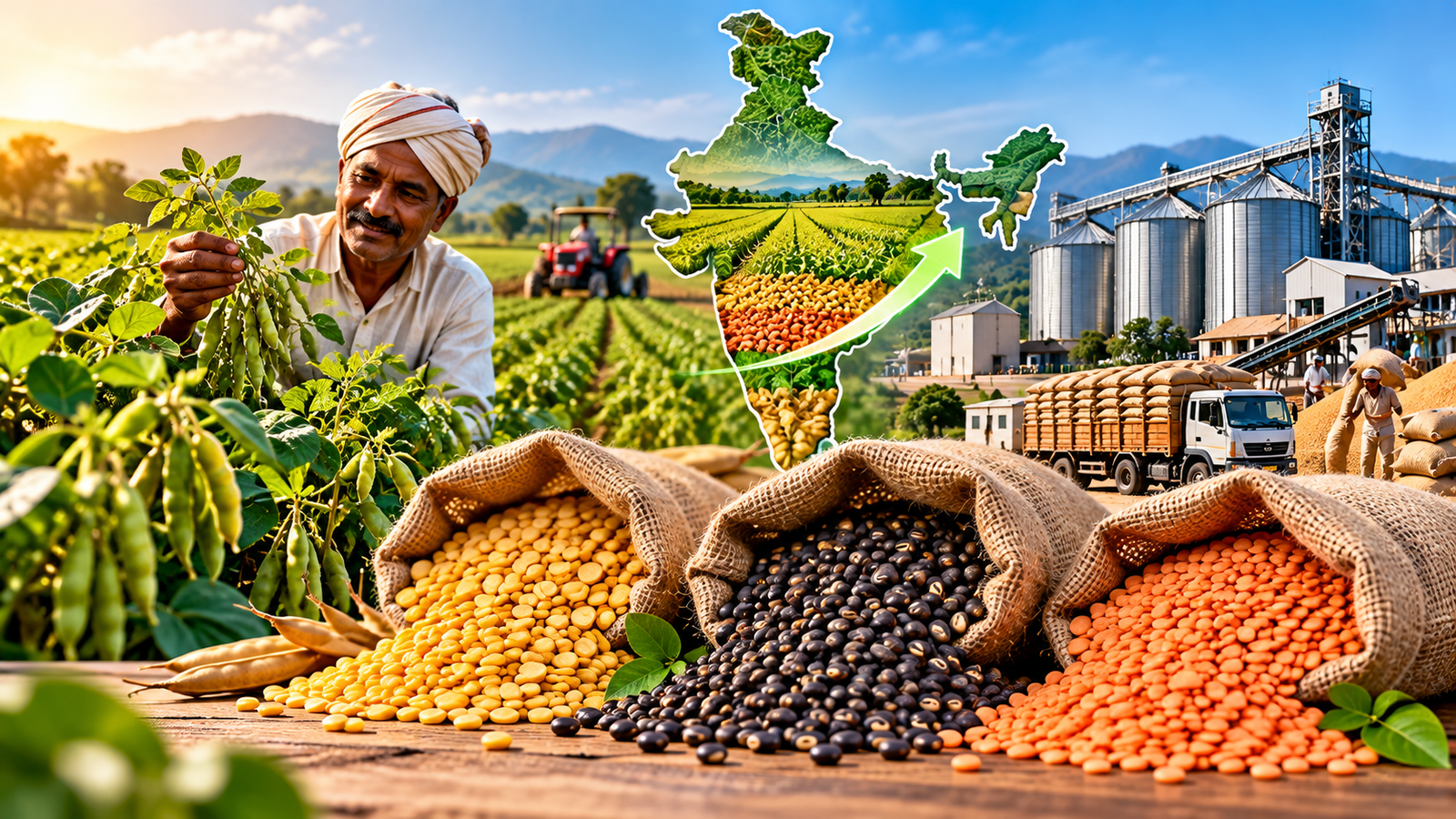
5. PM Dhan-Dhaanya Krishi Yojana: 100 Agricultural Districts
Priority: HIGH
The Union Agriculture Ministry reviewed the progress of the:
Prime Minister Dhan-Dhaanya Krishi Yojana — PM-DDKY
The programme focuses on:
100 identified agricultural districts
All 100 districts have prepared/uploaded their district-level action plans.
The average performance score of these districts improved from approximately:
22.54 in April 2026
to:
38.85 in July 2026
Key Numbers
The scheme involves convergence of approximately:
36 schemes
across:
11 ministries
with an annual outlay of around:
₹24,000 crore
for:
Six years
and is expected to benefit approximately:
1.7 crore farmers
These numbers are highly suitable for HPPSC statement-based questions.
Why Were These Districts Selected?
The selection focuses particularly on districts facing problems such as:
- Low agricultural productivity
- Low cropping intensity
- Low agricultural credit disbursement
This gives us three major static concepts.
Agricultural Productivity
In crop agriculture, productivity commonly refers to:
Output per unit area
For example:
kg/hectare
or:
tonnes/hectare
Important distinction:
Production
Total crop output.
Productivity
Output per unit area.
Therefore:
Higher production does not automatically mean higher productivity.
A very large cultivated area may produce more total output while having lower yield per hectare.
Cropping Intensity
Cropping intensity tells us how frequently agricultural land is cultivated during a year.
Formula:
Cropping Intensity = (Gross Cropped Area ÷ Net Sown Area) × 100
Net Sown Area
Area cultivated at least once during an agricultural year.
A field is counted only once even if multiple crops are grown on it.
Gross Cropped Area
Total area under all crops during a year.
If the same field is cultivated twice, it is counted twice.
Therefore:
Gross Cropped Area can exceed Net Sown Area
and:
Cropping Intensity can exceed 100%
Example
Suppose:
Net Sown Area = 100 hectares
Some land is double cropped and Gross Cropped Area = 150 hectares.
Then:
Cropping Intensity = 150 ÷ 100 × 100 = 150%
Main Objectives of PM-DDKY
The programme seeks to improve:
- Agricultural productivity
- Crop diversification
- Sustainable agriculture
- Irrigation
- Agricultural credit
- Post-harvest storage
- Local agricultural infrastructure
Convergence Approach
PM-DDKY is important because it does not simply operate as another isolated government scheme.
It uses:
Convergence
That means existing schemes and programmes of different ministries are coordinated towards common district-level goals.
Therefore:
PM-DDKY is not simply a direct cash-transfer programme.
Aspirational Districts Programme Link
PM-DDKY draws inspiration from the approach of India’s:
Aspirational Districts Programme
The Aspirational Districts Programme was launched in:
2018
and is strongly associated with:
NITI Aayog
Major Number Trap
PM Dhan-Dhaanya Krishi Yojana
100 districts
Aspirational Districts Programme
112 districts
Do not interchange the numbers.
Agricultural Credit
Agricultural credit includes institutional finance available for agricultural activities.
Important institutions may include:
- Commercial banks
- Cooperative banks
- Regional Rural Banks
- NABARD-linked rural credit architecture
NABARD
National Bank for Agriculture and Rural Development
is India’s major apex development financial institution for agriculture and rural development.
Post-Harvest Infrastructure
The scheme also emphasises storage and post-harvest management.
Why is this important?
Without adequate storage, farmers may face:
- post-harvest losses,
- distress sales,
- lower price realisation,
- quality deterioration.
Therefore agricultural policy increasingly focuses not only on production but also on:
Storage + Processing + Logistics + Markets
Examiner Traps
- PM-DDKY covers 100 agricultural districts.
- Aspirational Districts Programme covers 112 districts.
- Cropping intensity and productivity are different.
- Cropping intensity can exceed 100%.
- Gross cropped area can exceed net sown area.
- Scheme uses convergence; it is not simply a cash transfer.
- District selection is not based only on rainfall.
Probable MCQ
Consider the following statements regarding PM Dhan-Dhaanya Krishi Yojana:
- It focuses on 100 agricultural districts.
- Low agricultural productivity is one criterion for district identification.
- It seeks convergence of multiple government schemes.
- It is exclusively a direct-income-transfer programme.
Answer: 1, 2 and 3 only
Final Rapid Revision Table
| Topic | Current Fact | Static Concepts |
|---|---|---|
| HP Rainfall | 16% deficit; ~217 mm vs 256.8 mm | Rain shadow, rainfall distribution, drought, landslides |
| Therapy on Wheels | Initial rollout in Mandi, Shimla & Kangra | Samagra Shiksha, inclusive education, RPwD Act |
| Semicon 2.0 | Six pillars; ₹1,27,500 crore | Semiconductor, doping, Fab, ATMP/OSAT, ISM |
| SCO Summit | 26th Summit at Bishkek | SCO chronology, RATS, Central Asia, Tian Shan |
| PM-DDKY | 100 agricultural districts | Productivity, cropping intensity, convergence |
Five Last-Minute Memory Chains
1. Himachal Rainfall
16% deficit → 217 mm vs 256.8 mm → rainfall distribution → Lahaul-Spiti → rain shadow → extreme events still possible
2. Therapy on Wheels
Mandi + Shimla + Kangra → Samagra Shiksha → Inclusive Education → RPwD Act 2016 → Article 21A
3. Semicon 2.0
₹1.275 lakh crore → Design → Machines → Fabs → ATMP/OSAT → R&D → Talent → ISM → MeitY
4. SCO
Shanghai Five 1996 → SCO 2001 → Beijing Secretariat → Tashkent RATS → India 2017 → Bishkek 2026 → Tian Shan
5. PM-DDKY
100 districts → 36 schemes → 11 ministries → ₹24,000 crore/year → Productivity → Cropping Intensity → Irrigation → Credit → Storage
Quick Practice Test
Q1. A rain-shadow region generally develops on which side of a mountain barrier?
A. Windward side
B. Leeward side
C. Equatorial side only
D. River-facing side
Answer: B
Q2. Therapy on Wheels in Himachal is associated with:
A. PM-JAY
B. Samagra Shiksha
C. PMGSY
D. Jal Jeevan Mission
Answer: B
Q3. Which one is correctly matched?
A. Fab — Semiconductor fabrication facility
B. ATMP — Atomic Testing Mission Programme
C. SoC — Supply of Chips
D. ISM — Indian Space Mission
Answer: A
Q4. SCO Secretariat is located at:
A. Shanghai
B. Tashkent
C. Beijing
D. Bishkek
Answer: C
Q5. RATS headquarters is located at:
A. Tashkent
B. Astana
C. Moscow
D. Dushanbe
Answer: A
Q6. Bishkek is the capital of:
A. Uzbekistan
B. Kyrgyzstan
C. Kazakhstan
D. Tajikistan
Answer: B
Q7. PM Dhan-Dhaanya Krishi Yojana focuses on:
A. 50 districts
B. 75 districts
C. 100 districts
D. 112 districts
Answer: C
Q8. Cropping intensity is calculated using:
A. Net Sown Area ÷ Gross Cropped Area
B. Gross Cropped Area ÷ Net Sown Area
C. Production ÷ Rainfall
D. Yield ÷ Irrigated Area
Answer: B
Q9. India became a full member of SCO in:
A. 2001
B. 2005
C. 2014
D. 2017
Answer: D
Q10. The Rights of Persons with Disabilities Act was enacted in:
A. 1995
B. 2002
C. 2016
D. 2020
Answer: C
Conclusion
The current affairs of 2 September 2026 once again demonstrate why HPAS/HPPSC preparation should move beyond headline memorisation.
Himachal’s 16% rainfall deficit becomes a geography question on rain shadow, spatial rainfall variability, drought and Himalayan hazards.
Therapy on Wheels becomes a polity and social-sector question on Samagra Shiksha, inclusive education, the RPwD Act and Article 21A.
Semicon 2.0 becomes a science question on silicon, semiconductor doping, fabs, ATMP/OSAT and India Semiconductor Mission.
The SCO Summit in Bishkek opens the entire Central Asian map—from Tian Shan and Issyk-Kul to Beijing Secretariat and Tashkent RATS.
And PM Dhan-Dhaanya Krishi Yojana transforms into an agriculture question on productivity, cropping intensity, agricultural credit, storage and convergence.