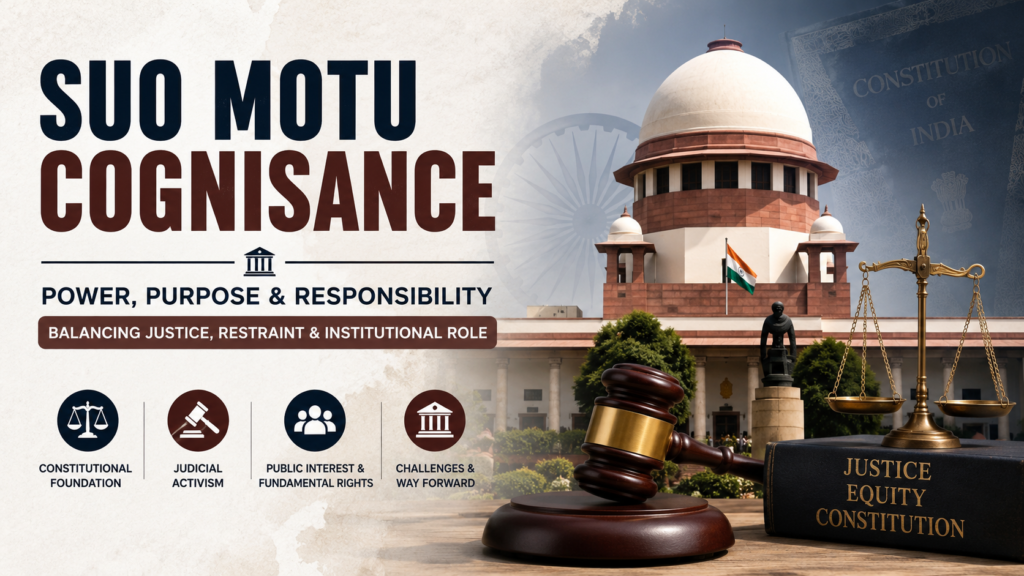
Suo Motu Cognisance: When Courts Act on Their Own
Why is it in News?
The Supreme Court of India has increasingly been using its suo motu powers, meaning it takes up certain matters on its own without waiting for a formal petition or complaint. Traditionally, this power was used only in exceptional situations, but in recent years it has become more frequent.
Many of these cases come to the Court’s attention through media reports, television debates, social media discussions, or public concerns. While this allows the judiciary to respond quickly to urgent issues, it has also sparked debates about judicial overreach and whether such interventions bypass lower courts that are already handling these matters.
For UPSC aspirants, this topic is important because it relates to the judiciary, judicial activism, separation of powers, and constitutional governance.
What is Suo Motu Cognisance?
The term “Suo Motu” is a Latin phrase that means “on its own motion” or “on its own initiative.”
Suo motu cognisance refers to the power of a court to initiate legal proceedings without receiving a formal complaint, petition, or application from an affected person.
In simple words, if the court notices a serious violation of law, fundamental rights, or public interest through newspapers, reports, or other sources, it can start hearing the matter on its own.
Example
Suppose a newspaper reports severe human rights violations in a prison. Even if no prisoner files a petition, the Supreme Court or a High Court may take suo motu cognisance and seek explanations from the authorities.
Constitutional Basis of Suo Motu Powers
The Constitution does not explicitly use the term “suo motu cognisance.” However, courts derive this power from their constitutional responsibilities.
Article 32
- Empowers the Supreme Court to protect Fundamental Rights.
- Citizens can directly approach the Supreme Court when their rights are violated.
- The Court may also act on its own in extraordinary situations involving public interest and fundamental rights.
Article 226
- Empowers High Courts to issue writs for the enforcement of Fundamental Rights and other legal rights.
- High Courts also exercise suo motu jurisdiction when necessary.
Article 142
- Allows the Supreme Court to pass any order necessary to do “complete justice” in a case.
- Often cited as an important source of the Court’s broad powers.
Role of the Ministry of Law and Justice
The Ministry of Law and Justice does not control judicial decisions but supports the judiciary through:
- Judicial infrastructure development
- Appointment-related processes
- Administrative coordination
- Budgetary support
Thus, while courts independently exercise suo motu powers, the ministry assists in maintaining the judicial system.
Why Do Courts Use Suo Motu Powers?
Courts generally invoke suo motu jurisdiction in exceptional situations such as:
1. Protection of Fundamental Rights
When large sections of society face violations of constitutional rights and are unable to approach courts.
2. Human Rights Violations
Cases involving:
- Custodial deaths
- Police brutality
- Prison conditions
- Violence against vulnerable groups
3. Environmental Issues
Courts may intervene in cases involving:
- River pollution
- Deforestation
- Illegal mining
- Ecological destruction
4. Public Safety and Governance Failures
Examples include:
- Industrial disasters
- Stampedes
- Building collapses
- Administrative negligence
5. Extraordinary Circumstances
During emergencies or crises where immediate judicial attention becomes necessary.
Nature of Suo Motu Jurisdiction
Suo motu power is considered a:
Residual Power
It is not intended to replace the normal judicial process.
Instead, it is used only when:
- Existing legal remedies are ineffective.
- Authorities fail to act.
- Victims cannot easily access justice.
- Urgent intervention is required.
Extraordinary Power
The judiciary treats it as an exceptional mechanism rather than a routine judicial function.
What Does Suo Motu Jurisdiction Not Cover?
Suo motu powers are generally not meant for:
- Routine civil disputes
- Regular criminal appeals
- Property disputes
- Service matters
- Ordinary litigation already progressing through normal judicial channels
The purpose is not to replace established legal procedures but to address exceptional situations requiring urgent intervention.
Benefits of Suo Motu Cognisance
Ensures Quick Justice
Courts can respond immediately to serious issues without waiting for lengthy legal procedures.
Protects Vulnerable Groups
Many affected individuals may lack the resources, awareness, or ability to approach courts.
Strengthens Accountability
Government authorities and institutions become more accountable when courts actively monitor important public issues.
Upholds Constitutional Values
The judiciary can safeguard:
- Rule of law
- Human dignity
- Fundamental rights
- Public interest
Concerns Regarding Increasing Use of Suo Motu Powers
Despite its advantages, the growing use of suo motu jurisdiction has raised several concerns.
1. Judicial Overreach
Critics argue that excessive intervention may push the judiciary into areas traditionally handled by:
- Legislature
- Executive
- Administrative agencies
This may blur the principle of Separation of Powers.
2. Media-Driven Justice
Many cases receive attention because of:
- Television debates
- Viral social media posts
- Extensive media coverage
Critics question whether courts should prioritize issues based on media visibility rather than objective legal importance.
3. Bypassing Lower Courts
India has a hierarchical judicial system:
- District Courts
- High Courts
- Supreme Court
Frequent direct intervention by higher courts may undermine the authority and effectiveness of subordinate courts.
4. Unequal Allocation of Judicial Time
Cases receiving public attention may get immediate hearings, while many equally important matters remain pending.
This can affect judicial efficiency and fairness.
“The Apex Court Rings Its Own Chain” – Meaning
The phrase suggests that the Supreme Court should exercise self-restraint while using suo motu powers.
In other words, the Court itself must establish limits and safeguards regarding when and how these powers should be used.
Suggested Reforms
1. Adopt Judicial Restraint
The Supreme Court should view suo motu jurisdiction as:
- An exceptional remedy
- A last resort mechanism
- A tool for extraordinary circumstances only
It should intervene primarily when there is a complete failure of the legal system to provide justice.
2. Strengthen the Subordinate Judiciary
Instead of relying solely on direct intervention, efforts should focus on:
- Filling judicial vacancies
- Improving court infrastructure
- Increasing judicial manpower
- Reducing case pendency
A stronger lower judiciary reduces the need for extraordinary intervention.
3. Establish Clear Selection Criteria
Courts should develop transparent guidelines for deciding:
- Which cases deserve suo motu attention
- What factors justify intervention
- How urgency and public interest should be assessed
This would reduce perceptions of arbitrariness.
Way Forward
Suo motu cognisance remains an important constitutional tool for protecting rights and ensuring justice. However, its effectiveness depends on careful and limited use.
A balanced approach should:
- Preserve judicial activism where necessary.
- Respect the role of lower courts.
- Maintain separation of powers.
- Ensure transparency and consistency in judicial interventions.
The goal should be to use suo motu powers as an exceptional safeguard for justice, not as a routine substitute for normal legal processes.
UPSC Mains Perspective
Previous Year Question (UPSC CSE Mains 2024)
Q. Explain the reasons for the growth of Public Interest Litigation (PIL) in India. As a result of it, has the Indian Supreme Court emerged as the world’s most powerful judiciary? (250 words)
Relevance to This Topic
The growth of:
- PILs
- Judicial Activism
- Suo Motu Cognisance
has significantly expanded the role of the Indian judiciary in governance and rights protection. However, it has also generated debates about judicial overreach and institutional balance.
UPSC Prelims Perspective
UPSC CSE Prelims 2014
Q. With reference to the Constitution of India, consider the following statements:
- No High Court shall have the jurisdiction to declare any Central law to be constitutionally invalid.
- An amendment to the Constitution of India cannot be called into question by the Supreme Court of India.
Which of the statements given above is/are correct?
(a) 1 only
(b) 2 only
(c) Both 1 and 2
(d) Neither 1 nor 2
Correct Answer: (d) Neither 1 nor 2
Explanation
- Statement 1 is incorrect: High Courts have the power of judicial review and can declare a Central law unconstitutional.
- Statement 2 is incorrect: The Supreme Court can review Constitutional Amendments under the Basic Structure Doctrine, established in the landmark case of Kesavananda Bharati v. State of Kerala.
Exam Keywords to Remember
- Suo Motu Cognisance
- Judicial Activism
- Judicial Restraint
- Article 32
- Article 226
- Article 142
- Fundamental Rights
- Public Interest Litigation (PIL)
- Judicial Overreach
- Separation of Powers
- Rule of Law
- Subordinate Judiciary
- Basic Structure Doctrine
UPSC Syllabus Link: GS Paper II – Indian Constitution, Judiciary, Separation of Powers, Judicial Activism, Public Interest Litigation (PIL), and Governance.