Indus Valley Civilization (Harappan Civilization): Features, Major Sites, Decline and Legacy
Why is it in News?
Renowned archaeologist Shereen Ratnagar recently passed away. She was widely respected for her pioneering research on the Indus Valley Civilization (IVC) and her innovative approach to understanding ancient societies through anthropology, trade networks, and economic systems.
Her work helped historians view the Harappan Civilization not merely as an archaeological discovery but as a complex and interconnected urban civilization with extensive international trade links.
For UPSC aspirants, the Indus Valley Civilization is one of the most important topics in Ancient Indian History, frequently appearing in both Prelims and Mains examinations.
What is the Indus Valley Civilization?
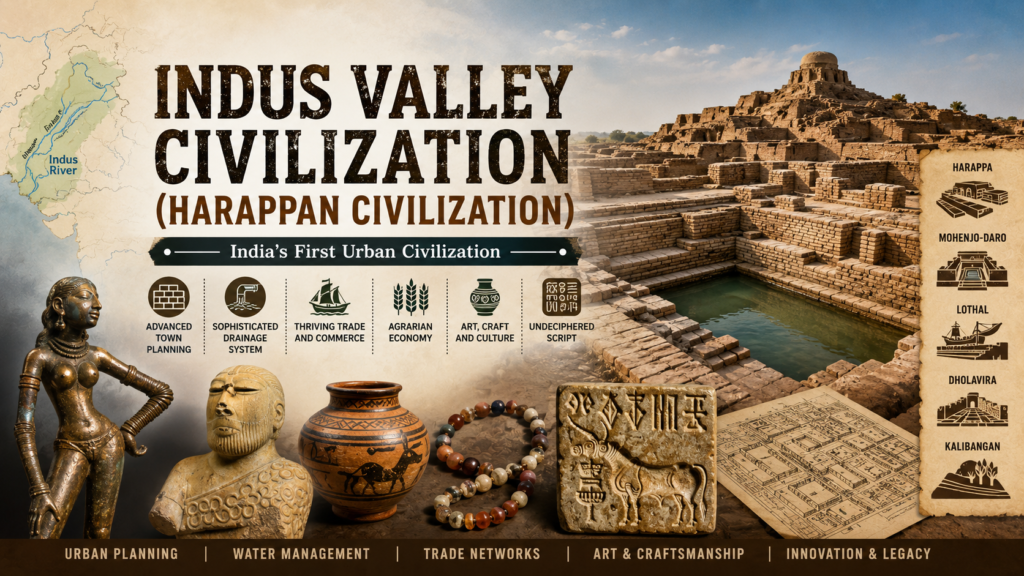
The Indus Valley Civilization (IVC), also known as the Harappan Civilization, was one of the world’s earliest urban civilizations.
It flourished during the Bronze Age and reached its mature phase between 2600 BCE and 1900 BCE.
The civilization developed along the Indus River and its tributaries and is considered one of the three great early civilizations of the ancient world, alongside:
- Ancient Egypt
- Mesopotamia
- Indus Valley Civilization
Among these, the Harappan Civilization was remarkable for its vast geographical spread, advanced urban planning, and sophisticated civic administration.
Legal Protection of Harappan Sites
In India, archaeological sites related to the Harappan Civilization are protected under the:
Ancient Monuments and Archaeological Sites and Remains (AMASR) Act, 1958
The Act aims to:
- Protect historical monuments
- Regulate archaeological excavations
- Prevent illegal construction near protected sites
- Preserve India’s cultural heritage
Geographical Extent of the Civilization
The Harappan Civilization covered an area of approximately 1.3 million square kilometres, making it the largest among contemporary ancient civilizations.
Boundaries
- West: Sutkagan Dor (Pakistan-Iran border)
- East: Alamgirpur (Uttar Pradesh)
- North: Manda (Jammu)
- South: Daimabad (Maharashtra)
The civilization extended across present-day:
- India
- Pakistan
- Afghanistan
Major Harappan Sites
1. Harappa
Harappa
- First Harappan site discovered.
- Excavated in 1921 by Daya Ram Sahni.
- Located in present-day Pakistan.
Important Features
- Massive granaries
- Planned settlements
- Worker quarters
- Advanced storage facilities
The civilization derives its name from this site.
2. Mohenjo-daro
Mohenjo-daro
Discovered in 1922 by Rakhaldas Banerji.
Important Discoveries
- Great Bath
- Assembly Hall
- Granary
- Dancing Girl Bronze Statue
- Bearded Priest Sculpture
Great Bath
One of the most remarkable public structures of the ancient world.
It was probably used for:
- Ritual bathing
- Religious ceremonies
- Community gatherings
3. Lothal
Lothal
Significance
- Major maritime trade centre.
- Known for the world’s earliest artificial dockyard.
Features
- Dockyard connected to river channels.
- Evidence of overseas trade.
- Bead-making industry.
- Warehouse facilities.
Lothal played a crucial role in trade with Mesopotamia and West Asia.
4. Dholavira
Dholavira
One of the most spectacular Harappan cities.
Important Features
- Three-tier city planning
- Sophisticated water conservation system
- Stone-built reservoirs
- Massive fortifications
Dholavira demonstrates the extraordinary engineering skills of the Harappans.
5. Kalibangan
Kalibangan
Important Features
- Earliest known ploughed agricultural field
- Fire altars
- Planned urban settlement
The discovery of ploughed fields provides evidence of advanced agricultural practices.
Urban Planning: The Greatest Achievement of Harappans
The Harappan Civilization is famous for its remarkable town planning.
Unlike many ancient settlements that grew randomly, Harappan cities were carefully designed.
Grid Pattern Layout
Cities were built using a grid system.
Characteristics
- Roads crossed each other at right angles.
- Straight streets divided the city into blocks.
- Residential and public areas were clearly organized.
This reflects advanced civic administration and planning.
Division of Cities
Most cities had two major parts:
Citadel
- Located on elevated ground.
- Contained important public buildings.
- Possibly housed administrators or elites.
Lower Town
- Residential area for the majority of the population.
- Well-planned houses and streets.
Fortifications and Granaries
Major cities were surrounded by strong defensive walls.
Purpose
- Protection from floods
- Security
- Administrative control
Granaries
Large granaries were built to store surplus food grains.
Their existence suggests:
- Agricultural prosperity
- Organized administration
- Efficient resource management
Advanced Drainage System
The drainage system of the Harappans remains one of their greatest achievements.
Features
- Every house had a drainage outlet.
- Drains connected to larger street drains.
- Covered drains prevented contamination.
- Inspection chambers enabled maintenance.
No other contemporary civilization possessed such an advanced sanitation network.
Standardized Burnt Bricks
Harappans extensively used kiln-burnt bricks.
Standard Ratio
Most bricks followed a uniform ratio:
4 : 2 : 1
(Length : Breadth : Thickness)
This remarkable uniformity across distant regions indicates strong administrative coordination.
Economy of the Harappans
The economy was based on:
- Agriculture
- Animal husbandry
- Trade
- Craft production
Agriculture
Major crops included:
- Wheat
- Barley
- Peas
- Sesame
Earliest Cotton Producers
The Harappans were the earliest known people in the world to cultivate cotton.
Because of this, Greeks later referred to cotton as:
“Sindon” (cloth from Sindh)
Animal Husbandry
Animals reared included:
- Cattle
- Buffaloes
- Sheep
- Goats
Evidence also exists for:
- Dogs
- Camels
- Elephants
Trade and Commerce
The Harappans maintained extensive internal and external trade networks.
Important Trade Partners
- Mesopotamia
- Oman
- Persia
- Gulf Region
Mesopotamian records refer to the Harappan region as:
Meluhha
This confirms strong international commercial relations.
Lothal Dockyard
The dockyard at Lothal indicates:
- Maritime expertise
- Organized overseas trade
- Ship-building capabilities
Art and Craftsmanship
Harappan artisans were highly skilled.
Important Artifacts
Dancing Girl
- Bronze statue
- Made using Lost-Wax Technique
Bearded Priest
- Stone sculpture
- Reflects artistic sophistication
Terracotta Figurines
- Human and animal forms
- Possibly religious and decorative
Pottery
- Red pottery with black designs
- Geometric patterns
Seals and Script
More than 2,000 seals have been discovered.
Material
Mostly made of:
- Steatite
Common Motifs
- Unicorn
- Bull
- Elephant
- Rhinoceros
- Tiger
Harappan Script
The script remains undeciphered.
Characteristics
- Pictographic
- Short inscriptions
- Appears on seals and pottery
Since it has not been deciphered, much about Harappan administration and language remains unknown.
Religion of the Harappans
Harappan religion appears to have been closely linked to nature and fertility.
Evidence Suggests Worship Of:
- Mother Goddess
- Trees (especially Pipal)
- Animals
- Natural forces
Pashupati Seal
Many historians associate the famous Pashupati seal with an early form of Shiva worship.
However, this interpretation remains debated.
Political System
Unlike Egypt and Mesopotamia, no monumental palaces or grand royal tombs have been discovered.
This suggests:
- Decentralized administration
- Strong merchant influence
- Limited concentration of political power
Was the Harappan Civilization Peaceful?
Archaeologists have found:
- Few weapons
- Limited evidence of warfare
- No military monuments
This suggests that Harappan society was largely focused on:
- Trade
- Agriculture
- Urban life
rather than military expansion.
Decline of the Harappan Civilization
Around 1900 BCE, the civilization entered its Late Harappan Phase and gradually declined.
Modern historians reject the older theory of a sudden foreign invasion.
Instead, multiple factors likely contributed.
1. Climate Change
Changes in monsoon patterns may have caused:
- Reduced rainfall
- Agricultural decline
- Water scarcity
2. Drying of River Systems
Geological changes may have altered river courses.
Many scholars associate this with the decline of the Saraswati-Ghaggar river system.
3. Ecological Degradation
Continuous use of resources may have resulted in:
- Deforestation
- Soil exhaustion
- Environmental stress
4. Economic Disruptions
Decline in long-distance trade could have weakened urban centres.
Legacy of the Harappan Civilization
Although cities declined, Harappan traditions influenced later Indian civilization.
Enduring Contributions
- Urban planning principles
- Drainage systems
- Standardized weights and measures
- Pottery traditions
- Water conservation techniques
- Religious symbols and motifs
Many of these elements continued to shape South Asian society for centuries.
Significance of Shereen Ratnagar’s Contribution
Shereen Ratnagar transformed the study of the Harappan Civilization by focusing on:
- Trade networks
- Economic organization
- Social structures
- Interaction with other Bronze Age civilizations
Her research helped explain how Harappan cities functioned within a broader global trading system.
UPSC Prelims Focus
Important Sites and Their Features
| Site | Important Feature |
|---|---|
| Harappa | Granary |
| Mohenjo-daro | Great Bath |
| Lothal | Dockyard |
| Dholavira | Water Management System |
| Kalibangan | Ploughed Field & Fire Altars |
Previous Year Question (UPSC Prelims 2021)
Q. Which ancient town is famous for its elaborate water harvesting and water management system through interconnected reservoirs?
(a) Dholavira
(b) Kalibangan
(c) Lothal
(d) Rakhigarhi
Correct Answer: (a) Dholavira
Exam Keywords
- Indus Valley Civilization
- Harappan Civilization
- Bronze Age
- Great Bath
- Dockyard
- Dholavira
- Drainage System
- Burnt Bricks
- Granary
- Meluhha
- Pashupati Seal
- Dancing Girl
- Harappan Script
- Urban Planning
- Water Management
UPSC Syllabus Reference
GS Paper I – Indian Heritage and Culture, Ancient Indian History, Salient Features of Indus Valley Civilization and Urbanization in Ancient India.