
Unlocking Nuclear Non-Proliferation: The Mechanics and Significance of Uranium Downblending
Why is it in News?
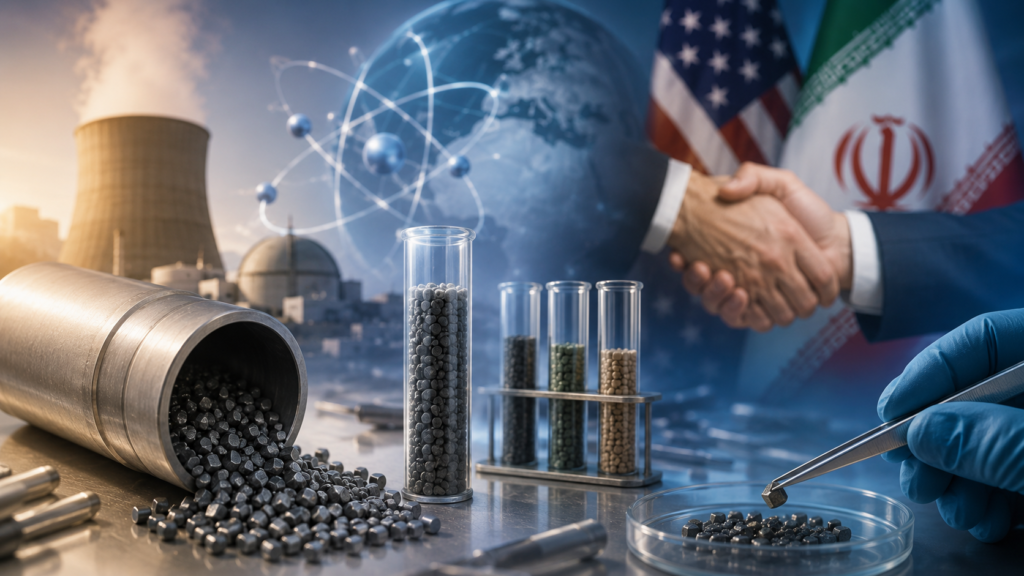
The United States and Iran have reportedly reached a major diplomatic understanding aimed at reducing tensions surrounding Iran’s nuclear program. A key component of the agreement is Iran’s commitment to downblend its stockpile of Highly Enriched Uranium (HEU) under international supervision.
The arrangement highlights the growing importance of uranium downblending as a practical tool for nuclear disarmament, confidence-building, and global non-proliferation efforts.
For UPSC aspirants, this topic is important under International Relations, Nuclear Security, Nuclear Energy, Non-Proliferation Regimes, and Global Governance.
What is Uranium Downblending?
Uranium downblending is the process of reducing the concentration of the fissile isotope Uranium-235 (U-235) in highly enriched uranium by mixing it with uranium containing lower concentrations of the isotope.
The process converts:
Highly Enriched Uranium (HEU)
into
Low Enriched Uranium (LEU)
which can be used for civilian nuclear energy generation but is unsuitable for nuclear weapons production.
Understanding Uranium Enrichment
Natural uranium contains:
- Approximately 99.3% Uranium-238 (U-238)
- Approximately 0.7% Uranium-235 (U-235)
Only U-235 can sustain a nuclear chain reaction required for power generation and nuclear weapons.
Low Enriched Uranium (LEU)
Typically contains:
- 3% to 5% U-235
Used in:
- Commercial nuclear power plants
- Research reactors
Highly Enriched Uranium (HEU)
Contains:
- More than 20% U-235
Weapons-grade uranium generally contains:
- Around 90% U-235
Such material can be used in nuclear weapons.
Why is Downblending Important?
Downblending serves as a bridge between:
- Nuclear security
- Civilian energy use
- Arms control
By reducing enrichment levels, countries can retain nuclear fuel while eliminating weapons-related risks.
Nodal Monitoring Authority
International Atomic Energy Agency (IAEA)
The IAEA verifies:
- Quantity of uranium
- Enrichment levels
- Compliance with agreements
- Storage and movement of nuclear material
The agency acts as the global watchdog for nuclear safeguards.
How Does Uranium Downblending Work?
The objective is to dilute HEU by mixing it with uranium that contains a lower concentration of U-235.
Possible blendstocks include:
- Natural uranium
- Depleted uranium
- Slightly enriched uranium
The resulting mixture achieves a target enrichment level suitable for civilian applications.
Why Can’t It Be Easily Reversed?
The process blends uranium isotopes at the molecular level.
To restore weapons-grade material, the uranium would have to undergo:
- Complex enrichment processes
- Advanced centrifuge operations
- Significant financial and technical investment
Therefore, downblending substantially reduces proliferation risks.
Major Methods of Uranium Downblending
1. Gaseous Blending
This is the most widely used commercial method.
Process
- HEU is converted into uranium hexafluoride (UF₆) gas.
- Blendstock is also converted into UF₆.
- The gases are mixed in specialized facilities.
Advantages
- Highly efficient
- Compatible with enrichment infrastructure
- Easy monitoring and verification
2. Liquid or Chemical Blending
In this method:
- Uranium is dissolved into a liquid chemical form.
- Solutions are mixed precisely.
- Uranium is then converted back into solid fuel material.
Common Compound
Uranyl nitrate hexahydrate
This method is commonly used in fuel fabrication facilities.
3. Molten Metal Blending
The uranium materials are:
- Melted at very high temperatures
- Mixed into a uniform alloy
- Solidified into usable forms
Although technically effective, this method is less commonly employed than gaseous blending.
Why Does the International Community Support Downblending?
Downblending provides a practical non-proliferation solution because it:
Reduces Nuclear Weapons Risks
Weapons-grade material becomes unsuitable for bomb production.
Supports Peaceful Nuclear Energy
The resulting LEU can fuel civilian reactors.
Builds International Trust
Countries demonstrate commitment to nuclear restraint.
Strengthens Verification
IAEA monitoring increases transparency.
Uranium Downblending and Nuclear Non-Proliferation
Downblending is closely linked to global non-proliferation efforts.
It complements major international frameworks such as:
Nuclear Non-Proliferation Treaty (NPT)
The cornerstone of global nuclear governance.
IAEA Safeguards System
Ensures peaceful use of nuclear materials.
Comprehensive Safeguards Agreements
Allow international inspections and verification.
Iran’s Nuclear Program and the Importance of Downblending
The international community has long expressed concern regarding Iran’s stockpile of highly enriched uranium.
The central issue is not civilian nuclear energy itself, but the possibility that highly enriched material could potentially be diverted for military purposes.
Downblending provides a compromise solution by:
- Allowing civilian nuclear activities.
- Reducing proliferation risks.
- Increasing international confidence.
Benefits of Uranium Downblending
Strategic Benefits
- Reduces geopolitical tensions.
- Supports diplomatic agreements.
- Promotes regional stability.
Economic Benefits
- Allows nuclear fuel to remain useful.
- Supports electricity generation.
- Avoids waste of enriched material.
Environmental Benefits
- Supports low-carbon electricity production.
- Helps countries transition away from fossil fuels.
Challenges in Uranium Downblending
Verification Challenges
Continuous monitoring is required.
Political Trust Deficit
International agreements depend on mutual confidence.
Technical Infrastructure
Specialized facilities are needed for safe handling.
Long-Term Compliance
Sustained inspections and transparency remain essential.
Why is This Important for India?
India closely follows developments in global nuclear governance because:
Energy Security
Nuclear power is an important component of India’s clean energy strategy.
Strategic Stability
Developments in West Asia affect regional and global security.
Nuclear Diplomacy
India works closely with the IAEA and supports responsible nuclear stewardship.
Global Governance
India advocates peaceful uses of nuclear technology while preventing proliferation.
Way Forward
The success of uranium downblending depends upon:
- Strong international verification.
- Continued diplomatic engagement.
- Transparent nuclear safeguards.
- Commitment to peaceful nuclear use.
Future agreements should balance:
- National sovereignty
- Energy requirements
- Global security concerns
to strengthen the international non-proliferation regime.
Conclusion
Uranium downblending is one of the most effective mechanisms for transforming potentially dangerous weapons-grade material into fuel for peaceful purposes. By reducing enrichment levels under international supervision, it simultaneously promotes nuclear security, diplomatic trust, and civilian energy generation.
As global concerns over nuclear proliferation continue, downblending will remain a critical instrument in advancing international peace, stability, and responsible nuclear governance.
UPSC Prelims Focus
Important Facts
| Feature | Details |
|---|---|
| HEU | More than 20% U-235 |
| Weapons Grade Uranium | Around 90% U-235 |
| LEU | Typically 3–5% U-235 |
| Monitoring Agency | IAEA |
| Common Blending Gas | Uranium Hexafluoride (UF₆) |
| Main Objective | Nuclear Non-Proliferation |
Previous Year Question (UPSC Prelims 2020)
In India, why are some nuclear reactors kept under “IAEA Safeguards” while others are not?
(a) Some use uranium and others use thorium.
(b) Some use imported uranium and others use domestic supplies.
(c) Some are operated by foreign enterprises and others are operated by domestic enterprises.
(d) Some are State-owned and others are privately owned.
Answer: (b)
UPSC Syllabus Mapping
GS Paper II: International Relations, Global Governance, International Institutions
GS Paper III: Nuclear Technology, Energy Security, Science & Technology, Non-Proliferation and Strategic Affairs