India’s First 5.56 km Free-Space Quantum Key Distribution Link
Category: Science & Technology | Quantum Technology | Cyber Security
UPSC GS: GS Paper III
HPPSC: Science & Technology | Cyber Security | Current Affairs
Key Themes: Quantum Communication, QKD, Post-Quantum Cryptography, Quantum Cyber Security, National Quantum Mission
Why in News?
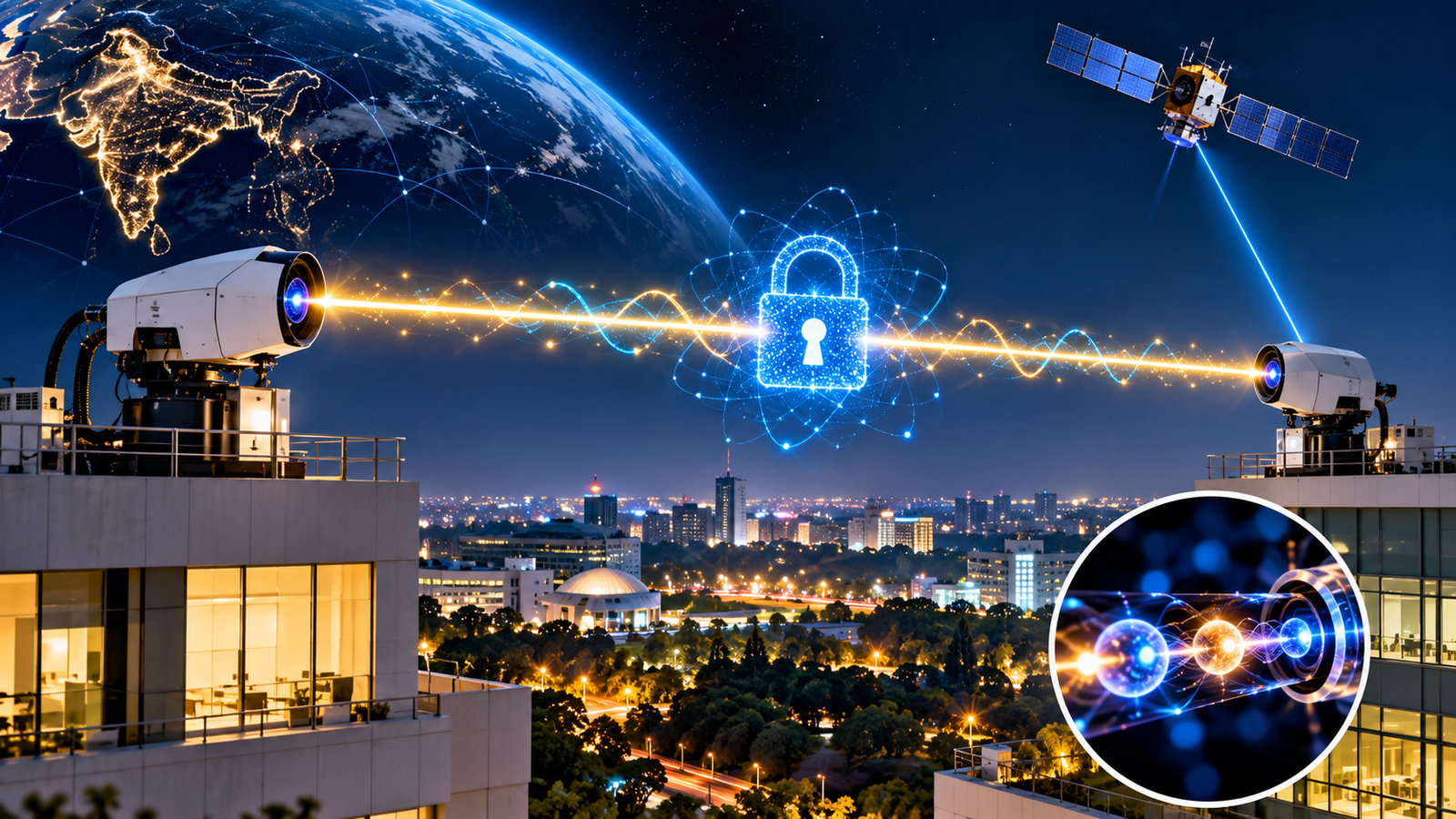
India has successfully demonstrated its first free-space Quantum Key Distribution (QKD) link at a distance of 5.56 km.
The field trial was conducted on the night of 27–28 September 2026 between BISAG-N and IIT Gandhinagar.
The demonstration was carried out by QNu Labs in collaboration with Bhaskaracharya National Institute for Space Applications and Geo-informatics (BISAG-N) and IIT Gandhinagar.
The trial achieved:
- 5.56 km free-space quantum communication
- Quantum Bit Error Rate (QBER) below 5%
- Secure key generation of 230–260 bits per second
- Successful integration with BISAG-N’s Vedic Kavach post-quantum cryptography platform
- Successful end-to-end encryption and decryption of test messages
The development is important because free-space QKD can potentially support long-distance and satellite-based quantum-secure communication networks.
First Understand the Basic Problem
Before understanding QKD, we need to understand why ordinary encryption may face a future problem.
Today, sensitive information is protected using cryptographic algorithms.
For example:
Message → Encryption → Encrypted data → Decryption → Message
Encryption converts readable information into an unreadable form using mathematical techniques.
The security of many existing cryptographic systems depends on the difficulty of solving certain mathematical problems.
But powerful quantum computers could potentially solve some of these problems much faster than conventional computers.
This creates a future cybersecurity concern:
Powerful Quantum Computer → Threat to Some Existing Cryptography
This is known as the quantum threat.
What is Quantum Computing?
A conventional computer uses bits.
A bit can have:
0 or 1
A quantum computer uses quantum bits or qubits.
Qubit
A qubit is the basic unit of quantum information.
Unlike a classical bit, a qubit can exist in a quantum combination of states called superposition.
English Definition:
A qubit is the basic unit of quantum information that can exist in a superposition of quantum states.
Other important quantum concepts include:
- Superposition
- Entanglement
- Quantum measurement
These properties give quantum computers capabilities that are fundamentally different from conventional computers.
What is Quantum Communication?
Quantum communication uses principles of quantum mechanics to transmit or establish information securely.
One of its important applications is:
Quantum Key Distribution
QKD does not primarily send the actual message.
Instead, it helps two parties securely establish a secret cryptographic key that can then be used to encrypt communication.
This distinction is extremely important for UPSC.
Remember:
QKD → Secure key distribution
Not:
QKD → Direct high-speed transmission of the entire message
In the 2026 Indian demonstration, the reported 230–260 bps refers to the rate of secure key generation, not ordinary Internet data-transfer speed.
What is Quantum Key Distribution?
Simple Explanation
Suppose:
Person A wants to securely communicate with Person B.
They need a secret key.
In conventional systems, the key exchange itself can become a security challenge.
QKD uses quantum states of light to establish the key.
The key principle is:
If an unauthorised person tries to measure the quantum state, the quantum state can be disturbed.
This disturbance can reveal the presence of an eavesdropper.
English Definition
Quantum Key Distribution is a method of securely establishing cryptographic keys between two parties using quantum states.
Why is QKD Considered Secure?
The security comes from fundamental properties of quantum mechanics.
Consider a photon carrying quantum information.
If an eavesdropper attempts to intercept and measure the quantum state, the state may be disturbed.
This can increase the error rate detected by the legitimate users.
Therefore:
Attempted interception → Quantum-state disturbance → Increased errors → Possible detection
This is fundamentally different from merely relying on the computational difficulty of a mathematical problem.
What is Free-Space QKD?
There are different ways of establishing a quantum communication link.
One approach uses:
Optical fibre
Another approach uses:
Free space
Free-Space Communication
Free-space communication transmits optical signals through the atmosphere rather than through a physical fibre cable.
In the Indian demonstration, the quantum signal travelled through open air over 5.56 km between BISAG-N and IIT Gandhinagar.
Simple Comparison
| Fibre QKD | Free-Space QKD |
|---|---|
| Uses optical fibre | Uses open-air optical path |
| Requires physical fibre infrastructure | Does not require a fibre between endpoints |
| Suitable for fixed networks | Useful for flexible links |
| Fibre attenuation limits distance | Can support future ground-to-satellite links |
| Infrastructure-intensive | Useful where fibre laying is difficult |
Why is Free-Space QKD Important?
Free-space QKD is particularly important for future:
- Satellite communication
- Long-distance quantum networks
- Secure government communication
- Defence communication
- Critical infrastructure
- Strategic communication
Satellite-based quantum communication is especially important because optical signals can travel between ground stations through space without requiring an extremely long physical fibre network.
Therefore:
Free-space QKD → Building block for satellite QKD
India’s 5.56 km Demonstration
The September 2026 trial connected:
BISAG-N ↔ IIT Gandhinagar
The system used QNu Labs’ Pointing, Acquisition and Tracking (PAT) system to maintain alignment between the communicating terminals.
The trial achieved:
Distance
5.56 km
QBER
Below 5%
Secure Key Generation
230–260 bits per second
End-to-End Test
The generated keys were successfully integrated into the Vedic Kavach platform for encryption and decryption of test messages.
What is QBER?
One of the most important technical terms in this development is:
Quantum Bit Error Rate
QBER stands for Quantum Bit Error Rate.
It measures the proportion of quantum bits that are received incorrectly compared with the total number of quantum bits examined.
English Definition:
QBER is the percentage of quantum bits detected incorrectly during quantum communication.
A lower QBER generally indicates a more stable and reliable quantum communication link.
In the Indian trial:
QBER < 5%
This indicates that the demonstrated link maintained a relatively low error rate during the field trial.
What is the Pointing, Acquisition and Tracking System?
Free-space optical communication requires precise alignment.
Imagine trying to point a laser beam from one building directly towards a tiny receiver several kilometres away.
Even a small movement can affect the connection.
Therefore, a Pointing, Acquisition and Tracking (PAT) system helps:
- Locate the receiving terminal
- Establish the optical connection
- Maintain alignment
- Compensate for movement or disturbances
In the Indian demonstration, QNu Labs used its PAT system to establish the 5.56-km free-space link.
What is Post-Quantum Cryptography?
QKD is not the only response to the future quantum threat.
Another important approach is:
Post-Quantum Cryptography
Post-Quantum Cryptography, or PQC, refers to cryptographic algorithms designed to remain secure even against attacks from powerful quantum computers.
English Definition:
Post-quantum cryptography uses mathematical algorithms designed to resist attacks from both conventional and future quantum computers.
Unlike QKD, PQC is primarily a software-based cryptographic approach.
Therefore:
QKD
Uses principles of quantum physics and specialised hardware.
PQC
Uses quantum-resistant mathematical algorithms and can be implemented through software and conventional computing infrastructure.
QKD vs Post-Quantum Cryptography
This distinction is extremely important for UPSC.
| Feature | QKD | Post-Quantum Cryptography |
|---|---|---|
| Basic principle | Quantum physics | Mathematical cryptography |
| Main purpose | Secure key distribution | Quantum-resistant encryption/authentication |
| Main requirement | Specialised quantum hardware | Cryptographic software/hardware |
| Detects interception | Quantum disturbance can reveal eavesdropping | Security based on mathematical hardness |
| Infrastructure | Specialised optical systems | Can use existing computing infrastructure |
| Nature | Hardware-intensive | Primarily software-based |
| Role | Key distribution | Cryptographic protection |
The two approaches are complementary, not necessarily competing.
What is Vedic Kavach?
Vedic Kavach is BISAG-N’s post-quantum cryptography-enabled platform.
In the 2026 trial, it provided the software-based cryptographic layer while QNu Labs’ Armos device provided the hardware-based QKD layer.
The system also incorporated Quantum Random Number Generation (QRNG).
Thus, the demonstration combined:
QKD + PQC + QRNG
This creates a layered security architecture.
What is Quantum Random Number Generation?
Conventional computers can generate what are called pseudo-random numbers using mathematical algorithms.
Quantum systems can exploit fundamentally unpredictable quantum processes to generate random numbers.
QRNG
Quantum Random Number Generation uses quantum phenomena to generate random numbers.
English Definition:
QRNG is a method of generating random numbers using fundamentally unpredictable quantum processes.
Random numbers are important in cryptography because cryptographic systems require secure keys and other random values.
What is Armos?
Armos is QNu Labs’ hardware-based QKD device used in the demonstration.
Its role was to generate and distribute quantum-secure keys through the free-space optical channel.
The overall architecture therefore looked like:
Armos QKD
↓
Free-Space Optical Link
↓
Quantum Key
↓
Vedic Kavach
↓
Encryption / Decryption
This is a useful flow to remember for Prelims.
Why Combine QKD and PQC?
This is one of the most important conceptual aspects of the demonstration.
QKD requires the physical quantum communication link to operate properly.
Free-space communication can face challenges such as:
- Atmospheric disturbances
- Weather
- Alignment problems
- Obstruction
- Temporary loss of connection
PQC can provide an additional layer of cryptographic protection.
Therefore:
QKD + PQC = Defence in Depth
Defence in Depth
Defence in depth means using multiple independent layers of security so that failure of one layer does not necessarily compromise the entire system.
English Definition:
Defence in depth is a cybersecurity strategy that uses multiple layers of protection against threats.
The Indian demonstration specifically integrated the two approaches to improve resilience.
Why is This Important for India?
Quantum-secure communication has strategic importance.
National Security
Sensitive government and defence communications require strong protection.
Financial Sector
Banks and financial institutions handle extremely sensitive information.
Critical Infrastructure
Quantum-secure networks could protect:
- Power grids
- Telecommunications
- Transport systems
- Government networks
- Strategic infrastructure
Defence Communication
Military communication requires highly secure channels.
Satellite Communication
Free-space QKD can contribute to future satellite-based quantum networks.
India’s National Quantum Mission
The 5.56-km demonstration should be understood within the broader framework of India’s National Quantum Mission (NQM).
The Union Cabinet approved the National Quantum Mission in April 2023 with a total outlay of ₹6,003.65 crore over eight years.
The mission focuses on four major areas:
Quantum Computing
Development of quantum computers and processors.
Quantum Communication
Development of secure quantum communication networks.
Quantum Sensing and Metrology
Development of highly sensitive quantum sensors and precision measurement systems.
Quantum Materials and Devices
Development of materials and technologies required for quantum applications.
National Quantum Mission: Communication Goal
The National Quantum Mission aims to develop:
- Satellite-based secure quantum communication
- Long-distance QKD
- Multi-node quantum networks
- Quantum memories
- Inter-city quantum communication
One of its important objectives is to establish satellite-based QKD over distances of around 2,000 km between ground stations in India.
Therefore:
5.56 km free-space demonstration
can be seen as an important experimental step towards:
Long-distance free-space QKD → Satellite QKD → Quantum-secure networks
India’s Earlier Progress in Quantum Communication
The latest demonstration is not India’s first experiment with quantum-secure communication.
India has already undertaken several important demonstrations.
2022
DRDO scientists demonstrated an intercity quantum communication link between Vindhyachal and Prayagraj using optical fibre.
2025
DRDO and IIT Delhi demonstrated entanglement-based free-space quantum communication over more than 1 km.
The demonstration achieved a secure key rate of nearly 240 bits per second with QBER below 7%.
The 2026 demonstration therefore represents continued progress in India’s quantum communication capabilities.
Free-Space QKD vs Fibre-Based QKD
Fibre-Based QKD
The quantum signal travels through optical fibre.
Advantages:
- Stable physical pathway
- Suitable for urban/inter-city networks
- Existing fibre infrastructure can sometimes be used
Limitations:
- Fibre attenuation
- Infrastructure requirements
- Distance limitations without advanced repeaters
Free-Space QKD
The signal travels through the atmosphere.
Advantages:
- No continuous fibre required between endpoints
- Useful for difficult terrain
- Important for satellite communication
- Potentially useful for long-distance links
Limitations:
- Weather
- Atmospheric turbulence
- Precise alignment
- Line-of-sight requirement
- Obstruction
Major Challenges
The 5.56-km demonstration is significant, but scaling quantum communication to national or global networks is much more difficult.
Distance
Longer distances create technical challenges for maintaining quantum signals.
Atmospheric Conditions
Clouds, fog, turbulence and other atmospheric conditions can affect free-space optical communication.
Alignment
The transmitting and receiving terminals must remain precisely aligned.
Infrastructure Cost
Quantum communication systems require specialised equipment.
Quantum Repeaters
Long-distance quantum networks require technologies such as quantum repeaters to overcome signal-loss limitations.
Quantum Repeater
A quantum repeater is a device or system designed to extend quantum communication over long distances by using techniques such as entanglement distribution and quantum memory.
English Definition:
A quantum repeater is a technology intended to extend quantum communication beyond the distance limitations of direct quantum links.
Cybersecurity in the Quantum Era
The emergence of quantum computers creates two simultaneous challenges.
Challenge 1
Protect current systems against future quantum attacks.
Challenge 2
Develop new communication networks that are secure in the quantum era.
This creates two major technological responses:
Post-Quantum Cryptography
Quantum Key Distribution
Therefore:
Quantum Computing → New Cybersecurity Threats
and simultaneously:
Quantum Technology → New Cybersecurity Solutions
Strategic Significance for India
Quantum-secure communication can strengthen India’s:
- Defence preparedness
- Cybersecurity
- Financial security
- Critical infrastructure protection
- Strategic communications
- Digital sovereignty
- Technological self-reliance
It can also reduce dependence on foreign quantum-security technologies.
Thus, the development is connected with:
Atmanirbhar Bharat + Strategic Technology + National Security
Science and Technology Significance
The demonstration represents the convergence of several technologies:
Quantum Physics
Photonics
Optical Communication
Cryptography
Artificial Intelligence / Digital Systems
Cybersecurity
This makes quantum communication a classic example of converging technologies.
UPSC Prelims Perspective
Important Facts
| Parameter | Fact |
|---|---|
| Technology | Free-space Quantum Key Distribution |
| Distance | 5.56 km |
| Endpoints | BISAG-N and IIT Gandhinagar |
| Trial | Night of 27–28 September 2026 |
| Demonstrated by | QNu Labs + BISAG-N + IIT Gandhinagar |
| QBER | Below 5% |
| Key generation | 230–260 bps |
| QKD device | Armos |
| PQC platform | Vedic Kavach |
| Additional technology | QRNG |
| Future relevance | Long-distance and satellite quantum communication |
Prelims Practice Question
Q. With reference to India’s recent free-space quantum communication demonstration, consider the following statements:
- Quantum Key Distribution is primarily used for secure distribution of cryptographic keys.
- Post-Quantum Cryptography and QKD are identical technologies based on the same physical principle.
- The recent 5.56-km demonstration connected BISAG-N and IIT Gandhinagar.
- The National Quantum Mission includes quantum communication as one of its major focus areas.
Which of the statements given above are correct?
Answer: 1, 3 and 4 only
Explanation
Statement 2 is incorrect.
QKD is based on principles of quantum physics, whereas Post-Quantum Cryptography relies on quantum-resistant mathematical cryptographic algorithms.
UPSC Mains Connection
GS Paper III
This topic can be linked with:
Science & Technology
- Quantum technology
- Quantum communication
- Quantum computing
- Emerging technologies
- Indigenous technology
Cyber Security
- Encryption
- Secure communication
- Critical infrastructure
- National security
- Quantum threat
Economy
- Deep-tech startups
- Indigenous technology
- Strategic technology ecosystem
- Research and innovation
Possible Mains Question
“Quantum technologies can simultaneously create new cybersecurity threats and provide new solutions to them. Discuss with reference to Quantum Key Distribution and Post-Quantum Cryptography.”
Answer Framework
Introduction
Quantum computing has the potential to challenge some existing cryptographic systems, creating the need for quantum-resilient cybersecurity.
Body
Explain:
Quantum threat
→ Potential threat to existing cryptographic systems
QKD
→ Quantum-based secure key distribution
PQC
→ Quantum-resistant mathematical cryptography
India’s approach
→ National Quantum Mission
→ Indigenous QKD technologies
→ Free-space QKD
→ Satellite communication
→ QKD + PQC integration
Challenges
→ Cost
→ Distance
→ Atmospheric conditions
→ Quantum repeaters
→ Skilled manpower
→ Standardisation
Conclusion
India should pursue a hybrid approach combining QKD, PQC, quantum research and secure digital infrastructure.
Geography Optional Connection
Although primarily a Science & Technology topic, it has some Geography relevance.
Free-Space Communication
The performance of free-space optical communication can be affected by:
- Atmospheric conditions
- Weather
- Cloud cover
- Turbulence
- Terrain
- Line of sight
Strategic Geography
Quantum-secure satellite communication can influence:
- Defence networks
- Border communication
- Space infrastructure
- Strategic connectivity
Thus, it can be used as a contemporary example in technology + strategic geography answers.
Important Keywords
Quantum Key Distribution
Hinglish: Quantum principles ka use karke two parties ke beech secure cryptographic key establish karna.
English Definition:
A method of securely distributing cryptographic keys using quantum states.
Free-Space Optical Communication
Hinglish: Fibre ke through nahi, balki open air/atmosphere ke through optical signal transmit karna.
English Definition:
Transmission of optical signals through free space rather than a physical fibre.
QBER
Hinglish: Quantum communication mein kitne quantum bits incorrectly receive hue, uska error measure.
English Definition:
The proportion or percentage of quantum bits received incorrectly.
Post-Quantum Cryptography
Hinglish: Aisi cryptography jo future quantum computers ke attacks ko resist karne ke liye design ki gayi ho.
English Definition:
Cryptographic algorithms designed to remain secure against quantum-computer-based attacks.
Quantum Entanglement
Hinglish: Do quantum particles ke states ka aisa strong correlation jisme unke quantum properties interconnected ho sakte hain.
English Definition:
A quantum phenomenon in which the states of two or more particles are strongly correlated.
Quantum Random Number Generation
Hinglish: Quantum processes ki inherent unpredictability ka use karke random numbers generate karna.
English Definition:
Generation of random numbers using fundamentally unpredictable quantum processes.
Quantum Network
Hinglish: Aisa communication network jo quantum information ko nodes ke beech transmit/distribute karta hai.
English Definition:
A communication network designed to transmit or distribute quantum information between connected nodes.
One-Page Revision
India’s 5.56 km Free-Space QKD
27–28 September 2026
↓
BISAG-N ↔ IIT Gandhinagar
↓
QNu Labs
↓
5.56 km Free-Space Optical Link
↓
QBER < 5%
↓
Key Generation: 230–260 bps
↓
Armos QKD Device
↓
Vedic Kavach
↓
Post-Quantum Cryptography + QRNG
↓
Successful Encryption/Decryption
↓
Future
Long-distance QKD → Satellite QKD → Quantum Networks
Memory Trick
Remember:
“5.56 – 5 – 230 – 260 – 2”
5.56 → km distance
5 → QBER below 5%
230–260 → bits/second secure key generation
2 → Two security layers: QKD + PQC
And remember:
QKD = Key
PQC = Quantum-resistant Cryptography
QRNG = Randomness
NQM = National Mission
Conclusion
India’s successful 5.56-km free-space Quantum Key Distribution demonstration is an important step in the development of quantum-secure communication infrastructure.
Its significance goes beyond the distance covered.
The demonstration brought together:
QKD + Free-Space Optical Communication + Post-Quantum Cryptography + QRNG
and successfully used the generated keys for end-to-end encryption and decryption of test messages.
The larger objective is to develop secure communication networks capable of operating in the quantum era, including future long-distance and satellite-based systems.
For India, this technology is important not only for scientific advancement but also for cybersecurity, defence, critical infrastructure, digital sovereignty and strategic autonomy.
The broader lesson for UPSC is:
Quantum technology is both a future security challenge and a potential solution to that challenge.
India’s strategy therefore needs to combine National Quantum Mission, indigenous quantum technologies, QKD, post-quantum cryptography, skilled manpower, research and secure digital infrastructure to build a resilient quantum-secure ecosystem.