HPAS/HPPSC Current Affairs: 5 High-Yield Topics for GS Prelims | 1 September 2026
For HPAS/HPPSC GS Prelims, Current Affairs should not be prepared as isolated one-line facts. A current development often becomes the starting point for questions on Himachal Pradesh geography, environment, science and technology, government institutions, economic concepts, international organisations, maps and chronology.
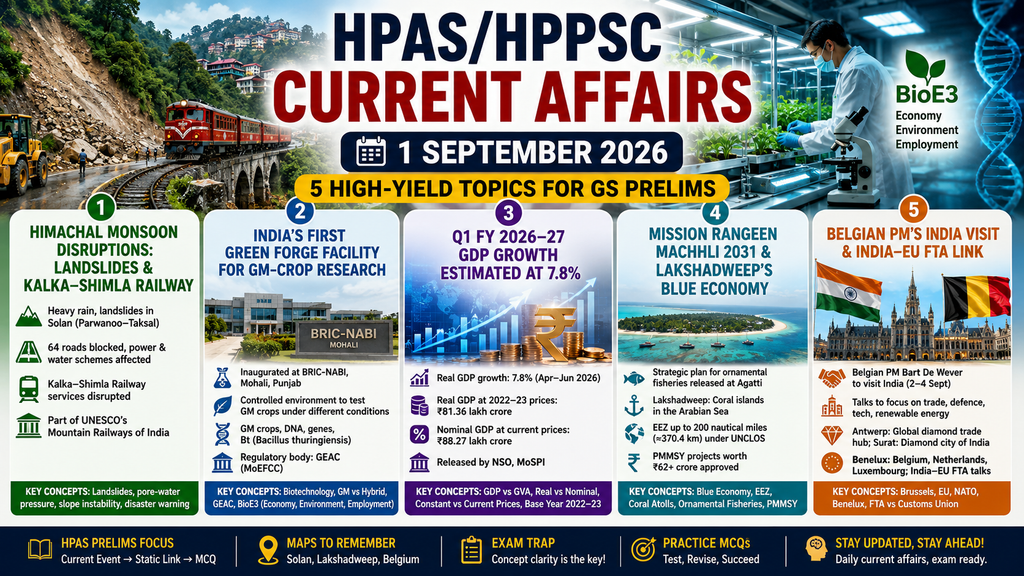
For 1 September 2026, five developments stand out as particularly important from the HPAS/HPPSC Prelims perspective:
- Himachal monsoon disruptions, landslides and the Kalka–Shimla Railway
- India’s first-of-its-kind Green Forge facility for GM-crop research
- India’s Q1 FY 2026–27 GDP growth estimated at 7.8%
- Mission Rangeen Machhli 2031 and Lakshadweep’s Blue Economy
- Belgian Prime Minister’s India visit and the India–EU linkage
The following analysis follows a simple exam-oriented chain:
Current Development → Static Concept → Map/Location → Institution → Examiner Trap → Probable MCQ
1. Himachal Monsoon Disruptions, Landslides and Kalka–Shimla Railway
Priority: VERY HIGH
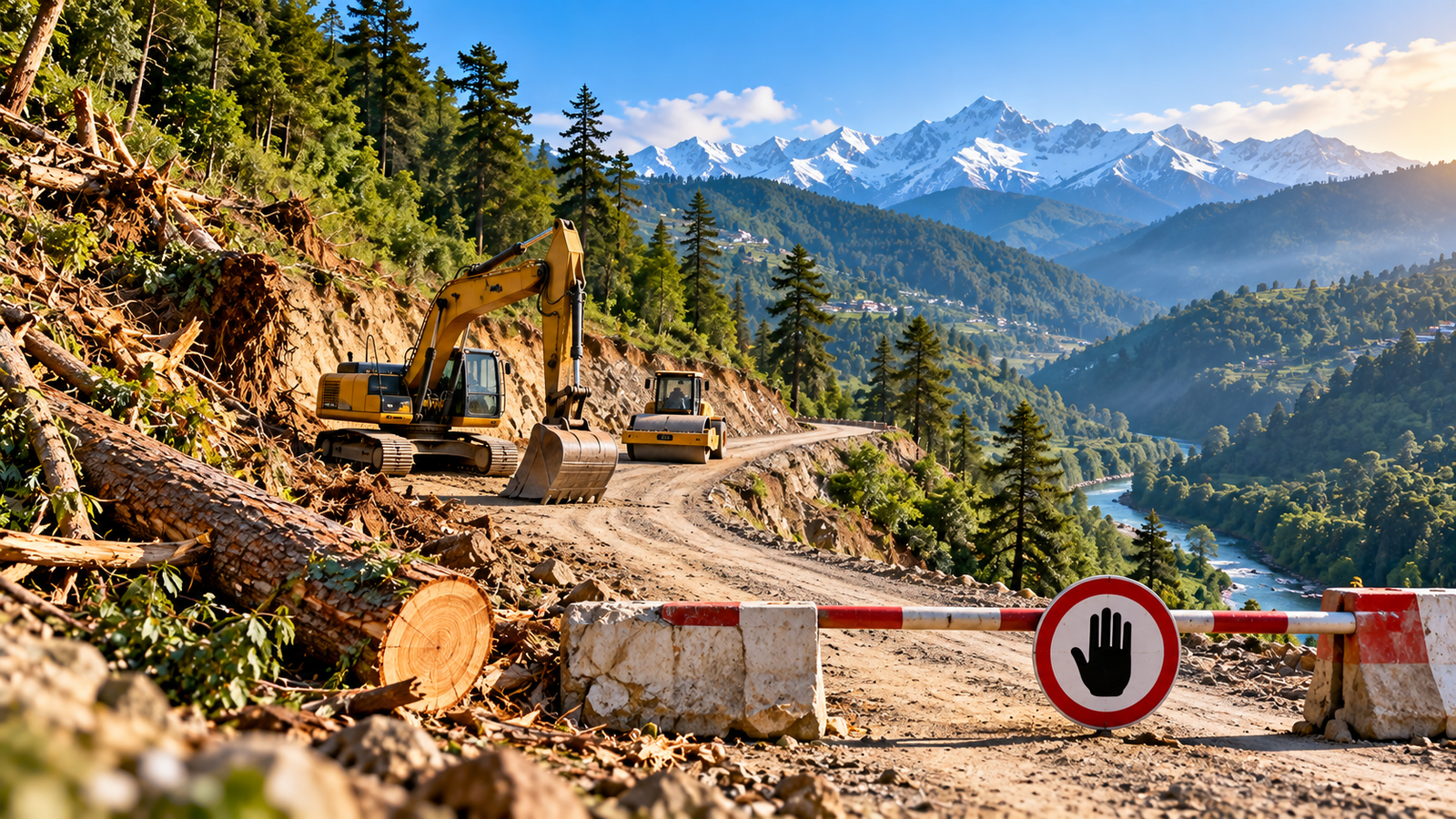
Heavy rainfall has once again highlighted the vulnerability of Himachal Pradesh’s mountain infrastructure.
By the end of August 2026, heavy rain had disrupted roads, electricity infrastructure and water-supply schemes across parts of the state. Landslides and waterlogging were also reported around the Parwanoo–Taksal region of Solan district.
The weather also affected the historic Kalka–Shimla Railway, after infrastructure damage between Gumman and Taksal disrupted railway services.
For HPAS, this is much more than a weather-related current-affairs fact.
It connects:
Himachal Geography → Himalayan Geology → Landslides → Monsoon → Disaster Management → Solan → Kalka–Shimla Railway → UNESCO
Why Are Landslides Common in Himachal Pradesh?
A landslide is the downslope movement of rock, soil or debris under the influence of gravity.
The Himalayas are particularly susceptible because they combine several risk factors:
- Young and tectonically active mountains
- Steep slopes
- Highly fractured rocks
- Intense rainfall
- Earthquakes
- River erosion
- Road cutting
- Construction on unstable slopes
- Deforestation and vegetation removal
- Poor drainage
A useful memory chain is:
Steep slope + Weak/fractured rock + Water + Gravity → Slope failure
How Does Heavy Rainfall Trigger Landslides?
Rainwater infiltrates soil and fractured rocks.
When pore spaces become saturated, pore-water pressure can increase.
Higher pore-water pressure can reduce the effective frictional resistance holding slope material together.
This can eventually cause:
Slope instability → Failure → Landslide
Exam-ready concept
Pore-water pressure is the pressure exerted by water present within the pores or fractures of soil and rock.
Rainfall Is a Trigger, Not the Only Cause
One important examiner trap is:
Every Himalayan landslide is not caused by rainfall.
Possible triggers include:
- Intense rainfall
- Earthquake
- River undercutting
- Snowmelt
- Construction activity
- Road cutting
- Blasting
- Slope overloading
Therefore, rainfall should be understood as one important trigger acting upon an already vulnerable slope.
Kalka–Shimla Railway
The current disruption also makes the Kalka–Shimla Railway extremely important.
The railway connects:
Kalka → Himachal hill region → Shimla
Kalka lies in Haryana, while Shimla is the capital of Himachal Pradesh.
The railway is part of UNESCO’s:
Mountain Railways of India
The World Heritage property includes famous mountain railway systems such as:
- Darjeeling Himalayan Railway
- Nilgiri Mountain Railway
- Kalka–Shimla Railway
Important Trap
Kalka–Shimla Railway is not a standalone UNESCO category called “Himalayan Railways of India”.
It forms part of:
Mountain Railways of India
Solan Map Link
Remember the chain:
Parwanoo → Taksal → Solan district → Southern Himachal → Kalka–Shimla corridor
Parwanoo is an important industrial and transport gateway into Himachal Pradesh.
The Kalka–Shimla corridor is highly sensitive to:
- Landslides
- Rockfalls
- Drainage problems
- Slope erosion
- Extreme rainfall
Weather Warning Trap
A weather warning indicates the possibility or expected severity of hazardous weather.
It does not necessarily mean:
A disaster has already occurred everywhere under the warning.
Therefore:
Weather Hazard ≠ Disaster
A disaster develops when a hazard interacts with:
Exposure + Vulnerability
Master Memory Chain
Himachal Rain → Solan → Parwanoo/Taksal → Landslide → Pore-water Pressure → Slope Failure → Kalka–Shimla Railway → UNESCO
Probable MCQ
Consider the following statements:
- Intense rainfall can increase pore-water pressure and contribute to slope failure.
- Kalka–Shimla Railway forms part of UNESCO’s Mountain Railways of India.
- Every Himalayan landslide is necessarily triggered by an earthquake.
Which of the statements given above are correct?
Answer: 1 and 2 only
2. Green Forge Facility for GM-Crop Research
Priority: VERY HIGH
A first-of-its-kind Green Forge facility has been inaugurated at the BRIC–National Agri-Food and Biomanufacturing Institute (BRIC-NABI) in Mohali, Punjab.
The facility allows scientists to study genetically modified crops under controlled environmental conditions.
Researchers can manipulate factors such as:
- Temperature
- Humidity
- Light
and observe how plants respond under different simulated environments.
The facility also has potential for integration with Artificial Intelligence.
For HPAS, the current event creates an important science chain:
Green Forge → Mohali → BRIC-NABI → Biotechnology → GM Crops → DNA/Genes → Bt Crops → GEAC → BioE3
What is a Genetically Modified Crop?
A genetically modified or GM crop is a crop whose genetic material has been altered using modern biotechnology to introduce or modify particular traits.
Possible desired traits include:
- Insect resistance
- Disease resistance
- Herbicide tolerance
- Drought tolerance
- Nutritional improvement
- Stress tolerance
What is a Gene?
A gene is a functional unit of heredity.
Genes are segments of:
DNA — Deoxyribonucleic Acid
DNA contains genetic information used in the development and functioning of living organisms.
Simplified chain:
DNA → Gene → Protein/Functional Product → Trait
GM Crop vs Hybrid Crop
This distinction is very important.
Hybridisation
Two genetically different varieties or lines are crossed through breeding to combine desirable characteristics.
Genetic Modification
Specific genetic material is deliberately altered or introduced using biotechnology techniques.
Therefore:
Hybrid ≠ GM
A crop can be hybrid without being genetically engineered.
Bt Crops
One of the most important examples is:
Bt Cotton
“Bt” comes from:
Bacillus thuringiensis
It is a bacterium that naturally produces certain insecticidal proteins.
Genes associated with these proteins can be introduced into crops to provide resistance against particular insect pests.
Major Trap
Bt does NOT stand for:
Biotechnology
It refers to:
Bacillus thuringiensis
GEAC
GM organisms can raise environmental and biosafety concerns.
An important Indian regulatory body is:
Genetic Engineering Appraisal Committee — GEAC
It operates within the environmental regulatory framework under the:
Ministry of Environment, Forest and Climate Change
GEAC is important in matters involving environmental release and related approvals concerning genetically engineered organisms/products under the applicable regulatory framework.
What Is the Purpose of Green Forge?
Green Forge provides controlled simulation chambers.
Scientists can alter environmental variables and observe crop performance.
For example:
High temperature → Crop response
Low humidity → Crop response
Different light conditions → Crop response
This helps scientists study plant performance before wider environmental deployment.
But:
Research inside Green Forge does not automatically mean a crop has been approved for commercial cultivation.
That is a crucial examiner trap.
BioE3 Policy
The development is also connected with India’s:
BioE3 Policy
BioE3 stands for:
Biotechnology for Economy, Environment and Employment
It aims to promote high-performance biomanufacturing and biotechnology-based innovation.
Remember:
E3 = Economy + Environment + Employment
Location
Green Forge is located at:
Mohali → Punjab
Mohali forms part of the wider Chandigarh urban/tri-city region.
Master Memory Chain
Green Forge → Mohali → BRIC-NABI → GM Crops → DNA/Gene → Bt → Bacillus thuringiensis → GEAC → MoEFCC → BioE3
Probable MCQ
Green Forge, recently seen in the news, is associated with:
A. Nuclear-fuel testing
B. Controlled-environment testing of genetically modified crops
C. Deep-sea mining
D. Green-hydrogen storage
Answer: B
3. India’s Q1 FY 2026–27 GDP Growth Estimated at 7.8%
Priority: VERY HIGH
India’s real Gross Domestic Product recorded an estimated growth of:
7.8%
during the first quarter of FY 2026–27.
The quarter covers:
April–June 2026
The corresponding growth rate during Q1 of the previous financial year was around 6.9%.
Real GDP at constant 2022–23 prices was estimated at approximately:
₹81.36 lakh crore
while nominal GDP at current prices was estimated at around:
₹88.27 lakh crore
This current development is important because it opens several core economic concepts:
GDP → GVA → Real vs Nominal → Constant vs Current Prices → Base Year → NSO → MoSPI
What is GDP?
GDP stands for:
Gross Domestic Product
GDP measures the monetary value of final goods and services produced within the domestic territory of an economy during a specified period.
Three words matter:
Gross
Depreciation has not been deducted.
Domestic
Production takes place within the domestic territory.
Product
It measures economic production/output.
GDP vs GVA
GVA stands for:
Gross Value Added
It measures value added by producers/sectors.
A simplified relationship is:
GDP at Market Prices = GVA at Basic Prices + Product Taxes − Product Subsidies
Therefore GDP and GVA are related, but they are not identical concepts.
Nominal GDP
Nominal GDP is measured using:
Current prices
Therefore it reflects changes in:
Output + Prices
If prices rise even without equivalent physical-output growth, nominal GDP can increase.
Real GDP
Real GDP is calculated using:
Constant prices
It attempts to remove the effect of changing prices and therefore provides a better indication of changes in actual production volume.
Golden Difference
Nominal GDP → Current Prices
Real GDP → Constant Prices
What Is a Base Year?
A base year is the reference year whose prices and economic structure are used for constant-price comparisons.
India’s latest series uses:
2022–23
as the base year for these estimates.
Base years are periodically revised because the structure of an economy changes over time.
New industries appear, consumption patterns change and better data sources become available.
Who Releases India’s GDP Data?
Quarterly and national-account estimates are associated with the:
National Statistical Office — NSO
under the:
Ministry of Statistics and Programme Implementation — MoSPI
Major Trap
RBI does not act as India’s primary national-accounts compilation agency.
Remember:
GDP → NSO → MoSPI
Does 7.8% GDP Growth Mean Everyone’s Income Rose by 7.8%?
No.
GDP growth should not automatically be equated with:
- Employment growth
- Wage growth
- Per-capita income growth
- Poverty reduction
- Equal distribution of income
These are separate indicators.
Real vs Nominal Example
Suppose an economy produces the same number of goods as last year, but prices rise by 10%.
Nominal GDP may rise substantially.
But real GDP may show little or no growth.
That is why real GDP is useful for measuring actual output growth.
Master Memory Chain
Q1 FY27 → 7.8% → Real GDP → Constant Prices → Base Year 2022–23 → GVA → NSO → MoSPI
Probable MCQ
Consider the following statements:
- Real GDP is measured at constant prices.
- Nominal GDP can be affected by both output and price changes.
- RBI is India’s primary agency for compiling national GDP estimates.
- GDP and GVA are identical under all circumstances.
Which statements are correct?
Answer: 1 and 2 only
4. Mission Rangeen Machhli 2031 and Lakshadweep’s Blue Economy
Priority: HIGH
The Mission Rangeen Machhli 2031 Strategic Action Plan has been released at Agatti in Lakshadweep.
The programme focuses on the development of India’s:
Ornamental Fisheries Sector
It aims to improve areas such as:
- Scientific management
- Breeding
- Hatcheries
- Biosecurity
- Quarantine
- Quality assurance
- Traceability
- Transportation
- Trade
For HPAS, this is another excellent current-static chain:
Rangeen Machhli → Ornamental Fisheries → Agatti → Lakshadweep → Coral Islands → Arabian Sea → Blue Economy → EEZ → PMMSY
What Are Ornamental Fish?
Ornamental fish are aquatic species primarily kept for:
- Aquariums
- Decoration
- Hobby purposes
rather than primarily for direct food consumption.
The ornamental-fish sector includes:
Breeding → Hatcheries → Health/Biosecurity → Aquarium trade → Transportation → Export
Lakshadweep Geography
Lakshadweep is a Union Territory located in the:
Arabian Sea
Its capital is:
Kavaratti
Important islands include:
- Kavaratti
- Agatti
- Minicoy
- Andrott
- Kalpeni
Lakshadweep is particularly important because its islands are predominantly of:
Coral origin
Many are associated with atolls.
What Is an Atoll?
An atoll is a ring-shaped coral reef or island system that partially or completely surrounds a lagoon.
Lakshadweep is therefore fundamentally different in geological origin from India’s continental mountain systems.
Fisheries Potential
Lakshadweep has significant marine-fisheries potential, particularly involving:
Tuna and tuna-like species
Its location in the Arabian Sea provides access to valuable marine resources.
This makes the islands important for India’s:
Blue Economy
What Is Blue Economy?
Blue Economy refers broadly to the sustainable use of:
- Oceans
- Seas
- Coastal areas
- Marine resources
for economic growth and livelihoods while maintaining ecological sustainability.
Possible sectors include:
- Fisheries
- Aquaculture
- Shipping
- Ports
- Marine biotechnology
- Offshore renewable energy
- Coastal tourism
Exclusive Economic Zone — EEZ
One of the most important static concepts from this topic is:
Exclusive Economic Zone
Under the UNCLOS framework, a coastal state generally enjoys sovereign rights over natural resources within an EEZ extending up to:
200 nautical miles
from the relevant baselines.
Conversion
1 nautical mile = 1.852 km
Therefore:
200 nautical miles ≈ 370.4 km
EEZ vs Territorial Sea
Do not confuse the two.
Territorial Sea
Generally extends up to:
12 nautical miles
The coastal state’s sovereignty is much stronger and resembles territorial sovereignty, subject to international-law rules such as innocent passage.
EEZ
Generally extends up to:
200 nautical miles
The coastal state has sovereign rights particularly relating to:
- Exploration
- Exploitation
- Conservation
- Management of natural resources
But:
EEZ is not legally identical to territorial sea.
PMMSY
The current development also connects with:
Pradhan Mantri Matsya Sampada Yojana — PMMSY
It is a major fisheries-sector development programme.
For Prelims remember:
PMMSY → Fisheries
not agriculture generally.
Biosecurity
Biosecurity in fisheries involves measures to reduce the introduction and spread of:
- Diseases
- Parasites
- Pathogens
- Harmful aquatic organisms
This becomes particularly important when fish are bred, transported or traded internationally.
Master Memory Chain
Mission Rangeen Machhli → Ornamental Fish → Agatti → Lakshadweep → Arabian Sea → Coral Atoll → Tuna → Blue Economy → EEZ 200 nm → PMMSY
Probable MCQ
Consider the following statements:
- Mission Rangeen Machhli 2031 is associated with ornamental fisheries.
- Lakshadweep lies in the Arabian Sea.
- An Exclusive Economic Zone may generally extend up to 200 nautical miles under UNCLOS.
- EEZ and territorial sea are legally identical.
Answer: 1, 2 and 3 only
5. Belgian Prime Minister’s India Visit: Belgium, EU and FTA
Priority: HIGH
Belgian Prime Minister Bart De Wever is scheduled to visit India from:
2–4 September 2026
The proposed bilateral discussions are expected to cover areas such as:
- Trade and investment
- Defence and security
- Technology
- Renewable energy
- Wider India–European Union relations
The visit also brings the proposed India–EU Free Trade Agreement into focus.
Since the visit is upcoming, an important current-affairs rule applies:
Expected agreements should not be treated as signed agreements until they are officially concluded.
For HPAS, the useful chain is:
Belgium → Brussels → EU → NATO → Antwerp → Diamonds → Benelux → India–EU FTA
Belgium — Basic Geography
Belgium is located in:
Western Europe
Its capital is:
Brussels
Neighbouring countries include:
- France
- Germany
- Netherlands
- Luxembourg
and Belgium has a coastline on the:
North Sea
Brussels
Brussels has major international institutional importance.
It hosts key institutions associated with the:
European Union
and is also home to:
NATO Headquarters
This makes Brussels one of Europe’s most important diplomatic centres.
Benelux
Benelux refers to:
Belgium
Netherlands
Luxembourg
The name itself is derived from:
BE + NE + LUX
This is a simple but highly probable matching question.
Antwerp and Diamonds
The Belgian city of:
Antwerp
is one of the world’s major diamond-trading centres.
India’s corresponding diamond-processing geography is strongly associated with:
Surat, Gujarat
Therefore remember the commercial chain:
Antwerp → Global Diamond Trading
Surat → Diamond Cutting and Polishing
European Union
Belgium is a member of the:
European Union — EU
Important trap:
Europe and the European Union are not synonymous.
Europe is a geographical continent/region.
The EU is a political and economic union with a specific membership.
Not every European country is an EU member.
What Is an FTA?
FTA stands for:
Free Trade Agreement
Under an FTA, participating economies reduce or eliminate selected trade barriers between themselves.
These may include:
- Tariffs
- Quotas
- Regulatory barriers
- Services restrictions
- Investment-related barriers
depending on the agreement.
FTA vs Customs Union
This distinction is important.
Free Trade Agreement
Members reduce trade barriers among themselves but can generally maintain their own trade policies/tariffs against non-members.
Customs Union
Members additionally adopt a:
Common External Tariff
towards non-members.
Therefore:
FTA ≠ Customs Union
India–EU FTA Link
India and the European Union have been negotiating a major trade agreement.
A final FTA could potentially affect sectors such as:
- Goods
- Services
- Investment
- Automobiles
- Pharmaceuticals
- Textiles
- Technology
- Agriculture
- Intellectual property
- Sustainability standards
However, until an agreement is officially concluded, proposed provisions should not be treated as final facts.
Master Memory Chain
Belgium → Brussels → EU + NATO → Antwerp → Diamonds → Benelux → Belgium + Netherlands + Luxembourg → India–EU → FTA
Probable MCQ
Consider the following pairs:
- Belgium — Brussels
- Antwerp — Diamond trade
- Benelux — Belgium, Netherlands and Luxembourg
- Belgium — Non-member of the European Union
Which are correctly matched?
Answer: 1, 2 and 3 only
Final Rapid Revision Table
| Topic | Current Fact | Static Branch |
|---|---|---|
| Himachal Monsoon | Landslides and Kalka–Shimla Railway disruption | Himalayan geology, pore pressure, UNESCO |
| Green Forge | GM-crop research facility at Mohali | Biotechnology, Bt, GEAC, BioE3 |
| India GDP | Q1 FY27 real GDP growth 7.8% | GDP/GVA, real/nominal, NSO, base year |
| Rangeen Machhli | Ornamental fisheries plan at Agatti | Lakshadweep, coral islands, EEZ, Blue Economy |
| Belgium Visit | Belgian PM visit scheduled for 2–4 Sept | Brussels, EU, NATO, Benelux, FTA |
Five Last-Minute Memory Chains
1. Himachal
Rain → Solan → Parwanoo/Taksal → Pore Pressure → Landslide → Kalka–Shimla Railway → UNESCO
2. Green Forge
Mohali → BRIC-NABI → GM Crop → Gene/DNA → Bt → Bacillus thuringiensis → GEAC → BioE3
3. GDP
7.8% → Q1 FY27 → Real GDP → Constant Prices → 2022–23 Base Year → NSO → MoSPI
4. Rangeen Machhli
Agatti → Lakshadweep → Arabian Sea → Coral Atoll → Ornamental Fish → Blue Economy → EEZ 200 nm → PMMSY
5. Belgium
Belgium → Brussels → EU/NATO → Antwerp → Diamonds → Benelux → India–EU FTA
Quick Practice Test
Q1. Kalka–Shimla Railway is part of which UNESCO World Heritage property?
A. Himalayan Heritage Railways
B. Mountain Railways of India
C. Indian Colonial Railways
D. Great Himalayan Transport Network
Answer: B
Q2. Bacillus thuringiensis is associated with:
A. Bt crops
B. Nuclear reactors
C. Blue-green algae
D. Nitrogen fertilisers
Answer: A
Q3. India’s national GDP estimates are primarily compiled by:
A. RBI
B. NITI Aayog
C. NSO
D. Finance Commission
Answer: C
Q4. Which is correctly matched?
A. ENSO — Atlantic Ocean
B. Lakshadweep — Arabian Sea
C. Andaman Islands — Arabian Sea
D. Minicoy — Bay of Bengal
Answer: B
Q5. India’s EEZ may generally extend up to:
A. 12 nautical miles
B. 24 nautical miles
C. 100 nautical miles
D. 200 nautical miles
Answer: D
Q6. Benelux consists of:
A. Belgium, Netherlands and Luxembourg
B. Belgium, Norway and Luxembourg
C. Britain, Netherlands and Luxembourg
D. Belgium, Netherlands and Liechtenstein
Answer: A
Q7. Antwerp is particularly associated with:
A. Uranium mining
B. Diamond trade
C. Tea auctions
D. Semiconductor manufacturing
Answer: B
Q8. Which statement is correct?
A. Real GDP is measured at current prices.
B. Nominal GDP is unaffected by inflation.
C. Real GDP uses constant prices.
D. GDP and GVA are always identical.
Answer: C
Q9. Green Forge is located at:
A. Shimla
B. Mohali
C. Hyderabad
D. Bengaluru
Answer: B
Q10. Mission Rangeen Machhli 2031 primarily concerns:
A. Deep-sea mining
B. Ornamental fisheries
C. River interlinking
D. Mangrove afforestation
Answer: B
Conclusion
The five developments of 1 September 2026 show why HPAS/HPPSC Current Affairs should never be prepared as isolated news headlines.
A monsoon disruption in Himachal becomes a question on pore-water pressure, Himalayan landslides, Solan geography and UNESCO’s Mountain Railways of India.
A new biotechnology facility in Mohali becomes a question on GM crops, DNA, Bt cotton, GEAC and BioE3.
A GDP-growth number becomes a question on real versus nominal GDP, GVA, constant prices, base year and NSO.
A fisheries mission in Lakshadweep becomes a question on coral islands, atolls, Blue Economy, EEZ and PMMSY.
And a diplomatic visit from Belgium can become a question on Brussels, Antwerp, Benelux, the European Union and Free Trade Agreements.
The ideal HPAS/HPPSC Current Affairs preparation chain is therefore:
Current Event → Static Concept → Map/Location → Institution → Chronology/Data → Examiner Trap → MCQ
This approach converts daily news into long-term, exam-ready knowledge rather than temporary current-affairs memorisation.