HPAS/HPPSC Current Affairs: 5 High-Yield Topics for GS Prelims | 31 August 2026
HPAS/HPPSC GS Prelims mein Current Affairs ki preparation ka matlab sirf “aaj kya hua?” yaad karna nahi hai. HPPSC examiner frequently current developments ko Himachal Pradesh GK, Geography, Environment, Science, Government Schemes, Constitutional provisions, reports, institutions aur map-based facts ke saath combine karke poochta hai.
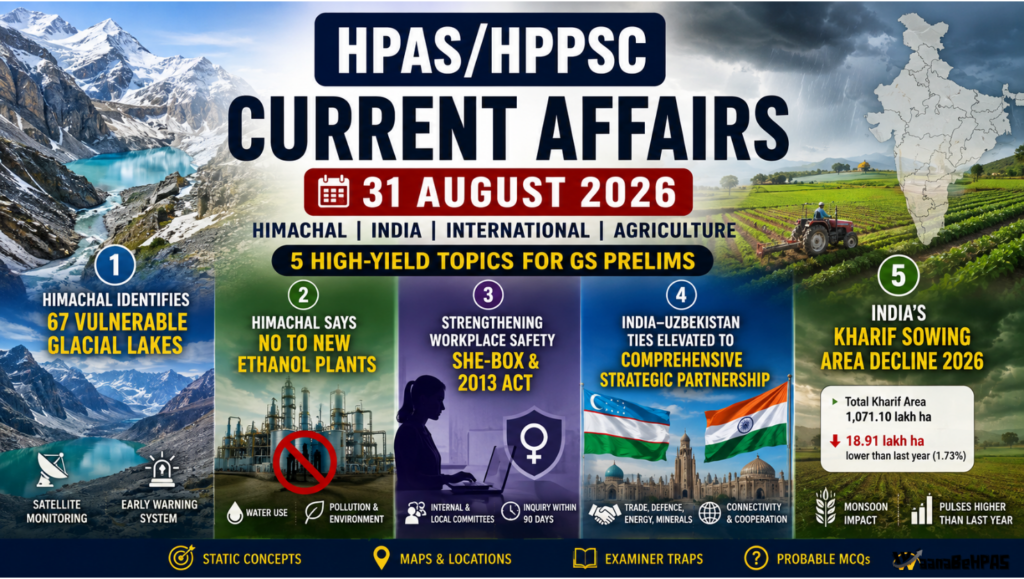
31 August 2026 ke current affairs ko isi approach se filter karne par five developments particularly important emerge hote hain:
- Himachal Pradesh identifies 67 vulnerable glacial lakes
- Himachal Pradesh says no to new ethanol plants
- Himachal to strengthen confidentiality of workplace-harassment complaints — SHe-Box & 2013 Act
- India–Uzbekistan ties upgraded to a Comprehensive Strategic Partnership
- India’s Kharif sowing area declines below last year’s level
Har topic ko hum Current Development → Static Concept → Geography/Location → Important Facts → Examiner Traps → Probable MCQ approach se understand karenge.
1. Himachal Pradesh Identifies 67 Vulnerable Glacial Lakes
Priority: VERY HIGH
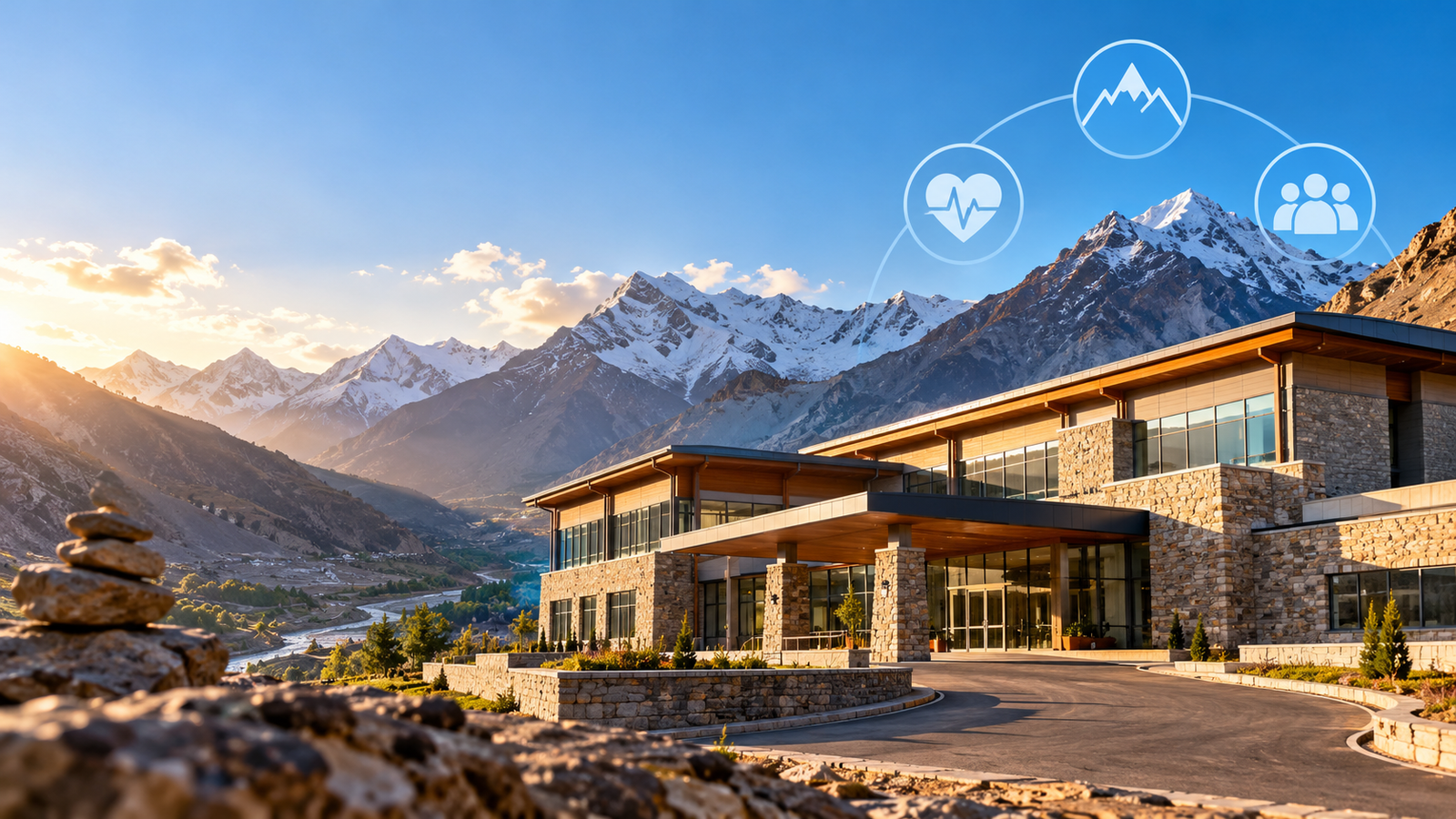
Himachal Pradesh has identified 67 vulnerable glacial lakes larger than 10 hectares in its high-altitude regions.
These lakes are being monitored through satellite imagery and scientific data, while early-warning systems are being prioritised at four vulnerable locations in Kinnaur and Lahaul-Spiti districts.
The development is extremely important for HPAS because it simultaneously connects:
Himachal Geography + Glaciers + Climate Change + Disaster Management + Remote Sensing + GLOF
What is a Glacial Lake?
A glacial lake is a water body whose formation or location is associated with a glacier.
When a glacier retreats, meltwater may accumulate in depressions or behind natural barriers created by glacial debris.
Depending on their location and origin, glacial lakes may include:
- Proglacial lakes — located in front of glaciers
- Moraine-dammed lakes — retained by glacial debris
- Supraglacial lakes — formed on glacier surfaces
- Ice-dammed lakes — retained by glacier ice
The most important term here is moraine.
What is a Moraine?
A moraine is an accumulation of rocks, sediments and debris transported and deposited by a glacier.
Unlike a concrete dam, a moraine dam can consist of unconsolidated material such as:
boulders + gravel + sand + silt + buried ice
This can make some moraine-dammed lakes vulnerable to failure.
Remember the process
Glacier retreat → Meltwater accumulation → Glacial lake formation/expansion → Moraine dam instability → Sudden failure → GLOF
What is GLOF?
GLOF = Glacial Lake Outburst Flood
It refers to the sudden release of a large volume of water from a glacier-related lake following failure, overtopping or destabilisation of the barrier containing the lake.
A GLOF may be triggered by:
- Rock or ice avalanche
- Moraine-dam failure
- Extreme rainfall
- Rapid snowmelt
- Earthquake
- Landslide
- Internal seepage or piping
- Overtopping of the natural dam
One major examiner trap is that heavy rainfall is not essential for every GLOF.
An avalanche entering a glacial lake can generate a displacement wave that overtops the moraine even in the absence of intense local rainfall.
Why are Himalayan GLOFs particularly dangerous?
The Himalayas combine several risk-enhancing factors:
Steep slopes + narrow valleys + fragile geology + glaciers + high sediment availability + downstream settlements and infrastructure
Once water is released, it can carry:
- rocks
- sediments
- boulders
- ice
- landslide debris
Therefore a GLOF may behave as much more than an ordinary flood.
Climate Change Connection
Rising temperatures can increase glacier mass loss and retreat in many Himalayan regions.
As glaciers retreat:
new depressions may become exposed → meltwater accumulates → existing lakes may expand
However:
Climate change does not mean every glacial lake will burst.
Actual GLOF risk depends on lake volume, dam stability, surrounding slopes, avalanche pathways, seismicity and downstream exposure.
Why Satellite Monitoring?
Many Himalayan glacial lakes are located in remote high-altitude terrain.
Satellite remote sensing can monitor:
- Lake area
- Shoreline changes
- Glacier retreat
- Snow and ice conditions
- Surrounding slopes
- Changes over time
India’s National Remote Sensing Centre (NRSC) also prepares glacial-lake inventories and atlases using satellite data.
Early Warning System
An Early Warning System does not prevent glacier melting or guarantee that a GLOF will never occur.
Its objective is:
Detect → Analyse → Communicate → Warn → Evacuate
Possible components include:
- Lake-level sensors
- Automatic Weather Stations
- Cameras
- Satellite communication
- Data analytics
- Sirens/alerts
- Evacuation protocols
A 2026 technological initiative in Sissu, Lahaul also demonstrated a high-altitude GLOF Early Warning System using monitoring equipment and satellite communication.
Himachal Map Linkage
Kinnaur
Remember:
Kinnaur → Sutlej → Baspa → Sangla
Sangla Valley lies along the Baspa River, an important tributary of the Sutlej.
Lahaul-Spiti
Remember:
Chandra + Bhaga → Chenab
The two rivers meet at Tandi.
Also revise:
- Bara Shigri Glacier
- Chandra Tal
- Sissu
- Cold Desert
- Trans-Himalayan environment
Master Memory Chain
67 lakes → >10 hectares → Kinnaur + Lahaul-Spiti → Glacier → Moraine → GLOF → Satellite monitoring → Early Warning System
Probable MCQ
Consider the following statements:
- Himachal Pradesh has identified 67 vulnerable glacial lakes larger than 10 hectares.
- Priority early-warning work includes locations in Kinnaur and Lahaul-Spiti.
- Every glacial lake necessarily produces a GLOF.
- Moraine-dam failure may trigger a GLOF.
Correct Answer: 1, 2 and 4 only
2. Himachal Pradesh Says No to New Ethanol Plants
Priority: VERY HIGH
The Himachal Pradesh government has announced that new ethanol plants will not be permitted in the state.
The decision was discussed in the Himachal Pradesh Legislative Assembly amid concerns related to:
- High water consumption
- Industrial pollution
- Groundwater contamination
- Hazardous waste
- Ecological carrying capacity
The state government cited water consumption of approximately 5–10 lakh litres per day for an ethanol plant.
The immediate geographical context is Nalagarh.
Nalagarh and BBN Industrial Belt
Nalagarh lies in Solan district.
It forms part of one of Himachal Pradesh’s most important industrial clusters:
BBN = Baddi–Barotiwala–Nalagarh
Remember:
Himachal Pradesh → Solan → BBN → Nalagarh
This location is extremely important for HPAS industrial-geography questions.
What is Ethanol?
Ethanol is an alcohol with the chemical formula:
C₂H₅OH
It is also called ethyl alcohol.
Ethanol can be used as:
- Fuel
- Petrol-blending component
- Industrial solvent
- Chemical feedstock
Do not confuse:
Methanol = CH₃OH
Ethanol = C₂H₅OH
How is Ethanol Produced?
Bioethanol can be produced through fermentation.
A simplified process is:
Feedstock → Sugar release → Fermentation → Distillation → Purification → Ethanol
Yeast converts glucose into ethanol and carbon dioxide.
Simplified reaction:
C₆H₁₂O₆ → 2C₂H₅OH + 2CO₂
1G vs 2G Ethanol
This distinction is extremely important.
First-Generation Ethanol — 1G
Produced primarily from conventional sugar- or starch-rich feedstocks.
Examples:
- Sugarcane juice
- Molasses
- Maize
- Grain feedstocks
Second-Generation Ethanol — 2G
Produced from lignocellulosic biomass.
Examples:
- Rice straw
- Wheat straw
- Crop residues
- Corn cobs
- Bagasse
Remember
1G → Sugar/Starch
2G → Agricultural residue/Lignocellulosic biomass
Molasses vs Bagasse
Another common trap:
Molasses
Sugar-rich thick syrup/by-product produced during sugar manufacture.
Bagasse
Fibrous residue remaining after sugarcane juice extraction.
Therefore:
Molasses ≠ Bagasse
What is E20?
E20 refers to petrol blended with approximately:
20% ethanol by volume
India promotes ethanol blending to:
- Reduce petroleum dependence
- Improve energy security
- Support agricultural value chains
- Utilise crop residues
- Potentially reduce lifecycle greenhouse-gas emissions
But:
Biofuel does not automatically mean zero pollution.
Environmental impact depends on:
Feedstock + Water + Fertiliser + Land + Processing energy + Transportation + Waste treatment
Why is Water Consumption Important?
Ethanol plants require water for several processes:
- Fermentation
- Cooling
- Steam generation
- Washing
- Utilities
- Effluent treatment
Therefore industrial location becomes important.
A water-intensive plant in a water-stressed region can compete with:
Domestic demand + Agriculture + Ecosystems + Other industries
Zero Liquid Discharge — ZLD
ZLD is an industrial wastewater-management system.
Its aim is to treat and recover wastewater so that routine liquid effluent is not discharged outside the facility.
Important trap:
ZLD does not mean zero water consumption.
It means:
Wastewater treatment + Recovery + Reuse + Minimal/no routine liquid discharge
Environmental Laws to Remember
| Law | Year |
|---|---|
| Water (Prevention and Control of Pollution) Act | 1974 |
| Air (Prevention and Control of Pollution) Act | 1981 |
| Environment (Protection) Act | 1986 |
| EIA Notification | 2006 |
Chronology
Water Act 1974 → Air Act 1981 → EPA 1986 → EIA Notification 2006
Examiner Trap
Himachal’s decision does not mean:
“India has banned ethanol.”
It means:
Himachal Pradesh will not permit new ethanol manufacturing plants in the state under the announced policy direction.
India’s ethanol-blending programme remains a separate national policy.
Master Memory Chain
No new ethanol plants → 5–10 lakh litres/day → Nalagarh → Solan → BBN → C₂H₅OH → 1G/2G → E20 → Water footprint → Pollution → ZLD
Probable MCQ
Second-generation ethanol can be produced from:
A. Crude petroleum
B. Lignocellulosic agricultural residues
C. Natural gas only
D. Uranium
Correct Answer: B
3. Himachal Workplace Harassment Complaints, SHe-Box and the 2013 Act
Priority: HIGH
During proceedings in the Himachal Pradesh Legislative Assembly, the state government announced steps to strengthen the confidentiality of complaints concerning harassment of women.
The Assembly was informed that 131 cases had been registered during the previous three years across specified:
- Government workplaces
- Semi-government workplaces
- Private workplaces
- Educational institutions
The development also brings the Central Government’s SHe-Box portal into focus.
What is SHe-Box?
SHe-Box = Sexual Harassment electronic Box
It is a digital platform associated with the:
Ministry of Women and Child Development
The revamped SHe-Box portal was launched on:
29 August 2024
It provides a single-window mechanism for workplace sexual-harassment complaints and facilitates routing and monitoring through the appropriate statutory committee.
Which Law Governs Workplace Sexual Harassment?
The full name is:
Sexual Harassment of Women at Workplace (Prevention, Prohibition and Redressal) Act, 2013
Commonly called:
PoSH Act / SH Act, 2013
Three keywords explain the objective:
Prevention + Prohibition + Redressal
Internal Committee — IC
An Internal Committee is the workplace-level statutory mechanism.
Most important threshold:
10 or more employees → Internal Committee required
The committee includes:
- Presiding Officer
- Employee members
- External member
At least half of the total members should be women.
Local Committee — LC
Do not confuse the Local Committee with the Internal Committee.
Internal Committee
Workplace level
Local Committee
District level
The Local Committee becomes particularly important where:
- The establishment has fewer than 10 workers, or
- The complaint is against the employer.
Golden Difference
IC → Workplace
LC → District
Does SHe-Box Replace These Committees?
No.
The basic mechanism is:
Woman files complaint → SHe-Box → Appropriate IC/LC → Inquiry → Status monitoring
SHe-Box facilitates access and digital monitoring.
It does not abolish the statutory committees.
Important Timeline
One of the most important numbers:
Inquiry → 90 days
A complaint is ordinarily to be made within the prescribed statutory period, while the inquiry itself is to be completed within 90 days.
Vishaka Guidelines
Before the 2013 law, India’s most important legal development was:
Vishaka v. State of Rajasthan — 1997
The Supreme Court issued the Vishaka Guidelines for preventing and addressing workplace sexual harassment.
Chronology
Vishaka Guidelines 1997 → Workplace Act 2013 → Revamped SHe-Box 2024 → Himachal development 2026
This is a highly probable chronology question.
Constitutional Linkages
Important Articles include:
Article 14
Equality before law.
Article 15
Prohibition of discrimination on specified grounds, including sex.
Article 15(3)
Allows special provisions for women and children.
Article 19(1)(g)
Freedom to practise any profession or carry on an occupation, trade or business.
Article 21
Life and personal liberty; dignity and privacy are important jurisprudential linkages.
Article 42
Directive Principle concerning just and humane conditions of work and maternity relief.
Article 51A(e)
Fundamental Duty to renounce practices derogatory to the dignity of women.
Important trap:
Article 42 → DPSP
Article 51A(e) → Fundamental Duty
Mission Shakti Linkage
SHe-Box is also connected with the wider digital ecosystem of the Ministry of Women and Child Development.
Mission Shakti is an umbrella programme focused on women’s:
Safety + Security + Empowerment
The SHe-Box system has also been integrated with the Mission Shakti mobile application.
Master Memory Chain
Himachal → 131 cases → Confidentiality → SHe-Box → MWCD → 2013 Act → 10+ employees → IC → LC → 90 days → Vishaka 1997
Probable MCQ
Consider the following pairs:
- Internal Committee — Workplace level
- Local Committee — District level
- SHe-Box — Ministry of Women and Child Development
- Article 42 — Fundamental Right
Which are correctly matched?
Correct Answer: 1, 2 and 3 only
4. India–Uzbekistan Ties Elevated to Comprehensive Strategic Partnership
Priority: VERY HIGH
Prime Minister Narendra Modi visited Uzbekistan on 29–30 August 2026.
During talks with Uzbekistan President Shavkat Mirziyoyev, India and Uzbekistan elevated their bilateral relationship to a:
Comprehensive Strategic Partnership
The two countries also set a target of:
USD 5 billion bilateral trade by 2030
Major cooperation areas include:
- Critical minerals
- Uranium and nuclear energy
- Mining
- Defence
- Digital Public Infrastructure
- UPI
- Connectivity
- Healthcare
- Pharmaceuticals
- Education
- Agriculture
Uzbekistan — Map Package
Capital:
Tashkent
Uzbekistan borders:
- Kazakhstan
- Kyrgyzstan
- Tajikistan
- Afghanistan
- Turkmenistan
Remember
Uzbekistan does not border India.
Uzbekistan is Double-Landlocked
A double-landlocked country is a country whose neighbouring countries are themselves landlocked.
The world’s two standard examples are:
Uzbekistan
Liechtenstein
This is a highly probable geography question.
Five Central Asian Republics
| Country | Capital |
|---|---|
| Kazakhstan | Astana |
| Kyrgyzstan | Bishkek |
| Tajikistan | Dushanbe |
| Turkmenistan | Ashgabat |
| Uzbekistan | Tashkent |
Memorise all five together.
Uranium Cooperation
India and Uzbekistan also discussed progress towards a long-term uranium-supply arrangement.
An earlier contract signed in 2019 provided for supply of:
1,100 metric tonnes of natural uranium ore concentrate
during:
2022–2026
This creates an important science branch.
U-235 vs U-238
Natural uranium primarily contains:
Uranium-238
Much more abundant.
Uranium-235
Present in much smaller proportion but important because it is fissile.
Remember:
U-235 → Fissile
U-238 → Predominantly Fertile
A fertile material can be converted into fissile material through nuclear processes.
Nuclear Fission
In nuclear fission:
Heavy nucleus → Splits → Energy + Neutrons
Released neutrons may trigger further fissions, creating a:
Chain Reaction
Do not confuse with nuclear fusion.
Fission
Heavy nuclei split.
Fusion
Light nuclei combine.
Critical Minerals
India and Uzbekistan also agreed to deepen cooperation in critical minerals.
A critical mineral is important because of:
Economic/strategic importance + Supply-chain vulnerability
Important trap:
Critical mineral does not necessarily mean rare mineral.
Examples may include:
- Lithium
- Cobalt
- Nickel
- Graphite
- Rare earth elements
depending on national classifications.
Aral Sea — Extremely Important Geography Link
India announced a:
USD 1 million grant
for environmental rehabilitation/afforestation in the Aral Sea region.
The Aral Sea lies in the region of:
Kazakhstan + Uzbekistan
Two major rivers historically feeding it are:
Amu Darya
Syr Darya
Memory Chain
Amu Darya + Syr Darya → Aral Sea
Why Did the Aral Sea Shrink?
The major historical reason was diversion of river water for large-scale irrigation.
Process:
River diversion → Reduced inflow → Falling water level → Increased salinity → Fishery/ecosystem collapse → Exposed lake bed → Salt and dust storms
Cotton cultivation is strongly associated with this irrigation history.
Endorheic Basin
The Aral Sea is an inland endorheic water body.
An endorheic basin has:
No natural drainage outlet to the open ocean.
Water ends in inland lakes/depressions and is lost largely through evaporation.
Connectivity — Chabahar and INSTC
Because Uzbekistan is double-landlocked and India has no direct land boundary with Central Asia, connectivity is strategically important.
Chabahar Port
Located in:
Iran
Gwadar Port
Located in:
Pakistan
Do not confuse the two.
India also supports connectivity through the:
International North-South Transport Corridor — INSTC
DUSTLIK Exercise
India and Uzbekistan conduct the bilateral military exercise:
DUSTLIK
Remember:
DUSTLIK → India + Uzbekistan
Digital Payments Link
A 2026 outcome also involved cooperation between:
NPCI International Payments Limited — NIPL
and Uzbekistan’s payment infrastructure.
This can enable Indian UPI applications to interact with Uzbekistan’s UZQR merchant-payment ecosystem.
Buddhist Heritage Link
India and Uzbekistan also agreed on cooperation for restoration/conservation of:
Fayaz Tepa
Kara Tepa
These Buddhist heritage sites are located in:
Termez, Uzbekistan
Lal Bahadur Shastri–Tashkent Connection
Another important static linkage:
After the 1965 India–Pakistan War:
Tashkent Declaration — 1966
Prime Minister Lal Bahadur Shastri died in Tashkent shortly thereafter.
Chronology:
1965 India–Pakistan War → Tashkent Declaration 1966 → Shastri’s death in Tashkent
Master Memory Chain
Uzbekistan → Tashkent → Double-landlocked → CSP 2026 → $5 bn by 2030 → Uranium → U-235/U-238 → Critical minerals → Aral Sea → Amu Darya + Syr Darya → Chabahar/INSTC → DUSTLIK
Probable MCQ
Consider the following statements:
- Uzbekistan is a double-landlocked country.
- Tashkent is its capital.
- Amu Darya and Syr Darya are associated with the Aral Sea.
- Uzbekistan has a direct land boundary with India.
Correct Answer: 1, 2 and 3 only
5. India’s Kharif Sowing Area Declines in 2026
Priority: HIGH
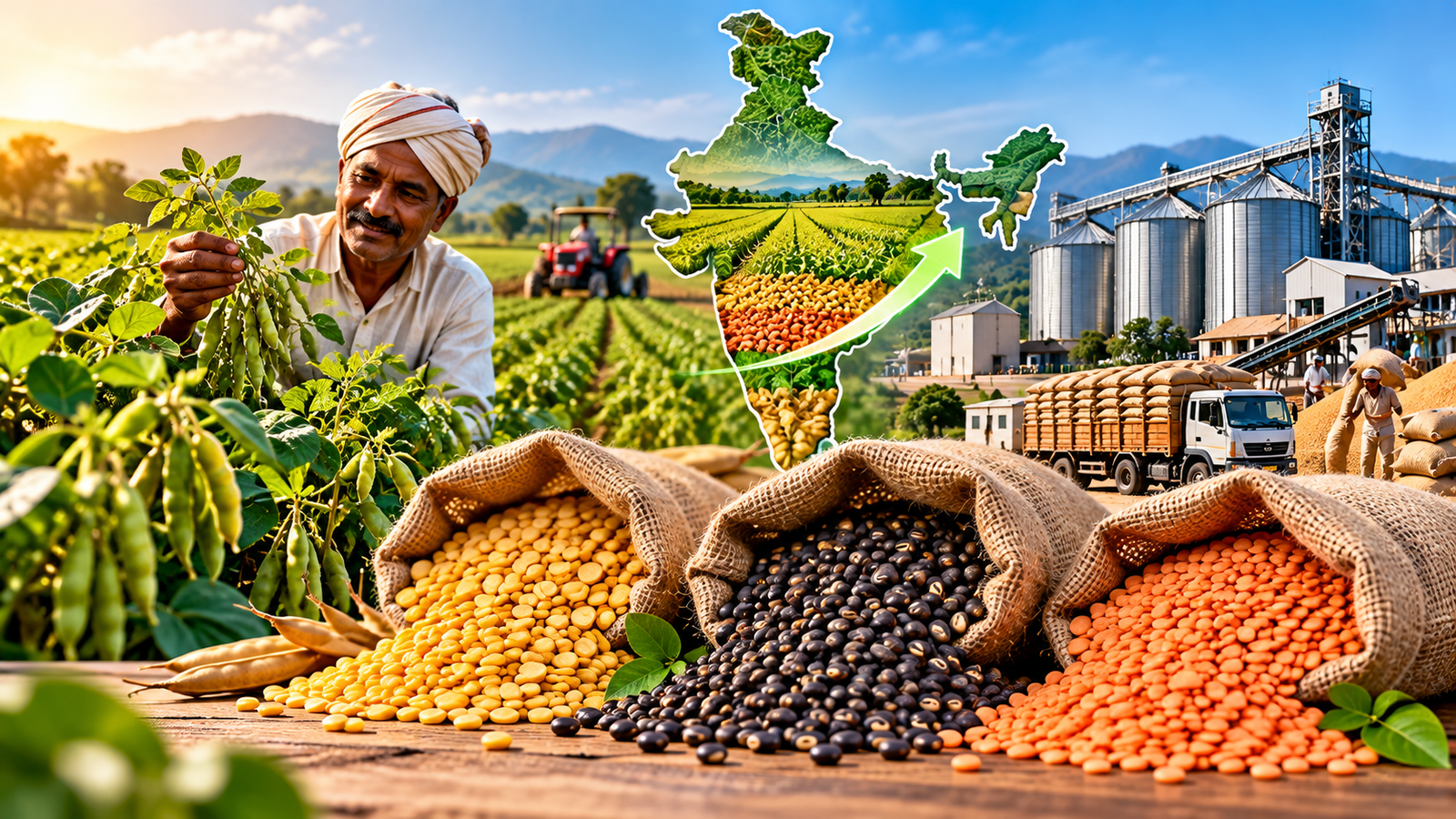
As of 28 August 2026, India’s total area under Kharif crops stood at:
1,071.10 lakh hectares
At the corresponding stage of the previous year:
1,090.01 lakh hectares
Therefore the current sowing area was lower by:
18.91 lakh hectares
or approximately:
1.73%
The decline was linked with weak and erratic monsoon conditions.
Important Crop Data
| Crop/Group | Area |
|---|---|
| Total Kharif | 1,071.10 lakh ha |
| Paddy | 414.10 lakh ha |
| Pulses | 115.05 lakh ha |
| Maize | 89.99 lakh ha |
| Soybean | 121.72 lakh ha |
| Cotton | 108.80 lakh ha |
One important trap:
Total pulses acreage was slightly higher than the previous year, even though total Kharif acreage was lower.
What is a Hectare?
1 hectare = 10,000 square metres
Also:
1 km² = 100 hectares
Therefore:
1 lakh hectares = 1,000 km²
Kharif Crops
Kharif crops are primarily associated with the Southwest Monsoon.
Broad cycle:
Monsoon onset → Sowing → Monsoon growth period → Autumn harvest
Important Kharif crops:
- Rice
- Maize
- Cotton
- Soybean
- Bajra
- Jowar
- Tur/Arhar
- Groundnut
Rabi Crops
Rabi crops are generally:
Sown in winter → Harvested in spring
Important examples:
- Wheat
- Gram
- Mustard
- Barley
Classic Trap
Rice → Kharif
Wheat → Rabi
Zaid Crops
Zaid is the short season between:
Rabi and Kharif
Examples include:
- Watermelon
- Muskmelon
- Cucumber
- Fodder crops
where irrigation and climatic conditions permit.
Why Does the Monsoon Matter?
The Southwest Monsoon affects:
- Soil moisture
- Sowing
- Reservoir storage
- Groundwater recharge
- Irrigation
- Crop growth
- Subsequent Rabi season
Therefore monsoon performance influences much more than just rainfall totals.
Rainfall Amount vs Rainfall Distribution
This distinction is crucial.
Suppose total seasonal rainfall is near normal.
Agriculture can still suffer if rainfall is:
- Delayed
- Concentrated in a few events
- Unevenly distributed
- Followed by long dry spells
- Regionally deficient
Therefore:
Normal rainfall does not necessarily mean normal agricultural conditions.
Southwest Monsoon
India’s Southwest Monsoon broadly dominates:
June–September
Two major branches are conventionally identified:
Arabian Sea Branch
Strongly influences India’s western side and produces heavy orographic rainfall along the windward Western Ghats.
Bay of Bengal Branch
Influences Northeast India and moves towards the Indo-Gangetic region.
ENSO
ENSO = El Niño–Southern Oscillation
It is associated with the tropical:
Pacific Ocean
El Niño
Abnormal warming of central/eastern equatorial Pacific waters.
La Niña
Abnormal cooling.
El Niño is often associated with weaker Indian monsoon conditions.
But:
Every El Niño does not automatically produce drought in India.
Indian Ocean Dipole — IOD
IOD is associated with sea-surface-temperature differences across the:
Indian Ocean
Remember:
ENSO → Pacific
IOD → Indian Ocean
Pulses
Important pulses include:
- Tur/Arhar
- Urad
- Moong
- Gram
Legumes often form symbiotic associations with:
Rhizobium bacteria
which help in biological nitrogen fixation.
But remember:
Soybean and groundnut are legumes botanically but are generally classified as oilseeds in agricultural statistics.
Millets — Shri Anna
Important millets include:
- Jowar
- Bajra
- Ragi
Government usage increasingly refers to millets as:
Shri Anna
Millets are valued for nutritional qualities and adaptation to diverse agro-climatic conditions.
Acreage vs Production vs Productivity
These three must never be confused.
Acreage
Area under a crop.
Production
Total crop output.
Productivity/Yield
Output per unit area.
Broad relationship:
Production = Area × Yield
Therefore:
A 1.73% decline in acreage does not automatically mean production will decline by exactly 1.73%.
Cropping Intensity
Formula:
Cropping Intensity = (Gross Cropped Area ÷ Net Sown Area) × 100
If the same land is cultivated twice in one year, it is counted twice in gross cropped area but once in net sown area.
Therefore cropping intensity can exceed:
100%
UPAg
The latest crop-area data are linked with:
UPAg — Unified Portal for Agricultural Statistics
It is associated with the:
Ministry of Agriculture and Farmers Welfare
Important trap:
UPAg is not a crop-insurance scheme.
PMFBY Linkage
Pradhan Mantri Fasal Bima Yojana — PMFBY
is India’s major crop-insurance programme.
Erratic rainfall, drought, floods and other crop risks make crop insurance relevant to the current Kharif situation.
But remember:
Area insured under PMFBY ≠ Total Kharif area sown
These are two different datasets.
Master Memory Chain
1,071.10 lakh ha → 18.91 lakh ha lower → Monsoon → Kharif → Paddy/Maize/Soybean → Pulses → Acreage vs Yield → ENSO/IOD → UPAg → PMFBY
Probable MCQ
Which of the following are generally Kharif crops?
- Rice
- Cotton
- Soybean
- Wheat
Correct Answer: 1, 2 and 3 only
Final Rapid Revision Table
| Topic | Most Important Facts | Static Link |
|---|---|---|
| HP Glacial Lakes | 67 vulnerable lakes; >10 ha; Kinnaur & Lahaul-Spiti | GLOF, moraine, glaciers, remote sensing |
| HP Ethanol Policy | No new ethanol plants; 5–10 lakh L/day | C₂H₅OH, 1G/2G, E20, ZLD, BBN |
| SHe-Box | 131 HP cases; confidentiality; MWCD | 2013 Act, IC/LC, 10+ employees, Vishaka |
| India–Uzbekistan | CSP; $5 bn by 2030 | Central Asia, uranium, Aral Sea, critical minerals |
| Kharif Sowing | 1,071.10 lakh ha; -18.91 lakh ha | Monsoon, crop seasons, ENSO/IOD, UPAg |
Five Memory Chains for Last-Minute Revision
1. Himachal Glacial Lakes
67 → >10 ha → Kinnaur/Lahaul-Spiti → Glacier → Moraine → GLOF → Satellite → EWS
2. Himachal Ethanol
No new plants → Nalagarh → Solan → BBN → C₂H₅OH → 1G/2G → E20 → Water → ZLD
3. SHe-Box
131 cases → Confidentiality → SHe-Box → MWCD → 2013 Act → 10+ → IC → LC → 90 days → Vishaka 1997
4. India–Uzbekistan
Tashkent → Double-landlocked → CSP → $5 bn → Uranium → Aral Sea → Amu Darya + Syr Darya → DUSTLIK
5. Kharif Agriculture
1,071.10 lakh ha → -18.91 lakh ha → Monsoon → Kharif → Pulses → ENSO/IOD → UPAg → PMFBY
Quick Practice Test
Q1. A moraine is associated with:
A. Volcanic eruption
B. Glacial deposition
C. Coral reef formation
D. Desert dunes
Answer: B
Q2. Second-generation ethanol is primarily associated with:
A. Crude petroleum
B. Lignocellulosic biomass
C. Uranium
D. Natural gas
Answer: B
Q3. SHe-Box is associated with which Ministry?
A. Ministry of Home Affairs
B. Ministry of Labour
C. Ministry of Women and Child Development
D. Ministry of Electronics and IT
Answer: C
Q4. Which pair is correctly matched?
A. Tashkent — Kazakhstan
B. Bishkek — Uzbekistan
C. Dushanbe — Tajikistan
D. Ashgabat — Kyrgyzstan
Answer: C
Q5. Amu Darya and Syr Darya are associated with:
A. Caspian Sea
B. Aral Sea
C. Black Sea
D. Red Sea
Answer: B
Q6. Which of the following is primarily a Rabi crop?
A. Cotton
B. Soybean
C. Wheat
D. Paddy
Answer: C
Q7. UPAg stands for:
A. Unified Portal for Agricultural Statistics
B. Universal Programme for Agricultural Growth
C. Unified Programme for Agro Governance
D. Union Portal for Agricultural Grants
Answer: A
Q8. The inquiry under the workplace sexual-harassment law is to be completed within:
A. 30 days
B. 60 days
C. 90 days
D. 180 days
Answer: C
Conclusion
The five developments of 31 August 2026 demonstrate exactly why HPAS Current Affairs cannot be prepared as isolated one-liners.
A news item about 67 glacial lakes becomes a question on GLOF, moraine, Kinnaur, Baspa and remote sensing.
A decision concerning ethanol plants becomes a question on C₂H₅OH, 1G/2G biofuels, E20, water footprint and the BBN industrial belt.
A Himachal announcement on women’s complaints leads directly to SHe-Box, the 2013 Act, Internal and Local Committees and Vishaka Guidelines.
The India–Uzbekistan visit opens questions on Central Asian capitals, uranium, critical minerals, the Aral Sea, Amu Darya and Syr Darya.
And a decline in Kharif acreage can be transformed into questions on cropping seasons, monsoon behaviour, ENSO, IOD, pulses, millets, UPAg and crop insurance.
For HPAS/HPPSC GS Prelims, the best preparation chain is therefore:
Current Event → Static Concept → Location/Map → Institution → Data/Chronology → Examiner Trap → MCQ
That approach converts daily current affairs from temporary news into exam-ready knowledge.