US–Iran–Israel Conflict Explained: Nuclear Ambitions, Strait of Hormuz and the Future of the Middle East
Introduction
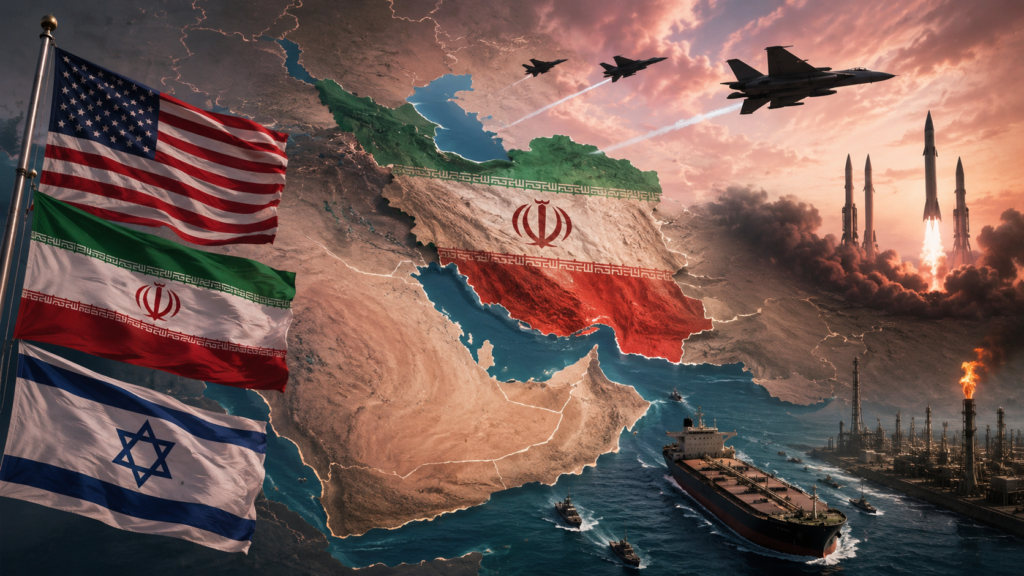
The conflict involving the United States, Iran, and Israel is one of the most significant geopolitical rivalries of the modern era. What appears on the surface as a dispute over nuclear weapons is, in reality, a complex struggle involving regional dominance, security concerns, energy routes, ideological differences, and global power politics.
The importance of this conflict extends far beyond the Middle East. It influences international oil prices, global trade, maritime security, nuclear non-proliferation efforts, and the strategic calculations of major powers across the world.
Historical Background
Iran Before the 1979 Revolution
Prior to 1979, Iran was ruled by Shah Mohammad Reza Pahlavi, a pro-Western monarch who maintained cordial relations with both the United States and Israel.
During this period:
- Iran was one of America’s closest allies in the Middle East.
- Israel and Iran cooperated economically and strategically.
- The United States supported Iran militarily and politically.
However, this relationship changed dramatically after the Iranian Revolution.
The Iranian Revolution of 1979
In 1979, the Shah was overthrown and Iran became an Islamic Republic under Ayatollah Ruhollah Khomeini.
The new regime adopted an anti-Western and anti-Israel foreign policy.
Key outcomes included:
- Severance of ties with Israel.
- Hostility toward the United States.
- Promotion of an Islamic revolutionary ideology across the region.
This revolution laid the foundation of the modern US-Iran rivalry.
Why Does Iran Oppose Israel?
Iran does not recognize Israel as a legitimate state and has consistently supported groups opposing Israeli policies.
Iran argues that:
- Palestinians have been denied their rights.
- Israeli actions in Palestinian territories are unjust.
Israel, on the other hand, views Iran as its most serious security threat because of Iran’s military capabilities, missile program, and support for armed groups across the region.
The Nuclear Question: The Core of the Conflict
The most important issue between Iran, Israel, and the United States is Iran’s nuclear program.
What is Uranium Enrichment?
Natural uranium contains only about 0.7% of Uranium-235, the isotope required for nuclear fission.
Through enrichment, the concentration of Uranium-235 is increased.
Low Enriched Uranium (LEU)
- Usually 3–5% U-235.
- Used in civilian nuclear power plants.
Highly Enriched Uranium (HEU)
- Above 20% U-235.
- Weapons-grade uranium is usually around 90%.
The international community fears that if Iran accumulates sufficient HEU, it could potentially develop nuclear weapons.
Why is Israel Concerned?
Israel views a nuclear-capable Iran as an existential threat.
Israeli leaders argue that:
- Nuclear weapons in Iranian hands could alter the regional balance of power.
- Iran-backed militant organizations could become more aggressive under a nuclear umbrella.
Consequently, Israel has repeatedly opposed Iran’s nuclear program and supported efforts to restrict it.
The Role of the United States
The United States has historically pursued three major objectives:
- Prevent Iran from developing nuclear weapons.
- Protect Israel’s security.
- Maintain stability in global energy markets.
To achieve these goals, Washington has imposed economic sanctions on Iran and supported international efforts to monitor its nuclear activities through the International Atomic Energy Agency (IAEA).
Recent negotiations between the United States and Iran have focused on limiting Iran’s nuclear activities, restoring inspections, easing sanctions, and ensuring maritime security in the Strait of Hormuz.
Iran’s Regional Influence and Proxy Network
Iran’s influence extends far beyond its borders through a network of allied organizations often referred to as the “Axis of Resistance.”
These include:
- Hezbollah in Lebanon.
- Hamas in Gaza.
- Houthi movement in Yemen.
- Various Shia militias in Iraq and Syria.
Through these groups, Iran can project influence without engaging in direct military confrontation.
This strategy is known as proxy warfare.
What is Proxy Warfare?
Proxy warfare occurs when states support non-state actors or allied groups to advance strategic objectives without directly entering a war.
Advantages include:
- Lower military costs.
- Reduced political risks.
- Strategic deniability.
Iran has relied extensively on this model to counter Israeli and American influence in the region.
The Strait of Hormuz: The World’s Most Important Energy Chokepoint
One of Iran’s greatest strategic advantages is its geographical position.
Location
The Strait of Hormuz lies between:
- Iran (north)
- Oman and the UAE (south)
It connects:
- Persian Gulf
- Gulf of Oman
- Arabian Sea
Why is the Strait of Hormuz Important?
A substantial share of the world’s oil and liquefied natural gas (LNG) exports passes through this narrow maritime corridor. Any disruption can significantly affect global energy markets and shipping.
For this reason, it is widely regarded as the most important energy chokepoint in the world.
How Can Iran Influence the Strait?
Iran cannot permanently close the Strait of Hormuz, but it can disrupt navigation through:
Naval Mines
Explosive devices deployed underwater.
Anti-Ship Missiles
Missiles positioned along the coastline.
Drones
Used for surveillance and attacks.
Fast Attack Craft
Small naval vessels capable of harassing commercial shipping.
Even limited disruption can increase:
- Oil prices.
- Shipping insurance costs.
- Global economic uncertainty.
Recent diplomatic efforts have specifically focused on ensuring freedom of navigation through the Strait of Hormuz.
Economic Sanctions on Iran
Economic sanctions are restrictions imposed to influence a country’s behavior.
Sanctions imposed on Iran have targeted:
- Oil exports.
- Banking systems.
- International trade.
- Foreign investments.
The objective has been to pressure Iran into limiting its nuclear activities and altering regional behavior.
However, sanctions have also imposed significant economic costs on Iranian society.
Nuclear Diplomacy and International Monitoring
The International Atomic Energy Agency (IAEA) serves as the principal international body responsible for monitoring Iran’s nuclear program.
Its responsibilities include:
- Inspecting nuclear facilities.
- Monitoring uranium stockpiles.
- Verifying compliance with agreements.
Recent diplomatic initiatives have included renewed IAEA inspections and discussions on uranium downblending to reduce proliferation risks.
Why the Conflict Matters to India
India has several interests linked to the region:
Energy Security
India imports a large share of its crude oil requirements from West Asia.
Maritime Trade
Any disruption in the Strait of Hormuz affects India’s trade and energy supplies.
Indian Diaspora
Millions of Indians live and work in Gulf countries.
Strategic Stability
Regional instability can impact India’s economic and security interests.
Therefore, India generally advocates:
- Peaceful resolution of disputes.
- Freedom of navigation.
- Diplomatic engagement.
- Nuclear non-proliferation.
Geopolitical Significance
The US–Iran–Israel conflict is not merely a regional dispute.
It involves:
- Nuclear proliferation.
- Energy security.
- Maritime chokepoints.
- Great power competition.
- Regional leadership.
- International diplomacy.
The outcome of this rivalry will significantly shape the future political and security architecture of the Middle East.
Conclusion
The US–Iran–Israel conflict is fundamentally a struggle over security, power, ideology, and strategic geography. While Iran seeks to preserve its sovereignty and regional influence, Israel aims to prevent the emergence of a hostile nuclear-capable rival, and the United States seeks to maintain regional stability, protect allies, and safeguard global energy flows.
At the center of this complex rivalry lie two critical issues: Iran’s nuclear program and the Strait of Hormuz. Together, they ensure that this conflict remains one of the most consequential geopolitical challenges of the twenty-first century.