
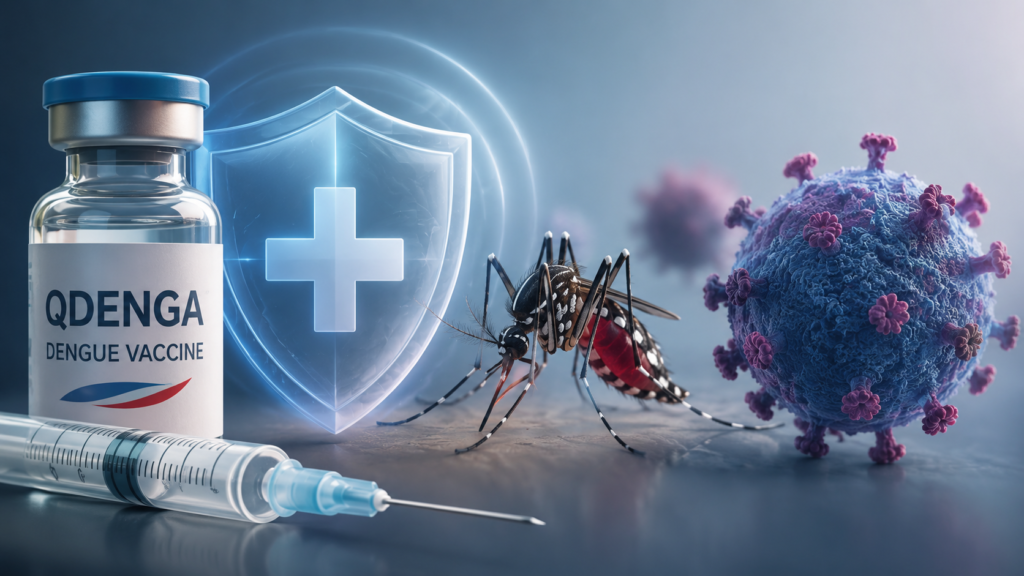
Qdenga Explained: Why India’s First Dengue Vaccine is a Scientific Breakthrough and a Public Health Debate
Introduction
India has approved its first dengue vaccine, Qdenga (TAK-003), marking a major milestone in disease prevention. However, concerns over Antibody-Dependent Enhancement (ADE), vaccine safety in seronegative individuals, and balanced immunity against all four dengue serotypes have sparked an important scientific debate. Understand the complete story behind dengue, Qdenga, ADE, CDSCO approval, and its UPSC relevance in simple language.
Why is it in News?
India’s drug regulator, the Central Drugs Standard Control Organisation (CDSCO), has approved Qdenga (TAK-003)—the country’s first approved dengue vaccine. At the same time, a clinical analysis published in Nature Medicine has highlighted a potential safety concern. Researchers found that in certain seronegative children (those who have never had dengue before), the vaccine may increase the risk of severe dengue caused by specific virus serotypes through a phenomenon known as Antibody-Dependent Enhancement (ADE).
This has triggered a wider discussion on vaccine safety, public health policy, immunology, and India’s drug regulatory framework.
Why is Developing a Dengue Vaccine So Difficult?
Imagine four criminals who belong to the same gang.
They wear similar clothes, but each has a different face.
The police successfully catches the first criminal and memorizes his face. A few years later, another criminal from the same gang appears. He looks similar, but not identical.
The police become confused.
Something very similar happens inside our body when we get dengue.
Unlike diseases such as measles or chickenpox, dengue is not caused by just one type of virus. It is caused by four different serotypes, and this makes vaccine development extremely challenging.
What Exactly is Dengue?
Dengue is a mosquito-borne viral disease caused by the Dengue Virus (DENV). It spreads through the bite of an infected female Aedes aegypti mosquito, which acts as the vector for the disease.
It is important to remember that dengue does not spread directly from one person to another. A mosquito first bites an infected person, acquires the virus, and later transmits it to another individual through its bite.
UPSC Exam Point
| Term | Meaning |
|---|---|
| Pathogen | Disease-causing organism (Dengue Virus) |
| Vector | Organism that transmits the pathogen (Aedes aegypti mosquito) |
What Makes Dengue Different from Other Viral Diseases?
The biggest challenge lies in the existence of four different serotypes of the dengue virus.
| Dengue Serotype | Full Name |
|---|---|
| DENV-1 | Dengue Virus Type 1 |
| DENV-2 | Dengue Virus Type 2 |
| DENV-3 | Dengue Virus Type 3 |
| DENV-4 | Dengue Virus Type 4 |
Although all four cause dengue fever, they are immunologically different because their outer surface proteins vary.
This means that your immune system has to recognize each one separately.
Can You Get Dengue More Than Once?
Yes.
This is one of the most unique characteristics of dengue.
Suppose you get infected with DENV-1.
Your immune system learns to recognize DENV-1 and usually develops lifelong immunity against that specific serotype. This is called Homologous Protection.
However, the protection against DENV-2, DENV-3 and DENV-4 is only temporary and incomplete. This is known as Cross-Protection.
Once this temporary protection fades, you can become infected again by another serotype.
Remember
One dengue infection does NOT provide lifelong protection against all four dengue viruses.
This single concept explains why dengue vaccines are so difficult to develop.
Before Understanding the Vaccine, Let’s Understand Our Immune System
Whenever a virus enters the body, the immune system immediately launches a defence.
Think of it as a country’s security system.
Different immune cells perform different responsibilities.
| Immune Component | Function |
|---|---|
| B Cells | Produce antibodies |
| T Cells | Destroy infected body cells |
| Macrophages | Engulf and digest pathogens |
| Memory Cells | Remember previous infections |
Together, these cells protect us from disease.
What are Antibodies?
Antibodies are special proteins produced by B cells to recognize and neutralize viruses.
Imagine a police department preparing a “Wanted Poster” for every criminal.
Whenever the same criminal returns, the police identify him immediately.
Antibodies work in exactly the same way.
They recognize viruses and prevent them from infecting our cells.
How Do Vaccines Actually Work?
Many people think vaccines cure diseases.
They don’t.
Vaccines train the immune system before the real infection occurs.
Instead of waiting for the dangerous virus to attack, a vaccine safely introduces the immune system to the virus (or part of it), allowing it to prepare antibodies and memory cells in advance.
Later, when the real virus enters the body, the immune system responds much faster.
How a Vaccine Protects Us
Vaccination
↓
Immune System Recognizes the Virus
↓
B Cells Produce Antibodies
↓
Memory Cells Are Formed
↓
Future Infection
↓
Rapid Immune Response
↓
Reduced Risk of Severe Disease
What is Qdenga?
Qdenga (TAK-003) is India’s first approved dengue vaccine.
It is developed by Takeda Pharmaceuticals and belongs to the category of Live-Attenuated Tetravalent Vaccines.
Let’s understand what this means.
Live-Attenuated Vaccine
A live-attenuated vaccine contains a weakened form of the virus.
The virus is still capable of stimulating the immune system but is modified so that it generally does not cause severe disease in healthy individuals.
This approach often produces a strong and long-lasting immune response.
What Does Tetravalent Mean?
“Tetra” means four.
Since dengue has four serotypes, the vaccine must ideally generate balanced protection against:
- DENV-1
- DENV-2
- DENV-3
- DENV-4
If protection is strong against only one or two serotypes, the remaining serotypes may still pose a risk.
Why Does Qdenga Use DENV-2 as its Genetic Backbone?
One of the most confusing terms in the news is “DENV-2 Genetic Backbone.”
Think of a car.
The chassis and engine remain the same, but different parts such as the doors and lights are modified.
Similarly, scientists used DENV-2 as the basic framework and, through Recombinant DNA Technology, engineered it to express important surface proteins from all four dengue serotypes.
As a result, the immune system is trained to recognize multiple dengue variants instead of just one.
UPSC Exam Point
Recombinant DNA Technology is a biotechnology technique in which DNA from different sources is combined to create organisms or products with desired characteristics.
It is widely used in:
- Vaccine development
- Insulin production
- Gene therapy
- Genetic engineering
Why Was Qdenga Considered a Major Achievement?
For decades, scientists struggled to develop an effective dengue vaccine because of the presence of four serotypes and the risk of severe secondary infections.
Qdenga became significant because it demonstrated:
- Protection against multiple dengue serotypes.
- Reduction in symptomatic dengue.
- Lower hospitalization rates.
- A scientifically advanced tetravalent design.
However, this was not the end of the story.
Just when it appeared that scientists had solved the dengue puzzle, another challenge emerged.
A study published in Nature Medicine raised concerns that, under specific circumstances, the immune response generated by the vaccine might actually increase the risk of severe dengue in certain individuals.
This phenomenon is called Antibody-Dependent Enhancement (ADE)—one of the most fascinating and challenging concepts in modern immunology.
How Can Antibodies Help the Virus Instead of Stopping It?
At first glance, this sounds impossible.
After all, antibodies are supposed to protect us.
So how can they become a problem?
The answer lies in one of the most fascinating concepts in immunology called Antibody-Dependent Enhancement (ADE).
Understanding ADE with a Simple Story
Imagine the police are chasing a dangerous criminal.
Instead of arresting him, they mistakenly escort him inside the police headquarters.
Once inside, the criminal gains access to weapons, confidential information and more officers to attack.
The very people who were supposed to stop him accidentally help him.
Something similar can happen during dengue infection.
What is Antibody-Dependent Enhancement (ADE)?
Antibody-Dependent Enhancement (ADE) is an immunological phenomenon in which antibodies bind to the dengue virus but fail to completely neutralize it. Instead of destroying the virus, these antibodies help it enter immune cells, allowing it to multiply rapidly and increasing the risk of severe dengue.
In simple words,
The antibodies recognize the virus but fail to stop it. Instead, they unintentionally help it infect more cells.
This unusual behaviour makes dengue very different from most viral diseases.
How Does ADE Actually Happen?
Let’s understand it step by step.
Step 1
A person gets infected with DENV-1 for the first time.
The immune system produces antibodies against DENV-1.
The person recovers.
Step 2
A few years later,
the same person gets infected with DENV-3.
The old antibodies recognize the virus because it looks somewhat similar.
So they immediately attach to it.
Step 3
However,
these antibodies were designed for DENV-1.
They cannot completely neutralize DENV-3.
Now the virus is coated with weak antibodies.
Step 4
Immune cells called macrophages see these antibody-coated viruses and think,
“The enemy has already been marked. Let’s destroy it.”
They engulf the virus.
Step 5
Instead of being destroyed,
the virus starts multiplying inside the macrophages.
The immune cell itself becomes a factory producing more viruses.
The result?
- Higher viral load
- Stronger immune reaction
- Greater inflammation
- Increased risk of severe dengue
This entire process is called Antibody-Dependent Enhancement (ADE).
Did You Know?
ADE is not unique to dengue, but dengue is one of the best-known examples where it has significant implications for vaccine development and disease severity.
Why is ADE a Challenge for Dengue Vaccines?
Now connect this with Qdenga.
Suppose a child has never had dengue before.
Scientists call such a person seronegative.
If the vaccine produces strong immunity against DENV-1 and DENV-2 but weaker immunity against DENV-3, then later exposure to natural DENV-3 could, in theory, create conditions where ADE becomes more likely.
This is exactly why scientists closely monitor dengue vaccines.
The goal is not just to produce antibodies.
The goal is to produce balanced, strongly neutralizing antibodies against all four serotypes.
Seropositive vs Seronegative
Understanding these two terms is essential.
| Seropositive | Seronegative |
|---|---|
| Previous dengue infection | Never infected with dengue |
| Already has antibodies | No dengue antibodies before vaccination |
| Vaccine generally boosts existing immunity | Vaccine acts as the first exposure to dengue antigens |
This distinction became central to the Qdenga debate.
What Did the Nature Medicine Study Find?
After analysing Phase III clinical trial data, researchers observed that the vaccine performed differently against different dengue serotypes.
Positive Findings
- Strong protection against DENV-1
- Strong protection against DENV-2
- Significant reduction in symptomatic dengue
- Fewer hospitalizations
However,
they also identified an important concern.
Among certain seronegative children, protection against DENV-3 appeared weaker.
Researchers suggested that this imbalance could create conditions where ADE might occur if those children were later infected naturally with DENV-3.
It is important to understand that this was reported as a safety signal, not proof that the vaccine causes severe dengue in every vaccinated child.
What is a Safety Signal?
A Safety Signal is an observation suggesting a possible safety issue that requires further scientific investigation.
It is not the same as proving that a vaccine is unsafe.
Think of it as an early warning system.
Scientists notice something unusual.
↓
They collect more data.
↓
They analyse whether the observation is genuine or coincidental.
This is how modern vaccine safety monitoring works.
If There Are Concerns, Why Did India Approve Qdenga?
This is perhaps the most important question.
The answer lies in Risk-Benefit Analysis.
No vaccine is judged solely on whether it has side effects.
Instead, regulators ask:
Do the overall benefits outweigh the potential risks?
For Qdenga,
the evidence showed that it:
- Reduced symptomatic dengue.
- Lowered hospitalization.
- Protected against multiple serotypes.
- Had an acceptable overall safety profile based on available evidence.
At the same time,
scientists recommended continued monitoring, especially in specific population groups.
This balanced approach is the foundation of modern public health policy.
Who Approved the Vaccine in India?
The vaccine was approved by the Central Drugs Standard Control Organisation (CDSCO), India’s national drug regulator functioning under the Ministry of Health and Family Welfare.
CDSCO evaluates:
- Clinical trial data
- Safety
- Effectiveness
- Manufacturing quality
- Risk-benefit profile
before granting regulatory approval.
Why Doesn’t Approval Mean the Research Ends?
Many people believe that once a vaccine is approved, scientific evaluation stops.
In reality,
approval marks the beginning of continuous safety monitoring.
This process is known as Pharmacovigilance.
Scientists continue collecting data from millions of vaccinated individuals to detect extremely rare side effects that may not appear during clinical trials.
Science evolves with evidence.
Policies evolve with science.
Should You Be Worried About Qdenga?
Based on the evidence currently available,
the answer is no—but the issue deserves careful scientific monitoring.
It is important to remember:
- The vaccine has demonstrated overall benefits.
- Researchers have identified specific areas requiring further study.
- Regulatory agencies continue to monitor safety.
- Public health decisions are based on evidence, not fear.
Rather than asking,
“Is the vaccine perfectly safe?”
scientists ask,
“Does the vaccine reduce overall disease and save lives while maintaining an acceptable safety profile?”
That is the standard used worldwide.
UPSC Exam Corner
Prelims Facts
| Topic | Fact |
|---|---|
| Cause of Dengue | Dengue Virus (RNA Virus) |
| Vector | Female Aedes aegypti mosquito |
| Serotypes | DENV-1, DENV-2, DENV-3, DENV-4 |
| Vaccine | Qdenga (TAK-003) |
| Vaccine Type | Live-Attenuated, Tetravalent |
| Drug Regulator | CDSCO |
| Key Concept | Antibody-Dependent Enhancement (ADE) |
Mains Perspective
Q. Why is developing a dengue vaccine scientifically more challenging than developing vaccines for many other viral diseases?
Answer Framework
- Dengue has four serotypes.
- One infection provides lifelong protection only against the same serotype.
- Secondary infection with another serotype may trigger ADE.
- Vaccine must generate balanced immunity against all four serotypes.
- Continuous pharmacovigilance is essential even after regulatory approval.
Frequently Asked Questions (FAQ)
Can dengue occur twice?
Yes. Infection with one serotype does not provide lifelong protection against the other three serotypes.
Does Qdenga prevent mosquito bites?
No.
It helps the immune system fight dengue but does not affect mosquito populations or breeding.
What is the biggest challenge in dengue vaccine development?
Generating balanced immunity against all four dengue serotypes while minimizing the risk of Antibody-Dependent Enhancement (ADE).
Does vaccine approval mean there are no risks?
No.
Approval means that, based on available evidence, regulators believe the overall benefits outweigh the potential risks. Safety monitoring continues even after approval.
Key Takeaways
- Dengue is caused by four distinct serotypes of the Dengue Virus.
- One infection protects only against the same serotype.
- Qdenga is India’s first approved live-attenuated tetravalent dengue vaccine.
- Scientists aim to generate balanced immunity against all four serotypes.
- Antibody-Dependent Enhancement (ADE) is the biggest scientific challenge in dengue vaccine development.
- CDSCO approved Qdenga after evaluating its overall benefits, while recommending continued safety monitoring through pharmacovigilance.
Conclusion
The approval of Qdenga marks a significant milestone in India’s fight against dengue, but it also highlights the complexity of vaccine science. Unlike many viral diseases, dengue presents a unique challenge because of its four serotypes and the possibility of Antibody-Dependent Enhancement (ADE). This makes vaccine development not just a scientific exercise, but also a careful balance between innovation, safety, public health, and evidence-based regulation.
For UPSC aspirants, this topic goes far beyond a single current affairs headline. It connects biology, immunology, biotechnology, public health, governance, ethics, and policy-making, making it an excellent example of the interdisciplinary approach that the Civil Services Examination increasingly expects.