The Blue Moon Phenomenon: Understanding Lunar Cycles and Celestial Mechanics
Why is it in News?
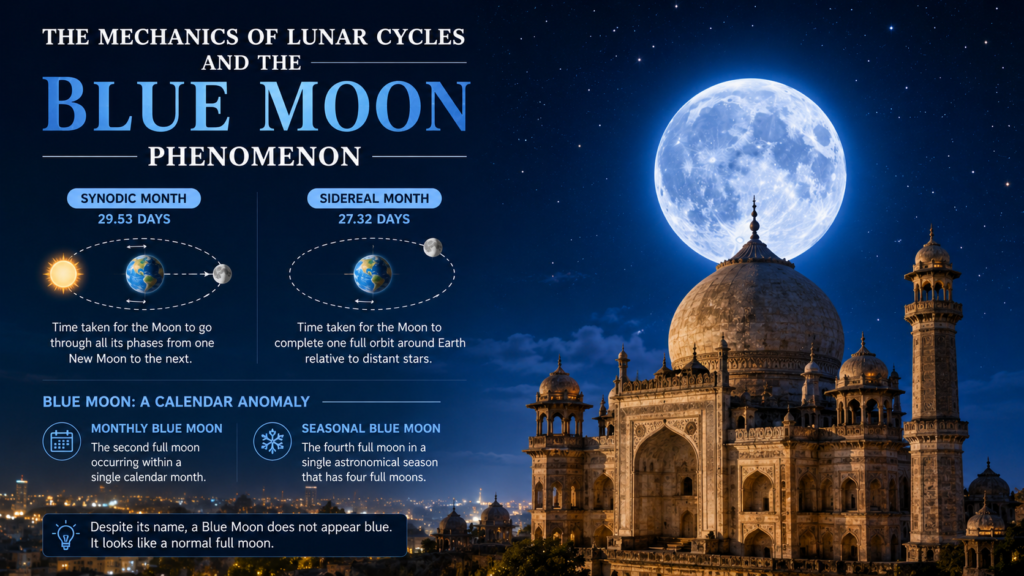
Recent images showing a Blue Moon aligned behind famous historical landmarks have attracted global attention and renewed public interest in astronomy. The event has sparked discussions about lunar cycles, celestial mechanics, and the fascinating relationship between Earth’s calendar system and the Moon’s orbit.
Despite its name, a Blue Moon is not actually blue. Instead, it is a rare calendar-based astronomical event that occurs due to the mismatch between the lunar cycle and the Gregorian calendar.
For UPSC aspirants, this topic is important under Science & Technology, Astronomy, Space Science, and Basic Physics.
What is a Blue Moon?
A Blue Moon refers to an extra full moon that occurs within a specific calendar period.
It is a rare event caused by the difference between:
- The lunar cycle
- The Earth’s calendar system
Contrary to popular belief, the Moon usually appears its normal:
- White
- Silver
- Pale yellow
color during a Blue Moon.
The term describes a timing phenomenon rather than a change in color.
Understanding Lunar Cycles
To understand the Blue Moon, we first need to understand how the Moon moves around the Earth.
The Moon continuously revolves around Earth while Earth simultaneously revolves around the Sun.
This creates different lunar cycles.
The Synodic Month
The Synodic Month is the time taken by the Moon to complete one full cycle of phases.
This means the period between:
One New Moon and the Next New Moon
or
One Full Moon and the Next Full Moon
Duration
Approximately:
29.53 Days
This cycle governs the lunar phases visible from Earth.
Lunar Phases During a Synodic Month
The Moon passes through several phases:
- New Moon
- Waxing Crescent
- First Quarter
- Waxing Gibbous
- Full Moon
- Waning Gibbous
- Last Quarter
- Waning Crescent
After completing these phases, the cycle repeats.
The Sidereal Month
The Sidereal Month measures the Moon’s actual orbital motion relative to distant stars.
It is the time taken by the Moon to complete:
One Full 360° Orbit Around Earth
when measured against fixed background stars.
Duration
Approximately:
27.32 Days
Why Are the Two Periods Different?
Many students wonder why:
- Synodic Month = 29.53 days
- Sidereal Month = 27.32 days
The answer lies in Earth’s own motion around the Sun.
Earth’s Continuous Movement
While the Moon is orbiting Earth:
Earth is also moving around the Sun
By the time the Moon completes one orbit around Earth, Earth has already advanced in its solar orbit.
As a result, the Moon must travel a little farther before:
- Earth
- Moon
- Sun
return to the same alignment.
This additional movement takes roughly:
2.2 Extra Days
creating the longer synodic month.
What Causes a Blue Moon?
The Gregorian calendar is based on solar cycles.
Most calendar months contain:
- 30 days
- 31 days
However, the lunar cycle lasts only:
29.53 Days
This mismatch gradually accumulates over time.
Eventually, a calendar period contains an extra full moon.
This extra full moon is known as a:
Blue Moon
Types of Blue Moon
Modern astronomy recognizes two accepted definitions.
1. Monthly Blue Moon
This is the most commonly used definition.
Definition
The second full moon occurring within a single calendar month.
How Does It Happen?
Suppose a full moon occurs on:
1st August
The next full moon will occur approximately:
29.53 Days Later
which may fall on:
30th or 31st August
As a result, the month contains:
Two Full Moons
The second full moon becomes the Blue Moon.
Frequency
A Monthly Blue Moon occurs roughly:
Every 2.5 to 3 Years
or approximately every:
2.7 Years
2. Seasonal Blue Moon
This is the traditional astronomical definition.
Definition
The fourth full moon occurring within a single astronomical season that contains four full moons instead of the usual three.
What is an Astronomical Season?
Astronomical seasons are defined by:
- Solstices
- Equinoxes
For example:
- Spring Equinox to Summer Solstice
- Summer Solstice to Autumn Equinox
Normally, a season contains:
Three Full Moons
Occasionally, a season contains:
Four Full Moons
In such cases, the fourth full moon is called the:
Seasonal Blue Moon
Does the Blue Moon Actually Appear Blue?
No.
A Blue Moon generally appears:
- White
- Silver
- Golden
just like any other full moon.
Why Was It Called a Blue Moon?
The term evolved through historical usage and calendar traditions.
Over time, it became associated with something:
Rare and Unusual
This is why the English phrase:
“Once in a Blue Moon”
means something that happens very infrequently.
Can the Moon Ever Appear Blue?
Although unrelated to the Blue Moon phenomenon, the Moon can occasionally appear bluish due to atmospheric conditions.
Examples include:
- Volcanic eruptions
- Forest fires
- Dust particles in the atmosphere
These particles scatter red light and allow blue wavelengths to dominate.
However, this is extremely rare and unrelated to the astronomical definition of a Blue Moon.
Importance of Studying Lunar Cycles
Understanding lunar cycles helps scientists:
Predict Eclipses
Moon phases influence eclipse calculations.
Develop Calendars
Many ancient and modern calendars are based on lunar cycles.
Understand Orbital Mechanics
The Moon serves as a natural laboratory for celestial mechanics.
Support Space Missions
Accurate lunar observations are essential for exploration programs.
The Moon and Human Civilization
Throughout history, lunar cycles have influenced:
- Agriculture
- Navigation
- Religious festivals
- Cultural traditions
Many civilizations used lunar calendars long before modern astronomy developed.
Interesting Facts About the Moon
Average Distance from Earth
Approximately:
384,400 km
Moon’s Gravity
About:
One-Sixth of Earth’s Gravity
Tidal Influence
The Moon’s gravitational pull causes:
- Ocean tides
- Spring tides
- Neap tides
Synchronous Rotation
The Moon rotates and revolves at the same rate.
As a result:
We always see the same side of the Moon from Earth.
Significance for Astronomy
The Blue Moon demonstrates how:
- Orbital mechanics
- Earth’s movement
- Lunar cycles
- Calendar systems
interact with each other.
It serves as an excellent example of how astronomical events are governed by precise mathematical relationships.
Way Forward
Increasing public awareness of astronomical phenomena can:
- Promote scientific temper.
- Encourage STEM education.
- Strengthen interest in space science.
- Improve understanding of celestial mechanics.
Events like Blue Moons offer valuable opportunities to connect scientific concepts with everyday observations.
UPSC Prelims Focus
Important Terms
| Term | Meaning |
|---|---|
| Synodic Month | 29.53-day lunar phase cycle |
| Sidereal Month | 27.32-day orbital cycle relative to stars |
| Blue Moon | Extra full moon in a calendar period |
| Full Moon | Moon fully illuminated as seen from Earth |
| Equinox | Equal day and night |
| Solstice | Longest or shortest day of the year |
Previous Year Question (UPSC Prelims 2012)
Which one of the following statements is correct with reference to our Solar System?
(a) The Earth is the densest of all the planets in our Solar System.
(b) The predominant element in Earth’s composition is silicon.
(c) The Sun contains 75 percent of the mass of the Solar System.
(d) The diameter of the Sun is 190 times that of Earth.
Correct Answer: (a)
Exam Keywords
- Blue Moon
- Synodic Month
- Sidereal Month
- Lunar Cycle
- Full Moon
- Celestial Mechanics
- Lunar Phases
- Orbit
- Astronomy
- Equinox
- Solstice
- Earth-Moon System
- Space Science
- Orbital Motion
UPSC Syllabus Reference
GS Paper III – Science & Technology, Space Science, Astronomy, and Developments in Scientific Research.