CBSE On-Screen Marking (OSM): Transforming Board Exam Evaluation Through Digital Assessment
Why is it in News?
The Central Board of Secondary Education (CBSE) introduced the On-Screen Marking (OSM) system for the evaluation of Class XII Board Examination answer sheets in 2026. The initiative marks one of the biggest reforms in India’s examination evaluation process, aiming to improve transparency, accuracy, efficiency, and speed in result processing.
Recently, OSM has been in the news due to discussions regarding digital evaluation, technical challenges, student concerns over marks, and CBSE’s efforts to strengthen the security and reliability of the system.
For UPSC aspirants, this topic is relevant under Education Reforms, Digital Governance, E-Governance, and Technology in Public Administration.
What is CBSE On-Screen Marking (OSM)?
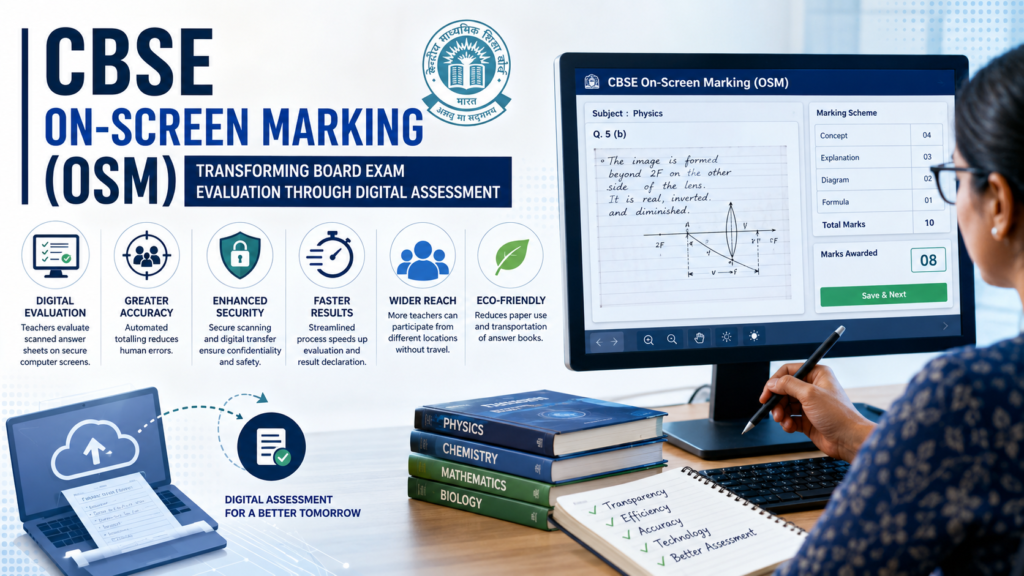
On-Screen Marking (OSM) is a digital evaluation system in which teachers assess scanned copies of answer sheets on computers instead of checking physical answer books manually. The evaluation criteria and marking scheme remain unchanged; only the mode of evaluation shifts from paper-based to digital.
The system is designed to modernize examination evaluation and reduce errors associated with traditional manual checking.
How Does OSM Work?
The OSM process follows several stages:
Step 1: Conduct of Examination
Students continue to write examinations in conventional physical answer books.
Step 2: Secure Scanning
After examinations, answer sheets are scanned at designated centers while maintaining confidentiality and anonymity.
Step 3: Digital Upload
Scanned answer books are uploaded to a secure digital platform.
Step 4: Allocation to Evaluators
Answer scripts are electronically distributed to trained examiners located across different regions.
Step 5: Digital Evaluation
Teachers evaluate responses directly on computer screens using CBSE’s approved marking scheme.
Step 6: Automated Verification
The system automatically calculates totals and verifies marks, reducing arithmetic and tabulation errors.
Why Did CBSE Introduce OSM?
CBSE conducts board examinations for millions of students every year.
Traditional evaluation faced challenges such as:
- Transportation of answer books
- Time-consuming evaluation
- Totalling errors
- Logistical difficulties
- Delays in result preparation
To address these issues, CBSE introduced OSM as part of its digital transformation strategy.
Key Features of OSM
Digital Evaluation
Teachers assess scanned answer sheets through a secure online platform.
Automated Totalling
The system automatically calculates marks, minimizing human errors in addition and tabulation.
Uniform Evaluation
Digital tools help ensure greater adherence to official marking schemes.
Real-Time Monitoring
CBSE can monitor evaluation progress centrally.
Enhanced Security
Digital allocation reduces the risks associated with transporting physical answer books.
Advantages of OSM
1. Improved Accuracy
Automatic calculation reduces:
- Totalling mistakes
- Data entry errors
- Manual processing errors
2. Faster Evaluation
Digital workflows speed up answer-sheet checking and result compilation.
3. Greater Transparency
The evaluation process becomes more traceable and standardized.
4. Wider Teacher Participation
Teachers can evaluate answer sheets from their own schools without travelling to evaluation centers.
5. Environment-Friendly
Digital evaluation reduces dependence on physical movement of answer books and supports sustainable practices.
6. Reduced Logistics Costs
Large-scale transportation and storage of answer sheets become unnecessary.
Scale of Implementation
CBSE’s first large-scale implementation of OSM was one of the largest digital evaluation exercises in the world.
According to reports:
- Around 98.66 lakh answer sheets were digitally evaluated.
- Nearly 70,000 evaluators participated.
- More than 6,000 evaluation centers were involved.
- Approximately 88,000 computers were utilized.
Challenges Faced During Implementation
Despite its advantages, OSM faced some initial challenges.
Scanning Issues
Some answer sheets had image-quality problems, requiring manual intervention. More than 13,000 answer books reportedly needed manual evaluation due to scanning concerns.
Student Concerns
Some students expressed concerns regarding:
- Unexpected marks
- Evaluation consistency
- Clarity of scanned copies
particularly in science subjects.
Technical Vulnerabilities
Certain vulnerabilities were identified in a testing environment associated with the system. CBSE clarified that the actual evaluation platform remained secure and was not compromised.
CBSE’s Response
CBSE has emphasized that:
- OSM changes only the mode of evaluation.
- Marking schemes remain unchanged.
- Security measures are continuously being strengthened.
- Technical issues are being addressed through expert consultations.
The Board has also worked with cybersecurity experts and technical institutions to enhance platform security.
OSM and Digital Governance
The introduction of OSM reflects broader trends in:
- Digital India
- E-Governance
- Technology-enabled public service delivery
It demonstrates how digital tools can improve transparency and efficiency in large-scale public systems.
Future of Digital Evaluation
The success of OSM may encourage:
- Expansion to other classes
- Adoption by state education boards
- Greater use of AI-assisted analytics
- Improved digital assessment systems
However, robust cybersecurity, quality assurance, and teacher training will remain essential.
Way Forward
To ensure long-term success, CBSE should focus on:
Improving Scanning Quality
Reducing image-related evaluation issues.
Strengthening Cybersecurity
Protecting digital examination infrastructure.
Teacher Capacity Building
Providing continuous training on digital evaluation practices.
Student Awareness
Educating students about the evaluation process.
System Upgradation
Regularly updating digital infrastructure to handle large-scale operations efficiently.
UPSC Prelims Focus
Important Facts
| Feature | Details |
|---|---|
| Full Form | On-Screen Marking (OSM) |
| Introduced By | CBSE |
| Purpose | Digital evaluation of answer sheets |
| Evaluation Mode | Scanned answer books assessed online |
| Main Benefit | Accuracy, transparency, speed |
| Applicable Initially | Class XII Board Examinations |
Exam Keywords
- CBSE OSM
- On-Screen Marking
- Digital Evaluation
- E-Governance
- Digital India
- Examination Reforms
- Educational Technology
- Assessment Reforms
- Digital Assessment
- Cybersecurity
- Transparency in Evaluation
- Technology in Education
UPSC Syllabus Reference
GS Paper II – Governance, Education, E-Governance, Government Policies and Interventions, and Use of Technology in Public Service Delivery.