India’s Climate Science Crisis: Why Indigenous Scientific Instruments Matter for Climate Research
Why is it in News?
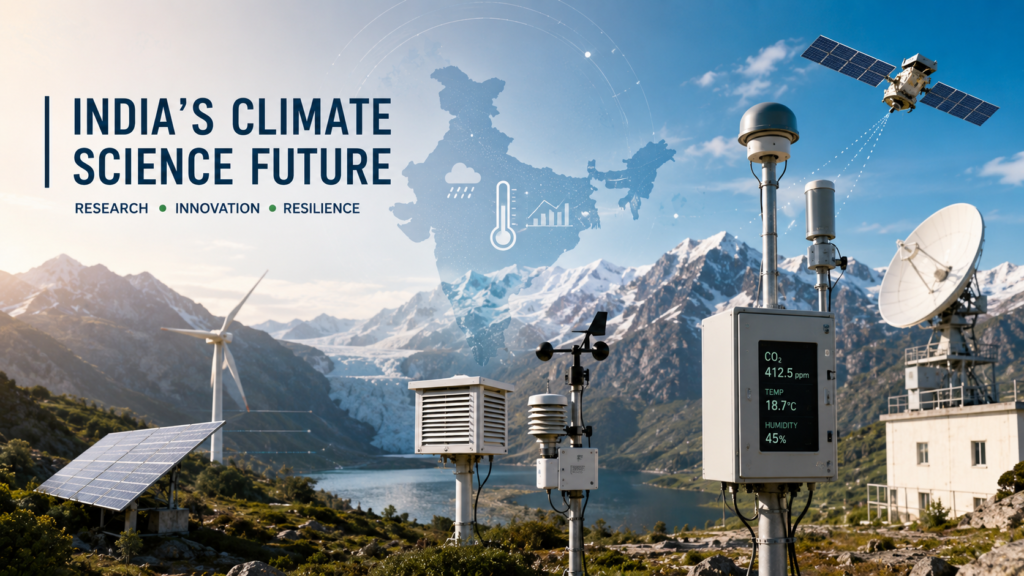
A group of leading Indian climate scientists has raised concerns that India is rapidly losing its ability to design and manufacture indigenous scientific instruments for climate research. The warning was highlighted in the Mega Science Vision-2035 (MSV) Report on Climate Research, submitted to the Office of the Principal Scientific Adviser (PSA) to the Government of India.
According to the report, India’s climate monitoring systems are becoming increasingly dependent on imported instruments, many of which may not be adequately calibrated for local conditions. Scientists argue that this dependency poses risks to the accuracy of climate observations, weather forecasting, environmental monitoring, and long-term climate planning.
For UPSC aspirants, this topic is important under Science and Technology, Climate Change, Research and Development (R&D), Environmental Governance, and Sustainable Development.
What is Mega Science Vision-2035 (MSV)?
The Mega Science Vision-2035 (MSV) is a long-term strategic roadmap aimed at strengthening India’s scientific capabilities in emerging and critical areas.
Traditionally, such roadmaps focused on sectors like:
- Space science
- Nuclear research
- Astronomy
- Advanced technology
For the first time, the framework has been expanded to include:
- Climate science
- Ecology
- Environmental monitoring
- Sustainability research
Who Prepared the Report?
The climate research roadmap was facilitated by:
Office of the Principal Scientific Adviser
The nodal institution responsible for preparing the climate science report was:
Indian Institute of Science (IISc)
What Does the Report Propose?
The report recommends the development of eight major climate science projects to be implemented in phases up to 2035.
These include:
- Advanced climate observatories
- Earth observation satellites
- In-situ monitoring networks
- Large-scale field campaigns
- Indigenous scientific sensors
- Carbon neutrality research programs
- Climate modelling infrastructure
- Environmental data systems
Why Are Scientific Instruments Important?
Scientific instruments are the backbone of modern research.
They help scientists:
- Measure temperature
- Track rainfall
- Monitor greenhouse gases
- Study ocean currents
- Observe glaciers
- Measure air pollution
- Analyze atmospheric changes
Without reliable instruments, scientific data becomes inaccurate and unreliable.
What is the Current Concern?
According to scientists, India has become increasingly dependent on imported instruments for climate observations.
This has created several challenges:
Dependence on Foreign Technology
Many critical climate monitoring devices are sourced from abroad.
Calibration Issues
Imported instruments may not always be optimized for India’s diverse climatic conditions.
High Costs
Dependence on imports increases operational and maintenance expenses.
Supply Chain Vulnerability
Geopolitical tensions can disrupt access to critical technologies.
Limited Domestic Innovation
Reduced indigenous manufacturing weakens India’s research ecosystem.
What is Indigenous Instrumentation?
Indigenous instrumentation refers to:
Designing, Developing and Manufacturing Scientific Equipment Within India
Examples include:
- Weather sensors
- Air quality monitors
- Ocean observation instruments
- Satellite payloads
- Carbon monitoring systems
Such capabilities strengthen scientific self-reliance.
Why Has Indigenous Capacity Declined?
Several factors have contributed to the decline.
Procurement Policies
Government research institutions often procure equipment based on:
Lowest Cost (L1) Criteria
Under this system, the cheapest bid usually wins.
While suitable for routine purchases, it may discourage innovation and customized scientific solutions.
Limited Domestic Industry
India has a relatively small ecosystem for advanced scientific instrument manufacturing.
Insufficient R&D Investment
Research and development spending remains lower than many advanced economies.
Dependence on Ready-Made Imports
Imported instruments are often easier and faster to procure.
As a result, domestic design capabilities receive less support.
Why Does Climate Science Need Specialized Instruments?
Climate systems are highly complex.
Scientists require precise instruments to measure:
Atmospheric Variables
- Temperature
- Humidity
- Wind speed
- Carbon dioxide levels
Oceanic Variables
- Sea surface temperature
- Ocean currents
- Salinity
Cryosphere Monitoring
- Glacier movement
- Snow cover
- Ice melt
Ecosystem Changes
- Biodiversity shifts
- Forest health
- Land-use change
Even small measurement errors can affect climate predictions.
India’s Climate Challenges
India is among the countries most vulnerable to climate change.
Major concerns include:
Heatwaves
Increasing frequency and intensity.
Floods
Extreme rainfall events becoming more common.
Droughts
Changing monsoon patterns.
Glacier Retreat
Rapid melting in the Himalayas.
Sea-Level Rise
Threats to coastal communities.
Accurate climate data is therefore essential for planning and adaptation.
The Importance of Climate Observatories
Climate observatories are specialized centres that continuously monitor environmental parameters.
They help:
- Track long-term climate trends.
- Improve weather forecasting.
- Validate climate models.
- Support disaster management.
The MSV report recommends expanding India’s observation networks significantly.
What are In-Situ Monitoring Networks?
“In-situ” means measurements taken directly at the location where phenomena occur.
Examples include:
- Weather stations
- Ocean buoys
- River monitoring stations
- Forest observation sites
Such systems provide real-time and highly accurate data.
Why is Data Quality Important?
Climate policies rely heavily on scientific evidence.
Poor-quality data can lead to:
- Incorrect climate projections.
- Weak disaster preparedness.
- Ineffective policy interventions.
- Economic losses.
Therefore, high-quality instrumentation is crucial.
The Link Between Climate Science and National Security
Climate research is no longer only an environmental issue.
It influences:
Food Security
Agriculture depends on climate forecasts.
Water Security
Climate affects river systems and groundwater.
Energy Security
Renewable energy planning requires climate data.
Disaster Risk Reduction
Early warning systems depend on accurate observations.
Thus, climate science has become a strategic national priority.
Balancing Renewable Energy and Environmental Protection
The report also emphasizes that renewable energy expansion must be scientifically planned.
Large-scale projects such as:
- Solar parks
- Wind farms
may have ecological impacts.
Therefore, environmental assessments should evaluate:
- Biodiversity impacts
- Land-use changes
- Habitat fragmentation
- Water usage
before project implementation.
Key Recommendations of Mega Science Vision-2035
Exempt Research Procurement from L1 Rules
Scientific institutions should prioritize:
- Quality
- Reliability
- Innovation
rather than simply choosing the lowest-cost equipment.
Invest in Indigenous Instrument Development
India should strengthen domestic manufacturing of scientific equipment.
Fund Mega Climate Projects
The proposed projects should receive long-term financial support up to 2035.
Build Climate Monitoring Infrastructure
Expand observation networks across the country.
Promote Industry-Academia Collaboration
Encourage partnerships between:
- Universities
- Research institutions
- Private industry
for technology development.
Benefits of Indigenous Scientific Instrumentation
Scientific Self-Reliance
Reduced dependence on foreign suppliers.
Better Data Quality
Customized instruments suited to Indian conditions.
Cost Efficiency
Lower long-term procurement costs.
Employment Generation
Development of high-tech industries.
Strategic Security
Reduced vulnerability to geopolitical disruptions.
Way Forward
India’s transition to a climate-resilient future requires strong scientific foundations.
The country should focus on:
- Reviving indigenous instrumentation capabilities.
- Increasing R&D investment.
- Expanding climate observation networks.
- Supporting long-term climate science projects.
- Building a globally competitive scientific equipment industry.
A strong climate research ecosystem will be essential for achieving sustainable development and climate resilience in the coming decades.
UPSC Prelims Focus
Important Facts
| Feature | Details |
|---|---|
| Report | Mega Science Vision-2035 |
| Nodal Institution | IISc Bengaluru |
| Coordinating Agency | Office of Principal Scientific Adviser |
| Focus Areas | Climate Research, Ecology, Astronomy |
| Time Horizon | Up to 2035 |
| Major Proposal | Eight Mega Climate Projects |
Previous Year Question (UPSC Prelims 2020)
With reference to the Social Cost of Carbon, which of the following best describes it?
Correct Answer:
(a) The long-term damage done by a tonne of CO₂ emissions in a given year.
Previous Year Question (UPSC Mains 2014)
Scientific research in Indian universities is declining because a career in science is not as attractive as business professions, engineering, or administration, and universities are becoming consumer-oriented. Critically comment.
Exam Keywords
- Mega Science Vision-2035
- Climate Research
- Indigenous Instrumentation
- Scientific Instruments
- Climate Monitoring
- R&D
- Climate Observatories
- Environmental Monitoring
- Climate Change
- Carbon Neutrality
- Scientific Self-Reliance
- IISc Bengaluru
- Principal Scientific Adviser
- Climate Resilience
UPSC Syllabus Reference
GS Paper III – Science and Technology, Climate Change, Environmental Conservation, Research and Development, Disaster Management, and Sustainable Development.