
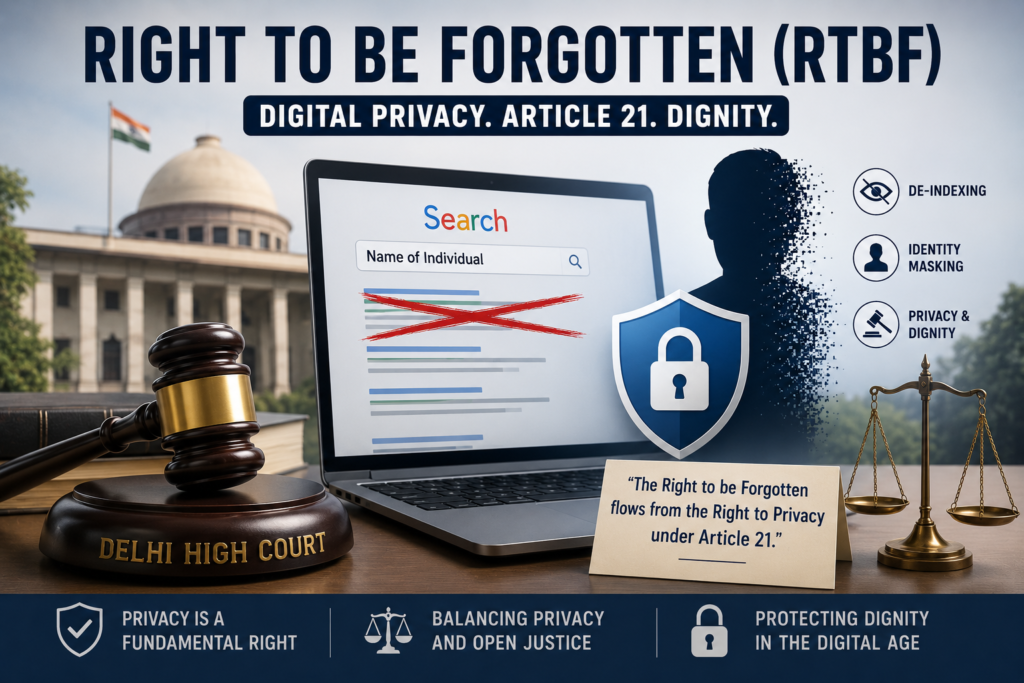
Right to be Forgotten (RTBF): Privacy, Digital Rights and the Delhi High Court Judgment
Why is it in News?
The Delhi High Court has delivered a landmark judgment recognizing that the Right to be Forgotten (RTBF) flows directly from the constitutional Right to Privacy under Article 21 of the Constitution of India.
In its detailed judgment, the court established a formal framework for:
- De-indexing judicial records from search engines.
- Masking personal identifiers in publicly accessible court records.
- Balancing privacy rights with the principles of transparency and open justice.
The judgment is considered a significant development in India’s evolving digital privacy regime.
For UPSC aspirants, this topic is important under Polity, Fundamental Rights, Data Protection, Governance, and Cyber Laws.
What is the Right to be Forgotten (RTBF)?
The Right to be Forgotten (RTBF) refers to an individual’s right to request the removal, erasure, or reduced visibility of personal information available online when such information becomes:
- Irrelevant
- Outdated
- Excessive
- No longer necessary
- Harmful to reputation without serving a public interest
In simple terms, RTBF allows individuals to move beyond past events and prevent unnecessary digital exposure that may negatively affect their lives.
Why is the Right to be Forgotten Important?
In the digital age, information uploaded online often remains accessible indefinitely.
This can create problems when:
- Criminal charges have been dropped.
- Individuals have been acquitted.
- Old disputes continue to appear in online searches.
- Personal information causes disproportionate reputational harm.
RTBF seeks to protect individuals from permanent digital stigma.
Constitutional Basis of RTBF in India
The Right to be Forgotten is primarily derived from:
Article 21
Article 21 guarantees:
Right to Life and Personal Liberty
The Supreme Court has interpreted Article 21 broadly to include various rights necessary for a dignified life.
The Puttaswamy Judgment (2017)
The constitutional foundation of RTBF emerged from the landmark judgment:
Justice K.S. Puttaswamy v. Union of India
In 2017, a nine-judge bench of the Supreme Court unanimously held that:
Right to Privacy is a Fundamental Right
The Court declared privacy to be an intrinsic part of:
- Article 21
- Human dignity
- Personal autonomy
This judgment paved the way for recognizing the Right to be Forgotten.
Digital Personal Data Protection (DPDP) Act, 2023
India’s statutory framework for data protection is provided by the:
Digital Personal Data Protection Act, 2023
Section 12 of DPDP Act
The Act grants individuals the right to request the deletion of personal data when:
- The purpose for data collection has been fulfilled.
- Consent has been withdrawn.
- Retention is no longer necessary.
Although the Act does not explicitly use the phrase “Right to be Forgotten,” it provides an important legal mechanism supporting the principle.
What Did the Delhi High Court Hold?
The Delhi High Court clarified that:
RTBF Flows from Article 21
The Court recognized that privacy rights extend into the digital domain and may require courts to protect individuals from disproportionate online exposure.
At the same time, it emphasized that RTBF is:
Not an Absolute Right
Every request must be evaluated carefully against competing public interests.
Two Important Judicial Remedies
The Court highlighted two major methods for protecting privacy.
1. De-indexing
What is De-indexing?
De-indexing means removing a webpage or court record from search engine results when a person’s name is searched.
Important Point
The original document remains available online.
However:
- Search engines stop displaying it prominently.
- Public access becomes significantly reduced.
Example
Suppose a person was acquitted in a criminal case years ago.
Even after acquittal, online search results may continue to display old reports.
A court may order:
De-indexing
so that the information does not appear when the individual’s name is searched.
2. Identity Masking
What is Identity Masking?
Identity masking involves replacing names and personal details with anonymous identifiers.
Examples:
- ABC
- XYZ
- Anonymous Petitioner
The legal facts remain publicly accessible while protecting personal identity.
Why is Identity Masking Used?
It helps protect:
- Privacy
- Reputation
- Dignity
while preserving transparency in judicial proceedings.
RTBF vs Open Justice
One of the biggest challenges is balancing two important constitutional values.
Right to Privacy
Protected under:
Article 21
Protects:
- Personal autonomy
- Reputation
- Dignity
- Informational privacy
Freedom of Speech and Right to Know
Protected under:
Article 19(1)(a)
Supports:
- Freedom of expression
- Press freedom
- Public accountability
- Open justice
Courts must carefully balance these competing interests.
Principle of Open Justice
Indian courts generally follow the principle of:
Open Justice
This means judicial proceedings should remain transparent and accessible to the public.
Transparency promotes:
- Accountability
- Public confidence
- Fairness
However, excessive disclosure can sometimes violate individual privacy.
When is RTBF More Likely to be Granted?
Courts may favour privacy protection in cases involving:
Acquittals
Where an individual has been found not guilty.
Quashed FIRs
Where criminal proceedings have been terminated.
Matrimonial Disputes
Sensitive family-related matters.
Minor and Outdated Offences
Cases where continued visibility causes disproportionate harm.
When is RTBF Less Likely to be Granted?
Courts may refuse removal requests where information involves:
Economic Frauds
Large-scale financial misconduct.
Corruption Cases
Matters involving public trust.
Crimes Against Women and Children
Serious offences carrying strong public interest.
Historical Importance
Cases with continuing public significance.
In such situations, public interest may outweigh privacy concerns.
Challenges in Implementing RTBF
Several practical challenges remain.
Defining Public Interest
Determining what qualifies as public interest can be subjective.
Digital Permanence
Information may remain available across multiple websites and platforms.
Technological Complexity
Removing information from search results requires coordination with digital platforms.
Balancing Rights
Courts must constantly balance:
- Privacy
- Transparency
- Free speech
- Public accountability
International Experience
The concept of RTBF gained global prominence through:
Google Spain Judgment
The European Court of Justice recognized an individual’s right to request the removal of certain personal information from search engine results.
This decision became a major foundation for global privacy law.
Way Forward
To strengthen privacy protection while preserving transparency, India should focus on:
Standardized Judicial Guidelines
Uniform procedures for courts across the country.
Privacy-by-Design Systems
Digital court databases should incorporate privacy safeguards from the beginning.
Clear Legislative Framework
Parliament may establish detailed statutory provisions defining RTBF.
Public Interest Tests
Transparent criteria for balancing competing rights.
Improved Data Governance
Stronger mechanisms for managing digital information.
Significance of the Judgment
The Delhi High Court’s decision represents an important step in India’s evolving privacy jurisprudence.
It reflects the growing recognition that:
Digital Rights Are Human Rights
The judgment seeks to protect personal dignity and privacy while preserving transparency, freedom of expression, and public accountability.
UPSC Prelims Focus
Important Constitutional Provisions
| Provision | Subject |
|---|---|
| Article 21 | Right to Life and Personal Liberty |
| Article 19(1)(a) | Freedom of Speech and Expression |
| DPDP Act, 2023 | Data Protection Framework |
| Puttaswamy Judgment (2017) | Right to Privacy |
Previous Year Question (UPSC Prelims 2018)
Q. Right to Privacy is protected as an intrinsic part of Right to Life and Personal Liberty. Which constitutional provisions imply this principle?
(a) Article 14 and the 42nd Amendment
(b) Article 17 and DPSPs
(c) Article 21 and the freedoms guaranteed in Part III
(d) Article 24 and the 44th Amendment
Correct Answer: (c)
Previous Year Question (UPSC Mains 2023)
“The Constitution of India is a living instrument with capabilities of enormous dynamism.” Illustrate with special reference to the expanding horizons of the Right to Life and Personal Liberty.
Exam Keywords
- Right to be Forgotten (RTBF)
- Article 21
- Right to Privacy
- Puttaswamy Judgment
- DPDP Act 2023
- Data Protection
- De-indexing
- Identity Masking
- Open Justice
- Informational Privacy
- Freedom of Speech
- Digital Rights
- Personal Liberty
- Constitutional Rights
UPSC Syllabus Reference
GS Paper II – Fundamental Rights, Constitution, Judiciary, Governance, Data Protection, Privacy Rights, and Emerging Issues in Digital Governance.