Wholesale Price Index (WPI) and Producer Price Index (PPI): Understanding India’s New Inflation Measurement Framework
Why is it in News?
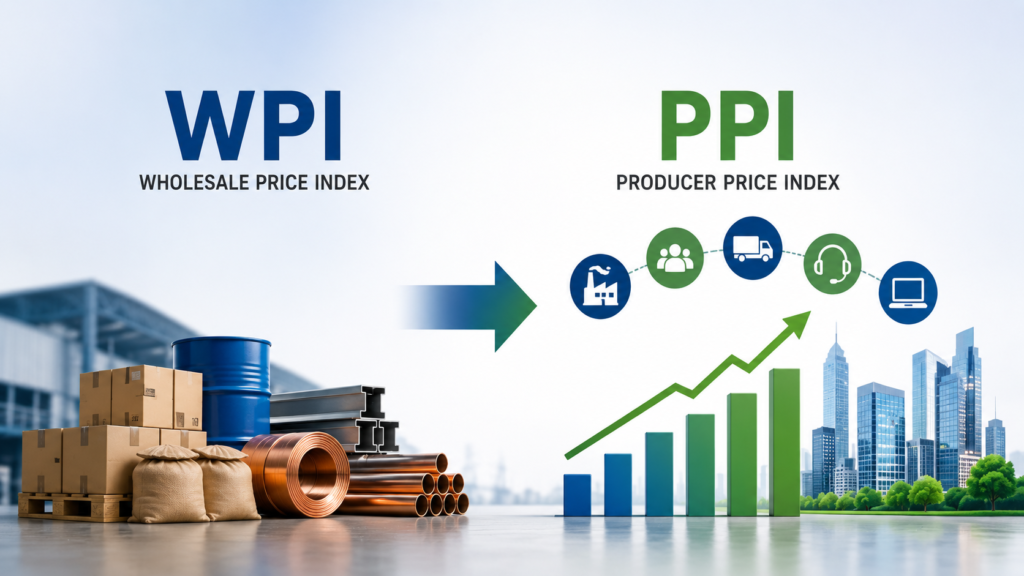
The Government of India has announced a major reform in the way producer-level inflation is measured. Over the next five years, the Wholesale Price Index (WPI) will be gradually phased out and replaced by a more comprehensive Producer Price Index (PPI).
As the first step, the government will launch:
- A revised WPI series with 2022–23 as the base year
- A new Producer Price Index (PPI)
on 15 June 2026.
The transition marks an important shift towards international best practices in measuring inflation and tracking economic activity.
For UPSC aspirants, this topic is important under Indian Economy, Inflation, Economic Indicators, Monetary Policy, and Economic Reforms.
What is Inflation?
Inflation refers to the sustained increase in the general price level of goods and services over time.
When inflation rises:
- Purchasing power declines.
- Cost of living increases.
- Businesses face higher input costs.
Governments and central banks closely monitor inflation to formulate economic policies.
Why Do We Need Inflation Indices?
Inflation cannot be measured by observing a single product.
Instead, economists use indices that track price changes across a basket of goods and services.
These indices help:
- Monitor economic trends.
- Formulate monetary policy.
- Guide fiscal decisions.
- Analyze cost pressures on businesses.
Two important inflation indicators are:
- Wholesale Price Index (WPI)
- Producer Price Index (PPI)
What is the Wholesale Price Index (WPI)?
The Wholesale Price Index (WPI) measures changes in the prices of goods traded in bulk between businesses at the wholesale level.
It captures price movements at the:
First Point of Bulk Sale
before goods reach retailers and consumers.
Who Publishes WPI?
The WPI is published by:
Office of the Economic Adviser
under the:
Ministry of Commerce and Industry
Current Base Year of WPI
2011–12
The government is now revising the series to:
2022–23
to better reflect the current structure of the economy.
Key Features of WPI
1. Covers Only Goods
WPI measures only:
- Physical commodities
- Manufactured products
- Raw materials
It does not include services such as:
- Banking
- Insurance
- Education
- Healthcare
- Information Technology
2. Includes Taxes and Trade Margins
WPI prices generally incorporate:
- Indirect taxes
- Transport costs
- Wholesale trade margins
As a result, policy changes such as GST revisions may influence WPI inflation.
3. Tracks Input Cost Pressures
WPI is widely used to assess:
- Manufacturing costs
- Producer inflation
- Supply-side price pressures
Components of India’s WPI
The current WPI basket is divided into three major categories.
1. Manufactured Products
Weightage: ~64.2%
This is the largest component.
Examples include:
- Chemicals
- Machinery
- Metals
- Textiles
- Industrial products
2. Primary Articles
Weightage: ~22.6%
Includes:
- Food grains
- Fruits and vegetables
- Oilseeds
- Commercial crops
- Crude petroleum
3. Fuel and Power
Weightage: ~13.2%
Includes:
- Coal
- Electricity
- Mineral oils
- Petroleum products
What is the Producer Price Index (PPI)?
The Producer Price Index (PPI) measures changes in the prices received by producers for their goods and services.
Unlike WPI, it tracks prices from the:
Producer’s Perspective
It focuses on what producers actually receive for their output.
Why is PPI Considered Better?
PPI provides a more accurate picture of inflation at the production stage.
It avoids distortions created by:
- Taxes
- Trade margins
- Transportation charges
This allows policymakers to understand genuine cost movements faced by producers.
Key Features of PPI
1. Covers Both Goods and Services
This is the biggest advantage of PPI.
PPI measures price changes in:
Goods
- Manufacturing
- Agriculture
- Mining
Services
- Banking
- Insurance
- Transport
- Information Technology
- Communication
This makes it more representative of a modern economy.
2. Excludes Taxes and Margins
PPI measures:
Basic Prices Received by Producers
It excludes:
- GST
- Other indirect taxes
- Transport charges
- Retail margins
This ensures a cleaner measure of producer-level inflation.
3. Internationally Accepted Standard
Most advanced economies use PPI as their primary producer inflation indicator.
Countries include:
- United States
- United Kingdom
- Canada
- Germany
International institutions such as:
- International Monetary Fund
- World Bank
also prefer PPI-based analysis.
Major Differences Between WPI and PPI
| Feature | WPI | PPI |
|---|---|---|
| Coverage | Goods only | Goods + Services |
| Perspective | Wholesale stage | Producer stage |
| Taxes Included | Yes | No |
| Trade Margins Included | Yes | No |
| Transport Costs | Included | Excluded |
| Double Counting Risk | Higher | Lower |
| Global Acceptance | Limited | Widely accepted |
Understanding Double Counting
One major limitation of WPI is:
Double Counting
A product may be counted multiple times as it moves through different stages of production.
Example
Steel may be counted:
- As an industrial input.
- Again as a component in machinery.
This can distort inflation measurement.
PPI minimizes this problem by focusing on the value added at each production stage.
Why is India Shifting from WPI to PPI?
Several structural changes have made PPI more suitable.
Growth of the Service Sector
India’s economy is increasingly driven by services.
Services contribute more than:
50% of India’s GDP
WPI fails to capture this large segment.
Better Inflation Measurement
PPI provides a clearer picture of actual producer costs.
International Best Practices
Most major economies have already adopted PPI.
Improved Policy Formulation
More accurate data helps:
- RBI
- Government ministries
- Businesses
make informed decisions.
How Will the Transition Take Place?
The government plans a gradual transition over:
Five Years
Both WPI and PPI will coexist during the initial period.
This will allow:
- Data comparison
- Methodological adjustments
- Industry adaptation
before WPI is eventually phased out.
Impact on Economic Policy
The shift to PPI could improve:
Monetary Policy
More accurate inflation signals.
Fiscal Policy
Better understanding of producer costs.
Industrial Planning
Improved sector-specific analysis.
Business Decisions
Better pricing and investment planning.
Challenges in Implementing PPI
Several issues must be addressed.
Data Collection
Large-scale data gathering from service providers.
Service Sector Coverage
Developing reliable methodologies for services.
Industry Adaptation
Businesses must revise contracts linked to WPI.
Digital Infrastructure
Strong data-reporting systems are necessary.
Way Forward
To ensure a smooth transition, India should focus on:
Strengthening Data Systems
Creating robust digital reporting networks.
Expanding Service Sector Coverage
Including all major service industries.
Industry Awareness
Helping businesses adapt to PPI-based contracts.
Statistical Capacity Building
Enhancing data collection and analysis capabilities.
Policy Integration
Gradually shifting economic analysis toward PPI.
UPSC Prelims Focus
Key Differences
| WPI | PPI |
|---|---|
| Measures wholesale prices | Measures producer prices |
| Goods only | Goods and services |
| Includes taxes | Excludes taxes |
| Wholesale perspective | Producer perspective |
Previous Year Question (UPSC Prelims 2020)
Consider the following statements:
- The weightage of food in CPI is higher than that in WPI.
- WPI does not capture changes in the prices of services, which CPI does.
- RBI has adopted WPI as its key inflation measure.
Correct Answer:
(a) 1 and 2 only
Previous Year Question (UPSC Prelims 2015)
With reference to inflation in India, which statement is correct?
Correct Answer:
(c) Decreased money circulation helps in controlling inflation
Exam Keywords
- Wholesale Price Index (WPI)
- Producer Price Index (PPI)
- Inflation
- Producer Inflation
- CPI
- Economic Indicators
- Monetary Policy
- RBI
- Price Measurement
- Service Sector Inflation
- Economic Reforms
- Base Year Revision
- Inflation Tracking
- Producer Prices
UPSC Syllabus Reference
GS Paper III – Indian Economy, Inflation, Economic Indicators, Monetary Policy, Growth and Development, and Government Reforms.