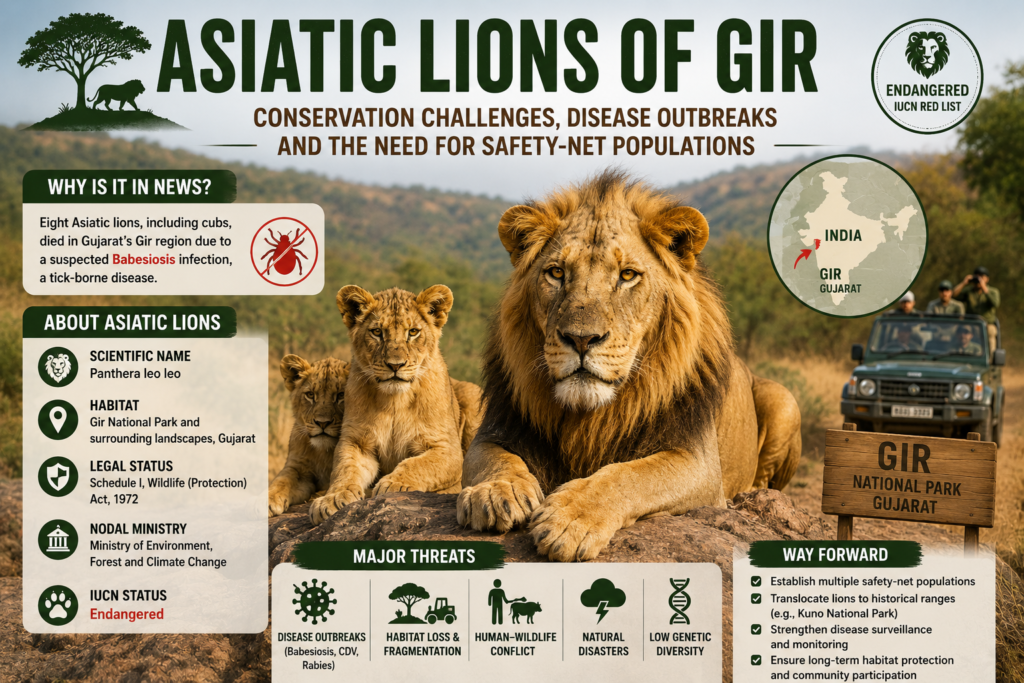
Asiatic Lions of Gir: Conservation Challenges, Disease Outbreaks and the Need for Safety-Net Populations
Why is it in News?
Eight Asiatic lions, including cubs, recently died in Gujarat’s Gir landscape due to a suspected outbreak of Babesiosis, a tick-borne parasitic disease. Following the deaths, the Gujarat Forest Department isolated lion populations within a 10-kilometre radius in affected areas of Gir Somnath and Amreli districts to prevent the disease from spreading further.
The incident has once again highlighted concerns about the vulnerability of the world’s only wild Asiatic lion population and the urgent need to establish additional lion habitats outside Gujarat.
For UPSC aspirants, this topic is important under Environment, Biodiversity, Wildlife Conservation, Protected Areas, and Species Conservation.
What is the Asiatic Lion?
The Asiatic Lion is a subspecies of lion found exclusively in India.
Scientific Name
Panthera leo leo
Historically, Asiatic lions were distributed across:
- Greece
- Turkey
- Iran
- Iraq
- Syria
- Arabia
- Northwestern India
However, due to hunting and habitat loss, their population declined drastically.
Today, wild Asiatic lions survive only in Gujarat.
Current Distribution of Asiatic Lions
The entire wild population is concentrated in and around:
Gir National Park
and the surrounding Gir landscape.
The lions are now found across:
- Gir National Park
- Gir Wildlife Sanctuary
- Gir Conservation Reserve
- Nearby forest areas
- Agricultural lands
- Coastal regions
- Human settlements
This makes the Asiatic lion one of the few large carnivores that frequently coexist with humans.
Why is the Asiatic Lion Unique?
The Asiatic lion differs from its African counterparts in several ways.
Distinctive Features
- Smaller mane compared to African lions.
- Prominent abdominal skin fold.
- Slightly smaller body size.
- Distinct genetic characteristics.
Scientific studies have confirmed that the Asiatic lion is genetically distinct and requires dedicated conservation efforts.
Conservation Status
IUCN Red List
The Asiatic lion is classified as:
Asiatic Lion – Endangered
This status indicates a high risk of extinction in the wild.
Wildlife Protection Act, 1972
The species receives the highest level of protection under:
Schedule I
This provides:
- Strict legal protection.
- Severe penalties for poaching.
- Enhanced conservation measures.
Nodal Ministry
The conservation of Asiatic lions is overseen by:
Ministry of Environment, Forest and Climate Change (MoEFCC)
Understanding Babesiosis
The recent lion deaths are suspected to have been caused by:
Babesiosis
Babesiosis is a disease caused by microscopic parasites belonging to the genus:
Babesia
These parasites infect red blood cells.
How Does the Disease Spread?
Babesiosis is primarily transmitted through:
Tick Bites
Ticks act as vectors and transfer the parasite from one animal to another.
The disease commonly affects:
- Wild mammals
- Domestic cattle
- Dogs
- Large carnivores
Symptoms of Babesiosis
Infected animals may suffer from:
- Fever
- Weakness
- Loss of appetite
- Anemia
- Organ damage
- Reduced immunity
In severe cases, the disease can become fatal.
Why Are Disease Outbreaks a Major Concern?
The biggest conservation concern is that the entire wild Asiatic lion population is concentrated in a single geographical region.
This creates a situation known as:
Single Population Risk
Any major disaster can affect the entire species.
Threats to the Asiatic Lion Population
1. Disease Outbreaks
Diseases such as:
- Babesiosis
- Canine Distemper Virus (CDV)
- Rabies
can spread rapidly through closely connected lion populations.
2. Natural Disasters
Gir lies in a region vulnerable to:
- Cyclones
- Floods
- Droughts
A major natural disaster could impact a large proportion of the population.
3. Habitat Fragmentation
Expansion of human settlements and infrastructure may affect habitat connectivity.
4. Human-Wildlife Conflict
As lion populations expand beyond protected areas, interactions with humans increase.
This can lead to:
- Livestock depredation
- Retaliatory actions
- Accidental injuries
Why Are Safety-Net Populations Important?
Conservation experts recommend creating:
Safety-Net Populations
These are separate populations established in different geographical locations.
Benefits
- Reduce extinction risk.
- Prevent species loss from disease outbreaks.
- Improve genetic diversity.
- Increase long-term survival chances.
This strategy is widely used in wildlife conservation worldwide.
The Kuno National Park Debate
One of the most discussed conservation proposals is the relocation of some Asiatic lions to:
Kuno National Park
Why Kuno?
Kuno National Park was identified as a suitable second home for Asiatic lions because:
- Adequate prey base exists.
- Habitat conditions are favourable.
- Human settlements were relocated.
- Long-term conservation planning has already been undertaken.
Why Has Relocation Been Delayed?
Despite scientific recommendations and judicial directions, lion translocation has faced delays due to:
- Administrative challenges.
- Inter-state disagreements.
- Conservation management concerns.
As a result, Gujarat continues to remain the only habitat for wild Asiatic lions.
Importance of Genetic Diversity
When a species remains confined to a single population for a long time, genetic diversity may decline.
Consequences
- Reduced disease resistance.
- Increased vulnerability to environmental changes.
- Greater risk of inherited disorders.
Creating multiple populations helps maintain healthier gene pools.
Success Story of Asiatic Lion Conservation
The Asiatic lion is considered one of India’s greatest conservation success stories.
Population Growth
The species once declined to fewer than:
20 Lions
during the late 19th century.
Today, conservation efforts have increased the population to several hundred individuals across the Gir landscape.
Conservation Measures Taken
Habitat Protection
Protection of forests and wildlife corridors.
Anti-Poaching Measures
Regular patrolling and surveillance.
Veterinary Monitoring
Health monitoring of lion populations.
Community Participation
Involving local communities in conservation initiatives.
Rescue and Rehabilitation
Treatment of injured or diseased animals.
Need for Enhanced Disease Surveillance
The recent outbreak demonstrates the need for:
Comprehensive Disease Monitoring
This includes:
- Regular health assessments.
- Tick-control measures.
- Early disease detection systems.
- Veterinary intervention protocols.
Way Forward
To ensure the long-term survival of Asiatic lions, India should focus on:
Establishing Additional Lion Populations
Creating geographically separate populations.
Implementing Lion Translocation
Developing scientifically managed reintroduction programmes.
Strengthening Disease Surveillance
Monitoring diseases before outbreaks occur.
Improving Habitat Connectivity
Maintaining movement corridors for wildlife.
Enhancing Research
Conducting genetic and ecological studies.
Community-Based Conservation
Strengthening local participation in wildlife protection.
UPSC Prelims Focus
Important Facts About Asiatic Lions
| Feature | Details |
|---|---|
| Scientific Name | Panthera leo leo |
| Habitat | Gir Landscape, Gujarat |
| IUCN Status | Endangered |
| WPA Status | Schedule I |
| Nodal Ministry | MoEFCC |
| Proposed Second Habitat | Kuno National Park |
Previous Year Question (UPSC Prelims 2019)
Consider the following statements:
- Asiatic lions are naturally found in India only.
- Double-humped camels are naturally found in India only.
- One-horned rhinoceros are naturally found in India only.
Which of the statements given above is/are correct?
(a) 1 only
(b) 2 and 3 only
(c) 1 and 3 only
(d) 1, 2 and 3
Correct Answer: (a) 1 only
Exam Keywords
- Asiatic Lion
- Gir National Park
- Babesiosis
- Tick-Borne Diseases
- Wildlife Conservation
- Endangered Species
- Kuno National Park
- Lion Translocation
- Genetic Diversity
- Wildlife Protection Act, 1972
- IUCN Red List
- Disease Surveillance
- Biodiversity Conservation
- Human-Wildlife Conflict
UPSC Syllabus Reference
GS Paper III – Environment, Biodiversity, Wildlife Conservation, Protected Areas, Species Conservation, and Environmental Challenges.