India–Indonesia Relations: Strengthening Maritime, Strategic and Economic Cooperation in the Indo-Pacific
Why is it in News?
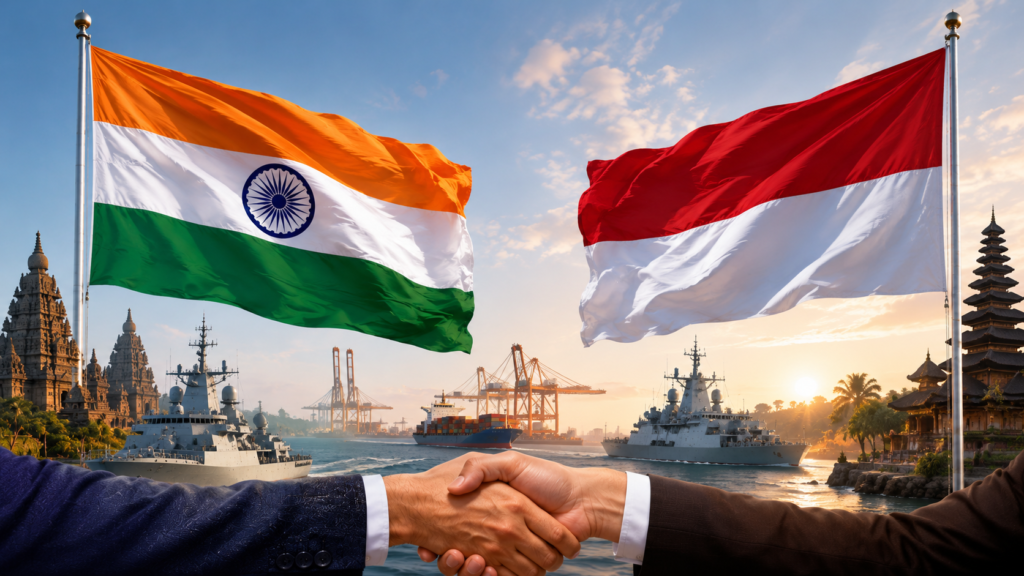
India and Indonesia recently held the 8th India–Indonesia Joint Commission Meeting (JCM) in New Delhi. During the meeting, External Affairs Minister S. Jaishankar and Indonesian Foreign Minister Sugiono discussed expanding cooperation in areas such as defense, maritime security, digital connectivity, infrastructure development, critical minerals, and emerging technologies.
The meeting also laid the groundwork for Prime Minister Narendra Modi’s upcoming visit to Jakarta and highlighted the growing importance of the India–Indonesia partnership in ensuring stability and prosperity in the Indo-Pacific region.
For UPSC aspirants, this topic is important under International Relations, India’s Act East Policy, Indo-Pacific Strategy, Maritime Security, and ASEAN Relations.
India–Indonesia Relations: An Overview
India and Indonesia share centuries-old civilizational ties that have evolved into a modern Comprehensive Strategic Partnership.
As two major democracies and maritime neighbors in the Indo-Pacific, both countries play an important role in regional stability, economic growth, and maritime security.
Diplomatic relations between India and Indonesia are based on:
- Historical connections
- Cultural exchanges
- Strategic cooperation
- Economic partnerships
- Shared democratic values
Historical and Cultural Foundations
Ancient Maritime Links
For centuries, maritime trade routes connected the Indian subcontinent with the Indonesian archipelago.
Ancient traders from India’s eastern coast, particularly Odisha, sailed to Southeast Asia through routes commemorated today in the famous:
Bali Jatra Festival
These interactions facilitated the spread of:
- Hinduism
- Buddhism
- Trade practices
- Cultural traditions
across Southeast Asia.
Influence of Indian Epics
Indian cultural influence remains visible in Indonesia even today.
Ancient epics such as:
- Ramayana
- Mahabharata
continue to inspire:
- Traditional theatre
- Dance performances
- Shadow puppetry (Wayang Kulit)
- Cultural festivals
especially in Bali and Java.
Post-Colonial Solidarity
India and Indonesia shared common experiences under colonial rule.
Following independence, both countries emerged as strong advocates of anti-colonialism and international cooperation.
A significant milestone occurred in:
1950
when Indonesian President:
Sukarno
became the Chief Guest at India’s first Republic Day celebrations.
Bandung Conference (1955)
India and Indonesia played key roles in the historic:
Bandung Conference
which promoted:
- Asian-African solidarity
- Anti-colonial cooperation
- Peaceful coexistence
The conference later contributed to the formation of the:
Non-Aligned Movement
in 1961.
Strategic Importance of Indonesia for India
Indonesia occupies a highly strategic location.
It lies between:
- Indian Ocean
- Pacific Ocean
and controls several important maritime routes.
Its position makes it a key partner for India’s Indo-Pacific strategy.
India’s Act East Policy
Indonesia is considered one of the most important partners under India’s:
Act East Policy
The policy seeks to:
- Strengthen engagement with Southeast Asia.
- Enhance economic integration.
- Improve connectivity.
- Promote regional security cooperation.
Maritime Cooperation
Shared Maritime Boundary
India and Indonesia share maritime proximity through the:
Andaman Sea
The strategic location of Indonesia makes it an important partner in safeguarding maritime routes.
Shared Vision of Maritime Cooperation
Both countries cooperate on:
- Maritime security
- Blue Economy
- Coastal surveillance
- Search and rescue operations
- Maritime domain awareness
Joint Naval Exercises
Samudra Shakti
India and Indonesia conduct the bilateral naval exercise:
Samudra Shakti
to improve interoperability and strengthen defense cooperation.
Coordinated Patrols
The two countries regularly conduct:
IND–INDO CORPAT
(Coordinated Patrols)
to combat:
- Piracy
- Smuggling
- Illegal fishing
- Maritime crimes
Defense Cooperation
Defense cooperation has expanded significantly in recent years.
Areas of collaboration include:
- Military training
- Naval cooperation
- Defense technology
- Strategic dialogue
BrahMos Missile Discussions
India and Indonesia are reportedly exploring opportunities for cooperation involving:
BrahMos Missile
which would further strengthen bilateral defense ties.
Economic and Commercial Relations
Indonesia is among India’s most important economic partners in Southeast Asia.
Bilateral Trade
Bilateral trade reached approximately:
USD 28.15 Billion
during FY 2024–25.
Indonesia is India’s:
Second-Largest Trading Partner in ASEAN
Resource Complementarity
The economic relationship is supported by complementary resource needs.
Crude Palm Oil
Indonesia is:
India’s Largest Supplier of Crude Palm Oil
which is widely used in:
- Food processing
- Cooking oil
- Consumer products
Coal Imports
Indonesia is also:
India’s Second-Largest Source of Imported Coal
supporting power generation and industrial production.
Emerging Areas of Cooperation
The partnership is rapidly expanding beyond traditional sectors.
Digital Connectivity
Both countries are strengthening cooperation in:
- Digital infrastructure
- Fintech
- Digital payments
- Technology innovation
Space Cooperation
Space technology has emerged as a promising area for collaboration.
Potential areas include:
- Satellite applications
- Remote sensing
- Disaster management
Critical Minerals
Critical minerals are becoming increasingly important due to their role in:
- Electric vehicles
- Batteries
- Renewable energy
- Electronics
Both countries are exploring cooperation in securing critical mineral supply chains.
Semiconductors
Semiconductor manufacturing and supply-chain resilience have become strategic priorities for both nations.
Strategic Infrastructure Cooperation
Sabang Port
One of the most important strategic projects is:
Sabang Port
located near the entrance of the:
Malacca Strait
This port has significant strategic value because it is close to India’s:
Andaman and Nicobar Islands
Development of Sabang can enhance:
- Maritime connectivity
- Trade routes
- Strategic access
across the Indo-Pacific.
Importance of the Indo-Pacific
The Indo-Pacific region has emerged as the center of global economic and strategic competition.
It accounts for:
- Major global trade routes
- Energy transportation networks
- Strategic sea lanes
India and Indonesia support:
A Free, Open, Inclusive and Rules-Based Indo-Pacific
Significance for India
Strengthening ties with Indonesia helps India:
Enhance Maritime Security
Protect critical sea lanes.
Strengthen Act East Policy
Deepen engagement with ASEAN.
Improve Energy Security
Secure access to important resources.
Expand Trade
Increase economic opportunities.
Counter Strategic Challenges
Promote regional stability in the Indo-Pacific.
Challenges in the Relationship
Despite strong ties, some challenges remain.
Connectivity Gaps
Physical and logistical connectivity remains limited.
Trade Imbalances
There is scope to diversify the trade basket.
Strategic Competition
Regional geopolitical competition requires careful balancing.
Way Forward
To further strengthen bilateral ties, both countries should focus on:
Fast-Tracking Sabang Port Development
Improving maritime connectivity.
Expanding Defense Cooperation
Including advanced defense technologies.
Diversifying Trade
Moving into:
- Pharmaceuticals
- Green energy
- Semiconductors
- Critical minerals
Enhancing Digital Cooperation
Promoting innovation and digital infrastructure.
Strengthening Indo-Pacific Partnerships
Including trilateral and minilateral cooperation frameworks.
UPSC Prelims Focus
Important Facts
| Feature | Details |
|---|---|
| Capital of Indonesia | Jakarta |
| Strategic Port | Sabang |
| Shared Maritime Area | Andaman Sea |
| Major Exercise | Samudra Shakti |
| Coordinated Patrol | IND–INDO CORPAT |
| Bilateral Trade (2024–25) | USD 28.15 Billion |
Previous Year Question (UPSC Prelims 2017)
With reference to the Indian Ocean Rim Association (IORA), consider the following statements:
- It was established recently in response to piracy and oil spills.
- It is an alliance meant only for maritime security.
Correct Answer:
(d) Neither 1 nor 2
Exam Keywords
- India–Indonesia Relations
- Act East Policy
- Indo-Pacific
- Sabang Port
- Samudra Shakti
- IND–INDO CORPAT
- Maritime Security
- ASEAN
- Critical Minerals
- Semiconductors
- BrahMos Missile
- Andaman Sea
- Bandung Conference
- Non-Aligned Movement
UPSC Syllabus Reference
GS Paper II – International Relations, India’s Neighborhood and Extended Neighborhood, ASEAN, Indo-Pacific Strategy, Maritime Security, and Bilateral Relations.