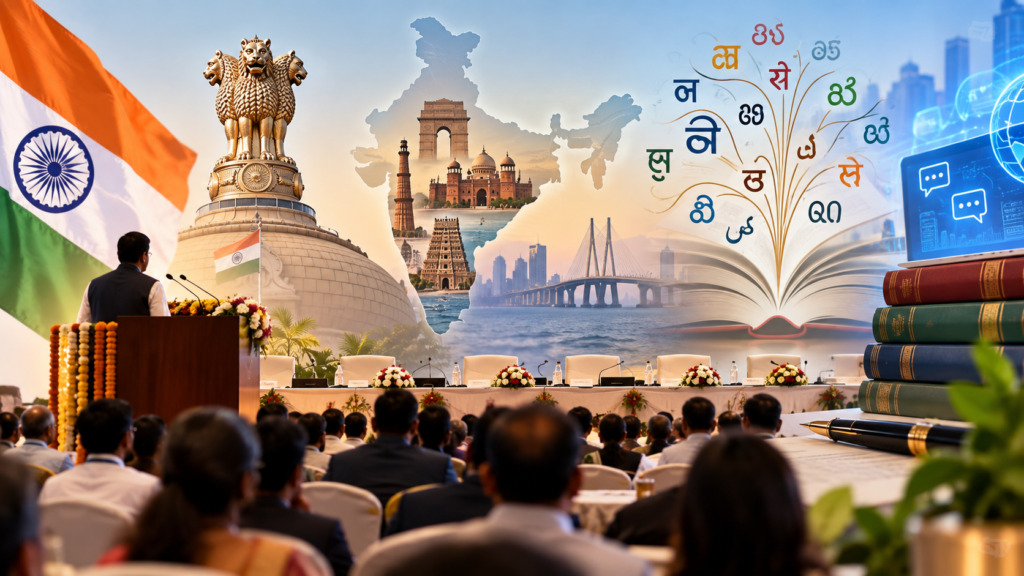
6th All India Official Language Conference 2026: Rajbhasha, Hindi and Constitutional Framework
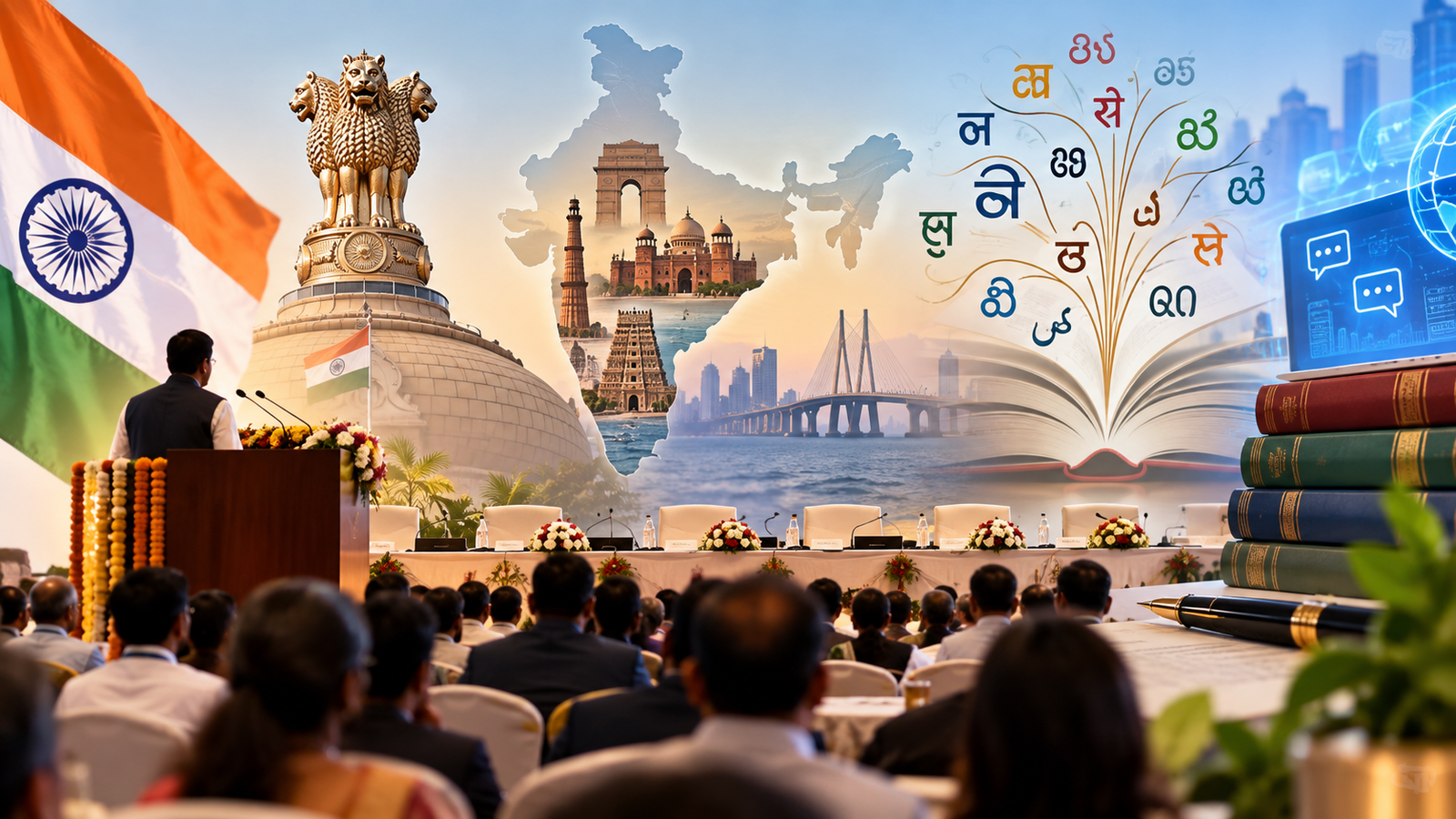
The 6th All India Official Language Conference 2026, organised by the Department of Official Language, Ministry of Home Affairs, was held at the CIDCO Exhibition Centre, Navi Mumbai, Maharashtra, on 14–15 September 2026. The conference was organised along with Hindi Diwas 2026 and brought together discussions on Hindi, Indian languages, official language implementation, translation, technology and linguistic harmony.
For UPSC and HPPSC aspirants, the event is important because it connects Indian Polity, Constitutional provisions on language, cultural diversity, governance, linguistic minorities and the role of technology in public administration.
Why in News?
Union Home Minister and Minister of Cooperation Amit Shah addressed the inaugural session of Hindi Diwas 2026 and the 6th All India Official Language Conference in Navi Mumbai.
The conference also saw the presentation of the Rajbhasha Kirti Puraskar and Rajbhasha Gaurav Puraskar for 2025–26.
A major focus of the conference was to promote the progressive use of Hindi in official work while simultaneously emphasising coordination and dialogue among India’s different languages.
The 2026 edition was particularly significant because it highlighted the relationship between Hindi and the rich linguistic, literary and cultural traditions of Maharashtra.
What is the All India Official Language Conference?
The All India Official Language Conference is an annual national-level conference organised by the Department of Official Language under the Ministry of Home Affairs.
The conference series began in 2021 and has subsequently been organised in different Indian cities.
The journey of the conference has been:
Varanasi → Surat → Pune → New Delhi → Gandhinagar → Navi Mumbai
Thus, the 2026 event was the 6th edition.
Basic Facts
| Particular | Details |
|---|---|
| Event | 6th All India Official Language Conference |
| Year | 2026 |
| Dates | 14–15 September 2026 |
| Venue | CIDCO Exhibition Centre, Navi Mumbai, Maharashtra |
| Organiser | Department of Official Language |
| Ministry | Ministry of Home Affairs |
| Held with | Hindi Diwas 2026 |
| Chief Guest | Union Home Minister Amit Shah |
| Main focus | Official language implementation, Hindi and Indian languages |
| Awards | Rajbhasha Kirti and Rajbhasha Gaurav Puraskar |
What is Rajbhasha?
The term Rajbhasha literally means the language used for official governmental work.
In the Indian constitutional context, Hindi in Devanagari script is the official language of the Union under Article 343.
However, it is important to remember:
Hindi is the Official Language of the Union, not the National Language of India.
The Constitution does not declare any language as the “National Language”.
This distinction is extremely important for UPSC and HPPSC examinations.
Constitutional Framework of Languages in India
The constitutional provisions dealing with languages are primarily contained in Part XVII of the Constitution, covering Articles 343 to 351.
The subject can be understood through four broad areas:
Official Language of the Union → Regional Languages → Language of Courts → Protection of Linguistic Interests
Article 343: Official Language of the Union
Article 343 is the most important provision in this topic.
It provides that:
- The official language of the Union shall be Hindi.
- The script shall be Devanagari.
- The form of numerals to be used for official purposes of the Union shall be the international form of Indian numerals.
The Constitution originally provided for the continuation of English for 15 years from the commencement of the Constitution, i.e. until 1965.
However, English continued to be used for official purposes through subsequent legislation, particularly the Official Languages Act, 1963.
Exam Point
Do not write:
“Hindi is India’s national language.”
Correct statement:
“Hindi in Devanagari script is the official language of the Union under Article 343.”
Article 344: Official Language Commission and Parliamentary Committee
Article 344 deals with institutional mechanisms concerning the official language.
It provides for:
- A Commission appointed by the President.
- A Committee of Parliament associated with the progressive use of Hindi for official purposes.
The constitutional framework therefore does not simply prescribe a language; it also provides mechanisms for reviewing and guiding its use.
Articles 345–347: Languages of States and Regional Languages
The Constitution recognises India’s linguistic diversity.
Article 345
A State Legislature may adopt:
- one or more languages in use in the State, or
- Hindi
as the language or languages to be used for official purposes of that State.
This is why the language arrangements of different States can vary.
Article 346
Article 346 deals with communication between:
- one State and another State, and
- a State and the Union.
It provides the constitutional framework for official communication between different governmental units.
Article 347
Article 347 provides for recognition of a language spoken by a section of a State’s population when there is sufficient demand and the constitutional conditions are met.
The President may direct that such language be officially recognised for specified purposes.
Articles 348–349: Language of Courts and Legislation
This is another important area for examinations.
Article 348
Unless Parliament provides otherwise, proceedings in:
- the Supreme Court,
- High Courts,
- authoritative texts of Bills,
- Acts,
- Ordinances,
- orders, rules and regulations
are generally associated with the English language.
Therefore, students should not assume that because Hindi is the official language of the Union, all proceedings of the Supreme Court and High Courts are conducted in Hindi.
Articles 350–350B: Linguistic Rights
The Constitution also contains provisions intended to protect linguistic interests.
Article 350
Every person has the right to submit a representation for the redress of grievances to an officer or authority of the Union or a State in any of the languages used in the Union or the State.
Article 350A
It deals with facilities for instruction in the mother tongue at the primary stage for children belonging to linguistic minority groups.
Article 350B
It provides for a Special Officer for Linguistic Minorities.
The Special Officer investigates matters relating to safeguards provided for linguistic minorities and reports to the President.
Article 351: Development of Hindi
Article 351 is particularly relevant to the current conference.
It directs the Union to promote the spread of Hindi and develop it so that it may serve as a medium of expression for all elements of India’s composite culture.
It also provides that Hindi should draw, wherever necessary or desirable, from:
- Hindustani
- other languages included in the Eighth Schedule
for its vocabulary.
Why is Article 351 important?
It shows that the constitutional approach towards Hindi is not simply about replacing other Indian languages.
The provision envisages the development and enrichment of Hindi through India’s broader linguistic heritage.
Hindi and India’s Linguistic Diversity
One of the most important points emerging from the 6th conference is the need to understand Hindi within India’s multilingual character.
India is not a linguistically uniform country.
The Constitution’s language framework attempts to balance:
Official communication + linguistic diversity + regional identities + linguistic minority protection
This balance is important because language is closely connected with:
- identity
- culture
- literature
- education
- administration
- political representation
- social integration
Therefore, language policy in India is not merely a question of choosing one language over another.
It is also a question of coexistence and accommodation.
Major Highlights of the 6th Conference
Vande Mataram-Centred Sessions
One of the special features of the 2026 conference was a discussion centred on Vande Mataram.
The sessions examined its:
- historical significance
- literary dimensions
- cultural importance
A special commemorative issue of Rajbhasha Bharati, the journal of the Department of Official Language, was also associated with the theme.
Town Official Language Implementation Committees
Another important component was the discussion on TOLICs, or Town Official Language Implementation Committees, also known as NARAKAS.
What are TOLICs?
These committees work at the town/city level to facilitate the implementation of the Official Language Policy among organisations such as:
- Central Government offices
- Public Sector Undertakings
- banks
- other central government organisations
Their importance lies in taking official language implementation beyond individual ministries and departments and into the local administrative ecosystem.
The 2026 conference included a dedicated session on strengthening and evaluating the functioning of these committees.
Multilingual Exhibition
A special exhibition with 32 stalls was organised at the venue.
It showcased work and initiatives involving:
- government ministries
- banks
- public sector organisations
- publications
- linguistic research
- translation technology
- other institutions
The exhibition demonstrates an important emerging dimension of language policy: technology-assisted multilingual governance.
Hindi and Artificial Intelligence
The growing role of technology and AI in translation and language development is particularly relevant to the current language policy debate.
AI-based tools can potentially help governments in:
- translation between Indian languages
- preparation of multilingual government documents
- accessibility of public services
- preservation of linguistic resources
- development of technical terminology
- improving citizen-government communication
This is important for India’s goal of making governance more inclusive and accessible.
Hindi Shabd-Sindhu
A notable development highlighted at the 2026 conference was Hindi Shabd-Sindhu.
According to the Ministry of Home Affairs, more than 50,000 words from local languages have been incorporated into it, making Hindi more flexible and inclusive.
The dictionary has reached around 8 lakh words, with an objective of making it the world’s largest dictionary by 2029.
Why is this important?
This illustrates an important principle:
Language development does not necessarily require linguistic isolation.
A language can become richer by absorbing vocabulary and expressions from other languages.
For UPSC, this can be connected with:
- cultural diversity
- linguistic pluralism
- preservation of intangible heritage
- technology and language
- inclusive governance
Rajbhasha Kirti Puraskar 2025–26
The Rajbhasha Kirti Puraskar recognises outstanding implementation of the Official Language Policy.
The award scheme covers categories including:
- Ministries and Departments
- Public Sector Undertakings
- Boards/Autonomous Bodies/Trusts
- Nationalised Banks
- departmental Hindi magazines
- TOLICs
The Department of Official Language revised the scheme from 2025–26.
2025–26: Department of Financial Services
The Department of Financial Services (DFS), Ministry of Finance, received the First Prize under the Rajbhasha Kirti category in the relevant category of Ministries/Departments with fewer than 300 personnel.
This makes DFS an important Prelims current affairs fact for 2026.
Rajbhasha Utkrishtata Sammaan
The Department of Administrative Reforms and Public Grievances (DARPG) received the Rajbhasha Utkrishtta Sammaan for 2025–26.
This special recognition was significant because DARPG had already received the Rajbhasha Kirti Puraskar First Prize for two consecutive years — 2023–24 and 2024–25.
Under the rules, an organisation receiving the first prize for two consecutive years is not given the same prize in the immediately following year.
Therefore, DARPG was given the special Rajbhasha Utkrishtta Sammaan in recognition of its continued excellence.
Prelims Fact
DARPG → Rajbhasha Utkrishtta Sammaan → 2025–26
This is more important than simply memorising that DARPG won an award.
The reason behind the special award can also be asked.
Rajbhasha Gaurav Puraskar
The Rajbhasha Gaurav Puraskar focuses primarily on encouraging high-quality writing and literary/intellectual work in Hindi.
The scheme covers areas such as:
- Science and Technology
- Engineering
- Medicine
- Information Technology
- Management
- Psychology
- contemporary issues
- Law
- Police Research
- Forensic Science
- Culture
- Arts
- Heritage
It also includes recognition for certain books translated into Hindi.
Thus, the award is not restricted to conventional literature.
It encourages the availability of scientific, technical and contemporary knowledge in Hindi.
Hindi Diwas and the Official Language
The conference was organised along with Hindi Diwas.
Hindi Diwas is observed on 14 September because on 14 September 1949, the Constituent Assembly adopted Hindi in Devanagari script as the official language of the Union.
The constitutional provision subsequently became part of Article 343.
Therefore, the date has important constitutional and historical significance.
Official Language vs National Language
This is one of the most important examination areas.
Official Language
An official language is a language designated for use in governmental and administrative functions.
National Language
A national language generally refers to a language symbolically associated with the identity of a nation.
India’s Constitutional Position
India has no constitutionally declared national language.
Hindi is the official language of the Union under Article 343.
English also continues to be used for several official purposes under the legal framework.
Common UPSC Trap
Statement: Hindi is the national language of India.
Answer: Incorrect.
Correct: Hindi is the official language of the Union in Devanagari script.
Eighth Schedule and Indian Languages
The Eighth Schedule of the Constitution recognises 22 languages.
These languages are important because Article 351 specifically refers to the languages included in the Eighth Schedule while discussing the enrichment of Hindi.
The constitutional language framework therefore recognises India’s linguistic diversity rather than treating Hindi as the only Indian language of importance.
Significance of the 6th Conference
Strengthening Multilingual Governance
India’s public administration has to serve citizens speaking different languages.
Greater availability of government information in multiple Indian languages can improve:
- accessibility
- citizen participation
- public service delivery
- administrative transparency
Promoting Indian Languages in Science and Technology
A major challenge is the availability of scientific and technical knowledge in Indian languages.
Initiatives such as technical literature in Hindi and AI-based translation can help bridge the gap between:
knowledge generation → knowledge translation → citizen access
This is especially relevant in education and digital governance.
Cultural Integration
Language is an important component of cultural identity.
Promoting interaction between Hindi and other Indian languages can contribute to:
- cultural exchange
- literary interaction
- preservation of linguistic traditions
- national integration
However, such promotion must remain consistent with India’s constitutional commitment to linguistic diversity.
Technology and Language Policy
The inclusion of AI-driven translation tools in the conference exhibition shows how language policy is increasingly connected with technology.
This opens possibilities for:
- machine translation
- multilingual digital governance
- speech-to-text systems
- language databases
- preservation of endangered linguistic resources
- easier access to government services
Constitutional Balance: The Core Idea
The most important conceptual takeaway from this current affair is the balance between promotion and accommodation.
India’s Constitution simultaneously:
promotes Hindi
↓
recognises State languages
↓
protects linguistic minorities
↓
permits continued use of English
↓
recognises 22 languages in the Eighth Schedule
↓
protects linguistic diversity
Therefore, India’s language policy should be understood as a system of constitutional accommodation within a multilingual democracy.
UPSC Syllabus Linkage
UPSC Prelims
Relevant areas:
- Constitutional provisions related to languages
- Article 343
- Article 344
- Articles 345–347
- Articles 348–351
- Eighth Schedule
- Official Language of the Union
- Linguistic minorities
- Rajbhasha Kirti Puraskar
- Rajbhasha Gaurav Puraskar
- Hindi Diwas
- Department of Official Language
- Ministry of Home Affairs
- TOLIC/NARAKAS
UPSC Mains GS Paper I
Indian culture and diversity
Language as a component of India’s cultural diversity and composite culture.
UPSC Mains GS Paper II
Constitution and governance
- Constitutional provisions relating to language
- Centre-State relations
- Linguistic minorities
- Inclusive governance
- Citizen access to government services
UPSC Mains GS Paper III
Science and Technology
- AI-based translation
- Digital language technologies
- Technology for inclusive governance
Essay
Potential themes:
- Unity in diversity
- Linguistic diversity and national integration
- Indian languages in the digital age
- Technology and preservation of cultural heritage
Prelims Practice Questions
Question 1
With reference to the language provisions of the Indian Constitution, consider the following statements:
- Hindi in Devanagari script is the official language of the Union.
- The Constitution declares Hindi as the national language of India.
- Article 351 deals with the promotion and development of Hindi.
Which of the statements given above is/are correct?
Answer: 1 and 3 only
Question 2
Article 350A of the Constitution is associated with:
A. Official language of the Union
B. Language of the Supreme Court
C. Instruction in mother tongue at the primary stage for linguistic minorities
D. Development of Hindi
Answer: C
Question 3
Consider the following pairs:
| Constitutional Provision | Subject |
|---|---|
| Article 343 | Official language of the Union |
| Article 350A | Mother-tongue instruction for linguistic minorities |
| Article 350B | Special Officer for Linguistic Minorities |
| Article 351 | Development of Hindi |
Which of the above pairs are correctly matched?
Answer: All four
Question 4
Consider the following statements regarding the 6th All India Official Language Conference:
- It was organised by the Department of Official Language.
- The Department of Official Language functions under the Ministry of Home Affairs.
- The 2026 conference was held in Navi Mumbai.
- The conference series began in 2021.
Which of the statements given above are correct?
Answer: 1, 2, 3 and 4
Mains Answer Framework
Question
“India’s language policy reflects an attempt to balance national administrative requirements with linguistic diversity.” Discuss.
Introduction
India is a multilingual country with significant linguistic, cultural and regional diversity. The Constitution therefore adopts a framework that promotes the use of Hindi for Union purposes while simultaneously recognising State languages, protecting linguistic minorities and permitting the continued use of English.
Body
Constitutional framework
- Article 343 — Official language of the Union
- Article 345 — Official language of a State
- Article 350A — Mother-tongue instruction
- Article 350B — Special Officer for Linguistic Minorities
- Article 351 — Development of Hindi
- Eighth Schedule — 22 recognised languages
Need for balance
- Administrative efficiency
- Cultural diversity
- Linguistic identity
- National integration
- Citizen-centric governance
Emerging opportunities
- AI-based translation
- Digital governance in Indian languages
- Scientific and technical literature
- Preservation of linguistic heritage
Challenges
- Linguistic sensitivities
- Unequal availability of technical resources
- Digital language gaps
- Need to avoid linguistic homogenisation
Conclusion
India’s linguistic framework is based not on linguistic uniformity but on constitutional accommodation and coexistence. The development of Hindi and other Indian languages, supported by technology and multilingual governance, can strengthen both accessibility and national integration.
Key Takeaways for UPSC and HPPSC
6th All India Official Language Conference — Navi Mumbai, September 2026
Organiser: Department of Official Language, Ministry of Home Affairs
Conference series started: 2021
6th edition: 2026
Hindi Diwas: 14 September
Article 343: Official language of Union — Hindi in Devanagari
Article 344: Official Language Commission and Parliamentary Committee
Article 345: Official language of State
Article 350A: Mother-tongue instruction for linguistic minorities
Article 350B: Special Officer for Linguistic Minorities
Article 351: Promotion and development of Hindi
Eighth Schedule: 22 languages
2025–26 Rajbhasha Kirti First Prize: Department of Financial Services
Rajbhasha Utkrishtta Sammaan 2025–26: DARPG
Special theme: Vande Mataram
Important institutional mechanism: TOLIC/NARAKAS
Technology angle: AI-driven translation and multilingual governance
Conclusion
The 6th All India Official Language Conference 2026 is important beyond the promotion of Hindi. It provides an opportunity to understand India’s broader constitutional approach to language.
The Indian model attempts to combine Hindi as the Official Language of the Union, continued use of English, State-level linguistic autonomy, protection of linguistic minorities and recognition of India’s diverse languages.
The growing use of AI, digital translation and multilingual technology can further strengthen this framework by making government information and knowledge more accessible.
For UPSC and HPPSC aspirants, the key lesson is therefore:
India’s language policy is fundamentally about balancing administrative communication with linguistic diversity, constitutional rights and national integration.
Official Sources
PIB — 6th All India Official Language Conference 2026
Department of Official Language — Government of India
Rajbhasha Kirti Puraskar Scheme