
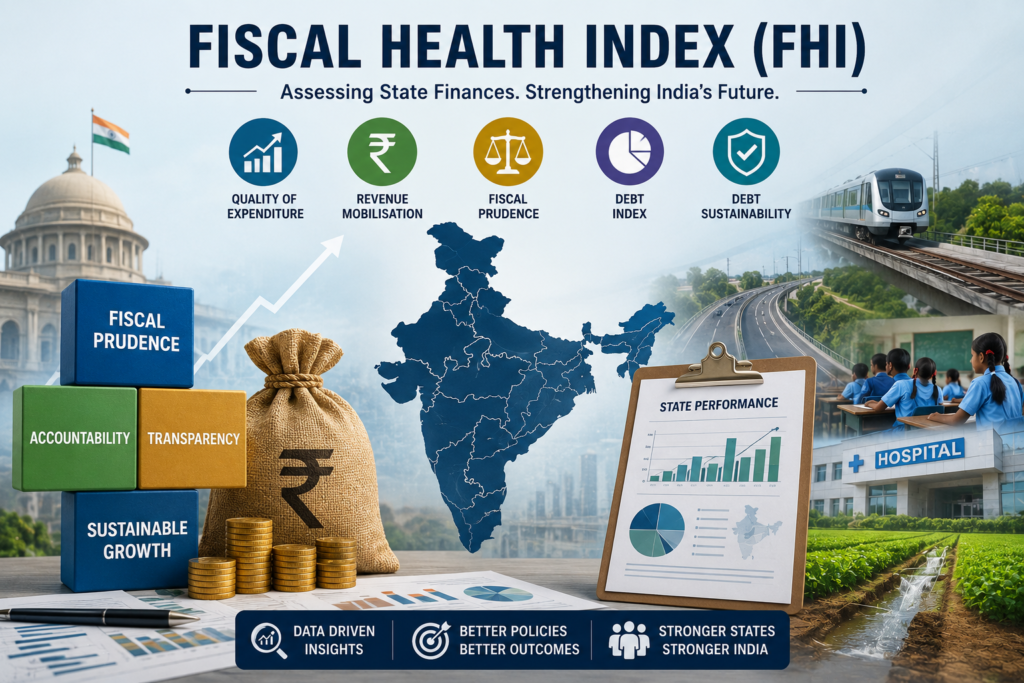
Rethinking India’s Fiscal Health Index (FHI): Balancing Fiscal Prudence with Social Development
Why is it in News?
The NITI Aayog has released two editions of the Fiscal Health Index (FHI) based on audited data from the Comptroller and Auditor General (CAG) for the financial years 2022–23 and 2023–24. The index aims to assess and compare the fiscal performance of 18 major Indian states.
However, the rankings have sparked a debate among economists and policymakers regarding whether the framework disproportionately rewards fiscally conservative and resource-rich states while inadequately recognizing states that spend heavily on social welfare, healthcare, education, and human development.
For UPSC aspirants, the topic is important under Indian Economy, Fiscal Federalism, Public Finance, Governance, and State Finances.
About the Fiscal Health Index (FHI)
The Fiscal Health Index (FHI) is a comprehensive framework developed by NITI Aayog to evaluate the financial health and fiscal sustainability of Indian states.
The index seeks to move beyond traditional measures such as fiscal deficit and debt by examining the broader quality and sustainability of state finances.
Since state governments account for a substantial share of India’s public expenditure and debt, their fiscal health has a direct impact on macroeconomic stability and long-term development.
Objectives of the Fiscal Health Index
The FHI aims to:
- Assess the fiscal performance of states.
- Encourage responsible financial management.
- Promote transparency and accountability.
- Facilitate inter-state comparisons.
- Support evidence-based policymaking.
- Improve long-term fiscal sustainability.
Institutional Framework
Nodal Agency
NITI Aayog
Data Source
The index relies on audited financial data from the:
Comptroller and Auditor General of India
ensuring consistency and reliability.
Why Fiscal Health Matters?
Strong state finances are essential because states are responsible for major public services such as:
- Education
- Healthcare
- Agriculture
- Infrastructure
- Social welfare
- Urban development
Poor fiscal management can lead to:
- Rising debt burdens
- Reduced developmental expenditure
- Fiscal instability
- Lower economic growth
Core Pillars of the Fiscal Health Index
The Fiscal Health Index evaluates states across five major dimensions.
1. Quality of Expenditure
This pillar assesses how effectively a state utilizes public resources.
Key Indicators
- Developmental expenditure
- Capital expenditure
- Capital outlay as a percentage of GSDP
Why It Matters?
Higher capital spending generally creates productive assets such as:
- Roads
- Schools
- Hospitals
- Irrigation systems
which support future economic growth.
2. Revenue Mobilisation
This pillar measures the ability of states to generate their own revenue.
Key Components
- Own tax revenue
- Own non-tax revenue
- Revenue relative to GSDP
- Revenue relative to total expenditure
Importance
States with stronger revenue bases are less dependent on transfers from the Union Government.
3. Fiscal Prudence
This dimension evaluates fiscal discipline.
Key Indicators
- Fiscal deficit
- Revenue deficit
- Compliance with fiscal targets
Objective
To assess whether states are managing expenditure and borrowing responsibly.
4. Debt Index
The debt index measures:
- Total outstanding liabilities
- Debt composition
- Debt burden
A high debt burden can constrain future development expenditure.
5. Debt Sustainability
Debt sustainability assesses whether a state can continue servicing its debt without causing fiscal distress.
Key Questions
- Can the state repay debt comfortably?
- Will debt servicing crowd out development spending?
- Is borrowing supporting productive investments?
Understanding Fiscal Responsibility and Budget Management (FRBM)
The Fiscal Health Index also considers compliance with fiscal discipline norms under the:
Fiscal Responsibility and Budget Management Act
The FRBM framework seeks to:
- Reduce excessive borrowing
- Maintain fiscal discipline
- Promote macroeconomic stability
The Debate Around Fiscal Health Rankings
Although the FHI has been welcomed as an innovative tool, several concerns have emerged.
Concern 1: Rewarding Resource-Rich States
Some states possess significant natural resources that generate large non-tax revenues through:
- Mining
- Royalties
- Energy resources
These revenues may boost fiscal scores even when tax collection efficiency remains moderate.
Concern 2: Penalizing High Social Spending States
Several states invest heavily in:
- Education
- Public health
- Nutrition
- Social welfare
Such expenditures may increase deficits in the short term but contribute significantly to long-term human capital development.
Critics argue that these developmental investments are not adequately reflected in fiscal rankings.
Concern 3: Focus on Fiscal Restraint
A narrow emphasis on deficits and debt can create incentives for excessive austerity.
This may discourage states from undertaking necessary public investments.
Fiscal Prudence vs Social Development
The central policy question is:
Should a state be rewarded merely for spending less?
or
Should fiscal evaluation also consider developmental outcomes?
For example:
A state with low debt but poor healthcare and education outcomes may rank higher than a state with moderate debt but strong human development indicators.
This raises questions about the broader meaning of “fiscal health.”
Importance of Linking Finance with Outcomes
Modern public finance increasingly emphasizes:
Outcome-Based Governance
This approach evaluates not only how much money is spent but also:
- What results are achieved.
- Whether citizens benefit.
- Whether expenditure improves quality of life.
Challenges in Measuring Fiscal Health
Several structural challenges complicate state-level fiscal comparisons.
Diverse Economic Structures
States differ significantly in:
- Population size
- Resource endowments
- Industrial base
- Tax capacity
Different Development Priorities
Some states prioritize:
- Infrastructure
while others focus on:
- Health
- Education
- Social welfare
Direct comparisons may therefore be imperfect.
Natural Resource Bias
States rich in minerals or energy resources often enjoy higher revenues without corresponding tax efforts.
Significance of the Fiscal Health Index
Despite criticism, the FHI remains an important reform.
It encourages:
Greater Fiscal Transparency
States become more accountable for financial decisions.
Better Public Financial Management
Fiscal indicators promote prudent budgeting.
Competitive Federalism
States are incentivized to improve performance.
Evidence-Based Policy
Data-driven rankings support informed policymaking.
Way Forward
To improve the Fiscal Health Index, several reforms can be considered.
Link Fiscal Metrics with Social Outcomes
The index should incorporate indicators such as:
- Education outcomes
- Health outcomes
- Human Development Index (HDI)
- Poverty reduction
This would provide a more holistic picture of fiscal performance.
Separate Resource Revenues from Tax Effort
States should be assessed based on:
- Tax buoyancy
- Tax administration efficiency
- Revenue effort
rather than merely total revenue.
Encourage Productive Social Spending
Fiscal frameworks should recognize investments in:
- Education
- Healthcare
- Skill development
as long-term growth-enhancing expenditures.
Strengthen Outcome-Based Budgeting
Budget evaluation should increasingly focus on measurable developmental outcomes.
Balance Prudence and Development
States should be incentivized to achieve both:
- Fiscal sustainability
- Social progress
rather than prioritizing one at the expense of the other.
Significance for India’s Fiscal Federalism
The Fiscal Health Index represents an important step toward strengthening fiscal governance in India.
However, the future evolution of the index will depend on its ability to balance:
Fiscal Discipline
with
Human Development and Inclusive Growth
A truly healthy fiscal system is not merely one that minimizes deficits, but one that uses public resources effectively to improve citizens’ lives while maintaining long-term financial sustainability.
UPSC Prelims Focus
Important Facts
| Feature | Details |
|---|---|
| Developed By | NITI Aayog |
| Data Source | CAG Audited Accounts |
| Coverage | 18 Major States |
| Key Objective | Assess Fiscal Health |
| Major Dimensions | 5 Pillars |
| Related Framework | FRBM |
Previous Year Question (UPSC Prelims 2018)
Consider the following statements regarding the FRBM Review Committee:
- It recommended a debt-to-GDP ratio of 60% for the combined government sector.
- State Governments were assigned a 20% debt-to-GDP target.
- Under the Constitution, states with outstanding liabilities to the Centre require Central consent before raising loans.
Correct Answer:
(c) 1 and 3 only
Exam Keywords
- Fiscal Health Index (FHI)
- NITI Aayog
- Fiscal Federalism
- State Finances
- Fiscal Prudence
- Revenue Mobilisation
- Debt Sustainability
- FRBM Act
- CAG
- Public Finance
- Capital Expenditure
- Fiscal Deficit
- Debt Management
- Outcome-Based Governance
UPSC Syllabus Reference
GS Paper III – Indian Economy, Public Finance, Fiscal Policy, Government Budgeting, Fiscal Federalism, and Sustainable Development.