Adivasi Identity, Faith and Constitutional Rights: Understanding the Debate Around the Janjati Suraksha Manch
Why is it in News?
A recent gathering organized by the Janjati Suraksha Manch (JSM) in Delhi has sparked a nationwide debate on Adivasi identity, religion, constitutional rights, and cultural autonomy.
The event was attended by several political leaders and focused on the demand to remove constitutional protections from Adivasis who have converted to religions such as Christianity. The discussions have reignited important questions about whether tribal identity is linked to religion and how the Constitution protects the rights of Scheduled Tribes (STs).
For UPSC aspirants, this issue is important under Polity, Tribal Affairs, Fundamental Rights, Social Justice, and Constitutional Provisions relating to Scheduled Tribes.
Who are Adivasis?
The term Adivasi literally means:
“Original Inhabitants”
Adivasis are India’s indigenous tribal communities who have historically maintained distinct:
- Cultural traditions
- Languages
- Social institutions
- Religious beliefs
- Customs and practices
India recognizes many tribal communities under the category of:
Scheduled Tribes (STs)
under Article 342 of the Constitution.
Why is the Issue Being Debated?
The central issue revolves around the question:
Does an Adivasi lose tribal identity after converting to another religion?
Some groups argue that tribal individuals who convert to Christianity or other religions should no longer enjoy Scheduled Tribe protections.
Others argue that tribal identity is based on:
- Ethnicity
- Community ties
- Historical background
- Cultural practices
and not solely on religion.
This debate has significant implications for:
- Reservation policies
- Political representation
- Cultural rights
- Tribal autonomy
Constitutional Status of Scheduled Tribes
The Constitution provides special protections to Scheduled Tribes to address historical disadvantages and ensure social justice.
Important Constitutional Provisions
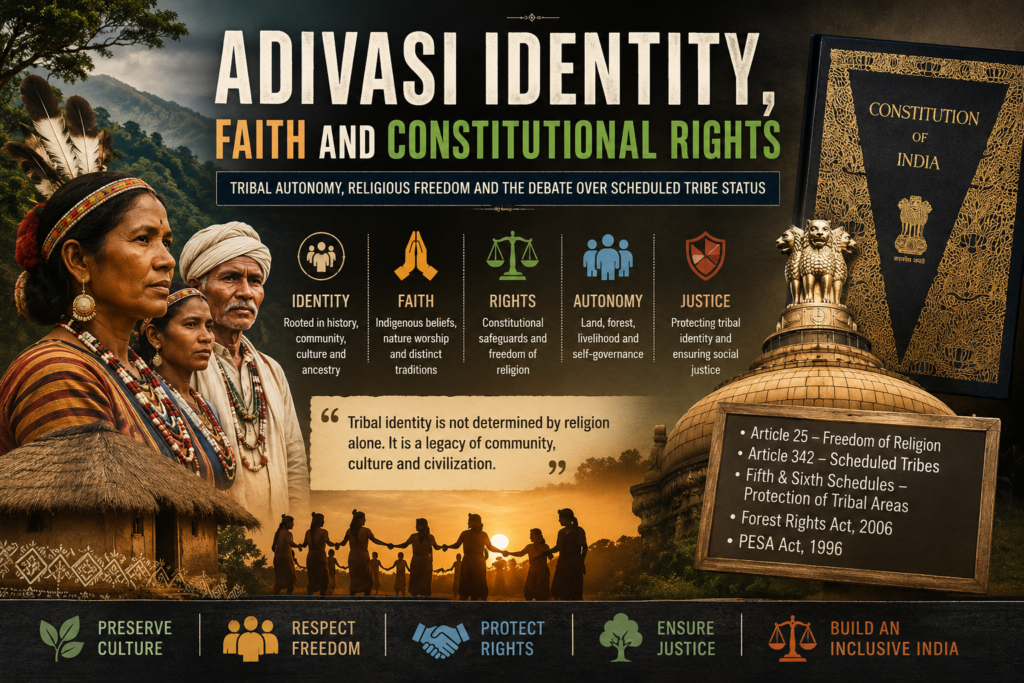
Article 342
Empowers the President to specify Scheduled Tribes in consultation with state governments.
Fifth Schedule
Provides special administrative arrangements for tribal areas in mainland India.
Sixth Schedule
Provides autonomous governance arrangements for tribal areas in certain northeastern states.
Article 46
Directs the State to promote the educational and economic interests of Scheduled Tribes and protect them from exploitation.
Is Tribal Identity Based on Religion?
One of the most important legal questions is whether religion determines tribal identity.
Several judicial decisions have clarified that:
Tribal identity is primarily linked to ethnicity, community, ancestry, and social practices rather than religion.
A person belonging to a tribal community does not automatically cease to be a member of that tribe merely because of religious conversion.
Important Judicial Perspective
A frequently cited legal principle emerged from judicial rulings involving members of tribal communities.
The courts observed that:
- Tribal identity is rooted in ethnic and community relationships.
- Conversion does not automatically erase tribal ancestry.
- Many converted tribal communities continue to participate in traditional festivals and cultural practices.
- Community identity often survives religious change.
This interpretation has become important in discussions on tribal rights and reservations.
Understanding Adivasi Religion
Many tribal communities traditionally follow indigenous faith systems that differ from major organized religions.
Common Characteristics
- Nature worship
- Sacred groves
- Ancestor worship
- Community rituals
- Local deities
- Spiritual connection with forests, rivers, and mountains
Many tribal organizations argue that these belief systems constitute distinct religions and should receive separate recognition.
Demand for a Separate Tribal Religion Code
A growing movement among tribal groups seeks:
Separate Religious Recognition in the Census
Supporters argue that:
- Adivasi faith traditions are distinct from Hinduism, Christianity, Islam, or other organized religions.
- Tribal belief systems deserve independent recognition.
- Separate enumeration would help preserve cultural identity.
Several tribal organizations have demanded a separate column in census records for indigenous tribal religions.
Cultural Assimilation vs Cultural Preservation
A major concern raised by tribal activists relates to cultural assimilation.
What is Cultural Assimilation?
It refers to a process where smaller cultural groups gradually lose their unique identity and become absorbed into a dominant culture.
Critics argue that:
- Traditional tribal practices may be marginalized.
- Local deities may be reinterpreted through mainstream religious frameworks.
- Distinct tribal customs may weaken over time.
Supporters of cultural preservation emphasize protecting indigenous traditions and beliefs.
Freedom of Religion and Tribal Communities
The Constitution guarantees freedom of religion through:
Article 25
Article 25 provides:
- Freedom of conscience
- Freedom to profess religion
- Freedom to practice religion
- Freedom to propagate religion
This means every citizen, including Adivasis, has the right to choose and follow a religion of their choice.
Tribal Rights Beyond Religion
Many scholars and tribal organizations argue that the major concerns facing Adivasi communities today are not primarily religious.
Instead, they include:
1. Land Rights
Protection against displacement from ancestral lands.
2. Forest Rights
Recognition of traditional rights over forests and natural resources.
3. Livelihood Security
Access to sustainable economic opportunities.
4. Education
Improved educational facilities in tribal regions.
5. Healthcare
Better health infrastructure and services.
6. Political Representation
Meaningful participation in governance and decision-making.
Forest Rights and Tribal Communities
One of the most significant legislations protecting tribal interests is:
Forest Rights Act, 2006
The Act recognizes:
- Community forest rights
- Individual land rights
- Traditional forest usage rights
Many tribal organizations consider effective implementation of this law essential for protecting Adivasi interests.
Panchayats (Extension to Scheduled Areas) Act, 1996 (PESA)
PESA Act
The Act extends self-governance provisions to Scheduled Areas.
Key Features
- Empowers Gram Sabhas.
- Protects customary traditions.
- Ensures community participation in resource management.
- Gives local communities a role in development decisions.
The Act is considered crucial for tribal self-governance.
Why Adivasi Identity Matters
Adivasi identity is not merely a question of religion.
It encompasses:
- History
- Culture
- Language
- Territory
- Community institutions
- Traditional knowledge systems
Many scholars argue that reducing tribal identity solely to religious affiliation oversimplifies a much more complex reality.
Major Issues Faced by Tribal Communities Today
Land Alienation
Loss of traditional land ownership due to development projects and resource extraction.
Displacement
Migration caused by dams, mining, industrial projects, and infrastructure development.
Poverty
Many tribal areas continue to experience economic deprivation.
Educational Backwardness
Lower literacy rates and limited access to quality education.
Health Challenges
Higher rates of malnutrition and inadequate healthcare facilities.
Environmental Degradation
Loss of forests and biodiversity affects traditional livelihoods.
The Larger Constitutional Debate
The current discussion highlights a broader constitutional question:
How can India balance cultural diversity, religious freedom, and tribal rights?
The challenge is to ensure that:
- Constitutional protections remain effective.
- Tribal identity is respected.
- Freedom of religion is protected.
- Indigenous cultures are preserved.
Way Forward
A balanced approach should focus on:
Protecting Constitutional Rights
Safeguarding provisions available to Scheduled Tribes.
Respecting Freedom of Religion
Ensuring individuals can freely choose their faith.
Preserving Tribal Culture
Supporting indigenous languages, traditions, and belief systems.
Strengthening Local Governance
Effective implementation of PESA and Forest Rights Act.
Promoting Inclusive Development
Ensuring development benefits tribal communities without undermining their identity.
UPSC Prelims Focus
Important Constitutional Provisions
| Provision | Subject |
|---|---|
| Article 25 | Freedom of Religion |
| Article 46 | Welfare of Scheduled Tribes |
| Article 342 | Identification of Scheduled Tribes |
| Fifth Schedule | Administration of Tribal Areas |
| Sixth Schedule | Autonomous Tribal Areas |
UPSC Mains Relevance
GS Paper II
- Vulnerable Sections
- Tribal Issues
- Constitutional Rights
- Social Justice
GS Paper I
- Indian Society
- Tribal Communities
- Diversity and Cultural Identity
Exam Keywords
- Adivasi Identity
- Scheduled Tribes
- Article 25
- Article 342
- Tribal Rights
- Forest Rights Act
- PESA Act
- Indigenous Faiths
- Religious Freedom
- Cultural Autonomy
- Tribal Self-Governance
- Social Justice
- Gram Sabha
- Fifth Schedule
- Sixth Schedule
UPSC Syllabus Reference
GS Paper II – Welfare Schemes for Vulnerable Sections, Constitutional Rights, Tribal Governance, Social Justice, and Issues Related to Scheduled Tribes.