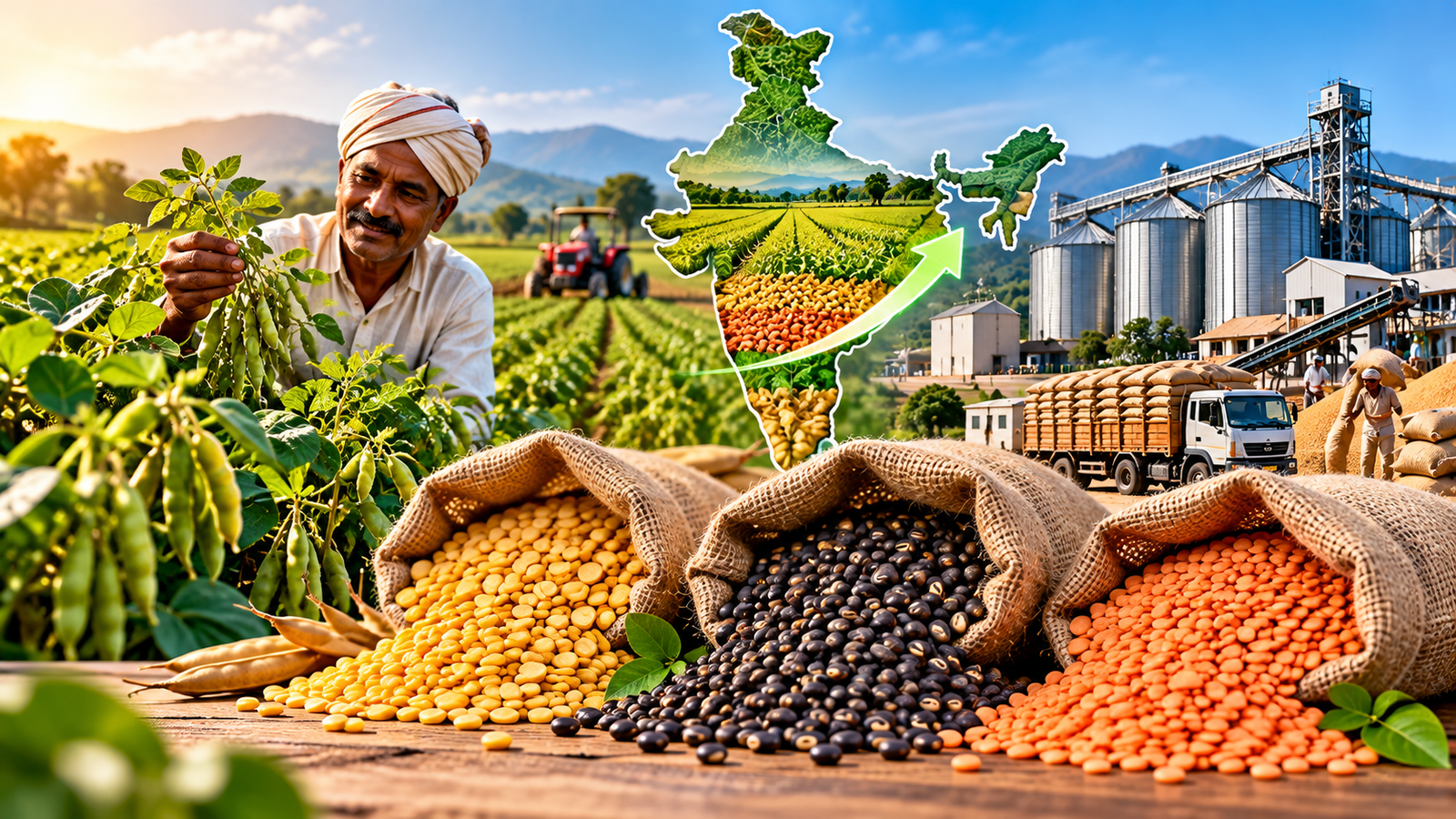
Mission for Aatmanirbharta in Pulses 2026: ₹11,440 Crore Scheme, MSP, Targets and Benefits
Why in News?
The Mission for Aatmanirbharta in Pulses completed its first year on 11 October 2026. Launched in October 2025, the mission aims to make India self-reliant in pulses by increasing domestic production, improving crop productivity, strengthening farmers’ incomes and reducing dependence on imports.
The Union Government has allocated ₹11,440 crore for the six-year period from 2025–26 to 2030–31.
The mission gives special attention to Tur (Arhar), Urad and Masoor, three important pulses in India’s food and agricultural systems.
According to the Government of India’s latest progress update, the mission aims to increase pulses production to 350 lakh tonnes by 2030–31. Its strategy combines better seeds, expansion of cultivation, assured procurement, processing infrastructure and digital monitoring.
For UPSC and HPPSC aspirants, this scheme is important for Agriculture, Food Security, Minimum Support Price (MSP), farmers’ income, import dependence and sustainable agricultural development.
What Is the Mission for Aatmanirbharta in Pulses?
The Mission for Aatmanirbharta in Pulses is a Centrally Sponsored Scheme designed to increase domestic pulses production and reduce India’s dependence on imported pulses.
Centrally Sponsored Scheme: A government scheme in which the Union Government and State Governments share implementation responsibilities and, according to the scheme’s funding pattern, the expenditure.
The mission follows a value-chain approach. This means it does not focus only on growing more pulses; it also seeks to improve the supply of seeds, procurement, storage, processing and market access.
Its central objective is to create a stronger domestic pulses sector that benefits farmers while supporting affordable and nutritious food for consumers.
Key Facts About the Mission
| Feature | Details |
|---|---|
| Scheme | Mission for Aatmanirbharta in Pulses |
| Launch date | 11 October 2025 |
| Implementation period | 2025–26 to 2030–31 |
| Total financial outlay | ₹11,440 crore |
| Main crops | Tur, Urad and Masoor, among other pulses covered by wider production efforts |
| Production target | 350 lakh tonnes by 2030–31 |
| Target cultivation area | 310 lakh hectares |
| Target yield | 1,130 kg per hectare |
| Seed support | 87.5 lakh free seed kits planned over six years |
| Certified seeds | 126 lakh quintals planned over six years |
| Processing infrastructure | 1,000 pulse processing units |
| Geographic coverage | Cluster-based approach covering 489 districts |
| Procurement agencies | NAFED and NCCF |
| Main objective | Higher domestic production and reduced import dependence |
Why Does India Need Self-Reliance in Pulses?
India is among the world’s largest producers and consumers of pulses. However, domestic production has not always been sufficient to meet the country’s total demand.
This creates several economic and social challenges.
Import Dependence
When domestic production falls short of demand, India imports pulses from other countries.
Dependence on imports can expose consumers to international price fluctuations, supply disruptions and changes in export policies of producing countries.
Increasing domestic production can reduce this vulnerability, although complete self-sufficiency also depends on demand growth, productivity and crop performance.
Nutritional Security
Pulses are an important source of plant-based protein, fibre, vitamins and minerals.
They are especially important for households that depend on cereal-based diets and need affordable sources of protein.
Higher and more stable pulses availability can support dietary diversity and nutritional security.
Farmers’ Income
Pulses provide farmers with opportunities to diversify beyond crops such as rice and wheat.
Better seeds, reliable procurement, improved productivity and local processing can increase the economic viability of pulses cultivation.
However, higher production alone does not guarantee higher income. Farmers also need remunerative prices, market access and protection from crop losses.
Foreign Exchange Savings
If domestic production meets a greater share of demand, India may need to spend less foreign exchange on pulses imports.
The actual savings will depend on domestic demand, international prices, import volumes and the competitiveness of Indian production.
Major Objectives of the Mission
Increase Domestic Production
The mission targets pulses production of 350 lakh tonnes by 2030–31.
The objective is to improve both the area under pulses and the quantity produced per hectare.
Improve Crop Productivity
Productivity means the amount of crop obtained from a given area of land.
The mission aims to raise average pulses yield to 1,130 kg per hectare by 2030–31 through improved seeds, better farming practices and more effective crop management.
Promote Climate-Resilient Seeds
Climate-resilient seeds are varieties better suited to withstand certain stresses, such as drought, heat or irregular rainfall.
Such varieties can help reduce production risks, although their performance depends on local conditions, soil, water availability and agricultural practices.
Expand Cultivation
The mission aims to increase the area under pulses by 35 lakh hectares, taking the targeted total area to 310 lakh hectares.
This includes expanding cultivation in suitable rice-fallow areas and promoting crop diversification where agronomic conditions permit.
Strengthen Procurement
The mission seeks to improve farmers’ access to price support through the procurement of Tur, Urad and Masoor under the applicable government framework.
Develop Processing Infrastructure
The mission plans to establish 1,000 pulse processing units to strengthen local value chains, reduce post-harvest losses and improve farmers’ access to markets.
Which Pulses Are Given Special Attention?
Tur or Arhar
Tur, also known as pigeon pea or red gram, is an important source of plant-based protein.
It is widely used in Indian diets, particularly in the preparation of dal.
Urad
Urad, or black gram, is used in dishes such as dal, idli and dosa.
It is also important for crop diversification and soil management in suitable farming systems.
Masoor
Masoor, or lentil, is an important winter-season pulse and a source of protein and other nutrients.
The mission places particular emphasis on these crops because of their importance in domestic consumption and the objective of reducing import dependence.
Major Components of the Mission
Improved Seed Supply
The mission plans to distribute 87.5 lakh free seed kits and 126 lakh quintals of certified seeds over six years.
Quality seeds can help improve germination, crop establishment and productivity.
The benefits, however, depend on seed quality, timely distribution, suitable varieties and access to agricultural extension services.
Expansion in Rice-Fallow Areas
Rice fallows are agricultural fields that remain uncultivated after the rice harvest.
Where soil moisture, temperature and other conditions are suitable, farmers can cultivate pulses after rice instead of leaving fields unused.
This can improve land utilisation and provide additional farm income.
However, pulse cultivation should be introduced only where local conditions support it and where it does not create excessive pressure on water or soil resources.
Cluster-Based Production
The mission proposes a cluster-based approach across 489 districts.
A cluster-based approach means concentrating support in selected geographical areas to coordinate seed supply, demonstrations, extension services, procurement and processing.
This can improve implementation by linking production with local market infrastructure.
Assured Procurement
NAFED and NCCF are the designated central procurement agencies for Tur, Urad and Masoor under the mission’s applicable procurement arrangements.
The mission provides for procurement at MSP for willing and registered farmers under the prescribed conditions.
Procurement can reduce the risk that farmers will be forced to sell at very low prices during periods of excess supply.
Processing and Value Addition
The mission aims to establish 1,000 pulse processing units.
Processing units can clean, grade, split, package and prepare pulses for sale.
Local processing can create rural employment and allow farmers and producer organisations to capture a larger share of the value chain.
What Is MSP and How Does It Help Pulse Farmers?
Minimum Support Price (MSP) is a price announced by the Government of India for specified crops to provide farmers with a reference level of price support.
The Commission for Agricultural Costs and Prices (CACP) recommends MSPs, while the Union Government takes the final decision.
For pulses, MSP can help protect farmers when market prices fall below remunerative levels, provided procurement or other effective price-support arrangements are available.
Under the Mission for Aatmanirbharta in Pulses, Tur, Urad and Masoor receive special attention through procurement arrangements involving NAFED and NCCF.
Important Distinction: MSP Is Not the Same as Guaranteed Procurement Everywhere
The announcement of an MSP does not mean that every farmer can automatically sell any quantity of a crop to a procurement agency at that price.
Procurement depends on the applicable scheme, crop, registration, quality requirements, procurement period and operational arrangements.
This distinction is important for both UPSC Prelims and Mains.
How Does the Mission Support Soil Health?
Pulses belong to the legume family. Many legumes form a symbiotic relationship with bacteria in root nodules that can fix atmospheric nitrogen.
Biological Nitrogen Fixation: The process through which certain microorganisms convert atmospheric nitrogen into forms that plants can use.
This can improve nitrogen availability in agricultural systems and may reduce the need for some nitrogen fertilisers when pulses are integrated appropriately into crop rotations.
Pulses can also support crop diversification and improve the sustainability of farming systems.
However, benefits vary according to crop variety, soil conditions, nutrient management and farming practices.
Role in Food and Nutritional Security
India’s food security challenge is not limited to the availability of cereals.
A balanced diet also requires adequate protein and other essential nutrients.
Pulses can support nutritional security because they are relatively accessible sources of plant-based protein.
Higher domestic production, better storage and efficient supply chains can help improve availability and reduce some supply-related price pressures.
However, nutritional outcomes also depend on household income, dietary diversity, food distribution systems and public health interventions.
Economic Significance of the Mission
Reduction in Import Dependence
Higher domestic production can reduce the need for imports when local output meets a greater share of consumption requirements.
Rural Employment
Seed production, harvesting, storage, transport, processing and marketing can generate employment across rural value chains.
Farmer Diversification
Pulses can provide alternatives to rice and wheat in suitable areas, potentially reducing excessive dependence on a limited number of crops.
Growth of Food Processing
New processing units can strengthen local enterprises and improve the value captured within agricultural regions.
Price Stability
Higher domestic availability and better storage may help moderate supply shortages. Nevertheless, retail prices also depend on weather, demand, stocks, transport costs and international markets.
Challenges in Achieving Pulses Self-Sufficiency
Low and Variable Productivity
Pulses yields can be affected by limited irrigation, low-quality seeds, pests, diseases and insufficient access to extension services.
Climate Risks
Drought, heat stress, irregular rainfall and extreme weather can damage crops.
Climate-resilient varieties and improved agricultural practices can reduce some risks but cannot eliminate them completely.
Limited Mechanisation
In some regions, harvesting and other farm operations remain labour-intensive.
Suitable machinery and custom-hiring services can help reduce costs and post-harvest losses.
Market Uncertainty
Farmers may hesitate to expand pulses cultivation if they are uncertain about market prices, procurement access or timely payments.
Storage and Processing Gaps
Inadequate storage and processing can increase losses, reduce quality and weaken farmers’ bargaining power.
Competition for Land
Pulses compete with other crops for agricultural land.
Farmers will adopt pulses on a sustained basis only when expected returns, risk and local growing conditions make them attractive.
Way Forward
Improve seed research: Develop high-yielding, disease-resistant and climate-resilient varieties suited to different agro-climatic zones.
Strengthen extension services: Provide farmers with timely advice on sowing, irrigation, pest management and harvesting.
Expand irrigation where appropriate: Promote efficient water management without encouraging unsustainable groundwater extraction.
Improve procurement access: Make registration, procurement centres, quality testing and payment systems accessible and transparent.
Strengthen Farmer Producer Organisations: FPOs can help small farmers aggregate produce, purchase inputs and negotiate better market terms.
Develop local processing: Establish processing units in suitable production clusters and ensure that they have reliable access to raw material, finance and markets.
Promote crop diversification: Expand pulses in suitable rice-fallow and other areas while considering local soil, climate, water and market conditions.
Use digital monitoring: Tools such as seed traceability, geo-tagging and digital crop surveys can improve implementation and accountability.
Improve storage and market linkages: Better warehouses, grading, transport and market information can reduce post-harvest losses and price uncertainty.
Monitor outcomes: Assess the mission not only by the number of seed kits or processing units distributed, but also by yield growth, farmer income, procurement effectiveness and reduced import vulnerability.
Relevance for Himachal Pradesh
For HPPSC aspirants, the mission can be linked with agricultural diversification and sustainable farming in Himachal Pradesh.
The state’s varied agro-climatic conditions create opportunities for suitable pulses in selected regions.
Pulses can contribute to:
- Crop diversification
- Improved soil fertility through appropriate crop rotations
- Additional farm income
- Local food and nutritional security
- Reduced dependence on a narrow range of crops
However, expansion should be based on district-specific suitability, growing seasons, local varieties, water availability and market access.
Agricultural universities, extension services, farmer groups and local procurement networks can help identify appropriate opportunities.
UPSC and HPPSC Syllabus Relevance
UPSC GS Paper III
- Major crops and cropping patterns
- Agricultural production and productivity
- Irrigation and agricultural inputs
- Minimum Support Price and agricultural marketing
- Food security
- Agricultural subsidies and procurement
- Food processing and supply chains
- Sustainable agriculture
UPSC GS Paper II
- Government policies and interventions
- Welfare of farmers and vulnerable sections
- Implementation of public schemes
HPPSC General Studies
- Himachal Pradesh agriculture
- Crop diversification
- Rural development
- Sustainable farming
- Agricultural marketing and farmers’ welfare
Prelims Quick Revision
| Topic | Key fact |
|---|---|
| Mission launch | 11 October 2025 |
| Financial outlay | ₹11,440 crore |
| Duration | 2025–26 to 2030–31 |
| Production target | 350 lakh tonnes |
| Cultivation area target | 310 lakh hectares |
| Target yield | 1,130 kg per hectare |
| Priority crops | Tur, Urad and Masoor |
| Seed kits | 87.5 lakh planned |
| Certified seeds | 126 lakh quintals planned |
| Processing units | 1,000 planned |
| Procurement agencies | NAFED and NCCF |
| Main goal | Higher domestic production and lower import dependence |
Prelims Practice Question
Consider the following statements about the Mission for Aatmanirbharta in Pulses:
- It has a financial outlay of ₹11,440 crore for the period 2025–26 to 2030–31.
- It aims to increase pulses production to 350 lakh tonnes by 2030–31.
- NAFED and NCCF are associated with the mission’s procurement arrangements for Tur, Urad and Masoor.
- The announcement of MSP automatically guarantees procurement of every pulse crop from every farmer without conditions.
Which of the statements given above are correct?
A. 1 and 2 only
B. 1, 2 and 3 only
C. 2, 3 and 4 only
D. 1, 2, 3 and 4
Answer: B
Explanation: Statement 4 is incorrect because MSP announcement and actual procurement are different. Procurement operates under applicable scheme conditions and arrangements.
Mains Practice Question
“The Mission for Aatmanirbharta in Pulses seeks to strengthen India’s nutritional security and reduce import dependence. Examine its major components and discuss the challenges in achieving pulses self-sufficiency.”
Suggested Answer Framework
Introduction: Explain the importance of pulses in India’s diet and agricultural economy.
Body:
- Describe the mission’s financial outlay and 2030–31 targets.
- Explain seed support, cultivation expansion, procurement and processing infrastructure.
- Discuss the links with farmer income, soil health, nutrition and foreign exchange.
- Identify challenges related to productivity, climate, market uncertainty and storage.
Way Forward: Recommend better seeds, research, extension, procurement, processing, digital monitoring and region-specific crop diversification.
Conclusion: Emphasise that self-sufficiency requires a productive, climate-resilient and remunerative pulses value chain.
One-Page Revision Notes
Mission: Aatmanirbharta in Pulses
Outlay: ₹11,440 crore
Duration: 2025–26 to 2030–31
Production target: 350 lakh tonnes
Area target: 310 lakh hectares
Main crops: Tur, Urad and Masoor
Major interventions:
- Improved and climate-resilient seeds
- Expansion into suitable rice-fallow areas
- Cluster-based production
- Procurement through NAFED and NCCF
- 1,000 planned processing units
- Digital monitoring and seed traceability
Expected benefits:
- Lower import dependence
- Improved nutritional security
- Better agricultural diversification
- Stronger rural value chains
- Potential improvement in farmers’ income
Major challenges:
- Low productivity
- Climate variability
- Market uncertainty
- Storage and processing gaps
- Procurement access
UPSC relevance: GS II and GS III
HPPSC relevance: Agriculture, rural development and sustainable farming in Himachal Pradesh
Conclusion
The Mission for Aatmanirbharta in Pulses represents an integrated effort to strengthen India’s pulses sector through improved seeds, expanded cultivation, procurement support and processing infrastructure.
Its success will depend on whether these interventions translate into sustained improvements in crop productivity, farmers’ incomes and reliable domestic supply.
For India, pulses self-sufficiency is not merely an agricultural objective. It is also connected with nutritional security, rural livelihoods, sustainable farming and economic resilience.