Living Planet Report 2026: 73% Wildlife Decline, Key Findings and India’s Biodiversity
Why in News?
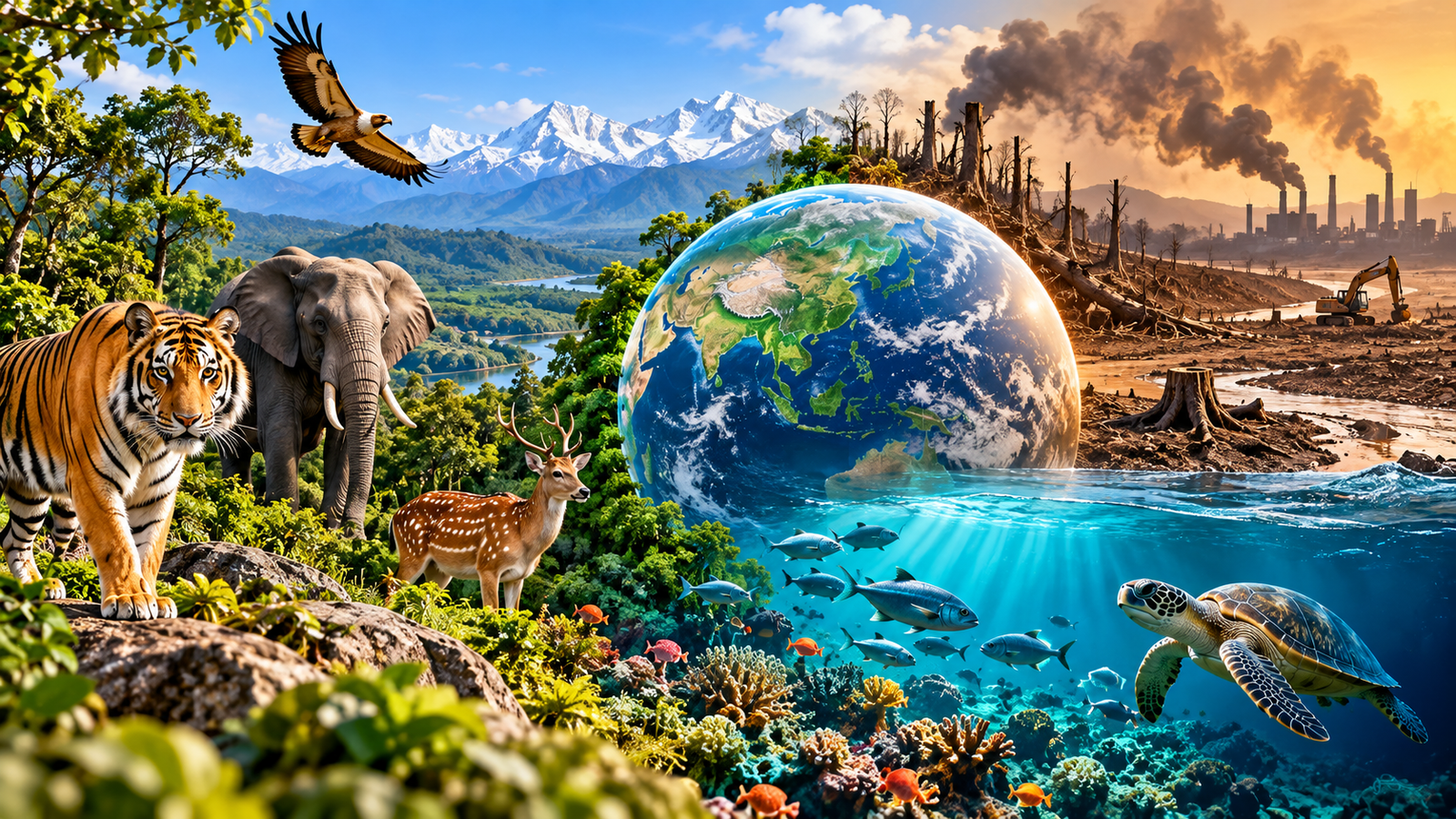
The World Wide Fund for Nature (WWF) released the Living Planet Report 2026 on 7 October 2026. The report highlights a major decline in monitored wildlife populations across the world and calls for urgent action to protect biodiversity.
According to the report, the average size of monitored vertebrate wildlife populations declined by 73% between 1970 and 2022. Freshwater populations experienced the steepest decline, followed by terrestrial and marine populations.
However, the report also presents reasons for hope. Conservation efforts have helped several wildlife populations recover, including tigers, green sea turtles and bluefin tuna.
The central message is that protecting wildlife requires more than creating protected areas. The world must also transform the food, energy and financial systems that contribute to biodiversity loss.
For UPSC and HPPSC aspirants, the report is important for Environment and Ecology, biodiversity conservation, climate change, sustainable development and environmental governance.
What Is the Living Planet Report?
The Living Planet Report is a major global assessment published by WWF, which examines trends in wildlife populations and the condition of nature.
It uses the Living Planet Index (LPI), produced by the Zoological Society of London (ZSL), to track changes in monitored populations of vertebrate species.
The index covers five major groups:
- Mammals
- Birds
- Reptiles
- Amphibians
- Fish
The report helps scientists and policymakers understand how wildlife populations are changing over time and identify the major pressures affecting them.
Important distinction: The report measures changes in the average size of monitored wildlife populations. It does not mean that 73% of all individual wild animals or 73% of all wildlife species have disappeared.
Key Findings of the Living Planet Report 2026
| Indicator | Key finding |
|---|---|
| Monitoring period | 1970–2022 |
| Average decline in monitored wildlife population sizes | 73% |
| Population trends analysed | 35,803 |
| Vertebrate species covered | 5,790 |
| Freshwater populations | 85% decline |
| Terrestrial populations | 69% decline |
| Marine populations | 59% decline |
| Latin America and the Caribbean | 95% decline |
| Africa | 80% decline |
| Asia-Pacific | 49% decline |
The report shows that the decline is widespread, although its severity varies across regions and ecosystems.
Around half of the monitored populations were stable or increasing. However, the magnitude of declines in other populations was large enough to produce an overall negative trend.
What Does the 73% Decline Actually Mean?
This is one of the most important concepts for understanding the report.
Suppose scientists monitor a wildlife population containing 1,000 animals in 1970. If its size declines by 50%, the monitored population would fall to 500 animals.
The Living Planet Index combines population trends across many monitored vertebrate populations to calculate an overall trend.
Therefore, the reported 73% decline represents a change in the average size of monitored populations over the period.
It does not mean that every monitored population declined by 73%. Some populations declined sharply, some remained stable, and others increased.
This distinction is important for interpreting environmental reports correctly.
Why Are Wildlife Populations Declining?
The report identifies several major drivers of biodiversity loss.
Habitat Loss and Degradation
Habitat loss occurs when natural areas are converted into agricultural land, settlements, roads, industries or other human uses.
Habitat degradation occurs when an ecosystem becomes less suitable for wildlife, even if some of its original area remains.
Examples include deforestation, wetland destruction, river modification and the degradation of grasslands.
Habitat loss and degradation are among the most frequently reported threats to monitored wildlife populations.
Overexploitation
Overexploitation occurs when humans harvest or use wildlife faster than populations can recover.
Examples include:
- Illegal hunting and poaching
- Overfishing
- Unsustainable wildlife trade
- Excessive extraction of natural resources
When animals are removed from an ecosystem faster than they can reproduce, their populations may decline rapidly.
Climate Change
Climate change affects wildlife through rising temperatures, changing rainfall patterns, extreme weather, melting glaciers and changes in habitat suitability.
For example, warming oceans can cause coral bleaching, while changing temperature and precipitation patterns can affect mountain species and their habitats.
Climate change can also worsen existing threats such as habitat degradation and water scarcity.
Pollution
Pollution affects terrestrial, freshwater and marine ecosystems.
Major forms include plastic pollution, pesticide contamination, industrial waste, untreated sewage and chemical pollutants.
In freshwater ecosystems, pollution can reduce water quality, damage aquatic habitats and affect fish and other organisms.
Invasive Alien Species
An invasive alien species is a species introduced outside its natural range that spreads and causes ecological, economic or social harm.
Such species may compete with native species, prey on them, introduce diseases or change ecosystem processes.
Invasive plants can also alter grasslands, forests and other habitats.
Disease
Wildlife diseases can spread through natural contact, livestock interactions, human activities and environmental changes.
Disease outbreaks can become particularly damaging when populations are already small, fragmented or under stress.
Why Are Freshwater Ecosystems Under Severe Pressure?
The report records an average decline of 85% in monitored freshwater wildlife populations, the steepest among the three major ecosystem categories.
Freshwater ecosystems include rivers, lakes, wetlands, streams and other inland water bodies.
They support fish, amphibians, aquatic plants, birds and numerous other organisms.
Major threats include:
- Dams and changes in river flow
- Wetland destruction
- Water pollution
- Excessive water extraction
- Agricultural runoff
- Overfishing
- Climate change
Freshwater ecosystems are particularly vulnerable because many species depend on specific water conditions and connected habitats.
The decline also matters for people. Healthy freshwater ecosystems support drinking water, irrigation, fisheries, livelihoods and flood regulation.
Why Does Biodiversity Matter?
Biodiversity refers to the variety of life at the genetic, species and ecosystem levels.
It is essential for maintaining the ecological processes that support human societies.
Ecosystem Services
Ecosystem services are the benefits that humans obtain from nature.
These include:
- Provision of food, freshwater, timber and other resources
- Pollination of crops
- Nutrient cycling and soil formation
- Regulation of climate and water flows
- Cultural, recreational and spiritual benefits
The loss of biodiversity can weaken these services and increase risks to food security, water availability, livelihoods and economic stability.
Food Security
Agriculture depends on healthy soils, pollinators, water availability and genetic diversity.
The destruction of natural habitats can reduce pollinator populations, degrade soils and disrupt ecological processes that support agricultural production.
Human Health
Healthy ecosystems can support clean water, food security and human well-being.
Environmental degradation may increase exposure to pollution and some infectious disease risks, although the relationship varies by ecosystem and disease.
Economic Security
Forestry, fisheries, agriculture and tourism depend directly or indirectly on healthy ecosystems.
Biodiversity loss can damage livelihoods, disrupt supply chains and increase the costs of restoring degraded environments.
What Does the Report Say About India?
India presents important examples of wildlife conservation and population recovery.
Conservation efforts have contributed to increases in several major species, including tigers, one-horned rhinoceroses and other wildlife.
However, national or species-specific recovery does not mean that all ecosystems are healthy. Habitat fragmentation, human-wildlife conflict, pollution and pressures on freshwater ecosystems remain important concerns.
India therefore needs to combine species-focused conservation with wider ecosystem protection.
Project Tiger
Launched in 1973, Project Tiger is one of India’s major wildlife conservation programmes.
It supports tiger conservation through protected areas, habitat management, monitoring and efforts to reduce poaching.
India’s tiger recovery demonstrates that sustained conservation investment and coordinated management can produce positive results.
Project Elephant
Project Elephant was launched in 1992 to support elephant conservation, habitat management and the protection of elephant corridors.
Maintaining connectivity between habitats is important because elephants require large areas for movement and access to food and water.
Wildlife Protection Act, 1972
The Wildlife (Protection) Act, 1972 provides the principal legal framework for protecting wild animals, birds and plants in India.
It supports wildlife protection, regulation of hunting and the management of protected areas, subject to the Act’s provisions.
Biological Diversity Act, 2002
The Biological Diversity Act, 2002 provides a framework for biodiversity conservation, sustainable use of biological resources and fair and equitable sharing of benefits arising from their use.
These objectives connect biodiversity protection with livelihoods, traditional knowledge and sustainable development.
Himachal Pradesh: Biodiversity Conservation and Ecological Challenges
For HPPSC aspirants, the report connects directly with Himachal Pradesh’s forests, Himalayan ecosystems, rivers, wetlands and wildlife.
Himalayan Biodiversity
Himachal Pradesh contains diverse ecological zones, from subtropical forests to temperate forests and alpine habitats.
These ecosystems support species such as the snow leopard, Himalayan monal, western tragopan and musk deer.
Changes in land use, infrastructure development, forest degradation and climate change can affect these habitats.
Great Himalayan National Park
Located in Kullu district, the Great Himalayan National Park Conservation Area is a UNESCO World Heritage Site.
It protects Himalayan ecosystems and supports a wide range of plants and animals.
Its conservation importance also demonstrates the value of protecting interconnected habitats rather than focusing only on individual species.
Wetlands and Freshwater Ecosystems
Wetlands such as Pong Dam Lake, Renuka Lake and Chandertal support birds and other wildlife.
Their ecological health depends on water quality, habitat management and the maintenance of suitable hydrological conditions.
The report’s findings on freshwater ecosystems make wetland conservation particularly relevant.
Human-Wildlife Conflict
As human activities expand into wildlife habitats, encounters between people and animals can increase.
Measures such as habitat restoration, wildlife corridors, community participation, early-warning systems and compensation mechanisms can help reduce conflict.
For Himachal Pradesh, conservation planning must account for both ecological protection and the needs of mountain communities.
What Is the Report’s Central Message?
The Living Planet Report 2026 argues that wildlife recovery cannot be achieved through isolated conservation projects alone.
It highlights the need to transform three interconnected systems.
Food Systems
Agriculture and food production contribute to habitat loss and biodiversity decline when natural ecosystems are converted or degraded.
Solutions include:
- Sustainable farming
- Reducing food loss and waste
- Protecting natural habitats
- Improving soil and water management
- Supporting nature-friendly agricultural practices
Energy Systems
Energy production affects biodiversity through greenhouse gas emissions, mining, infrastructure development and land-use change.
Expanding clean energy can help address climate change, but renewable energy projects should also be planned carefully to minimise harm to wildlife and habitats.
Financial Systems
Financial institutions influence which economic activities receive investment.
The report calls for directing more finance towards nature-positive activities and reducing financial support for activities that damage ecosystems.
Nature-positive investment includes financing conservation, ecosystem restoration and sustainable production.
What Are Positive Tipping Points?
A tipping point is a threshold beyond which a system can undergo a major change.
In environmental discussions, tipping points are often associated with dangerous changes, such as ecosystem collapse.
However, the report also discusses positive tipping points.
A positive tipping point occurs when a system crosses a threshold that allows beneficial change to become self-reinforcing.
For example, the falling cost of solar power has helped accelerate its adoption in many parts of the world.
Similarly, changes in food production, investment decisions and conservation practices could make nature-friendly activities more widely adopted.
The key idea is that governments, businesses and communities can create conditions in which sustainable choices become easier and more economically attractive.
Global and Indian Conservation Measures
Several approaches can help reverse biodiversity loss.
Protected areas: National parks, wildlife sanctuaries and conservation reserves protect important habitats.
Wildlife corridors: Corridors connect fragmented habitats and allow animals to move between populations.
Habitat restoration: Restoring forests, wetlands, grasslands and degraded landscapes improves ecological functioning.
Community participation: Local communities and Indigenous Peoples can contribute to conservation through traditional knowledge, stewardship and sustainable resource use.
Anti-poaching measures: Enforcement, monitoring and efforts to reduce illegal wildlife trade can protect threatened species.
Sustainable agriculture: Nature-friendly farming can reduce pressure on natural habitats and support pollinators and soil biodiversity.
Environmental impact assessment: Careful planning and assessment can help identify and reduce the ecological effects of infrastructure and industrial projects.
Nature-positive finance: Investment can be redirected towards activities that protect or restore ecosystems.
Challenges in Reversing Biodiversity Loss
Despite the availability of conservation approaches, several challenges remain.
- Competing demands for land, water and natural resources
- Habitat fragmentation caused by infrastructure
- Limited funding for long-term conservation
- Illegal wildlife trade and poaching
- Weak implementation of environmental safeguards
- Human-wildlife conflict
- Climate change and extreme weather
- Inadequate monitoring in some ecosystems
- Economic incentives that favour short-term extraction over long-term sustainability
Addressing these challenges requires coordinated action across governments, industries, scientific institutions and local communities.
Way Forward
India and the international community should focus on the following priorities:
Strengthen ecosystem protection: Protect forests, wetlands, grasslands, rivers and marine ecosystems, including areas outside formally protected zones.
Restore degraded habitats: Scale up restoration using appropriate native species and ecosystem-specific approaches.
Improve scientific monitoring: Expand long-term biodiversity monitoring and use satellite data, camera traps, acoustic monitoring and other suitable technologies.
Integrate biodiversity into development planning: Roads, railways, dams and industrial projects should account for habitat connectivity and ecological impacts.
Promote sustainable food systems: Reduce food waste, improve resource efficiency and support farming practices that protect biodiversity.
Mobilise conservation finance: Increase investment in ecosystem restoration and ensure that financial decisions account for nature-related risks.
Empower communities: Include local communities in conservation planning and ensure that they share the benefits of sustainable resource management.
Strengthen international cooperation: Countries should implement their biodiversity and climate commitments and cooperate on cross-border conservation.
UPSC Syllabus Relevance
GS Paper III — Environment and Ecology
- Conservation of biodiversity
- Environmental pollution and degradation
- Environmental impact assessment
- Climate change
- Sustainable development
- Conservation of natural resources
GS Paper II — Governance
- Government policies and interventions
- International environmental agreements
- Role of institutions and civil society
HPPSC General Studies
- Himachal Pradesh’s biodiversity
- National parks and wildlife sanctuaries
- Forest and wetland conservation
- Himalayan environmental challenges
- Human-wildlife conflict
Prelims Facts to Remember
| Fact | Detail |
|---|---|
| Report | Living Planet Report 2026 |
| Publisher | WWF |
| Index | Living Planet Index |
| Index producer | Zoological Society of London (ZSL) |
| Monitoring period | 1970–2022 |
| Overall trend | 73% average decline in monitored wildlife population sizes |
| Freshwater decline | 85% |
| Terrestrial decline | 69% |
| Marine decline | 59% |
| Main threats | Habitat loss, overexploitation, climate change, pollution, invasive species and disease |
| Indian conservation examples | Project Tiger, Project Elephant and protected-area management |
Prelims Practice Question
Consider the following statements regarding the Living Planet Report 2026:
- It uses the Living Planet Index to assess trends in monitored vertebrate wildlife populations.
- The reported 73% decline means that 73% of all individual wild animals disappeared between 1970 and 2022.
- Freshwater populations recorded a greater average decline than terrestrial and marine populations.
- Habitat loss and degradation are among the major drivers of biodiversity loss.
Which of the statements given above are correct?
A. 1 and 2 only
B. 1, 3 and 4 only
C. 2 and 4 only
D. 1, 2, 3 and 4
Answer: B
Explanation: Statement 2 is incorrect. The 73% figure represents the average change in the size of monitored wildlife populations, not the proportion of individual animals lost globally.
Mains Practice Question
“The Living Planet Report 2026 highlights the continuing decline of monitored wildlife populations. Discuss the major drivers of biodiversity loss and suggest measures to promote nature-positive development in India.”
Suggested Answer Framework
Introduction: Briefly explain the report’s findings and the importance of biodiversity.
Body:
- Explain habitat loss, overexploitation, climate change, pollution and invasive species.
- Discuss impacts on food security, water resources, livelihoods and ecosystem services.
- Highlight India’s conservation efforts and remaining challenges.
- Explain how sustainable food, energy and financial systems can support nature recovery.
Way Forward: Recommend habitat restoration, stronger enforcement, community participation, scientific monitoring, sustainable production and biodiversity-sensitive development planning.
Conclusion: Emphasise that long-term economic and ecological security depend on healthy ecosystems.
One-Page Revision
- Report: Living Planet Report 2026
- Publisher: WWF
- Index: Living Planet Index, produced by ZSL
- Key finding: 73% average decline in monitored wildlife population sizes from 1970 to 2022
- Freshwater: 85% decline
- Terrestrial: 69% decline
- Marine: 59% decline
- Major drivers: Habitat loss, overexploitation, climate change, pollution, invasive species and disease
- Core message: Conservation must be combined with changes in food, energy and finance systems
- India connection: Tiger recovery, elephant conservation, protected areas and ecosystem restoration
- Himachal connection: Himalayan biodiversity, Great Himalayan National Park, wetlands and wildlife corridors
- UPSC relevance: GS II, GS III and Environment and Ecology
Conclusion
The Living Planet Report 2026 highlights the continuing pressure on global biodiversity, but it also demonstrates that wildlife recovery is possible when conservation efforts are sustained and coordinated.
The 73% figure should be interpreted correctly: it measures the average decline in monitored wildlife population sizes, not the disappearance of 73% of all animals.
For India, the priority is to build on successful conservation programmes while addressing habitat fragmentation, freshwater degradation, unsustainable resource use and climate-related pressures.
Protecting biodiversity is not separate from economic development. Healthy ecosystems support food security, water availability, climate resilience, livelihoods and long-term human well-being.