Great Indian Bustard: From Captive Breeding to Soft Release
Category: Environment & Ecology | Biodiversity Conservation | Species Recovery
UPSC GS: GS Paper III
HPPSC: Environment, Biodiversity, Wildlife Conservation, Current Affairs
Geography Optional: Grassland Ecology, Human–Environment Interaction, Conservation Geography
Why in News?
India has entered an important new phase in the conservation of the Great Indian Bustard (GIB).
In September 2026, a dedicated GIB Soft Release Centre was inaugurated at Naliya in Kachchh, Gujarat. The centre has been developed to house and acclimatise captive-bred birds before their eventual release into the wild, subject to appropriate protocols and habitat conditions.
This development is important because India’s GIB conservation programme is gradually moving from:
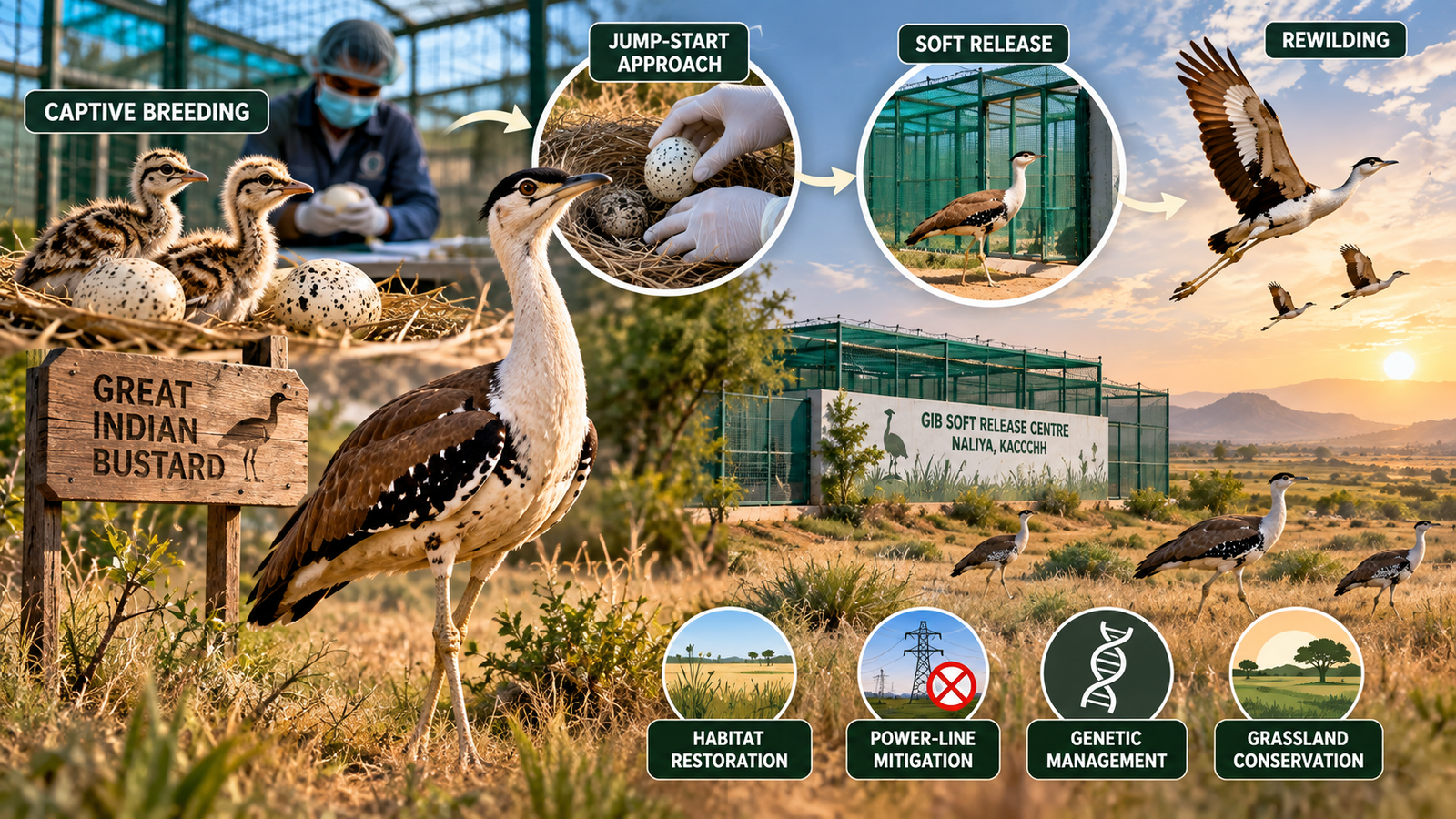
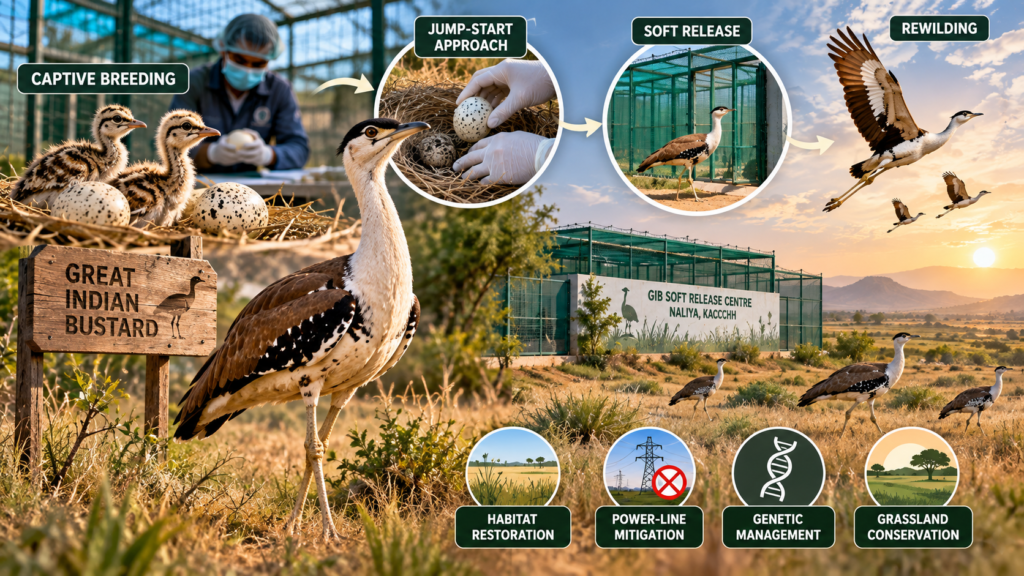
Captive Breeding → Habitat Restoration → Acclimatisation → Soft Release → Rewilding
The Wildlife Institute of India (WII) and government agencies are using captive breeding, habitat management, predator control, power-line mitigation and innovative interventions such as the Jump-start Approach to recover the species.
What is the Great Indian Bustard?
The Great Indian Bustard (Ardeotis nigriceps) is one of India’s most threatened birds.
It is a large ground-dwelling bird associated primarily with:
- Grasslands
- Open scrub
- Semi-arid landscapes
- Dry agricultural landscapes
The species is listed as Critically Endangered and is included in Schedule I of India’s wildlife protection framework.
Why is it important?
The GIB is an important indicator of the health of India’s open natural ecosystems.
Its conservation also protects the wider grassland ecosystem supporting species such as:
- Lesser Florican
- Chinkara
- Raptors
- Vultures
- Desert cats
- Other grassland fauna
Thus:
GIB conservation = Grassland ecosystem conservation
Where is the Great Indian Bustard Found?
Historically, the GIB had a much wider distribution across India’s dry and open landscapes.
Today, its important populations are highly restricted.
Major landscapes include:
Rajasthan
The Thar Desert supports the largest remaining population.
Gujarat
Important habitat remains in Kachchh, particularly around the Naliya landscape.
Maharashtra
Small populations occur around Solapur and Chandrapur.
Andhra Pradesh
Small populations have been reported from the Kurnool landscape.
Karnataka
Small populations have historically occurred around Bellary.
The Wildlife Institute of India identifies Rajasthan as the principal stronghold, with smaller populations in Gujarat, Maharashtra, Andhra Pradesh and Karnataka.
Why is the GIB Endangered?
The decline of the Great Indian Bustard is the result of multiple interacting threats.
Habitat Loss
Grasslands have historically been converted into:
- Agriculture
- Infrastructure
- Industrial areas
- Roads
- Power infrastructure
- Other land uses
This reduces suitable breeding and feeding habitats.
Habitat Fragmentation
What is Habitat Fragmentation?
Habitat fragmentation occurs when a large continuous habitat is divided into smaller isolated patches.
English Definition:
Habitat fragmentation is the breaking up of continuous habitat into smaller and often isolated patches.
For GIB, fragmentation can:
- Reduce breeding opportunities
- Restrict movement
- Isolate populations
- Reduce genetic exchange
- Increase exposure to infrastructure
Power-Line Collision
One of the most important modern threats is collision with overhead power lines.
The GIB is a large bird with limited ability to rapidly manoeuvre around high-voltage transmission infrastructure.
A bird may fail to detect a power line in time and collide with it.
Therefore:
Power-line mitigation = Major GIB conservation strategy
Possible measures include:
- Undergrounding of power lines in critical stretches
- Line marking/diverters
- Rerouting
- Identification of high-risk transmission corridors
This is an important example of the conflict between:
Infrastructure Development ↔ Wildlife Conservation
Predation
GIB nests and chicks are vulnerable to predators.
Nest predators can reduce breeding success.
Therefore, conservation programmes have included:
- Predator management
- Predator-proof fencing
- Nest protection
- Monitoring
In Kachchh, around 30 km of predator-proof fencing covering about 15 sq. km has been developed as part of ongoing conservation efforts.
Slow Reproduction
The GIB has a relatively slow reproductive strategy.
This makes population recovery difficult.
When adult mortality increases, the population cannot quickly compensate through reproduction.
This is why even apparently small increases in mortality can have major effects on a small population.
What is Conservation Breeding?
Conservation Breeding
Conservation breeding means breeding threatened species under controlled conditions to maintain a viable population and support eventual recovery.
English Definition:
Conservation breeding is the controlled breeding of threatened species to maintain genetic and demographic populations for conservation purposes.
It is also called ex-situ conservation breeding because breeding takes place outside the species’ natural habitat.
For GIB, conservation breeding facilities have been established in Rajasthan.
The programme has involved the Wildlife Institute of India, the Ministry of Environment, Forest and Climate Change and state forest departments.
GIB Captive Breeding Programme
India’s conservation breeding programme has made substantial progress.
In March 2026, the programme entered its fourth year, with the captive population reaching 70 birds after two additional chicks hatched at the Rajasthan Conservation Breeding Centre. One chick resulted from natural mating and another from artificial insemination.
By June 2026:
- 94 birds were in the captive stock.
- 26 chicks had hatched during the fourth breeding year.
- Of these, 18 resulted from artificial insemination.
- 4 resulted from natural breeding.
- 4 resulted from wild-collected eggs.
This demonstrates the increasing importance of scientific reproductive techniques in species recovery.
Artificial Insemination
What is Artificial Insemination?
Artificial insemination involves introducing sperm into the female reproductive tract using a controlled scientific procedure rather than natural mating.
English Definition:
Artificial insemination is an assisted reproductive technique in which sperm is deliberately introduced into a female to achieve fertilisation.
For a species with a very small captive population, such techniques can help increase breeding opportunities.
However, conservation breeding must also maintain genetic diversity.
Why Genetic Diversity Matters
Genetic Diversity
Genetic diversity refers to variation in genes among individuals of a species.
English Definition:
Genetic diversity is the variation in genetic characteristics among individuals within a population.
High genetic diversity generally improves a population’s ability to adapt to environmental changes and resist disease.
A very small population can face:
Small population → Inbreeding risk → Reduced genetic diversity → Lower adaptive capacity
Therefore, GIB conservation cannot simply focus on increasing the number of birds.
It must also maintain a genetically healthy population.
The Jump-start Approach
One of the most interesting GIB conservation techniques is the Jump-start Approach.
What is the Jump-start Approach?
In this approach, an infertile egg laid by a wild GIB female is replaced with a viable egg obtained from the conservation breeding programme.
The wild female then incubates the viable egg.
This can increase recruitment in the wild without removing the wild female from her natural environment.
English Definition:
The Jump-start Approach supplements natural recruitment by replacing infertile wild-laid eggs with viable conservation-bred eggs.
Why was Jump-start Needed in Gujarat?
Kachchh has a particularly vulnerable GIB population.
The local population had lost all surviving males, leaving only females.
Therefore, natural reproduction was severely constrained.
In March 2026, a captive-bred GIB egg from Rajasthan was transported more than 19 hours by road in a portable incubator and placed in a nest in Kachchh.
The wild female successfully incubated the egg, and the chick hatched on 26 March 2026.
This was India’s first interstate implementation of the GIB Jump-start approach.
Why is Jump-start Important?
It combines:
Ex-situ conservation + In-situ conservation
Ex-situ
Conservation outside the natural habitat.
Example:
Captive breeding centre
In-situ
Conservation within the natural habitat.
Example:
Wild GIB habitat in Kachchh
Therefore:
Captive breeding → Viable egg → Wild nest → Natural incubation → Wild chick
This creates a bridge between captive conservation and wild population recovery.
From Captive Breeding to Soft Release
The next major step is soft release.
What is Soft Release?
Soft release means gradually introducing captive-bred animals into the wild after giving them a controlled period of acclimatisation and support.
English Definition:
Soft release is a gradual reintroduction method in which captive-bred animals are acclimatised to natural conditions before or during their release into the wild.
It differs from simply opening an enclosure and immediately releasing an animal.
Why Soft Release?
A captive-bred bird may not have experienced:
- Natural weather
- Wild food conditions
- Predators
- Open landscapes
- Natural movement patterns
- Human disturbance
Therefore, immediate release may create survival challenges.
A soft-release facility provides a transition:
Captive Environment → Semi-natural Environment → Wild Environment
GIB Soft Release Centre
A dedicated GIB Soft Release Centre has been developed near Naliya in Kachchh, Gujarat.
It was inaugurated in September 2026.
Its purpose is to:
- House captive-bred birds
- Acclimatise them
- Monitor their behaviour
- Prepare them for natural conditions
- Support eventual release into suitable habitat
The facility is designed to support conservation, monitoring and gradual adaptation to the natural environment.
Soft Release is Not the Same as Reintroduction
This distinction is important for UPSC.
Soft Release
A method of releasing captive-bred animals gradually into the wild.
Reintroduction
Returning a species to an area where it has disappeared, with the objective of establishing a viable wild population.
Translocation
Moving individuals from one location to another.
Supplementation
Adding individuals to an existing wild population to strengthen it.
These terms should not be used interchangeably.
Gujarat Action Plan for GIB Conservation
In September 2026, the Gujarat Action Plan for GIB Conservation was released.
It was prepared by the Wildlife Institute of India in collaboration with the Gujarat Forest Department.
The plan aims to establish:
Minimum viable population: More than 30 birds
and secure:
200–500 sq. km. of safe, contiguous habitat
The immediate focus is on the approximately 200 sq. km. Lala–Rawa landscape.
What is a Minimum Viable Population?
Minimum Viable Population
A minimum viable population is the smallest population size considered capable of surviving for a sufficiently long period under given environmental and demographic conditions.
English Definition:
Minimum viable population is the smallest population expected to have a reasonable probability of long-term persistence.
For GIB, the objective is therefore not simply:
“Increase the number of birds.”
It is:
“Create a sufficiently large, genetically viable and ecologically secure wild population.”
Landscape Restoration
A major shift in India’s GIB strategy is the movement from species-focused conservation towards landscape-level conservation.
In Kachchh, approximately:
- 11 sq. km. of grassland affected by invasive Prosopis juliflora has been restored.
- Around 30 km of predator-proof fencing has been established.
- About 15 sq. km. has been covered by the fencing intervention.
This is important because GIB survival depends on the condition of the entire grassland ecosystem.
Prosopis juliflora
What is Prosopis juliflora?
Prosopis juliflora is an invasive plant species that can spread aggressively in dry and semi-arid landscapes.
English Definition:
An invasive species is a non-native organism that spreads rapidly and causes ecological, economic or social harm.
In GIB habitat, invasive vegetation can alter open grassland characteristics.
Therefore:
Invasive species removal → Grassland restoration → Better habitat quality
Landscape-Level Conservation
Species-Level Approach
Focus mainly on protecting the target species.
Landscape-Level Approach
Focus on the entire ecological system in which the species survives.
For GIB:
Bird + Grassland + Water + Prey/Food + Nesting Sites + Predator Management + Infrastructure + Local Communities
This is a more integrated conservation approach.
Why Grasslands Matter
Grasslands are often incorrectly viewed as “wastelands”.
This is a major conceptual issue.
Wasteland
A land classification term that does not necessarily indicate ecological uselessness.
Grassland
A distinct ecosystem dominated primarily by grasses and other herbaceous vegetation.
Grasslands support:
- Herbivores
- Birds
- Pollinators
- Raptors
- Reptiles
- Soil organisms
- Carbon storage
- Local livelihoods
Therefore:
Grassland ≠ Wasteland
This is an important conceptual point for UPSC Environment and Geography.
GIB and Infrastructure Development
The GIB represents a classic example of the development–conservation interface.
India needs:
- Electricity transmission
- Renewable energy
- Roads
- Infrastructure
- Economic development
But poorly planned infrastructure can increase risks to wildlife.
The challenge is therefore:
Development + Ecological Sustainability
Possible solutions include:
- Wildlife-sensitive infrastructure planning
- Power-line mitigation
- Underground transmission in critical stretches
- Environmental impact assessment
- Landscape-level planning
- Wildlife corridors and safe habitats
GIB and Renewable Energy
This issue is particularly relevant because many GIB habitats overlap with areas having strong potential for renewable energy.
Therefore, the expansion of:
Solar + Wind + Transmission Infrastructure
must be balanced with:
Wildlife conservation + Habitat protection
This makes GIB an important case study for the broader UPSC question:
How can India achieve energy transition without creating new ecological risks?
Project Great Indian Bustard
The conservation programme is commonly referred to as Project Great Indian Bustard (Project GIB).
The programme focuses on a combination of:
- Conservation breeding
- Habitat management
- Predator management
- Power-line mitigation
- Scientific monitoring
- Community participation
- Genetic management
- Wild population recovery
The Wildlife Institute of India has played a major scientific role in the conservation breeding and research programme.
Role of the Wildlife Institute of India
The Wildlife Institute of India (WII) is an autonomous institution under the Ministry of Environment, Forest and Climate Change.
Its work related to GIB includes:
- Population assessment
- Conservation breeding
- Habitat research
- Telemetry
- Threat assessment
- Genetic and reproductive research
- Habitat improvement
- Technical support to conservation programmes
WII’s work demonstrates the importance of science-based conservation.
Conservation Breeding vs Wild Conservation
| Conservation Breeding | Wild Conservation |
|---|---|
| Ex-situ | In-situ |
| Controlled environment | Natural environment |
| Breeding management | Habitat management |
| Artificial insemination possible | Natural reproduction |
| Genetic management | Natural selection |
| Supports population recovery | Long-term survival |
The two approaches are complementary, not alternatives.
Major Challenges Ahead
The transition from captive breeding to wild release is much more difficult than simply producing chicks.
Survival After Release
Captive-bred birds must survive in natural conditions.
Behavioural Adaptation
They must adapt to:
- Food
- Weather
- Predators
- Landscape
- Human activity
Genetic Diversity
Captive breeding must avoid excessive inbreeding.
Habitat Availability
There must be sufficiently large and connected habitat.
Infrastructure Risk
Power lines and other infrastructure can continue to threaten released birds.
Human–Wildlife Interface
Conservation measures must also consider local communities and livelihoods.
Way Forward
A successful GIB recovery strategy should combine:
Strong Captive Breeding
Continue scientific breeding and genetic management.
Safe Soft Release
Release birds only after appropriate behavioural and ecological preparation.
Habitat Restoration
Restore degraded grasslands and remove invasive species.
Power-Line Mitigation
Reduce collision mortality in important GIB landscapes.
Predator Management
Protect nests and chicks where scientifically justified.
Landscape Protection
Secure sufficiently large and connected habitats.
Community Participation
Involve local communities in grassland conservation.
Long-Term Monitoring
Use:
- GPS/telemetry
- Camera traps
- Field surveys
- Genetic monitoring
- Population modelling
to evaluate released birds.
UPSC Prelims Perspective
Important Facts
| Fact | Detail |
|---|---|
| Scientific name | Ardeotis nigriceps |
| Conservation status | Critically Endangered |
| Habitat | Grasslands, open scrub, semi-arid landscapes |
| Major stronghold | Rajasthan |
| Important other landscape | Kachchh, Gujarat |
| Major threat | Habitat loss, fragmentation, power-line collision |
| Conservation approach | In-situ + Ex-situ |
| Captive breeding centres | Rajasthan |
| Soft Release Centre | Naliya, Kachchh, Gujarat |
| Scientific institution | Wildlife Institute of India |
| Jump-start approach | Viable captive-bred egg replaces infertile wild egg |
| Gujarat target | >30 birds as minimum viable population |
| Gujarat habitat target | 200–500 sq. km. safe contiguous habitat |
Prelims Practice Question
Q. Consider the following statements regarding the Great Indian Bustard:
- It is primarily associated with open grassland and semi-arid ecosystems.
- The Jump-start Approach involves replacing an infertile egg laid by a wild female with a viable egg from conservation breeding.
- Soft release means immediate release of captive-bred animals into the wild without an acclimatisation phase.
- Habitat fragmentation and power-line collisions are important threats to the species.
Which of the statements given above are correct?
Answer: 1, 2 and 4 only
Explanation
Statement 3 is incorrect.
Soft release involves gradual acclimatisation and adaptation, rather than immediate release.
UPSC Mains Connection
GS Paper III
This topic can be connected with:
Environment and Ecology
- Biodiversity conservation
- Endangered species
- Grassland ecosystems
- Habitat fragmentation
- Invasive species
- Wildlife management
- Human–wildlife conflict
Science and Technology
- Artificial insemination
- Genetic management
- Telemetry
- Conservation breeding
Infrastructure
- Power-line collision
- Renewable energy
- Sustainable infrastructure
Geography Optional Connection
GIB provides an excellent case study for:
Biogeography
Distribution of species and ecological regions.
Grassland Ecology
Relationship between vegetation, herbivores, birds and climate.
Human–Environment Interaction
Infrastructure development versus ecological conservation.
Environmental Geography
Habitat fragmentation and ecosystem degradation.
Conservation Geography
In-situ and ex-situ conservation.
Possible Mains Question
“The conservation of the Great Indian Bustard illustrates the need to move from species-specific protection towards landscape-level conservation. Discuss.”
Answer Framework
Introduction
Introduce GIB as a critically endangered bird associated with India’s open and semi-arid ecosystems.
Body
Explain:
- Habitat loss
- Fragmentation
- Power-line collisions
- Low reproductive rate
- Predator pressure
Then discuss:
Captive breeding → Jump-start → Habitat restoration → Soft release → Rewilding
Finally explain the importance of:
- Grassland restoration
- Power-line mitigation
- Community participation
- Landscape-level planning
Conclusion
GIB conservation requires not merely increasing captive numbers but establishing a self-sustaining wild population within a secure and connected grassland ecosystem.
Important Keywords
Great Indian Bustard:
A critically endangered large ground-dwelling bird of India’s open and semi-arid ecosystems.
Conservation Breeding:
Controlled breeding of threatened species for conservation purposes.
Soft Release:
Gradual release of captive-bred animals after acclimatisation.
Rewilding:
Restoring captive-bred or translocated animals to natural ecosystems with the objective of establishing self-sustaining populations.
Jump-start Approach:
Replacing infertile wild eggs with viable conservation-bred eggs to improve recruitment.
Habitat Fragmentation:
Breaking continuous habitat into smaller isolated patches.
Genetic Diversity:
Variation in genetic characteristics within a population.
Minimum Viable Population:
The smallest population expected to have a reasonable probability of long-term persistence.
Landscape-Level Conservation:
Conservation that considers the entire ecological landscape rather than only an individual species.
In-situ Conservation:
Conservation of species in their natural habitats.
Ex-situ Conservation:
Conservation outside the natural habitat, such as in breeding centres.
One-Page Revision
Great Indian Bustard
Scientific name: Ardeotis nigriceps
Status: Critically Endangered
Habitat: Open grasslands + scrub + semi-arid landscapes
Major stronghold: Rajasthan
Important habitat: Kachchh, Gujarat
Major Threats
Habitat loss
↓
Fragmentation
↓
Power-line collisions
↓
Low reproductive rate
↓
Predation
↓
Population decline
Conservation Chain
Captive Breeding
↓
Artificial Insemination / Natural Breeding
↓
Viable Eggs
↓
Jump-start
↓
Soft Release Centre
↓
Acclimatisation
↓
Wild Release
↓
Long-term Monitoring
↓
Self-sustaining Wild Population
Memory Trick
Remember:
“GIB = Grassland, Infrastructure, Breeding”
G — Grassland conservation
I — Infrastructure threats
B — Breeding and rewilding
For current affairs, remember:
94 → Captive stock reported by June 2026
11 → sq. km. grassland restored in Kachchh
30 → km predator-proof fencing
15 → sq. km. covered by fencing
30+ → Minimum viable population target in Gujarat
200–500 → sq. km. safe contiguous habitat target
These numbers are especially useful for UPSC/HPPSC Prelims.
Conclusion
The Great Indian Bustard conservation programme represents a shift from simply protecting the remaining birds to attempting to rebuild a viable wild population.
India is combining:
Scientific breeding + Genetic management + Jump-start intervention + Habitat restoration + Soft release + Infrastructure mitigation + Landscape conservation
The inauguration of the Soft Release Centre at Naliya marks an important transition towards rewilding, but successful conservation will ultimately depend on whether released birds can survive and reproduce in secure, connected natural habitats.
For UPSC, the GIB should therefore be studied not merely as an endangered species but as a case study of biodiversity conservation, grassland ecology, conservation breeding, genetic management, sustainable infrastructure and landscape-level environmental governance.