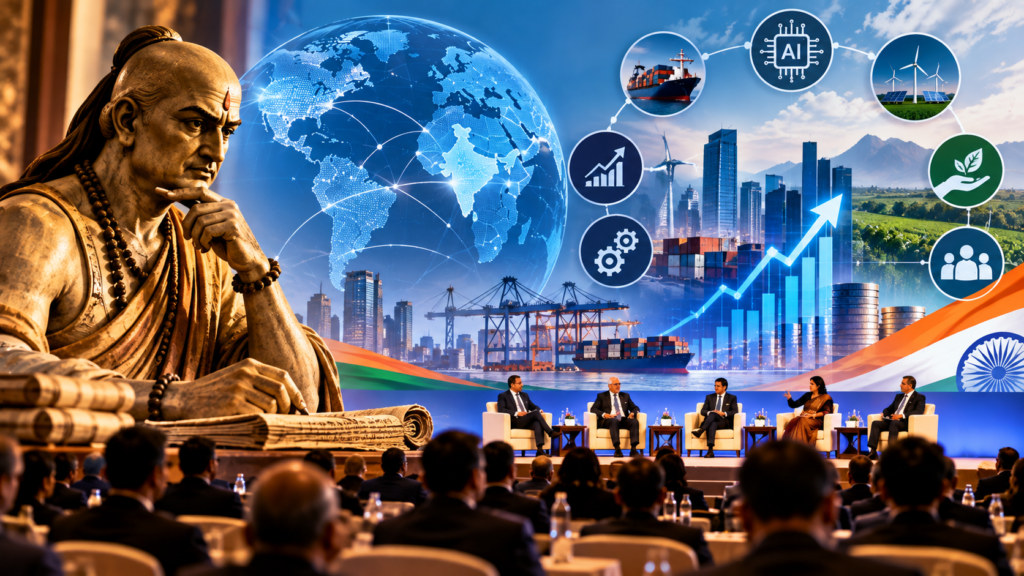
Kautilya Economic Conclave 2026: Resilience in an Age of Flux
Category: Indian Economy | International Economy | Globalisation | Economic Governance
UPSC GS: GS Paper II, GS Paper III
HPPSC: Indian Economy, International Relations, Current Affairs
Key Themes: Economic Resilience, Global Fragmentation, Trade, Supply Chains, AI, Digital Economy, Climate Resilience, Multilateral Institutions
Why in News?
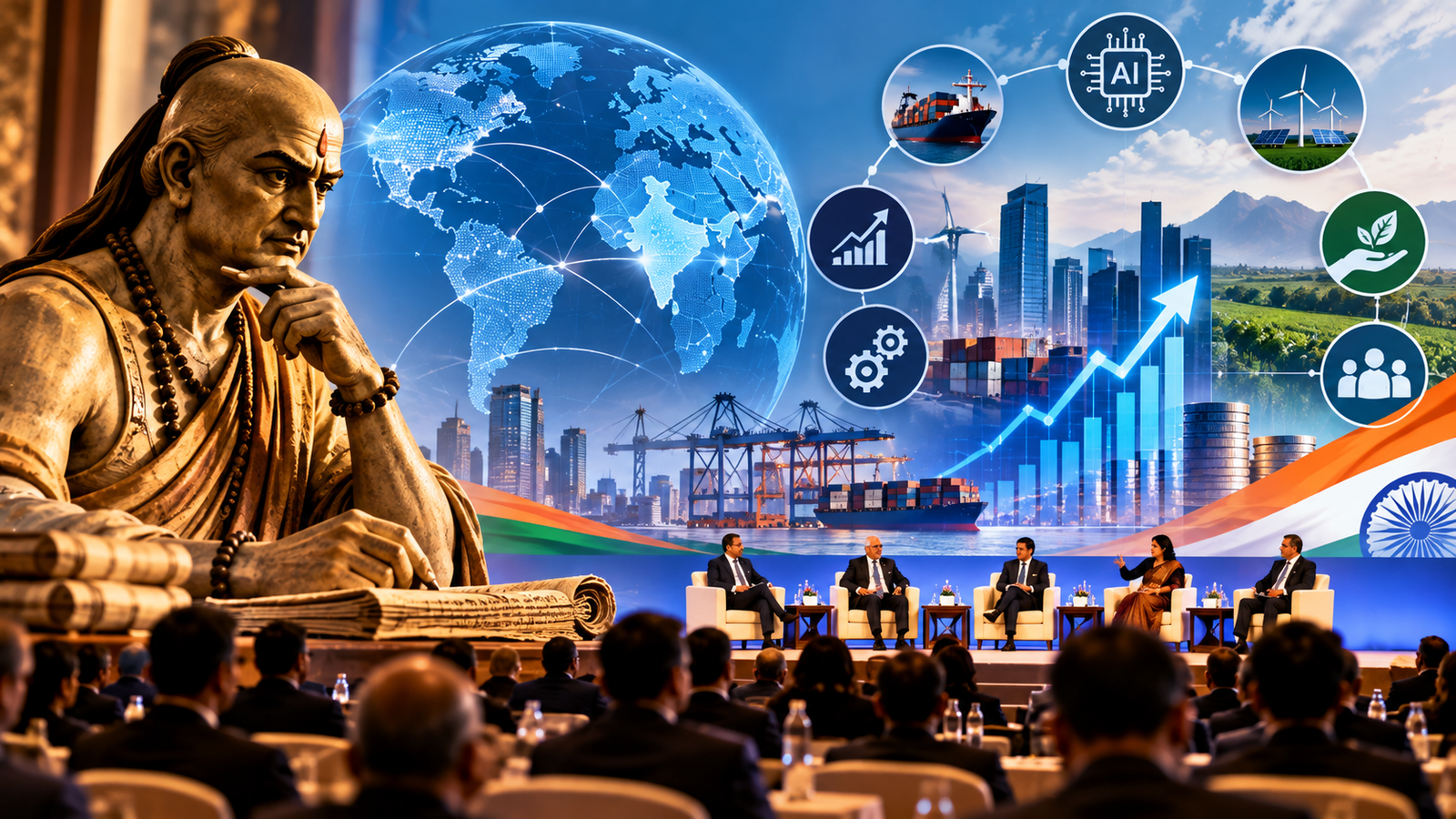
The 5th Kautilya Economic Conclave (KEC 2026) is being held in New Delhi from 3 to 5 October 2026 under the theme “Resilience in an Age of Flux.”
The conclave brings together policymakers, economists, academics, financial experts and international thought leaders to discuss major economic challenges emerging from global uncertainty, technological disruption, trade fragmentation and geopolitical risks.
The 2026 edition has participants from around 30 countries and focuses on issues such as global economic resilience, trade, investment, technology, artificial intelligence, climate, agriculture, healthcare, demography and the future of work.
What is the Kautilya Economic Conclave?
The Kautilya Economic Conclave is an economic policy dialogue platform organised by the Institute of Economic Growth (IEG) in partnership with the Ministry of Finance, Government of India.
It was first organised in 2022.
Its purpose is to bring policymakers, economists, researchers and international experts together to discuss contemporary economic and policy challenges.
Institute of Economic Growth
The Institute of Economic Growth (IEG) was established in 1952 under the leadership of economist Professor V. K. R. V. Rao.
It is a research and academic institution working on areas such as:
- Economic development
- Public policy
- Agriculture
- Labour
- Demography
- International economics
- Social development
Therefore, remember:
KEC = Institute of Economic Growth + Ministry of Finance
Theme of KEC 2026
The theme of the 2026 conclave is:
“Resilience in an Age of Flux”
What does “Resilience” mean?
Resilience means the ability of an economy or institution to absorb shocks, adapt to changing conditions and continue functioning.
English Definition:
Economic resilience is the capacity of an economy to withstand, adapt to and recover from economic shocks.
What does “Flux” mean?
Flux means a state of continuous change.
In the present global economy, countries face frequent changes because of:
- Geopolitical tensions
- Trade conflicts
- Supply-chain disruptions
- Energy price shocks
- Technological changes
- Artificial Intelligence
- Climate change
- Financial instability
- Changing patterns of globalisation
Therefore, the central question is:
How can economies remain stable and grow when the global environment is continuously changing?
Why is Economic Resilience Important?
The global economy has become highly interconnected.
For example:
Geopolitical conflict → Shipping disruption → Higher freight cost → Higher import cost → Inflationary pressure
Similarly:
Energy shock → Higher energy prices → Higher production costs → Higher inflation
This means that a shock originating in one part of the world can affect economies far away.
Economic resilience therefore requires:
- Diversified supply chains
- Strong domestic institutions
- Adequate financial buffers
- Energy security
- Technological capability
- Skilled workforce
- Social protection
- Stable macroeconomic policies
Major Issues Discussed at KEC 2026
The 2026 conclave is particularly important for UPSC because it connects several major areas of the syllabus.
Global Economic Fragmentation
What is Economic Fragmentation?
Economic fragmentation refers to the increasing division of the global economy into competing economic blocs because of geopolitical tensions, strategic rivalry and national security concerns.
English Definition:
Economic fragmentation is the process through which global trade, investment and supply chains become divided among competing geopolitical or economic blocs.
Factors behind fragmentation include:
- Geopolitical rivalry
- Trade restrictions
- Export controls
- Industrial policies
- Sanctions
- Strategic competition
- Economic security concerns
This can reduce the efficiency of globalisation.
Globalisation to Fragmentation
One important session at KEC 2026 focuses on:
“From Globalisation to Fragmentation: Rewiring Trade Networks”
The discussion examines how strategic rivalry, industrial policy and economic security are changing global trade, investment and supply chains.
Earlier model:
Globalisation → Specialisation → Global Supply Chains → Lower Costs
Emerging model:
Geopolitical Risk → Supply-chain diversification → Friend-shoring / Near-shoring → Greater resilience
Important Terms
Friend-shoring:
Moving production or supply chains towards politically trusted countries.
Near-shoring:
Moving production closer to the final market.
Supply-chain diversification:
Reducing dependence on a single country or source by developing multiple suppliers.
Supply Chain Resilience
Modern economies depend on complex international supply chains.
For example, a modern automobile may involve:
- Minerals from one country
- Semiconductor components from another
- Batteries from another
- Software from another
- Final assembly in another country
A disruption at any stage can affect production.
Supply Chain Resilience
English Definition:
Supply-chain resilience is the ability of supply networks to withstand disruptions, adapt and recover quickly.
For India, important strategies include:
- Diversifying import sources
- Developing domestic manufacturing
- Strengthening logistics
- Developing semiconductor capabilities
- Building strategic reserves
- Increasing domestic production of critical minerals
- Strengthening trade partnerships
Artificial Intelligence and the Economy
KEC 2026 also examines the impact of Artificial Intelligence (AI) and strategic technologies on economic power, labour markets, skills and regulation.
AI can increase productivity through:
- Automation
- Better decision-making
- Faster data analysis
- Improved logistics
- Precision agriculture
- Financial technology
- Healthcare applications
But it can also create challenges.
Major concerns
- Job displacement
- Skill mismatch
- Digital divide
- Data privacy
- Algorithmic bias
- Concentration of technological power
- Cybersecurity
Therefore, the policy challenge is:
AI adoption + productivity growth + employment + responsible regulation
Digital Infrastructure
Another important theme is the relationship between:
Digital Infrastructure + Finance + Artificial Intelligence
Digital infrastructure includes:
- Broadband networks
- Data centres
- Digital payment systems
- Cloud infrastructure
- Digital public infrastructure
- Communication networks
Strong digital infrastructure can reduce transaction costs and improve access to financial services.
India’s experience with Digital Public Infrastructure (DPI) provides an important case study for UPSC.
Trade and Investment
The conclave also examines changes in global trade and investment networks.
Global trade is increasingly influenced not only by economics but also by:
- National security
- Strategic technologies
- Critical minerals
- Energy security
- Industrial policy
- Geopolitical relationships
This represents an important shift from a purely efficiency-oriented approach towards a combination of:
Efficiency + Resilience + Security
Energy Shocks and Economic Stability
One of the opening discussions at KEC 2026 is titled:
“A World Priced for Risk”
It examines how energy shocks, supply-chain disruptions and the use of economic access as a strategic tool can affect macroeconomic management and investment.
India is particularly sensitive to global energy prices because it imports a substantial share of its crude oil requirements.
Therefore:
Energy security → Economic security → Macroeconomic stability
Energy security can be strengthened through:
- Renewable energy
- Nuclear power
- Strategic Petroleum Reserves
- Energy diversification
- Domestic exploration
- Green hydrogen
- Electric mobility
- Energy efficiency
Climate Resilience
Climate change is not only an environmental issue.
It is increasingly an economic issue.
Climate-related events can affect:
- Agriculture
- Food prices
- Infrastructure
- Insurance
- Labour productivity
- Water availability
- Electricity generation
- Public finances
Therefore, climate resilience requires:
Mitigation + Adaptation + Climate-resilient infrastructure
This connects KEC 2026 directly with:
UPSC GS Paper III – Environment + Economy
Agriculture and Food Systems
KEC 2026 also includes discussions on “Feeding the Future”, focusing on the resilience of agriculture and food systems in the context of climate uncertainty and trade disruptions.
India’s food-system resilience depends on:
- Crop diversification
- Irrigation
- Climate-resilient agriculture
- Storage infrastructure
- Supply-chain efficiency
- Agricultural research
- Market access
- Food processing
UPSC Connection
This topic can be connected with:
- Food security
- MSP
- Agricultural diversification
- Climate change
- PDS
- Supply chains
- Inflation
- Farmer income
Demography and Future of Work
Another important area is demographic change.
The conclave examines:
- Ageing
- Fertility
- Migration
- Labour markets
- Productivity
India currently has a large working-age population, creating a potential demographic dividend.
But demographic dividend is not automatic.
It requires:
Education + Skills + Health + Employment + Productivity
Otherwise, a large working-age population can become a challenge instead of an economic advantage.
Multilateral Development Banks
KEC 2026 also discusses the reform of Multilateral Development Banks (MDBs).
What are MDBs?
Multilateral Development Banks are international financial institutions that provide financing and technical assistance for development projects.
Examples include:
- World Bank
- Asian Development Bank
- African Development Bank
- Asian Infrastructure Investment Bank
Their importance is increasing because developing countries require huge amounts of financing for:
- Infrastructure
- Climate adaptation
- Health
- Education
- Sustainable development
Reforming MDBs is therefore linked with:
Global financial governance + Development finance + Climate finance
Asia–Africa Economic Partnerships
KEC 2026 includes a session on:
“The New Growth Corridor: Reimagining Asia-Africa Economic Partnerships”
The focus is on opportunities for greater:
- Trade
- Investment
- Infrastructure
- Development cooperation
between Asia and Africa.
This is particularly relevant to India’s broader engagement with the Global South.
Kautilya: Why the Name?
The conclave is named after Kautilya, traditionally associated with the ancient Indian text Arthashastra.
Kautilya is associated with ideas relating to:
- Statecraft
- Public finance
- Administration
- Taxation
- Trade
- Economic management
- Strategic policy
The modern Kautilya Economic Conclave uses this historical association while focusing on contemporary economic policy challenges.
Exam Point
Do not confuse:
Kautilya Economic Conclave → Modern economic policy dialogue
with
Arthashastra → Ancient Indian text on statecraft, administration and political economy
Previous Editions of KEC
| Year | Theme |
|---|---|
| 2022 | Redefining the Future |
| 2023 | Navigating a World on Fire |
| 2024 | The Indian Era |
| 2025 | Seeking Prosperity in Turbulent Times |
| 2026 | Resilience in an Age of Flux |
The progression of themes reflects changing global economic concerns.
KEC 2026 and India’s Economic Priorities
The 2026 conclave discusses how India can:
- Sustain economic growth
- Maintain macroeconomic stability
- Increase investment
- Improve productivity
- Strengthen digital infrastructure
- Respond to technological disruption
- Diversify supply chains
- Strengthen trade
- Build climate resilience
- Improve human capital
The central policy challenge is to maintain growth while improving resilience.
Economic Resilience: A Simple Framework
For UPSC, remember the following framework:
R — Reserves
Foreign exchange reserves, strategic reserves and fiscal buffers.
D — Diversification
Diversification of trade, energy and supply chains.
D — Domestic Capability
Strong domestic manufacturing, technology and productive capacity.
I — Infrastructure
Physical and digital infrastructure.
H — Human Capital
Education, health, skills and employment.
I — Institutions
Strong and credible economic institutions.
R-D-D-I-H-I = Economic Resilience
Significance for India
The Kautilya Economic Conclave is important because India’s economic strategy is increasingly shaped by a changing global environment.
India needs to balance:
Growth ↔ Stability
Globalisation ↔ Economic Security
Efficiency ↔ Resilience
Technology ↔ Regulation
Development ↔ Sustainability
Openness ↔ Strategic Autonomy
These are important policy trade-offs for the coming decade.
Challenges to Economic Resilience
India and other emerging economies face several challenges:
External Shocks
Global recessions, geopolitical conflicts and financial instability can affect domestic growth.
Energy Dependence
High dependence on imported energy exposes India to international price fluctuations.
Supply-Chain Vulnerabilities
Dependence on a limited number of countries for critical inputs can create risks.
Technological Disruption
AI and automation can create productivity gains but may also increase skill gaps.
Climate Change
Extreme weather can affect agriculture, infrastructure and livelihoods.
Human Capital
Employment generation and skill development remain essential for converting India’s demographic potential into economic gains.
Way Forward
India’s economic resilience can be strengthened through a combination of:
- Diversified global supply chains
- Strong domestic manufacturing
- Greater investment in R&D
- Critical-mineral security
- Energy diversification
- Climate-resilient infrastructure
- Skill development
- Strong social protection
- Digital public infrastructure
- Stable macroeconomic policies
- Deeper but diversified international economic partnerships
The objective should not be isolation from the global economy.
Rather, it should be:
“Resilient integration with the global economy.”
UPSC Prelims Perspective
Important Facts
- 5th Kautilya Economic Conclave: 2026
- Dates: 3–5 October 2026
- Venue: New Delhi
- Theme: Resilience in an Age of Flux
- Organised by: Institute of Economic Growth
- In partnership with: Ministry of Finance
- First edition: 2022
- IEG established: 1952
- Founder associated with IEG: Professor V. K. R. V. Rao
Prelims Practice Question
Q. With reference to the Kautilya Economic Conclave, consider the following statements:
- It is organised by the Institute of Economic Growth in partnership with the Ministry of Finance.
- Its first edition was held in 2022.
- The 2026 edition focuses on economic resilience amid global uncertainty and fragmentation.
Which of the statements given above is/are correct?
Answer: 1, 2 and 3
UPSC Mains Connection
GS Paper II
International Relations
- Global economic governance
- Global South
- International economic cooperation
- Multilateral institutions
- India’s global partnerships
GS Paper III
Indian Economy
- Economic growth
- Macroeconomic stability
- Investment
- Trade
- Supply chains
- Digital economy
- AI and productivity
- Energy security
- Climate resilience
Essay
Possible themes:
“Economic resilience is the new foundation of sustainable globalisation.”
“In an uncertain world, resilience matters as much as economic efficiency.”
Mains Answer Framework
Question
“Global economic fragmentation has increased the importance of economic resilience. Discuss the major challenges and suggest measures for India.”
Introduction
Global economic integration has created efficiency and growth but has also increased the transmission of geopolitical, financial, energy and supply-chain shocks.
Body
Challenges
- Geopolitical tensions
- Trade restrictions
- Energy shocks
- Supply-chain disruptions
- Climate risks
- Technological disruption
- Financial volatility
India’s response
- Supply-chain diversification
- Domestic manufacturing
- Critical-mineral strategy
- Renewable energy
- Digital infrastructure
- Skill development
- Strong macroeconomic management
- Diversified international partnerships
Conclusion
India’s objective should be to remain globally integrated while developing sufficient domestic capabilities and diversified partnerships to withstand external shocks.
Important Keywords
Economic Resilience: Ability of an economy to withstand and recover from shocks.
Economic Fragmentation: Division of global economic activity into competing blocs.
Supply-Chain Resilience: Ability of supply networks to withstand and recover from disruptions.
Friend-shoring: Shifting supply chains towards trusted geopolitical partners.
Near-shoring: Moving production closer to the final market.
Macroeconomic Stability: Stable conditions relating to growth, inflation, employment, fiscal position and external balance.
Strategic Autonomy: Ability of a country to make independent strategic decisions while maintaining international partnerships.
Digital Public Infrastructure: Shared digital systems that enable large-scale delivery of public and private services.
Multilateral Development Banks: International institutions that provide finance and support for development.
One-Page Revision
KEC 2026
→ 5th edition
→ 3–5 October 2026
→ New Delhi
→ Theme: Resilience in an Age of Flux
→ IEG + Ministry of Finance
→ First held in 2022
Major Themes
→ Global fragmentation
→ Trade and supply chains
→ AI and technology
→ Digital infrastructure
→ Energy security
→ Climate resilience
→ Agriculture
→ Demography
→ Future of work
→ MDB reform
→ Asia–Africa economic partnerships
Core UPSC Idea
Global uncertainty → External shocks → Need for resilience → Diversification + Domestic capability + Strong institutions + International cooperation
Memory Trick
Remember “R-T-A-C-D”
R — Resilience
T — Trade & supply chains
A — AI & technology
C — Climate & agriculture
D — Demography & development finance
These five areas cover a large part of KEC 2026’s UPSC relevance.
Conclusion
The Kautilya Economic Conclave 2026 is important for UPSC not simply as an event but as a window into the major economic questions facing India and the world.
The central issue is how economies can maintain growth, openness and investment while dealing with geopolitical uncertainty, supply-chain disruptions, technological transformation, climate risks and changing global trade patterns.
For India, the emerging policy approach is not complete withdrawal from globalisation but resilient integration — strengthening domestic capabilities while remaining connected to global markets, technology, capital and institutions.
The theme “Resilience in an Age of Flux” therefore provides a useful framework for understanding India’s economic strategy in an increasingly uncertain global environment.