
BitChat Controversy Explained: Mesh Networks, GitHub, IT Act, Article 19 & the Constitutional Debate on Digital Freedom
Why is it in News?
The Ministry of Home Affairs (MHA) has directed GitHub to remove repositories hosting BitChat, an open-source decentralized messaging application. The government argues that BitChat’s serverless and peer-to-peer architecture could make lawful interception difficult and may allow anonymous communication during internet shutdowns, riots, or other public order situations.
The issue has triggered a larger debate over national security, digital privacy, freedom of speech, open-source software, intermediary liability, and constitutional rights. It also raises important questions about the powers of the government under the Information Technology Act, 2000, and the limits imposed by the Constitution.
What is BitChat?
BitChat is an open-source, decentralized peer-to-peer (P2P) messaging application that communicates through Bluetooth Mesh Networks instead of the internet.
Unlike conventional messaging applications, BitChat does not require:
- Internet connectivity
- Mobile data
- Wi-Fi
- Cellular networks
- Mobile number registration
- Central servers
Instead, messages travel directly from one nearby device to another using Bluetooth technology.
In Simple Words
BitChat is a messaging application that allows nearby devices to exchange encrypted messages directly through Bluetooth without relying on the internet or a central server.
How Do Traditional Messaging Apps Work?
Most messaging applications such as WhatsApp, Telegram and Facebook Messenger depend on central servers.
Communication Flow
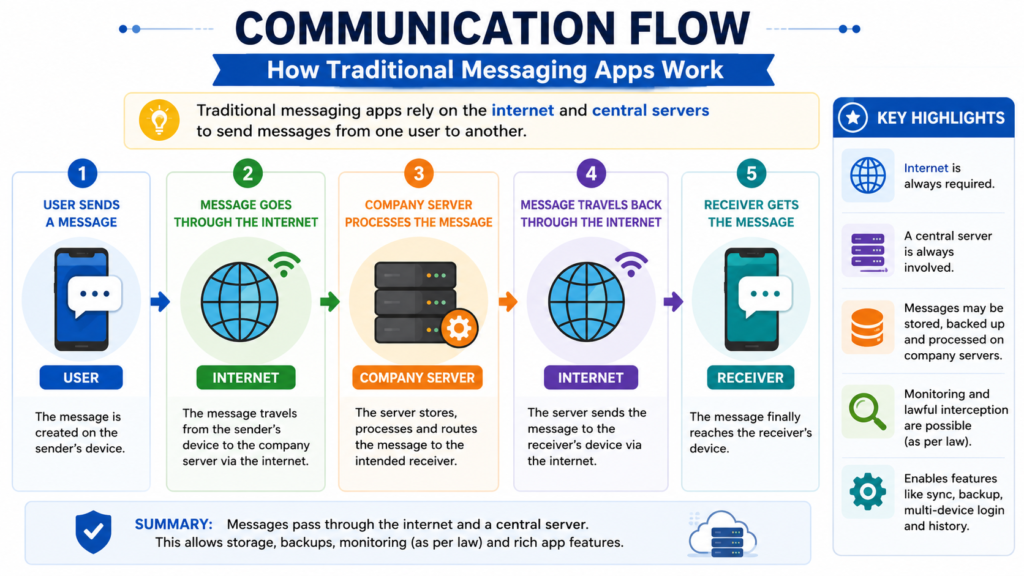
The server stores, processes and forwards messages between users.
Because communication passes through company servers, service providers can maintain records, perform backups and comply with lawful requests from authorities wherever applicable under law.
What is a Server?
A server is a powerful computer that stores, processes and distributes information over a network.
It acts as the central point through which users exchange data.
Examples
- Gmail stores emails on Google’s servers.
- Instagram stores photos on Meta’s servers.
- WhatsApp routes communication through Meta’s infrastructure.
What is a Centralized Network?
A centralized network is one where communication depends on a single central authority or server.
Characteristics
- Central control
- Easier monitoring
- Easier backups
- Easier regulation
- Easier lawful interception
Examples
- Gmail
How is BitChat Different?
BitChat completely changes this architecture.
Instead of sending messages through company servers, every user’s phone communicates directly with nearby devices.
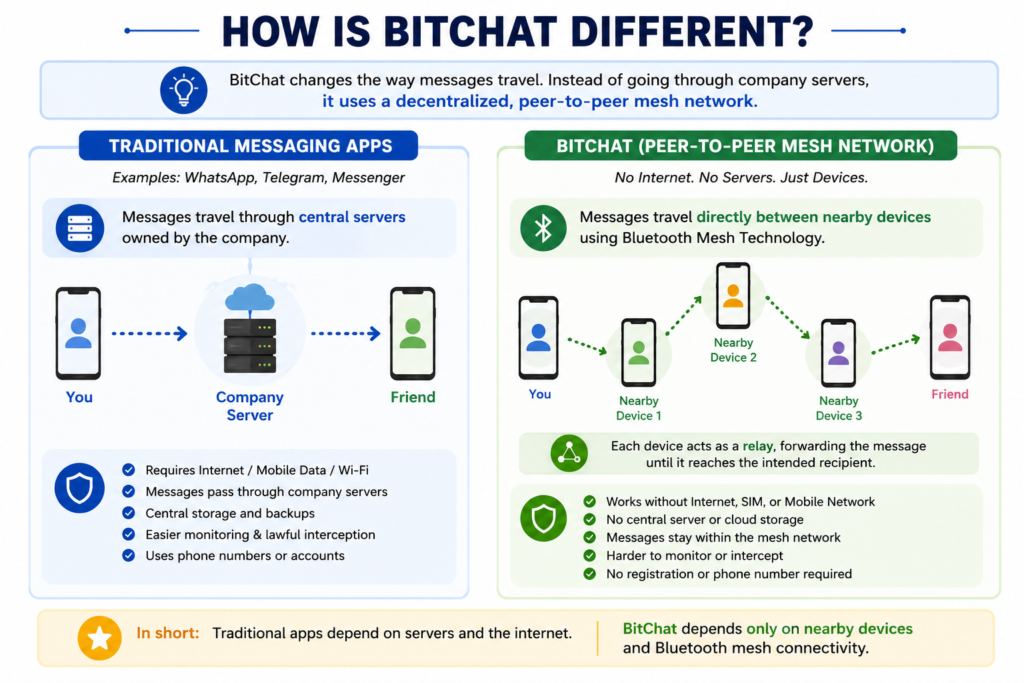
Each phone forwards the encrypted message until it reaches the destination.
This architecture eliminates the need for any central infrastructure.
Understanding Peer-to-Peer (P2P) Communication
A Peer-to-Peer (P2P) network allows devices to communicate directly without a central intermediary.
Every device functions both as:
- Sender
- Receiver
- Relay
Unlike centralized systems, there is no single authority controlling communication.
Advantages
- No central point of failure
- Greater resilience
- Better connectivity during network disruptions
What is a Mesh Network?
A Mesh Network is a communication system in which every connected device helps forward data to other nearby devices.
Instead of relying on one communication tower or server, every phone becomes a relay point.
Key Features
- Self-organizing
- Self-healing
- Multi-hop communication
- Distributed architecture
- No central infrastructure
Multi-Hop Communication
BitChat messages move through multiple nearby devices before reaching the intended recipient.
For example,
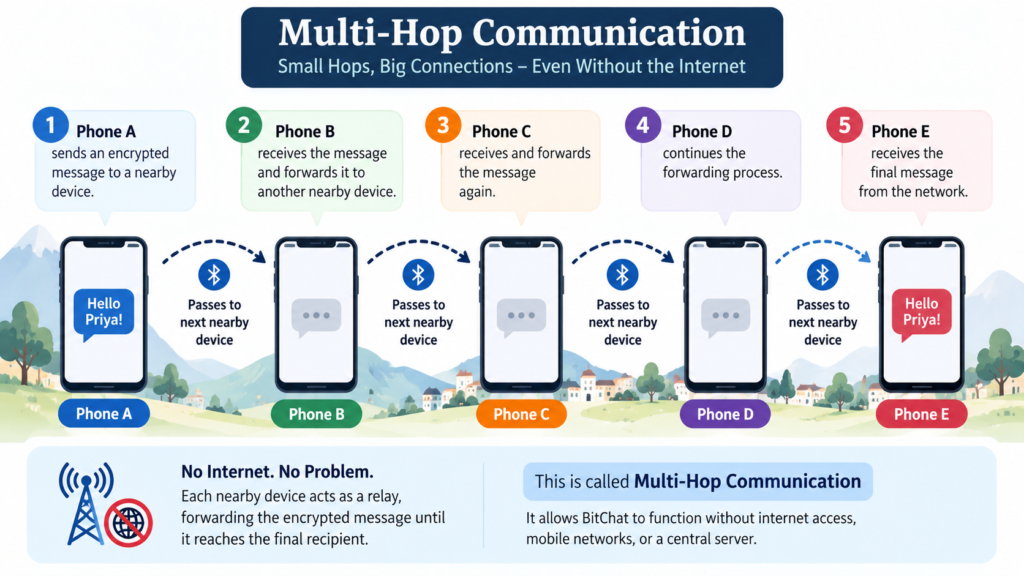
Each intermediate phone forwards the encrypted message.
This process is known as Multi-Hop Communication.
Why Doesn’t BitChat Need the Internet?
Traditional messaging applications require internet connectivity because messages pass through company servers.
BitChat bypasses this requirement by using Bluetooth Mesh Networking, allowing nearby devices to communicate directly.
As a result, BitChat may continue functioning even during:
- Internet shutdowns
- Mobile network failures
- Natural disasters
- Communication blackouts
What Does Open Source Mean?
BitChat is an open-source application.
This means its source code is publicly available.
Anyone can:
- Study the code
- Modify it
- Improve it
- Build new versions
Examples of Open-Source Software
- Linux
- Android Open Source Project (AOSP)
- Mozilla Firefox
- VLC Media Player
What is Source Code?
Source code is the collection of programming instructions written by software developers.
It acts as the blueprint of a software application and tells computers exactly how the program should function.
Why is BitChat Controversial?
The Government believes BitChat’s decentralized architecture presents several security challenges.
Since there is:
- No central server
- No user registration
- No centralized database
- No message backups
law enforcement agencies may find it more difficult to investigate unlawful communications.
The concern becomes particularly significant during:
- Terrorist incidents
- Riots
- Organized crime
- Internet shutdowns
- Public order emergencies
Government’s Concerns
The Ministry of Home Affairs believes BitChat could:
- Circumvent internet shutdowns
- Make lawful interception difficult
- Enable anonymous communication
- Complicate cybercrime investigations
- Be misused by anti-national or criminal groups
It is important to note that these concerns relate to the potential misuse of the technology rather than its ordinary lawful use.
What is GitHub?
GitHub is the world’s largest platform for hosting software source code.
It allows developers to:
- Upload projects
- Share software
- Collaborate globally
- Improve open-source applications
GitHub is owned by Microsoft.
What is a Repository?
A repository is a digital storage location where software developers maintain:
- Source code
- Documentation
- Updates
- Installation files
- Project history
BitChat’s source code is available through such repositories.
Why Did the Government Ask GitHub to Remove BitChat Repositories?
Since BitChat is open source, anyone can download its code and create new versions.
The government believes that limiting access to the repositories could reduce the widespread availability of the software.
However, this has also generated legal debates regarding freedom of expression and open-source software development.
Understanding Anonymous Communication
BitChat does not require users to register using a mobile number or central account.
As a result, identifying the sender of a message may become more difficult compared to conventional messaging platforms.
Anonymous communication has both legitimate and illegitimate uses.
Legitimate Uses
- Journalists
- Human rights defenders
- Disaster management teams
- Researchers
- Whistle-blowers
Potential Misuse
- Terrorism
- Organized crime
- Riots
- Criminal conspiracies
Technology itself remains neutral; its impact depends on how it is used.
What is Lawful Interception?
Lawful Interception refers to the legally authorized monitoring of communications by government agencies for purposes such as:
- National security
- Counter-terrorism
- Organized crime investigations
- Public safety
Traditional messaging services provide a centralized point through which legally authorized interception may be carried out.
BitChat’s decentralized architecture makes this process significantly more challenging.
What is an Internet Shutdown?
An Internet Shutdown refers to the temporary suspension of internet services by the government in a particular area.
Such measures are generally imposed during situations involving:
- Public order
- Communal violence
- Terrorism
- National security emergencies
Since BitChat functions through Bluetooth rather than the internet, it may continue to operate locally during such shutdowns.
Constitutional Issues Involved
The BitChat controversy is not merely a technological issue.
It directly involves constitutional rights and state powers.
The central constitutional question is:
Can the Government restrict a communication technology because it might be misused in the future?
The answer requires balancing individual liberty with collective security.
Article 19(1)(a): Freedom of Speech and Expression
Article 19(1)(a) guarantees every citizen the Freedom of Speech and Expression.
In today’s digital age, this protection extends to:
- Online communication
- Digital platforms
- Messaging applications
- Social media
- Electronic publication
Therefore, access to communication technologies forms an important aspect of free expression.
Article 19(2): Reasonable Restrictions
Freedom of speech is not absolute.
Article 19(2) permits the State to impose reasonable restrictions on grounds such as:
- Sovereignty and Integrity of India
- Security of the State
- Public Order
- Friendly Relations with Foreign States
- Decency
- Morality
- Contempt of Court
- Defamation
- Incitement to an Offence
The Government argues that restrictions on BitChat may fall within these constitutional grounds.
Information Technology Act, 2000
The Information Technology Act, 2000 is India’s principal legislation governing cyberspace.
Its objectives include:
- Recognition of electronic records
- Regulation of digital transactions
- Prevention of cybercrime
- Regulation of intermediaries
- Online governance
Section 69A: Government’s Blocking Powers
Section 69A empowers the Central Government to block public access to online information on grounds including:
- Security of the State
- Sovereignty and Integrity of India
- Defence of India
- Friendly Relations with Foreign States
- Public Order
- Prevention of certain offences
Blocking orders must follow the legal procedure prescribed under the Information Technology (Procedure and Safeguards for Blocking for Access of Information by Public) Rules, 2009, including procedural safeguards such as recorded reasons and review mechanisms.
Section 79: Safe Harbour Protection
Section 79 grants Safe Harbour Protection to intermediaries.
This means online platforms are generally not liable for third-party content uploaded by users, provided they comply with applicable legal obligations.
Platforms covered include:
- GitHub
- YouTube
Who is an Intermediary?
An intermediary is an entity that stores, transmits or hosts information on behalf of users without necessarily creating that information.
GitHub functions as an intermediary because developers upload software repositories to its platform.
Conditional Immunity under Section 79
Safe Harbour protection is not absolute.
Under Section 79(3)(b), an intermediary may lose its protection if, after receiving a valid legal notice or government direction under the applicable legal framework, it fails to act as required by law.
Section 69A vs Section 79
Both provisions deal with digital regulation but serve different purposes.
| Section 69A | Section 79 |
|---|---|
| Empowers the Government to block public access to online information | Provides safe harbour protection to intermediaries |
| Operates through the Blocking Rules, 2009 with procedural safeguards | Governs intermediary liability and due diligence obligations |
| Focuses on blocking online information | Focuses on intermediary responsibility |
Some legal experts argue that using Section 79 alone for a complete application takedown may raise procedural questions because Section 69A contains a more detailed blocking mechanism.
Landmark Judgment: Shreya Singhal v. Union of India (2015)
In this landmark judgment, the Supreme Court:
- Struck down Section 66A of the IT Act as unconstitutional.
- Held that vague restrictions create a chilling effect on free speech.
- Upheld Section 69A, recognizing that it contains procedural safeguards and review mechanisms.
The judgment remains the cornerstone of online free speech jurisprudence in India.
Doctrine of Proportionality
Whenever the Government restricts Fundamental Rights, courts apply the Doctrine of Proportionality.
The restriction must:
- Pursue a legitimate objective
- Be suitable to achieve that objective
- Be necessary
- Be the least restrictive measure available
- Maintain a balance between rights and public interest
Anuradha Bhasin v. Union of India (2020)
This landmark judgment dealt with internet shutdowns in Jammu & Kashmir.
The Supreme Court held that restrictions on internet access must be:
- Lawful
- Necessary
- Temporary
- Proportionate
- Subject to periodic review
The judgment reinforced that digital restrictions cannot be indefinite or arbitrary.
The Constitutional Debate
Government’s Perspective
The Government argues that BitChat could:
- Circumvent internet shutdowns
- Hamper lawful interception
- Be exploited by terrorists or criminal groups
- Affect public order and national security
Therefore, preventive regulatory action may be justified.
Digital Rights Perspective
Many legal experts argue that:
- BitChat is merely software.
- Open-source code has legitimate educational and technological uses.
- Restricting software because of potential misuse may affect innovation and freedom of expression.
- Illegal activities should be targeted rather than technology itself.
Way Forward
India’s digital governance framework must strike a careful balance between innovation and security.
Key priorities include:
- Strengthening cyber security while respecting constitutional freedoms.
- Ensuring transparency and procedural fairness in takedown decisions.
- Applying the doctrine of proportionality in all digital restrictions.
- Protecting lawful open-source innovation.
- Enhancing judicial oversight over executive actions affecting digital rights.
Conclusion
The BitChat controversy is far more than a debate over a messaging application. It represents the growing constitutional challenge of regulating emerging technologies in a democratic society. While the State has a legitimate responsibility to protect national security and maintain public order, such measures must remain consistent with Article 19, the Information Technology Act, 2000, and the constitutional principles laid down by the Supreme Court in Shreya Singhal and Anuradha Bhasin.
As decentralized technologies become more common, India’s digital governance framework will need to ensure that security, innovation, privacy, and constitutional freedoms evolve together rather than at the expense of one another. This balanced approach is essential for safeguarding both the nation’s security interests and the democratic rights of its citizens.