75 Years of the First Constitutional Amendment: The Amendment That Reshaped India’s Democracy
Why is it in News?
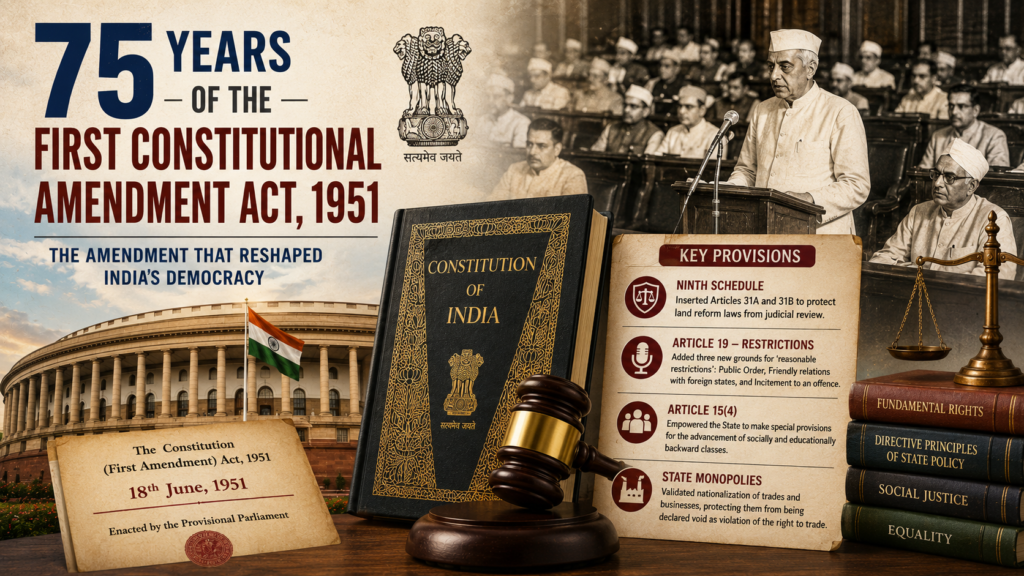
18 June 2026 marks the 75th anniversary of the First Constitutional Amendment Act, 1951, one of the most significant constitutional changes in India’s history. Signed by India’s first President, Rajendra Prasad, the amendment fundamentally altered the relationship between Fundamental Rights, social justice, land reforms, and state power.
Often described by constitutional scholars as a “Second Constitution,” the amendment laid the foundation for many legal and political debates that continue to shape India today.
For UPSC aspirants, this topic is important under Indian Polity, Constitutional Amendments, Fundamental Rights, Judiciary, Land Reforms, and Social Justice.
What Was the First Constitutional Amendment Act, 1951?
The First Constitutional Amendment Act, 1951 was the first major amendment made to the Constitution of India after its adoption in 1950.
The amendment was enacted by the Provisional Parliament under the leadership of Prime Minister Jawaharlal Nehru.
Its primary objective was to overcome judicial obstacles to land reforms, affirmative action policies, and government regulation of speech and economic activities.
Historical Background
Soon after the Constitution came into force, several government policies faced legal challenges in courts.
These included:
- Land reform laws
- Zamindari abolition measures
- Reservation policies
- Restrictions on speech
The judiciary struck down or questioned several laws as violations of Fundamental Rights.
This created a conflict between:
Fundamental Rights
and
Directive Principles of State Policy (DPSPs)
which aimed to promote social and economic justice.
Why Was the Amendment Needed?
The government believed that rigid protection of individual rights was slowing down socio-economic reforms.
The amendment sought to:
- Protect land reform legislation.
- Promote social equality.
- Enable affirmative action.
- Clarify restrictions on free speech.
- Support state-led economic development.
Major Provisions of the First Constitutional Amendment
1. Introduction of Articles 31A and 31B
The amendment inserted:
Article 31A
and
Article 31B
to protect land reform measures from constitutional challenges.
Objective
The government wanted to abolish:
- Zamindari system
- Feudal land ownership
- Concentration of land
without constant judicial intervention.
2. Creation of the Ninth Schedule
One of the most significant features of the amendment was the introduction of the:
Ninth Schedule
through Article 31B.
Purpose
The Ninth Schedule was designed to protect certain laws from being challenged in courts on the ground that they violated Fundamental Rights.
Initially, it primarily included:
- Land reform laws
- Agrarian redistribution legislation
Significance
The Ninth Schedule became a powerful constitutional tool allowing governments to shield laws from judicial scrutiny.
3. Changes to Freedom of Speech (Article 19)
The amendment expanded the grounds on which the government could impose reasonable restrictions on freedom of speech and expression.
Three important grounds were added:
Public Order
Friendly Relations with Foreign States
Incitement to an Offence
Why Was This Done?
Several court judgments had interpreted free speech very broadly.
The government argued that additional safeguards were necessary to maintain:
- Law and order
- National stability
- Diplomatic relations
4. Affirmative Action and Article 15(4)
The amendment inserted:
Article 15(4)
which empowered the State to make special provisions for:
- Socially backward classes
- Educationally backward classes
- Scheduled Castes
- Scheduled Tribes
Triggering Case
The amendment was enacted following the:
State of Madras v. Champakam Dorairajan
judgment.
The Supreme Court had struck down caste-based reservations in educational institutions.
The government responded by amending the Constitution.
Long-Term Impact
Article 15(4) became the constitutional foundation for India’s reservation policy.
5. State Monopolies
The amendment also protected state-led economic activities.
It enabled governments to:
- Nationalize industries.
- Establish public monopolies.
- Restrict private participation in certain sectors.
without violating the right to trade.
Important Cases Linked to the Amendment
Shankari Prasad Case (1951)
Shankari Prasad v. Union of India
The Supreme Court held that:
- Parliament could amend Fundamental Rights.
- Constitutional amendments were not “law” under Article 13.
This judgment validated the First Amendment.
Kesavananda Bharati Case (1973)
Kesavananda Bharati v. State of Kerala
A landmark judgment that introduced the:
Basic Structure Doctrine
The Court ruled that:
- Parliament can amend the Constitution.
- Parliament cannot destroy its basic structure.
I.R. Coelho Case (2007)
I.R. Coelho v. State of Tamil Nadu
The Supreme Court held that:
- Laws inserted into the Ninth Schedule after 24 April 1973 are subject to judicial review.
- Such laws can be struck down if they violate the Basic Structure of the Constitution.
Evolution of the Ninth Schedule
The Ninth Schedule’s constitutional journey can be understood in three phases:
1951 – Complete Protection
The First Amendment created a near-total shield from judicial review.
1973 – Basic Structure Doctrine
Judicial scrutiny expanded after Kesavananda Bharati.
2007 – I.R. Coelho Judgment
The Ninth Schedule became subject to constitutional review.
Why is the First Amendment Called a “Second Constitution”?
Many constitutional scholars describe it as a “Second Constitution” because it fundamentally altered:
- Fundamental Rights
- Judicial review
- Social justice policies
- Property rights
- Free speech framework
Few amendments have had such a wide-ranging impact on India’s constitutional order.
Supporters’ Perspective
Supporters argue that the amendment:
Enabled Land Reforms
Helped dismantle feudal land ownership structures.
Promoted Social Justice
Created the constitutional basis for reservations.
Strengthened Welfare Policies
Allowed governments to pursue redistributive measures.
Balanced Rights and Development
Facilitated socio-economic transformation.
Critics’ Perspective
Critics contend that the amendment:
Weakened Free Speech
Expanded state control over expression.
Reduced Judicial Oversight
Through the Ninth Schedule mechanism.
Increased State Power
At the expense of individual rights.
Set a Precedent
For future constitutional restrictions.
Relevance Today
Even after 75 years, debates arising from the First Amendment remain highly relevant.
Current discussions on:
- Reservation policies
- Judicial review
- Freedom of speech
- Land rights
- Constitutional amendments
continue to trace their roots back to the changes introduced in 1951.
Way Forward
The First Amendment demonstrates the ongoing challenge of balancing:
Individual Liberties
with
Social Justice and Development
Modern constitutional governance requires maintaining this balance while protecting democratic values and constitutional morality.
Significance for UPSC
This topic is crucial for:
- Fundamental Rights
- Constitutional Amendments
- Judicial Review
- Basic Structure Doctrine
- Social Justice
- Land Reforms
- Parliament–Judiciary Relations
UPSC Prelims Focus
Important Facts
| Feature | Details |
|---|---|
| Amendment | First Constitutional Amendment Act |
| Year | 1951 |
| Prime Minister | Jawaharlal Nehru |
| President | Rajendra Prasad |
| Introduced | Articles 31A & 31B |
| Created | Ninth Schedule |
| Added | Article 15(4) |
| Modified | Article 19 |
Previous Year Question (UPSC Prelims 2019)
The Ninth Schedule was introduced during the prime ministership of:
(a) Jawaharlal Nehru
(b) Lal Bahadur Shastri
(c) Indira Gandhi
(d) Morarji Desai
Correct Answer:
(a) Jawaharlal Nehru
Exam Keywords
- First Constitutional Amendment Act, 1951
- Ninth Schedule
- Article 31A
- Article 31B
- Article 15(4)
- Article 19
- Land Reforms
- Judicial Review
- Basic Structure Doctrine
- Kesavananda Bharati
- I.R. Coelho
- Shankari Prasad
- Reservation Policy
- Constitutional Amendments
UPSC Syllabus Reference
GS Paper II – Indian Constitution, Constitutional Amendments, Parliament, Judiciary, Fundamental Rights, and Social Justice.