
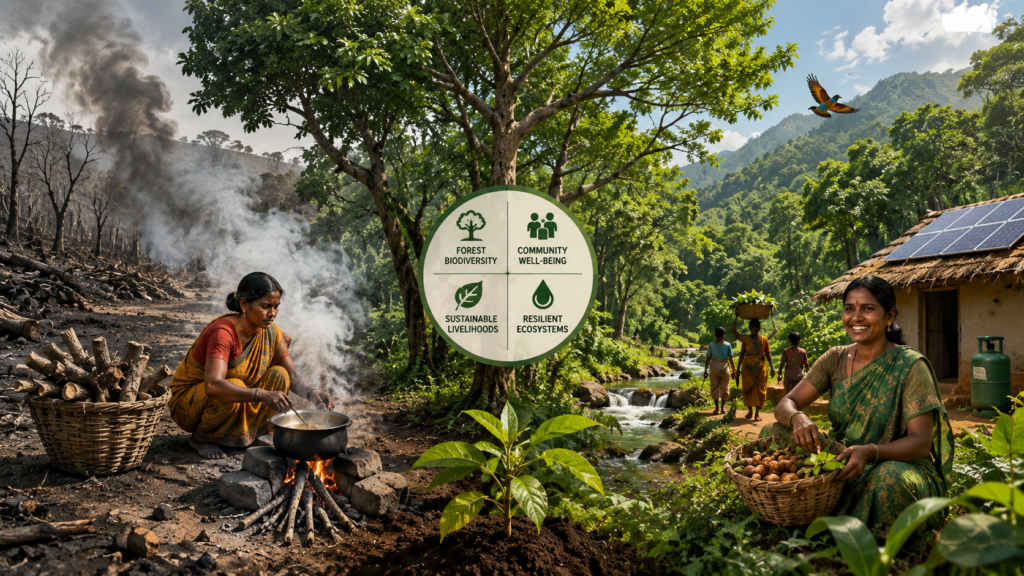
India Can Save Its Forests by Winning the War on Poverty
Why is it in News?
A recent study published in the scientific journal Nature Sustainability has highlighted a crucial connection between forest conservation and human development. The study found that forests located near poor communities heavily dependent on fuelwood tend to have lower tree species diversity, indicating that biodiversity conservation cannot succeed without addressing rural poverty, energy insecurity, and livelihood challenges.
The findings reinforce a growing global consensus that environmental protection and socio-economic development must progress together rather than being treated as separate policy goals.
For UPSC aspirants, this topic is important under Environment, Biodiversity, Sustainable Development, Forest Conservation, Poverty Alleviation, and Climate Change.
Understanding Forest Biodiversity
Forest biodiversity refers to the variety of:
- Plant species
- Animal species
- Microorganisms
- Genetic resources
- Ecosystems
present within forest landscapes.
Forests are among the most biologically rich ecosystems on Earth.
Why Forest Biodiversity Matters
Forests provide numerous ecological and economic benefits.
They:
- Regulate climate
- Conserve soil
- Protect water resources
- Support wildlife
- Store carbon
- Sustain livelihoods
Globally, forests host:
More than 80% of terrestrial species
making them indispensable for biodiversity conservation.
Forests and Livelihoods: An Inseparable Relationship
Forests are not merely environmental assets.
For millions of people, they are a source of daily survival.
Globally, more than:
1.6 Billion People
depend directly or indirectly on forests for their livelihoods.
This relationship is particularly significant in developing countries such as India.
Forest Governance in India
Constitutional Status
Forests fall under the:
Concurrent List
following the:
42nd Constitutional Amendment Act, 1976
This allows both the Union and State Governments to legislate on forest-related matters.
Traditional Conservation Model
Historically, forest management often followed the:
Fortress Conservation Model
Under this approach:
- Human activities were restricted.
- Local communities were excluded.
- Conservation areas were isolated from human use.
The objective was to protect biodiversity through strict protection measures.
However, this approach often ignored the livelihood needs of forest-dependent populations.
How Biodiversity Supports Livelihoods
Forest biodiversity plays a direct role in supporting economic and social resilience.
Non-Timber Forest Products (NTFPs)
One of the most important livelihood contributions comes from:
Non-Timber Forest Products (NTFPs)
These include:
- Medicinal plants
- Bamboo
- Honey
- Wild fruits
- Nuts
- Resins
- Mushrooms
For many rural households, NTFPs provide an essential source of income.
Economic Importance
In many forest-fringe regions:
Up to 40% of Household Income
can come from forest-based resources.
These resources become particularly important during:
- Crop failures
- Droughts
- Economic distress
Ecosystem Services for Agriculture
Healthy forests support agriculture in multiple ways.
Water Security
Forests regulate:
- Groundwater recharge
- Watershed functions
- Stream flows
This ensures a stable water supply for farming.
Soil Protection
Forests help:
- Prevent soil erosion
- Improve soil fertility
- Reduce land degradation
Pollination Services
Many wild pollinators depend on forest ecosystems.
These pollinators enhance:
- Crop productivity
- Agricultural resilience
Natural Pest Control
Forest biodiversity supports predators that naturally control agricultural pests.
This reduces dependence on chemical pesticides.
Forests as Food Security Safety Nets
During periods of economic or climatic stress, forests provide:
- Wild fruits
- Edible leaves
- Tubers
- Mushrooms
- Medicinal resources
These resources help vulnerable communities cope with food shortages.
Thus, forests function as:
Natural Safety Nets
for millions of people.
The Forest–Poverty Nexus
The recent study highlights a critical challenge.
Where poverty levels remain high, communities often rely heavily on forests for:
- Fuelwood
- Charcoal
- Grazing
- Timber
Without affordable alternatives, extraction pressures increase.
This can lead to:
- Forest degradation
- Biodiversity loss
- Habitat fragmentation
Energy Poverty and Forest Degradation
One of the biggest drivers of forest degradation is:
Energy Poverty
Many rural households continue to depend on:
- Fuelwood
- Biomass
- Charcoal
for cooking and heating.
Consequences
Excessive fuelwood collection leads to:
- Reduced tree density
- Loss of species diversity
- Habitat degradation
As a result, forests become less resilient.
Climate Change as a Multiplier
Climate change is worsening existing pressures on forests.
Rising Temperatures
Heatwaves stress forest ecosystems.
Droughts
Prolonged droughts reduce regeneration capacity.
Wildfires
Increasing temperatures increase the frequency and intensity of forest fires.
Changing Species Composition
Climate stress alters:
- Forest structure
- Species distribution
- Ecosystem functioning
Challenges of Exclusionary Conservation
Strict protection policies can sometimes create unintended consequences.
Community Displacement
Historically, some protected areas led to:
- Displacement of indigenous communities.
- Loss of traditional livelihoods.
Livelihood Conflicts
When communities lose access to forest resources without alternative income opportunities, tensions may emerge.
Illegal Extraction
Exclusion without livelihood support can encourage:
- Illegal logging
- Poaching
- Encroachment
Forest Rights and Community Participation
India has increasingly moved toward community-based conservation approaches.
An important step was the:
Scheduled Tribes and Other Traditional Forest Dwellers (Recognition of Forest Rights) Act, 2006
commonly known as the Forest Rights Act (FRA).
Objectives of FRA
The Act seeks to:
- Recognize traditional forest rights.
- Empower local communities.
- Improve conservation outcomes.
- Promote participatory governance.
Role of Gram Sabha
Under FRA:
Gram Sabha
plays a central role in identifying and recognizing community and individual forest rights.
Why Poverty Reduction is Essential for Forest Conservation
The central lesson from recent research is clear:
Forest Conservation Cannot Succeed in Isolation
Communities struggling for survival often have little choice but to depend heavily on natural resources.
Reducing poverty can:
- Lower pressure on forests.
- Improve biodiversity outcomes.
- Strengthen conservation efforts.
Integrated Solutions
A sustainable approach requires simultaneous action in multiple areas.
Clean Energy Access
Expand access to:
- LPG
- Biogas
- Solar energy
- Clean cooking technologies
to reduce fuelwood dependence.
Alternative Livelihoods
Promote:
- Eco-tourism
- Agroforestry
- Sustainable NTFP enterprises
- Green jobs
Community-Based Conservation
Involve local communities as partners rather than treating them as threats.
Climate-Resilient Forest Management
Strengthen adaptation strategies to cope with:
- Heat stress
- Droughts
- Wildfires
Strengthening Forest Governance
Improve:
- Monitoring
- Community institutions
- Sustainable harvesting practices
Way Forward
India’s environmental future depends on recognizing that conservation and development are not competing goals.
Policies should focus on:
Protecting Forests
while simultaneously
Improving Human Well-Being
By reducing poverty, improving energy access, securing community rights, and creating sustainable livelihood opportunities, India can strengthen both biodiversity conservation and rural development.
The path to saving forests ultimately lies not only in protecting trees but also in improving the lives of the people who depend upon them.
UPSC Prelims Focus
Important Facts
| Feature | Details |
|---|---|
| Forests in Constitution | Concurrent List |
| Shifted by | 42nd Constitutional Amendment (1976) |
| Key Rights Law | Forest Rights Act, 2006 |
| Major Livelihood Source | NTFPs |
| Global Forest Dependence | ~1.6 Billion People |
| Forest Biodiversity | >80% of Terrestrial Species |
Previous Year Question (UPSC Prelims 2019)
Consider the following statements:
- Gram Sabha is the authority to initiate the process of determining Individual Forest Rights and Community Forest Rights under the Forest Rights Act, 2006.
- Under the Forest Conservation Act, 1980, State Governments can declare Reserved Forests without prior approval of the Central Government.
Correct Answer:
(a) 1 only
Exam Keywords
- Forest Biodiversity
- Forest Rights Act
- NTFPs
- Sustainable Livelihoods
- Energy Poverty
- Community-Based Conservation
- Biodiversity Conservation
- Forest Governance
- Climate Change
- Ecosystem Services
- Rural Development
- Gram Sabha
- Environmental Sustainability
UPSC Syllabus Reference
GS Paper III – Environment, Biodiversity, Conservation, Climate Change, Sustainable Development, and Forest Resources.