The Future of India’s Semiconductor Industry: Building a Self-Reliant Chip Ecosystem
Why is it in News?
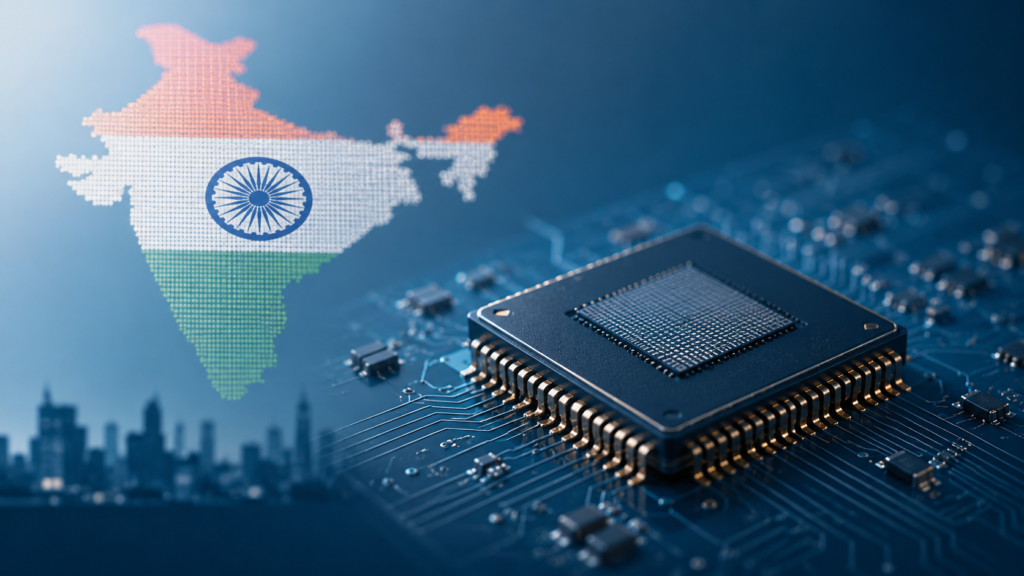
The Frontier Tech Hub of NITI Aayog recently released a report titled “Future of India’s Semiconductor Industry”. The report highlights that while India has made semiconductor manufacturing a national priority, the domestic ecosystem is still not capable of meeting the country’s growing demand for chips.
The report emphasizes the urgent need to strengthen local semiconductor manufacturing, reduce import dependence, and secure supply chains amid increasing geopolitical uncertainties and technological competition.
For UPSC aspirants, this topic is important under Science & Technology, Electronics Manufacturing, Industrial Development, Economic Growth, and Strategic Technologies.
What are Semiconductors?
Semiconductors, commonly known as microchips or chips, are materials that form the foundation of modern electronics.
They power almost every digital device we use today, including:
- Smartphones
- Computers
- Laptops
- Electric vehicles
- Medical equipment
- Satellites
- Defence systems
- Data centres
- Artificial Intelligence (AI) systems
Without semiconductors, modern technology would not function.
Why Are Semiconductors Called the “Brains” of Electronics?
Microchips process, store, and transmit information.
They perform billions of calculations every second and control the functioning of electronic devices.
Just as the human brain controls body functions, semiconductors control electronic systems.
Understanding Conductors, Insulators and Semiconductors
Materials are classified according to how well they conduct electricity.
Conductors
Conductors allow electricity to flow easily.
Examples
- Copper
- Silver
- Aluminium
These materials contain free-moving electrons.
Insulators
Insulators resist the flow of electricity.
Examples
- Rubber
- Plastic
- Glass
Their electrons are tightly bound and cannot move freely.
Semiconductors
Semiconductors lie between conductors and insulators.
Their conductivity can be controlled under specific conditions.
This unique property makes them ideal for electronic circuits.
Why is Silicon Used in Semiconductors?
The most widely used semiconductor material is:
Silicon (Si)
Silicon is preferred because it is:
- Abundantly available
- Chemically stable
- Durable
- Cost-effective
- Easy to manufacture
Most modern chips are built using silicon wafers.
The Concept of Doping
Pure silicon is not very useful for electronic applications.
Scientists improve its conductivity through a process called:
Doping
Doping involves adding tiny amounts of impurities to silicon.
This changes its electrical properties.
N-Type Semiconductor
When silicon is doped with elements such as:
- Phosphorus
- Arsenic
extra electrons are introduced.
This creates:
N-Type (Negative-Type) Semiconductor
where electrons become the primary charge carriers.
P-Type Semiconductor
When silicon is doped with elements such as:
- Boron
- Gallium
electron vacancies called “holes” are created.
This forms:
P-Type (Positive-Type) Semiconductor
where holes act as positive charge carriers.
What is a P-N Junction?
When P-type and N-type semiconductors are joined together, they form a:
P-N Junction
This junction acts as a one-way gate for electrical current.
The P-N junction is the basic building block of:
- Diodes
- Transistors
- Integrated Circuits (ICs)
What is a Transistor?
A transistor is a tiny electronic switch.
It can:
- Turn current on and off.
- Amplify signals.
- Process digital information.
Modern microchips contain billions of transistors packed into a small area.
These transistors process binary data:
0 and 1
which form the language of computers.
Why Are Semiconductors Strategically Important?
Semiconductors are now considered strategic assets because they influence:
Economic Growth
Nearly every industry depends on chips.
National Security
Defence technologies require advanced semiconductors.
Digital Sovereignty
Countries seek greater control over critical technologies.
Artificial Intelligence
AI systems depend on powerful processors and chips.
Emerging Technologies
- 5G
- Quantum Computing
- Internet of Things (IoT)
- Autonomous Vehicles
all require semiconductors.
Global Semiconductor Supply Chain
The semiconductor industry is highly specialized.
Different stages occur in different countries.
Design
Dominated by:
- United States
- United Kingdom
Manufacturing
Led by:
- Taiwan Semiconductor Manufacturing Company (Taiwan)
- Samsung Electronics
Equipment
Controlled largely by companies from:
- Netherlands
- United States
- Japan
Raw Materials
Supplied by multiple countries.
This makes the global supply chain highly interconnected.
Why is India Focusing on Semiconductors?
India is one of the world’s largest consumers of electronic products.
Demand is rising rapidly due to:
- Smartphone expansion
- Digital economy growth
- AI adoption
- Electric vehicles
- Electronics manufacturing
However, India imports most of its semiconductor requirements.
This creates:
- Strategic vulnerabilities
- Supply chain risks
- High import bills
India’s Semiconductor Mission
To address these challenges, India launched:
India Semiconductor Mission (ISM)
Objectives of ISM
The mission aims to:
- Develop domestic chip manufacturing.
- Attract global investments.
- Create a semiconductor ecosystem.
- Strengthen research and innovation.
- Build supply chain resilience.
Key Components of India’s Semiconductor Ecosystem
Semiconductor Fabrication (Fab)
Fabrication facilities manufacture semiconductor chips on silicon wafers.
These facilities require:
- Massive investments
- Advanced technology
- Highly skilled workforce
Chip Design
India already possesses strong capabilities in semiconductor design.
Many global firms operate design centres in India.
Assembly, Testing, Marking and Packaging (ATMP)
This stage prepares chips for commercial use after manufacturing.
India is increasingly attracting investment in this segment.
Research and Development
Innovation is critical for long-term competitiveness.
India is focusing on:
- Advanced materials
- Chip architecture
- Semiconductor research
Challenges Facing India’s Semiconductor Industry
High Capital Requirements
A modern semiconductor fabrication plant may require investments exceeding billions of dollars.
Technology Dependence
Advanced manufacturing technologies remain concentrated in a few countries.
Skilled Workforce Requirements
The industry needs highly specialized engineers and technicians.
Supply Chain Dependencies
India still depends heavily on imported:
- Equipment
- Raw materials
- Advanced technologies
Water and Energy Requirements
Chip manufacturing requires:
- Large quantities of ultra-pure water
- Reliable electricity supply
Geopolitical Importance
Recent global events have highlighted the importance of semiconductor security.
Major concerns include:
- Supply chain disruptions
- Trade restrictions
- Technology competition
- Strategic dependencies
Countries are increasingly pursuing:
Semiconductor Self-Reliance
to strengthen national resilience.
Opportunities for India
India possesses several advantages.
Large Domestic Market
Growing demand for electronics.
Strong Talent Pool
Large number of engineers and technology professionals.
Government Support
Substantial incentives under semiconductor policies.
Expanding Electronics Manufacturing
Growth in mobile phone and electronics production.
Strategic Partnerships
Collaboration with global technology leaders.
Future Outlook
The NITI Aayog report suggests that India has the potential to emerge as a major semiconductor hub if it can:
- Strengthen manufacturing capacity.
- Build supply chain resilience.
- Encourage private investment.
- Develop skilled manpower.
- Promote innovation and R&D.
The coming decade is likely to determine whether India can successfully establish itself as a significant player in the global semiconductor value chain.
Way Forward
To build a robust semiconductor ecosystem, India should focus on:
Accelerating Fabrication Projects
Speeding up semiconductor manufacturing facilities.
Strengthening R&D
Investing in next-generation technologies.
Developing Skilled Talent
Enhancing semiconductor-focused education and training.
Building Supply Chains
Encouraging domestic production of components and materials.
Promoting Global Partnerships
Collaborating with leading semiconductor nations and firms.
UPSC Prelims Focus
Key Terms
| Term | Meaning |
|---|---|
| Semiconductor | Material with controllable conductivity |
| Silicon | Most commonly used semiconductor material |
| Doping | Adding impurities to alter conductivity |
| N-Type | Electron-rich semiconductor |
| P-Type | Hole-rich semiconductor |
| P-N Junction | Foundation of electronic devices |
| Transistor | Basic switching component of chips |
Previous Year Question (UPSC Mains 2025)
India aims to become a semiconductor manufacturing hub. What are the challenges faced by the semiconductor industry in India? Mention the salient features of the India Semiconductor Mission.
Previous Year Question (UPSC Prelims 2015)
With reference to Solar Power Production in India, consider the following statements:
- India is the third-largest producer of silicon wafers used in photovoltaic units.
- The Solar Energy Corporation of India is the nodal agency for establishing solar power projects in India.
Correct Answer:
(b) 2 only
Exam Keywords
- Semiconductor
- Microchip
- Silicon
- Doping
- P-N Junction
- Transistor
- India Semiconductor Mission
- Chip Manufacturing
- Semiconductor Fabrication
- Electronics Industry
- Artificial Intelligence
- Semiconductor Supply Chain
- Digital Economy
- Strategic Technology
UPSC Syllabus Reference
GS Paper III – Science & Technology, Electronics Manufacturing, Industrial Development, Innovation, Emerging Technologies, and Economic Growth.