Land Pooling Scheme (LPS): A Modern Solution to Urban Land Acquisition Challenges
Why is it in News?
The Government of Rajasthan has announced its first Land Pooling Scheme (LPS) to facilitate land availability for roads, urban infrastructure, and planned development projects.
The initiative reflects a growing trend across Indian states where Land Pooling Schemes (LPS) and Town Planning Schemes (TPS) are increasingly being adopted as alternatives to traditional land acquisition methods.
These models aim to reduce disputes, lower government expenditure, and ensure that landowners directly benefit from urban development.
For UPSC aspirants, this topic is important under Urban Development, Governance, Land Reforms, Infrastructure Development, and Public Policy.
Understanding Land Acquisition in India
Land is a critical resource for:
- Roads
- Railways
- Industrial corridors
- Housing projects
- Smart cities
- Public infrastructure
Traditionally, governments acquired land through compulsory acquisition mechanisms.
What is Land Acquisition?
Land acquisition refers to the process through which the government acquires private land for public purposes.
The current legal framework is:
Right to Fair Compensation and Transparency in Land Acquisition, Rehabilitation and Resettlement Act, 2013
commonly known as:
RFCTLARR Act, 2013
Challenges of Traditional Land Acquisition
Although necessary for development projects, compulsory acquisition often faces several challenges.
High Compensation Costs
Governments need substantial financial resources to compensate landowners.
Legal Disputes
Land ownership disagreements often result in prolonged litigation.
Project Delays
Acquisition disputes frequently delay infrastructure projects.
Social Resistance
Communities may oppose displacement and loss of livelihoods.
Administrative Complexity
Multiple approvals and rehabilitation requirements increase implementation difficulties.
What is a Land Pooling Scheme (LPS)?
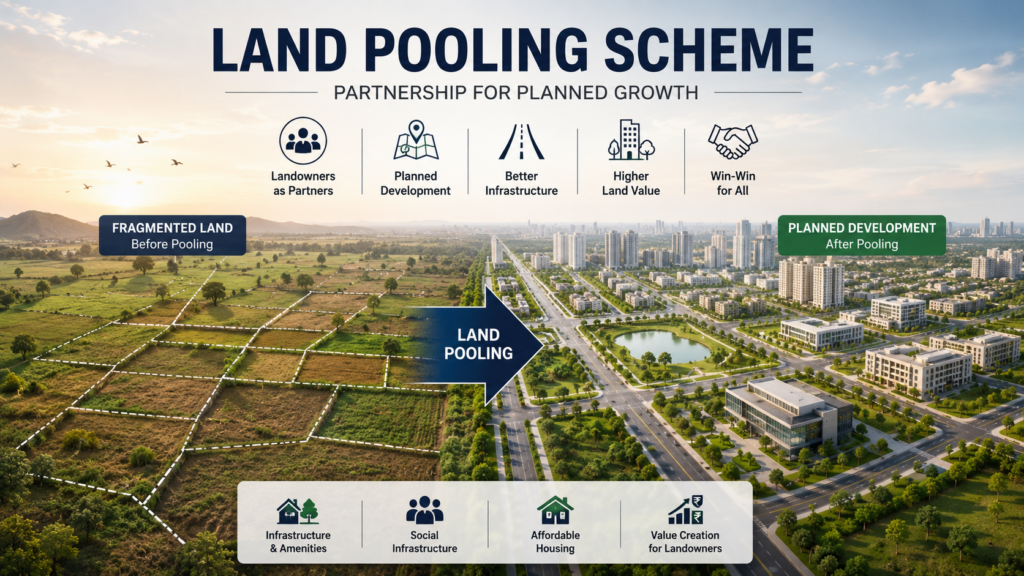
A Land Pooling Scheme (LPS) is a participatory urban development model in which landowners voluntarily contribute their land to a development authority.
Instead of acquiring land through compulsory purchase, the authority:
- Pools fragmented land parcels.
- Develops infrastructure.
- Reorganizes the area.
- Returns a portion of the developed land to original owners.
Thus, landowners become stakeholders in the development process rather than merely recipients of compensation.
What is a Town Planning Scheme (TPS)?
A Town Planning Scheme (TPS) is a more structured and legally backed form of land pooling.
It provides detailed planning regarding:
- Roads
- Zoning
- Public amenities
- Utility services
- Plot reconstitution
TPS acts as a micro-level implementation tool within broader urban development plans.
Land Pooling and Town Planning: Relationship
Both concepts are part of a larger planning approach known as:
Land Readjustment
Under this system:
- Landowners contribute land.
- Authorities develop infrastructure.
- Land is reorganized.
- Developed plots are returned.
This creates a win-win model for both governments and landowners.
How Does Land Pooling Work?
The process follows a systematic approach.
Step 1: Pooling of Land
Landowners voluntarily surrender their land parcels to the development authority.
The authority treats the entire area as a single planning unit.
Step 2: Preparation of Master Plan
The authority designs:
- Road networks
- Drainage systems
- Water supply
- Parks
- Public facilities
- Housing zones
Step 3: Infrastructure Development
The government creates urban infrastructure within the pooled area.
Step 4: Land Reconstitution
After development, a portion of the land is returned to original owners as:
Developed Plots
These plots are smaller in size but significantly higher in market value.
Typical Land Distribution Pattern
Development authorities usually retain around:
40–50% of the pooled land
for public purposes.
The remaining:
50–60%
is returned to landowners.
How Is Retained Land Utilized?
Roads and Connectivity
15–20%
used for:
- Roads
- Transport networks
- Urban mobility infrastructure
Social Infrastructure
5–10%
used for:
- Schools
- Hospitals
- Parks
- Community facilities
Affordable Housing
Around 5%
reserved for:
- Economically Weaker Sections (EWS)
- Affordable housing projects
Land Monetization
10–15%
retained for:
- Commercial development
- Sale or leasing
Revenue generated helps finance infrastructure projects.
What Does the Landowner Receive?
Landowners generally receive:
50–60% of Original Land Area
Although the physical area decreases, the value increases substantially because of:
- Better roads
- Utility connections
- Legal titles
- Commercial potential
- Urban infrastructure
Why Is Land Pooling Gaining Popularity?
Several Indian states are adopting this model because it offers multiple benefits.
Advantages of Land Pooling
1. Reduces Government Expenditure
The government avoids large compensation payments.
2. Faster Project Implementation
Voluntary participation reduces litigation and delays.
3. Higher Land Value
Landowners benefit from increased property values after development.
4. Planned Urbanization
Encourages organized city expansion.
5. Self-Financing Model
Infrastructure costs are partly recovered through land monetization.
6. Stakeholder Participation
Landowners become partners in development.
Examples of Land Pooling in India
Several states have experimented with land pooling models.
Delhi Land Pooling Policy
Implemented for planned urban expansion in Delhi.
Gujarat Town Planning Schemes
Widely regarded as one of India’s most successful land readjustment models.
Andhra Pradesh Capital Region
Land pooling was used extensively during the development of Amaravati.
Rajasthan’s New Initiative
The state’s first land pooling scheme aims to support future urban and infrastructure development.
Challenges Associated with Land Pooling
Despite its benefits, implementation is not always easy.
Landowner Resistance
Some landowners may fear losing land.
Lack of Awareness
Many stakeholders do not fully understand long-term benefits.
Land Record Issues
Discrepancies in ownership records can create disputes.
Delays in Development
If infrastructure development is slow, trust in the scheme may decline.
Institutional Capacity Constraints
Successful implementation requires strong planning and administrative institutions.
Importance of Digital Land Records
Accurate land records are essential for successful land pooling.
Benefits of Digitization
- Clear ownership verification.
- Reduced disputes.
- Faster implementation.
- Better transparency.
The government is increasingly emphasizing digital land governance under various reforms.
Significance for Urban Development
Land pooling supports:
Sustainable Urbanization
through planned growth.
Infrastructure Expansion
without excessive fiscal burden.
Affordable Housing
through reserved land allocation.
Smart City Development
by integrating infrastructure planning.
Ease of Doing Business
through faster land availability.
Way Forward
To maximize the benefits of land pooling, governments should focus on:
Building Public Trust
Clearly communicating benefits to landowners.
Strengthening Legal Frameworks
Creating flexible state-specific regulations.
Digitizing Land Records
Ensuring accurate ownership databases.
Enhancing Institutional Capacity
Improving planning and implementation agencies.
Ensuring Timely Development
Delivering promised infrastructure quickly.
UPSC Prelims Focus
Important Facts
| Feature | Land Pooling Scheme |
|---|---|
| Nature | Voluntary participation |
| Objective | Planned urban development |
| Compensation | Developed land instead of cash |
| Major Benefit | Increased land value |
| Key Stakeholders | Landowners and development authorities |
Previous Year Question (UPSC Prelims 2021)
With reference to the Right to Property in India, which statement is correct?
(a) It is a fundamental right available to citizens only.
(b) It is a legal right available to any person.
(c) It is a legal right available to citizens only.
(d) It is neither a fundamental right nor a legal right.
Correct Answer: (b)
Previous Year Question (UPSC Mains 2014)
The Right to Fair Compensation and Transparency in Land Acquisition, Rehabilitation and Resettlement Act, 2013 has come into effect from 1st January 2014. What are the key issues addressed by the Act? What implications does it have for industrialization and agriculture in India?
Exam Keywords
- Land Pooling Scheme (LPS)
- Town Planning Scheme (TPS)
- Land Readjustment
- Urban Development
- RFCTLARR Act 2013
- Land Acquisition
- Smart Cities
- Infrastructure Development
- Affordable Housing
- EWS Housing
- Urban Planning
- Digital Land Records
- Sustainable Urbanization
- Planned Development
UPSC Syllabus Reference
GS Paper II & III – Urban Development, Governance, Infrastructure, Land Reforms, Government Policies, Smart Cities, and Sustainable Urbanization.