Bamboo Development in Northeast India: Union Government’s ₹82.5 Crore Initiative for Sustainable Growth
Why is it in News?
On 26 January 2026, Union Minister for Development of North Eastern Region (MDoNER), Jyotiraditya Scindia, inaugurated two major bamboo development projects worth ₹82.5 crore in Guwahati.
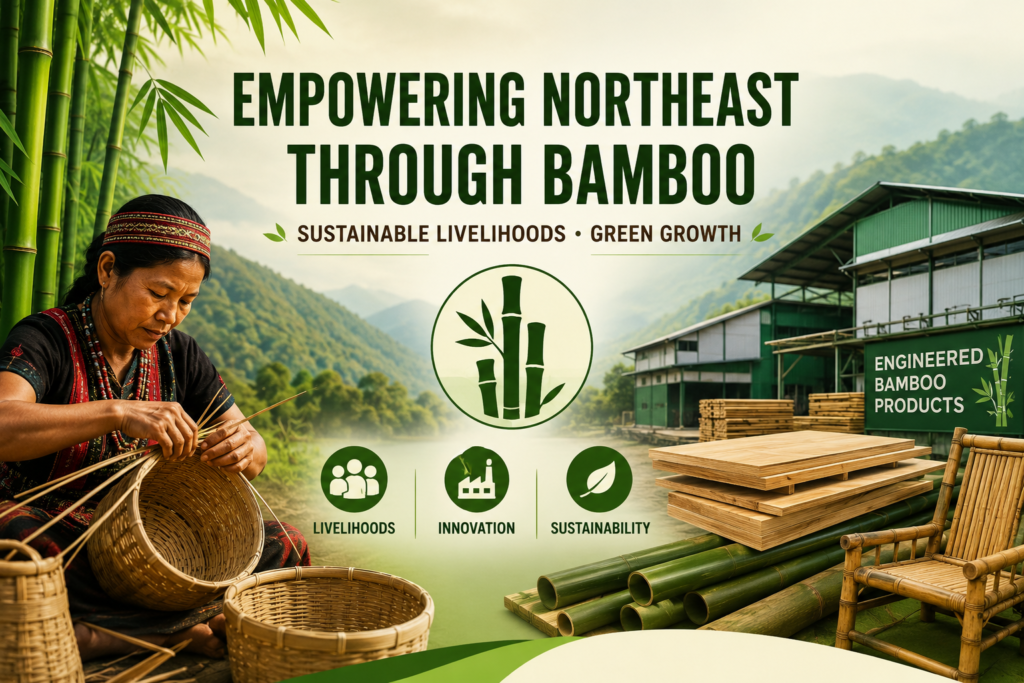
The projects are being implemented by the North Eastern Council (NEC) and the North East Cane and Bamboo Development Council (NECBDC) to transform bamboo into a major source of livelihood, industrial growth, and sustainable development across the Northeast.
These initiatives aim to combine traditional craftsmanship with modern technology and market access, thereby creating employment opportunities while promoting environmentally sustainable growth.
For UPSC aspirants, this topic is important under Economy, Agriculture, Rural Development, Environment, Sustainable Development, and North East India.
Why is Bamboo Important?
Bamboo is often referred to as:
“Green Gold”
because of its immense economic, environmental, and social value.
India possesses one of the largest bamboo resources in the world, with the Northeastern states accounting for a significant share of the country’s bamboo reserves.
Importance of Bamboo
Economic Importance
- Generates rural employment.
- Supports cottage and handicraft industries.
- Provides raw material for furniture and construction.
- Creates opportunities for exports.
Environmental Importance
- Absorbs large amounts of carbon dioxide.
- Helps prevent soil erosion.
- Supports biodiversity.
- Regenerates quickly compared to timber.
Social Importance
- Integral part of tribal and local cultures.
- Used in housing, handicrafts, tools, and traditional products.
Major Bamboo Development Projects Launched
The Union Government launched two flagship bamboo initiatives worth ₹82.5 crore.
Project 1: Strengthening Traditional Bamboo Artisan Clusters
Objective
To revive and modernize traditional bamboo artisan clusters across all eight Northeastern states.
Focus Areas
- Upgrading traditional tools.
- Improving product design.
- Enhancing production techniques.
- Increasing market access.
Modernization of Common Facility Centres (CFCs)
The project will strengthen:
Common Facility Centres (CFCs)
These centres provide:
- Shared machinery
- Processing equipment
- Design support
- Training facilities
for bamboo artisans.
Digital Market Access
A major feature of the initiative is connecting artisans to digital marketplaces through partnerships with:
Benefits
- Wider customer reach.
- Better product visibility.
- Increased incomes.
- Reduced dependence on intermediaries.
This is particularly beneficial for rural and tribal communities.
Impact on Traditional Crafts
The project seeks to preserve:
- Indigenous bamboo craftsmanship.
- Tribal artistic traditions.
- Local cultural heritage.
while simultaneously increasing commercial viability.
Project 2: Promotion of Engineered Bamboo Products
Objective
To develop modern bamboo-based industries in:
- Karbi Anglong (Assam)
- Mokokchung (Nagaland)
What is Engineered Bamboo?
Engineered bamboo refers to processed bamboo products designed for industrial use.
Examples include:
- Bamboo boards
- Bamboo panels
- Bamboo flooring
- Furniture
- Bamboo composites
These products can serve as sustainable alternatives to:
- Timber
- Plastic
- Synthetic materials
Key Features of the Project
Bamboo Cultivation
The initiative aims to develop:
1,000 Hectares
of certified bamboo plantations.
This will ensure a stable and sustainable supply of raw materials.
Skill Development
The project will train approximately:
1,000 Youth
in advanced bamboo processing and manufacturing techniques.
Benefits
- Employment generation.
- Entrepreneurship development.
- Industrial skill enhancement.
Industry Partnership
The project is supported through an MoU with:
Significance
The partnership will help:
- Scale production.
- Improve technology transfer.
- Strengthen industrial linkages.
- Expand market opportunities.
Strategic Planning Behind the Projects
These initiatives were developed after:
- 18 months of value-chain analysis.
- Cluster assessments.
- Consultations with state governments.
- Discussions with artisans.
- Stakeholder engagement.
The focus is on creating a:
Market-Oriented Bamboo Ecosystem
rather than merely providing subsidies.
Bamboo and the Vision of Green Growth
The projects align closely with India’s green growth strategy.
Objectives
- Promote sustainable industries.
- Reduce dependence on imported materials.
- Encourage eco-friendly manufacturing.
- Generate green jobs.
This supports India’s broader commitments toward:
- Sustainable Development Goals (SDGs)
- Climate action
- Circular economy
What is Circular Economy?
A circular economy seeks to:
- Minimize waste.
- Maximize resource efficiency.
- Recycle and reuse materials.
- Promote sustainable production.
Bamboo fits perfectly into this model because:
- It grows rapidly.
- It is renewable.
- It requires relatively fewer resources.
Economic Impact of the Projects
The ₹82.5 crore investment is expected to generate significant economic benefits.
Employment Generation
The projects are likely to create:
- Direct jobs in cultivation and processing.
- Indirect jobs in logistics, marketing, and retail.
Thousands of employment opportunities are expected across the Northeast.
Strengthening Rural Livelihoods
The initiatives will:
- Increase artisan incomes.
- Improve rural economic stability.
- Promote tribal entrepreneurship.
Industrial Development
The Northeast can emerge as:
India’s Bamboo Manufacturing Hub
with greater participation in:
- Domestic markets
- Export markets
- Sustainable construction industries
Benefits for Northeast India
The projects will contribute to:
Regional Development
By creating local economic opportunities.
Inclusive Growth
By involving tribal communities, women, and artisans.
Sustainable Industrialization
By promoting eco-friendly industries.
Cultural Preservation
By protecting traditional bamboo crafts and skills.
Government Institutions Supporting Bamboo Development
North Eastern Council (NEC)
The NEC is the apex regional planning body for the Northeastern states.
Functions
- Regional development planning.
- Infrastructure development.
- Economic growth initiatives.
North East Cane and Bamboo Development Council (NECBDC)
The NECBDC focuses specifically on:
- Bamboo cultivation.
- Skill development.
- Bamboo-based industries.
- Market promotion.
Why is Bamboo Called the Future Material?
Globally, bamboo is increasingly being used in:
- Green construction
- Sustainable furniture
- Packaging materials
- Textiles
- Bio-composites
As countries seek alternatives to timber and plastic, bamboo is emerging as a key resource for sustainable development.
Way Forward
To maximize the benefits of these projects, India should focus on:
Expanding Bamboo Value Chains
From cultivation to finished products.
Strengthening Export Potential
Promoting Indian bamboo products globally.
Supporting Innovation
Developing new bamboo-based technologies and products.
Enhancing Skill Development
Training youth and entrepreneurs in modern bamboo industries.
Promoting Sustainable Practices
Ensuring ecological conservation alongside industrial growth.
UPSC Prelims Focus
Important Institutions
| Institution | Role |
|---|---|
| NEC | Regional planning and development of Northeast |
| NECBDC | Bamboo and cane sector development |
| MDoNER | Ministry for development of Northeast region |
Bamboo and Sustainable Development
| Aspect | Contribution |
|---|---|
| Economy | Employment and industry |
| Environment | Carbon sequestration and biodiversity |
| Society | Tribal livelihoods and cultural preservation |
| Industry | Alternative to timber and plastic |
Exam Keywords
- Bamboo Mission
- Green Gold
- North Eastern Council (NEC)
- NECBDC
- Engineered Bamboo
- Circular Economy
- Sustainable Development
- Green Growth
- Rural Livelihoods
- Bamboo Value Chain
- Tribal Entrepreneurship
- Skill Development
- Carbon Sequestration
- Northeast India
UPSC Syllabus Reference
GS Paper III – Agriculture, Rural Development, Sustainable Development, Environmental Conservation, Inclusive Growth, and Government Initiatives for Regional Development.