Exoplanets and Space Observation: How the James Webb Space Telescope is Revolutionizing Alien Weather Studies
Why is it in News?
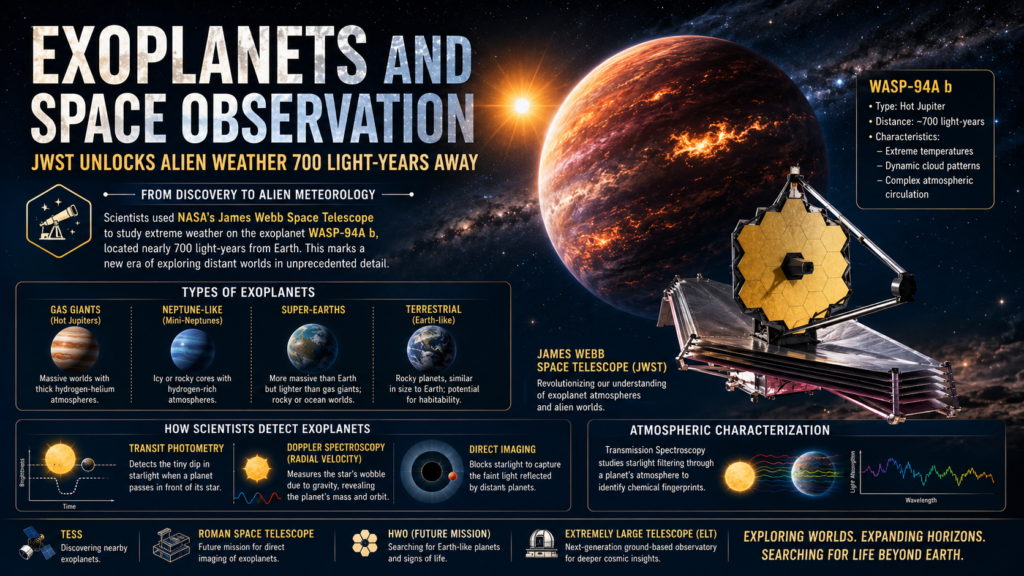
Scientists recently used NASA’s James Webb Space Telescope to study extreme weather patterns on a distant exoplanet called WASP-94A b, located nearly 700 light-years away from Earth.
This achievement marks a major milestone in astronomy. Scientists are no longer limited to discovering planets beyond our Solar System; they can now study their atmospheres, climate systems, clouds, and even weather patterns. This emerging field is often called Alien Meteorology.
For UPSC aspirants, this topic is important under Science & Technology, Space Technology, Astronomy, and Space Missions.
What is an Exoplanet?
An Exoplanet (Extrasolar Planet) is any planet that exists outside our Solar System and revolves around a star other than the Sun.
For centuries, scientists believed such planets might exist, but there was no proof.
The first confirmed exoplanet orbiting a Sun-like star was discovered in:
1995
The planet was:
51 Pegasi b
Since then, technological advancements have transformed exoplanet research.
Today, scientists have confirmed more than:
6,200 Exoplanets
Many billions more are believed to exist within the Milky Way Galaxy.
Why are Exoplanets Important?
Studying exoplanets helps scientists answer some of humanity’s biggest questions:
- How do planetary systems form?
- Is Earth unique?
- Can life exist elsewhere in the universe?
- How do planetary atmospheres evolve?
- What conditions make planets habitable?
Major Types of Exoplanets
Exoplanets vary greatly in size, composition, and environmental conditions.
Scientists generally classify them into four major categories.
1. Gas Giants
These planets are similar to:
- Jupiter
- Saturn
Characteristics
- Composed mainly of hydrogen and helium.
- Very large in size.
- Often possess thick atmospheres.
Hot Jupiters
Many discovered gas giants orbit extremely close to their stars.
These are known as:
Hot Jupiters
They experience extremely high temperatures due to intense stellar radiation.
The recently studied exoplanet WASP-94A b belongs to this category.
2. Neptune-like Planets
These planets resemble:
- Neptune
- Uranus
Characteristics
- Hydrogen-rich atmospheres.
- Rocky or icy interiors.
- Intermediate size between Earth and Jupiter.
Mini-Neptunes
Some planets are smaller than Neptune but larger than Earth.
These are called:
Mini-Neptunes
They are among the most common exoplanets discovered so far.
3. Super-Earths
Super-Earths are planets that:
- Are larger than Earth.
- Are smaller than Neptune.
Important Fact
No Super-Earth exists in our Solar System.
Characteristics
They may be:
- Rocky worlds
- Ocean worlds
- Mixed-composition planets
These planets are important candidates in the search for habitability.
4. Terrestrial Planets
These are rocky planets similar to Earth.
Characteristics
- Solid surfaces
- Relatively smaller size
- Potential for liquid water
Examples within our Solar System include:
- Earth
- Mars
- Mercury
- Venus
Scientists consider terrestrial exoplanets the most promising locations to search for life.
The Challenge of Finding Exoplanets
Exoplanets are extremely difficult to observe directly.
The main reason is that stars are incredibly bright while planets are comparatively faint.
The light from a host star often completely overwhelms the reflected light from nearby planets.
As a result, astronomers rely on indirect detection methods.
Major Methods of Exoplanet Detection
1. Transit Photometry
This is currently the most successful method for discovering exoplanets.
It is widely used by missions such as:
- Kepler Space Telescope
- Transiting Exoplanet Survey Satellite
How It Works
When a planet passes in front of its host star, it blocks a small portion of the star’s light.
This causes a temporary decrease in brightness.
Scientists record this brightness dip as a:
Light Curve
What It Reveals
- Planet size
- Orbital period
- Distance from the star
Most known exoplanets have been discovered through this technique.
2. Doppler Spectroscopy (Radial Velocity Method)
A planet’s gravity slightly pulls on its host star.
As a result, the star moves in a tiny orbit around a common centre of mass.
This creates a slight wobble.
Doppler Effect
When the star moves:
- Toward Earth → Light shifts toward blue wavelengths.
- Away from Earth → Light shifts toward red wavelengths.
What It Reveals
Scientists can determine:
- Planetary mass
- Orbital shape
- Orbital characteristics
3. Direct Imaging
This is one of the most challenging methods.
How It Works
Special instruments called:
- Coronagraphs
- Starshades
block the intense light from stars.
This allows astronomers to directly observe faint planets nearby.
Best For
- Large planets
- Young planets
- Planets far from their host stars
Beyond Discovery: Studying Exoplanet Atmospheres
Modern astronomy has entered a new phase.
The goal is no longer just discovering exoplanets.
Scientists now aim to:
Characterize Exoplanets
This means studying:
- Atmospheres
- Clouds
- Weather systems
- Chemical composition
- Climate patterns
Transmission Spectroscopy
The most important technique used for atmospheric studies is:
Transmission Spectroscopy
How It Works
When an exoplanet passes in front of its star:
- Some starlight travels through the planet’s atmosphere.
- Atmospheric gases absorb specific wavelengths.
- Scientists analyze the filtered light.
This produces unique chemical fingerprints.
What Can Scientists Detect?
Transmission spectroscopy can identify:
- Water vapour
- Methane
- Carbon dioxide
- Oxygen
- Clouds
- Atmospheric chemistry
This technique is crucial for the search for habitable worlds.
James Webb Space Telescope (JWST)
The most powerful space telescope ever built is:
James Webb Space Telescope
Launched in:
December 2021
JWST operates mainly in the:
Infrared Spectrum
Infrared observations allow scientists to study:
- Distant galaxies
- Star formation
- Exoplanet atmospheres
- Planetary weather systems
Why is JWST Revolutionary?
Compared to earlier telescopes, JWST offers:
Higher Sensitivity
It can detect extremely faint signals from distant planets.
Infrared Capability
Infrared wavelengths can penetrate dust clouds and reveal atmospheric details.
Atmospheric Analysis
Scientists can identify atmospheric gases with unprecedented precision.
Weather on a Distant World: WASP-94A b
Recent JWST observations focused on:
WASP-94A b
Located approximately:
700 Light-Years from Earth
Findings
Scientists observed:
- Dynamic atmospheric circulation
- Extreme temperature variations
- Complex cloud formation
- Daily weather cycles
Researchers believe the planet may contain:
Rock Clouds
Minerals such as magnesium silicates may vaporize in intense heat and later condense into clouds.
This is very different from Earth’s water-based weather system.
Other Important Space Missions
TESS Mission
Full Form
Transiting Exoplanet Survey Satellite
Agency
NASA
Objective
To discover planets around nearby bright stars.
TESS provides valuable targets for further observation by JWST.
Nancy Grace Roman Space Telescope
A future NASA mission designed to:
- Search for exoplanets
- Improve direct imaging techniques
- Study dark energy
Its advanced coronagraph technology will help observe planets directly.
Habitable Worlds Observatory (HWO)
A proposed future mission focused on:
- Earth-like planets
- Habitable zones
- Biosignatures
Biosignatures
Chemical indicators that may suggest the presence of life.
Examples include:
- Oxygen
- Methane
- Ozone combinations
Ground-Based Astronomy and the Future
Future discoveries will also be supported by powerful ground observatories.
One of the most anticipated projects is:
Extremely Large Telescope
Located in Chile, it will become one of the world’s largest optical telescopes.
The Future of Exoplanet Science
Astronomy is rapidly evolving from:
Planet Discovery
to
Planet Characterization
Scientists can now study:
- Climate systems
- Atmospheric chemistry
- Weather cycles
- Potential habitability
Future missions may even detect signs of life beyond Earth.
UPSC Prelims Focus
Important Terms
| Term | Meaning |
|---|---|
| Exoplanet | Planet outside the Solar System |
| Transit Photometry | Detecting planets through brightness dips |
| Radial Velocity | Detecting planets through stellar wobble |
| Transmission Spectroscopy | Studying planetary atmospheres |
| JWST | James Webb Space Telescope |
| TESS | Transiting Exoplanet Survey Satellite |
| HWO | Habitable Worlds Observatory |
Previous Year Question (UPSC Mains 2022)
Q. Launched in December 2021, the James Webb Space Telescope (JWST) has been much in the news. What are its unique features that make it superior to its predecessor space telescopes? What are the key goals of this mission?
Previous Year Question (UPSC Prelims 2015)
Q. Regarding India’s space observatory Astrosat, consider the following statements:
- Other than the USA and Russia, India is the only country to have launched a similar observatory into space.
- Astrosat is a 2000 kg satellite placed at an altitude of 1650 km.
Correct Answer: (d) Neither 1 nor 2
Exam Keywords
- Exoplanets
- JWST
- James Webb Space Telescope
- Transit Photometry
- Radial Velocity Method
- Transmission Spectroscopy
- Hot Jupiters
- Super-Earths
- TESS
- Nancy Grace Roman Space Telescope
- Habitable Worlds Observatory
- Biosignatures
- Alien Weather
- Atmospheric Characterization
UPSC Syllabus Reference
GS Paper III – Science & Technology: Space Technology, Space Missions, Emerging Technologies, Developments in Astronomy and Applications of Scientific Discoveries.