Near-Earth Objects (NEOs) and Meteors: Understanding Cosmic Threats and Planetary Defence
Why is it in News?
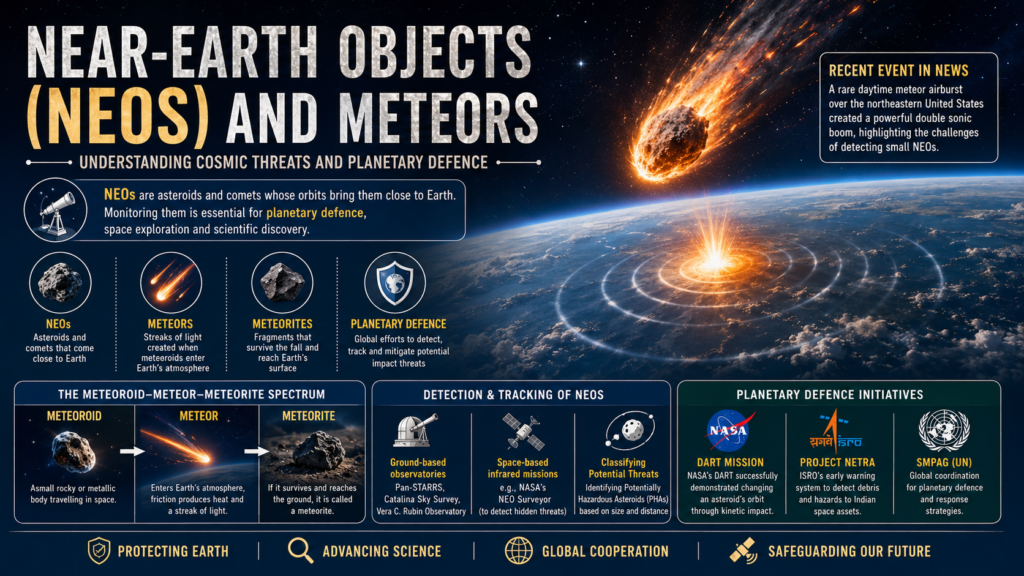
A rare daytime meteor airburst over the northeastern United States recently created a powerful double sonic boom that shook buildings across several states. The event drew global attention because it highlighted the challenges of detecting small space objects before they enter Earth’s atmosphere.
The incident has renewed discussions about Near-Earth Objects (NEOs), planetary defence, space surveillance systems, and global efforts to protect Earth from potential asteroid impacts.
For UPSC aspirants, this topic is important under Science & Technology, Space Technology, Disaster Management, and International Cooperation in Space.
What are Near-Earth Objects (NEOs)?
Near-Earth Objects (NEOs) are small celestial bodies whose orbits bring them close to Earth’s orbit.
These objects are considered remnants of the early Solar System and provide valuable information about the formation and evolution of planets.
Definition
An object is classified as a Near-Earth Object if its closest distance from the Sun (perihelion) is less than:
1.3 Astronomical Units (AU)
An Astronomical Unit (AU) is the average distance between the Earth and the Sun.
1 AU = Approximately 150 million kilometres
Why are NEOs Important?
Studying NEOs helps scientists:
- Understand the formation of the Solar System.
- Track potentially dangerous objects.
- Develop planetary defence strategies.
- Study the composition of early celestial bodies.
- Protect Earth from future impact threats.
Classification of Near-Earth Objects
NEOs are mainly divided into two categories.
1. Near-Earth Asteroids (NEAs)
These account for more than 99% of all discovered NEOs.
Characteristics
- Rocky or metallic in nature.
- Mostly originate from the Main Asteroid Belt between Mars and Jupiter.
- Their orbits are altered due to gravitational interactions.
Importance
Most potentially hazardous objects identified today belong to this category.
2. Near-Earth Comets (NECs)
These originate from the outer regions of the Solar System.
Sources
- Kuiper Belt
- Oort Cloud
Characteristics
- Made of ice, dust, and rocky material.
- Develop visible tails when approaching the Sun.
- Less common than Near-Earth Asteroids.
Understanding Meteoroids, Meteors and Meteorites
Many UPSC aspirants confuse these terms. The distinction is extremely important.
Meteoroid
A meteoroid is a small rocky or metallic object travelling through space.
Size
Can range from:
- Tiny dust particles
- Small stones
- Large boulders
Location
A meteoroid remains in outer space.
Meteor
When a meteoroid enters Earth’s atmosphere at high speed, friction with air molecules generates intense heat and light.
This glowing streak is called a:
Meteor
Commonly known as a:
“Shooting Star”
Speed
Typically travels at:
- 11 km/s to 72 km/s
- Up to 259,000 km/h
Most meteors burn up completely before reaching the ground.
Meteorite
If part of the meteoroid survives atmospheric entry and reaches Earth’s surface, it is called a:
Meteorite
Meteorites provide scientists with valuable clues about the early Solar System.
Simple Difference
| Term | Location |
|---|---|
| Meteoroid | In Space |
| Meteor | In Earth’s Atmosphere |
| Meteorite | On Earth’s Surface |
What is a Meteor Airburst?
A meteor airburst occurs when a meteoroid explodes in the atmosphere before reaching the ground.
How It Happens
- Meteoroid enters the atmosphere.
- Air pressure increases rapidly.
- Internal stress exceeds structural strength.
- Object breaks apart violently.
- Large amount of energy is released.
This creates:
- Bright fireballs
- Sonic booms
- Shockwaves
- Atmospheric explosions
without forming an impact crater.
The Recent U.S. Meteor Airburst Event
The meteor involved in the recent event was only about:
1 Metre Wide
Despite its small size, it travelled at approximately:
120,700 km/h
The atmospheric explosion released energy equivalent to:
300 Tons of TNT
The resulting double sonic boom was so powerful that many people mistook it for:
- An earthquake
- An industrial explosion
- A military event
Several reports were submitted to earthquake monitoring agencies.
Challenges in Tracking Small Near-Earth Objects
The recent incident highlights an important limitation of modern planetary defence systems.
1. Small Objects Are Difficult to Detect
Objects measuring only a few metres across are often too small to be detected before atmospheric entry.
This creates a significant observational blind spot.
2. Solar Glare Problem
Objects approaching from the Sun’s direction are difficult to observe because sunlight overwhelms telescope sensors.
3. Dark Asteroids
Many asteroids reflect very little sunlight.
These carbon-rich bodies are harder to identify using conventional optical telescopes.
4. Limited Warning Time
Small objects may only become visible shortly before entering Earth’s atmosphere.
This reduces preparation time.
Why Meteor Airbursts Matter
Although small airbursts rarely cause major damage, they provide valuable scientific data.
Distinguishing Natural and Artificial Objects
Scientists can determine whether an object is:
- Natural cosmic material
- Space debris
- Defunct satellites
- Rocket fragments
In the recent event, researchers confirmed that the object was naturally occurring.
Understanding Earth’s Atmospheric Shield
Earth’s atmosphere acts as a protective barrier.
Many dangerous objects burn up or fragment before reaching the ground.
Airburst events demonstrate how effectively the atmosphere protects life on Earth.
Improving Seismic Monitoring
Shockwaves produced by meteor explosions help scientists improve:
- Seismic sensors
- Atmospheric monitoring systems
- Explosion detection technologies
These improvements allow better differentiation between:
- Earthquakes
- Atmospheric explosions
- Human-made blasts
Potentially Hazardous Asteroids (PHAs)
Some Near-Earth Asteroids are classified as:
Potentially Hazardous Asteroids (PHAs)
These objects satisfy two conditions:
1. Close Approach
They can come within:
0.05 AU of Earth
(approximately 7.5 million kilometres)
2. Sufficient Size
Large enough to cause significant regional damage if an impact occurs.
These objects are continuously monitored by international space agencies.
Global Planetary Defence Efforts
Modern planetary defence focuses on detecting, tracking, and potentially deflecting dangerous objects.
Detection Infrastructure
Several observatories continuously scan the night sky.
Important Projects
- Pan-STARRS
- Catalina Sky Survey
- Vera C. Rubin Observatory
These systems help identify and map NEO trajectories.
NASA’s NEO Surveyor Mission
Objective
To detect difficult-to-find asteroids using infrared technology.
Why Infrared?
Unlike visible-light telescopes, infrared instruments can detect:
- Dark asteroids
- Carbon-rich objects
- Objects hidden by solar glare
The mission will significantly strengthen global asteroid detection capabilities.
DART Mission: Humanity’s First Asteroid Deflection Test
One of the most important achievements in planetary defence is NASA’s:
Double Asteroid Redirection Test (DART)
Objective
To test whether humans can alter the orbit of an asteroid.
Achievement
NASA deliberately crashed a spacecraft into the asteroid moonlet Dimorphos.
The mission successfully changed the asteroid’s orbit.
Significance
It proved that the:
Kinetic Impactor Technique
can potentially be used to deflect future asteroid threats.
India’s Role in Planetary Defence
India is also strengthening its space situational awareness capabilities.
Project NETRA
Full Form
Network for Space Object Tracking and Analysis
Implementing Agency
Indian Space Research Organisation
Objective
To provide an early warning system for:
- Space debris
- Satellite threats
- Near-Earth hazards
Importance
Project NETRA improves India’s ability to monitor objects that may threaten national space assets.
International Cooperation
SMPAG
Space Mission Planning Advisory Group
An international mechanism supported by the United Nations.
Functions
- Coordinates planetary defence planning.
- Facilitates global cooperation.
- Develops response strategies for asteroid threats.
Since asteroid impacts are global risks, international cooperation is essential.
Significance of Planetary Defence
Planetary defence is no longer a theoretical concept.
It has become an important component of:
- Space security
- Disaster preparedness
- Scientific research
- International cooperation
The successful DART mission and expanding global surveillance systems demonstrate humanity’s growing ability to predict and potentially prevent catastrophic asteroid impacts.
UPSC Prelims Focus
Important Terms
| Term | Meaning |
|---|---|
| NEO | Near-Earth Object |
| NEA | Near-Earth Asteroid |
| NEC | Near-Earth Comet |
| PHA | Potentially Hazardous Asteroid |
| AU | Astronomical Unit |
| DART | Double Asteroid Redirection Test |
| NETRA | Network for Space Object Tracking and Analysis |
Previous Year Question (UPSC Prelims 2021)
Q. What is Project NETRA, sometimes seen in the news?
(a) An ISRO project to build a space telescope to study exoplanets
(b) An early warning system in space to detect debris and hazards to Indian satellites
(c) A joint venture of India and France to study the environment of Mars
(d) A defence radar system developed by DRDO for border monitoring
Correct Answer: (b)
Exam Keywords
- Near-Earth Objects (NEOs)
- Asteroids
- Comets
- Meteoroid
- Meteor
- Meteorite
- Meteor Airburst
- Planetary Defence
- DART Mission
- NEO Surveyor
- Project NETRA
- Space Situational Awareness
- Potentially Hazardous Asteroids (PHAs)
- SMPAG
UPSC Syllabus Reference
GS Paper III – Science & Technology: Developments in Space Technology, Space Missions, Space Security, Disaster Management, and Emerging Technologies.