CAFE-III Norms 2027–32: India’s New Fuel-Efficiency Rules for Passenger Vehicles
Category: Environment | Economy | Science & Technology
UPSC GS: GS Paper III – Environment, Energy, Infrastructure, Technology
HPPSC Relevance: Environment, Energy, Transport and Sustainable Development
Why in News?
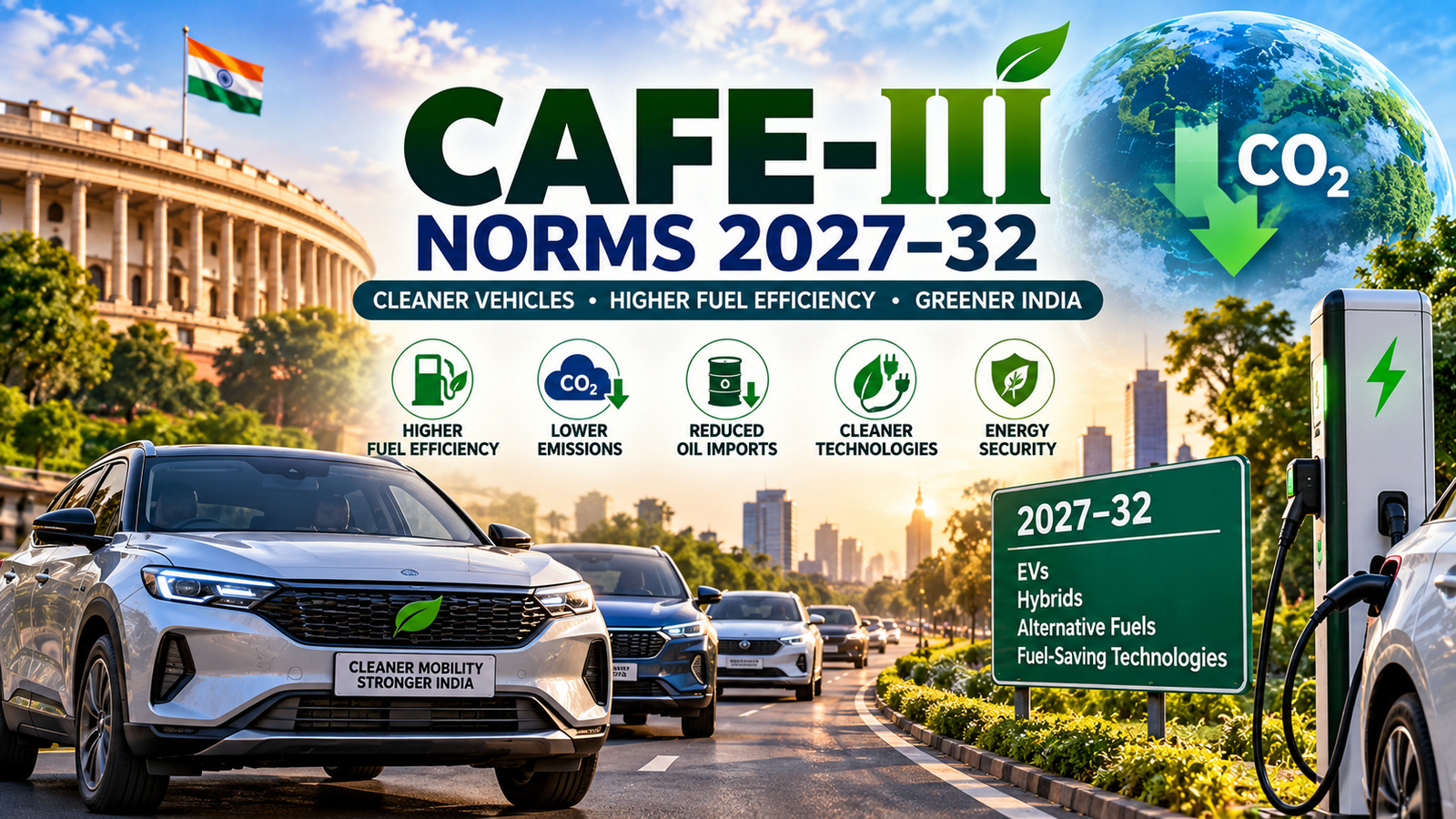
The Government of India has notified the new Corporate Average Fuel Economy (CAFE) Norms for 2027–28 to 2031–32, commonly referred to as CAFE-III.
The new norms will come into effect from 1 April 2027 and remain applicable until 31 March 2032. They will apply to new passenger vehicles manufactured or imported for sale in India.
The new framework aims to improve vehicle fuel efficiency by about 16.7% over five years. The benchmark for fleet-average fuel consumption will tighten from 3.996 litres per 100 km in 2027–28 to 3.3273 litres per 100 km in 2031–32.
The framework also provides manufacturers with several compliance pathways, including electric vehicles, hybrids, alternative fuels, fuel-saving technologies and credit trading.
What are CAFE Norms?
CAFE stands for Corporate Average Fuel Economy.
Simple meaning
CAFE norms do not require every car sold by a company to have the same fuel efficiency.
Instead, they look at the average fuel consumption of the manufacturer’s entire eligible passenger-vehicle fleet.
For example, suppose a company sells:
- fuel-efficient small cars,
- petrol SUVs,
- hybrid cars, and
- electric vehicles.
The government calculates the manufacturer’s overall fleet performance.
Therefore, a manufacturer can balance relatively fuel-intensive vehicles with more efficient vehicles.
Exam Definition
Corporate Average Fuel Economy (CAFE) is a regulatory framework that requires automobile manufacturers to maintain a prescribed average level of fuel efficiency across their eligible passenger-vehicle fleet.
Why is CAFE Important?
Road transport consumes large quantities of petroleum products.
Greater fuel efficiency can therefore help India:
- reduce petrol and other fossil-fuel consumption;
- reduce CO₂ emissions;
- reduce dependence on imported crude oil;
- improve energy security;
- encourage cleaner vehicle technologies;
- promote hybrid and electric vehicles;
- encourage alternative fuels;
- stimulate automobile-sector innovation.
The Bureau of Energy Efficiency notes that India’s CAFE norms were introduced in 2017 under the Energy Conservation Act, 2001, with the broader objective of reducing fuel consumption, CO₂ emissions, oil dependence and air pollution.
CAFE Evolution in India
India’s CAFE framework has developed in stages.
| Stage | Period | Broad purpose |
|---|---|---|
| CAFE Stage I | 2017–18 onwards | Initial fleet fuel-efficiency standards |
| CAFE Stage II | 2022–23 onwards | Stricter efficiency requirements |
| CAFE-III | 2027–28 to 2031–32 | Further tightening + technology flexibility |
| CAFE-IV | Future phase | Further strengthening of efficiency and emission standards |
The first CAFE standards were notified in 2017 under the Energy Conservation Act. Stage I became effective from 2017–18 and Stage II from 2022–23.
What has India Notified in 2026?
The Ministry of Power has notified the new CAFE framework for:
1 April 2027 → 31 March 2032
It replaces the existing CAFE framework from 1 April 2027.
The norms apply to new passenger vehicles manufactured or imported for sale in India.
The framework is designed to be:
- technology-neutral;
- flexible;
- progressively stricter;
- supportive of cleaner fuels;
- supportive of electrification;
- focused on energy efficiency.
The Most Important Number: 16.7%
The new CAFE framework progressively reduces permitted fleet-average fuel consumption.
| Financial Year | Benchmark fuel consumption |
|---|---|
| 2027–28 | 3.9960 litres/100 km |
| 2028–29 | progressively tighter |
| 2029–30 | progressively tighter |
| 2030–31 | progressively tighter |
| 2031–32 | 3.3273 litres/100 km |
The benchmark therefore improves by approximately 16.7% over the five-year period.
What does lower litres/100 km mean?
If a vehicle consumes fewer litres to travel 100 km, it is more fuel-efficient.
Therefore:
Lower litres/100 km = Higher fuel efficiency
This is an important Prelims concept.
CAFE is a Fleet-Level Regulation
One of the most important concepts for UPSC is that CAFE operates at the manufacturer/fleet level.
It is not simply:
“Every car must meet one identical fuel-consumption number.”
Instead, the average performance of eligible vehicles sold by a manufacturer is considered.
The target also takes vehicle weight into account.
The new framework has increased the reference weight from 1,082 kg to 1,229 kg.
Why does weight matter?
A heavier vehicle generally requires more energy to move.
Therefore, CAFE-III uses a weight-sensitive approach rather than treating every vehicle as identical.
The final framework does not create a separate regulatory concession for cars below 909 kg; instead, vehicle weight is incorporated into the broader fleet formula.
What is M1 Category?
This is an important technical term.
M1 category refers broadly to passenger vehicles designed for carrying passengers, with seating capacity not exceeding nine persons including the driver, and within the prescribed vehicle-weight limit.
CAFE regulations primarily focus on this passenger-vehicle category.
Exam Point
Do not confuse:
M1 passenger vehicles
with
all road vehicles.
CAFE-III is specifically focused on eligible passenger vehicles.
CAFE-III and Electric Vehicles
One of the most important features of CAFE-III is the recognition given to cleaner powertrains.
The framework provides volume derogation factors, commonly called super credits, for certain cleaner vehicle technologies.
These include:
- Battery Electric Vehicles (BEVs)
- Range-Extended Electric Vehicles (REEVs)
- Plug-in Hybrid Electric Vehicles (PHEVs)
- Strong Hybrid Electric Vehicles (SHEVs)
- Flex-Fuel Vehicles
What is a Super Credit?
A super credit means that a cleaner vehicle can receive a higher weight in the manufacturer’s fleet-average compliance calculation than its actual sales volume.
For example, under CAFE-III, a BEV/REEV receives a volume derogation factor of 3.
In simplified terms:
1 eligible BEV can count as 3 vehicles for the relevant fleet calculation.
This creates an incentive for manufacturers to increase the share of cleaner vehicles in their portfolios.
Super Credits Under CAFE-III
The final framework provides different factors for different technologies.
| Vehicle technology | Volume derogation factor |
|---|---|
| BEV / REEV | 3.0 |
| PHEV / flex-fuel strong hybrid | 2.5 |
| Strong Hybrid | 1.6 |
| Flex-Fuel Vehicle | 1.1 |
UPSC Trap
Super credit does NOT mean a direct cash subsidy to consumers.
It is a regulatory compliance mechanism used in calculating a manufacturer’s fleet performance.
What is a BEV?
BEV = Battery Electric Vehicle
A BEV is powered entirely by electricity stored in a battery.
It does not use an internal combustion engine as its primary propulsion system.
Examples include fully electric passenger cars.
What is a Hybrid Vehicle?
A hybrid vehicle combines an internal combustion engine with an electric propulsion system.
The basic idea is:
Engine + Electric Motor/Battery
Hybrids can improve fuel efficiency because the electric system can assist the engine and recover energy during braking.
What is a Plug-in Hybrid?
A Plug-in Hybrid Electric Vehicle (PHEV) has:
- an internal combustion engine;
- an electric motor;
- a battery;
- the ability to charge the battery externally.
It can therefore operate partly using electricity and partly using liquid fuel.
What is a Strong Hybrid?
A Strong Hybrid Electric Vehicle (SHEV) has a more capable electric propulsion system than a conventional mild hybrid.
It can use the electric motor for a meaningful portion of vehicle operation, depending on driving conditions.
CAFE-III and Alternative Fuels
CAFE-III does not rely only on electrification.
It also recognises the role of:
- ethanol-blended petrol;
- biofuels;
- Compressed Biogas (CBG);
- flex-fuels.
The framework introduces a Carbon Neutrality Factor (CNF) to recognise certain renewable and low-carbon fuels.
What is Carbon Neutrality Factor?
Carbon Neutrality Factor (CNF) is a regulatory factor used to recognise the contribution of certain low-carbon or renewable fuels in the CAFE compliance calculation.
This reflects an important policy idea:
Clean mobility does not necessarily mean only battery-electric mobility.
India can pursue multiple technological pathways.
CAFE-III and Fuel-Saving Technologies
The new framework significantly expands the list of recognised fuel-conservation technologies.
The number of recognised technologies increases from 4 to 12.
Eligible technologies can receive a concession of:
1 g CO₂/km per technology
subject to an overall maximum of:
9 g CO₂/km.
Examples include:
- regenerative braking;
- start-stop systems;
- tyre-pressure monitoring;
- efficient transmissions;
- efficient alternators;
- motor-generators;
- LED lighting;
- advanced glazing;
- electric water pumps;
- efficient air-conditioning;
- solar-reflective technologies.
This encourages manufacturers to improve conventional vehicles as well as adopt new powertrains.
What is Regenerative Braking?
This is an important Science & Technology concept.
In a conventional vehicle, much of the vehicle’s kinetic energy during braking is converted into heat and lost.
In regenerative braking:
Vehicle motion → electrical energy → battery storage
The recovered energy can later help power the vehicle.
Therefore, regenerative braking can improve overall energy efficiency.
CAFE Credits and Trading
CAFE-III also creates flexibility through a credit mechanism.
Suppose:
Manufacturer A performs better than its target
It can generate compliance credits.
Another manufacturer may have a compliance deficit.
Under the framework, eligible credits can be:
- carried forward within specified compliance blocks;
- exchanged/traded with other manufacturers;
- or addressed through the prescribed buyout mechanism.
The Bureau of Energy Efficiency (BEE) administers the buyout mechanism.
Why is credit trading useful?
Different manufacturers have different:
- product portfolios;
- technology capabilities;
- investment capacities;
- consumer markets.
Credit trading provides flexibility while maintaining an overall regulatory target.
Two Important Testing Cycles
CAFE-III provides for reporting under:
MIDC
Modified Indian Driving Cycle
It is an Indian vehicle testing cycle used for measuring vehicle performance, including fuel consumption under prescribed testing conditions.
WLTP
Worldwide Harmonized Light Vehicles Test Procedure
It is an internationally harmonised testing procedure designed to provide more globally comparable vehicle-performance measurements.
CAFE-III uses reporting under both MIDC and WLTP, supporting India’s gradual movement towards globally harmonised testing practices.
UPSC Point
MIDC → Indian testing framework
WLTP → Internationally harmonised testing procedure
Do not treat them as two different types of fuel or emission standards.
They are testing procedures/cycles.
CAFE vs Bharat Stage Emission Norms
This is a very important Prelims distinction.
| CAFE Norms | Bharat Stage Emission Norms |
|---|---|
| Focus on fleet-average fuel efficiency | Focus on vehicle exhaust emissions |
| Manufacturer-level approach | Vehicle/emission-type compliance |
| Energy efficiency and fuel consumption | Pollutants such as NOx, PM, CO and hydrocarbons |
| Operates under energy-efficiency framework | Part of India’s vehicular emission-control framework |
| BEE/Ministry of Power has major regulatory role | MoRTH and related emission-regulation institutions have major roles |
Simple memory trick
CAFE = How efficiently the fleet uses fuel
Bharat Stage = What pollutants come out of the vehicle
They are complementary, not interchangeable.
CAFE and India’s Energy Security
India imports a substantial share of its crude oil requirements.
Therefore, reducing petroleum consumption has implications beyond the environment.
Higher vehicle efficiency can contribute to:
Lower fuel consumption
↓
Lower crude-oil demand
↓
Lower import dependence
↓
Improved energy security
This is why CAFE is relevant not only to Environment, but also to Indian Economy and Energy Security.
Environmental Significance
Transport contributes to greenhouse-gas emissions and urban air pollution.
CAFE-III can contribute to:
- lower fuel consumption;
- lower CO₂ emissions;
- greater vehicle efficiency;
- cleaner technologies;
- greater use of alternative fuels;
- accelerated technological innovation.
The government describes the new framework as supporting cleaner, more energy-efficient and sustainable mobility.
However, CAFE should be understood primarily as a fuel-efficiency regulation, not as a standalone solution to India’s entire urban air-pollution problem.
Economic Significance
CAFE-III can affect the automobile industry in several ways.
Automobile manufacturers
Manufacturers may need greater investment in:
- EV technology;
- hybrid technology;
- efficient engines;
- lightweight materials;
- transmission systems;
- battery systems;
- regenerative braking;
- energy-efficient components.
Consumers
The changing regulatory environment could influence:
- vehicle technology choices;
- model availability;
- vehicle prices;
- fuel economy;
- operating costs.
The exact consumer impact will depend on manufacturers’ technology and pricing decisions.
Auto-component industry
Demand may increase for:
- batteries;
- electric motors;
- power electronics;
- advanced transmission systems;
- efficient thermal-management systems;
- sensors and control systems.
Thus, CAFE-III can also influence India’s automotive value chain.
Energy Security and Atmanirbhar Mobility
CAFE-III connects three major policy objectives:
Energy efficiency
Cleaner mobility
Energy security
India’s long-term challenge is not simply replacing petrol cars with EVs.
It also involves:
- reducing energy consumption;
- diversifying fuels;
- developing domestic technology;
- improving battery manufacturing;
- increasing renewable electricity;
- strengthening charging infrastructure;
- reducing oil-import dependence.
Therefore, CAFE-III should be understood as one component of India’s broader mobility transition.
Major Challenges
Cost of technology
Cleaner and more efficient technologies can require significant investment in:
- R&D;
- batteries;
- electronics;
- hybrid systems;
- advanced engines.
These costs can affect vehicle prices.
Charging infrastructure
Greater EV penetration requires:
- charging stations;
- reliable electricity;
- grid upgrades;
- battery recycling;
- urban charging infrastructure.
CAFE-III provides technology flexibility partly because India’s transition to cleaner mobility involves multiple pathways.
Battery supply chains
EV expansion creates dependence on critical minerals and battery components.
Important minerals include:
- lithium;
- nickel;
- cobalt;
- graphite;
- rare earth-related materials for certain technologies.
This creates a link between:
Clean mobility + Critical minerals + Geopolitics + Supply-chain security
Measurement challenges
Fuel efficiency depends on testing conditions.
Real-world fuel consumption can differ from laboratory or standard-cycle results because of:
- traffic;
- driving behaviour;
- road conditions;
- temperature;
- air-conditioning use;
- vehicle loading.
Therefore, testing methodology remains important.
Technology transition
India has a diverse automobile market.
Consumers use:
- petrol;
- diesel;
- CNG;
- hybrids;
- EVs;
- alternative fuels.
A technology-neutral framework provides manufacturers with flexibility, but the transition also creates regulatory and investment complexity.
Why a Technology-Neutral Approach?
A major feature of CAFE-III is that it does not depend on a single technology.
Instead, manufacturers can use a combination of:
EVs + Hybrids + Flex Fuel + Biofuels + CBG + Fuel-saving technologies + Efficient conventional vehicles
This is important for a country with:
- diverse consumer preferences;
- varying charging infrastructure;
- different regional conditions;
- a large automobile industry;
- energy-security concerns.
The government has explicitly described the new framework as technology-neutral and flexible.
CAFE-III and Climate Change
CAFE-III contributes to climate policy through improved energy efficiency.
The basic relationship is:
Lower fossil-fuel consumption
→
Lower CO₂ emissions
→
Lower carbon intensity of transport
→
Support for climate goals
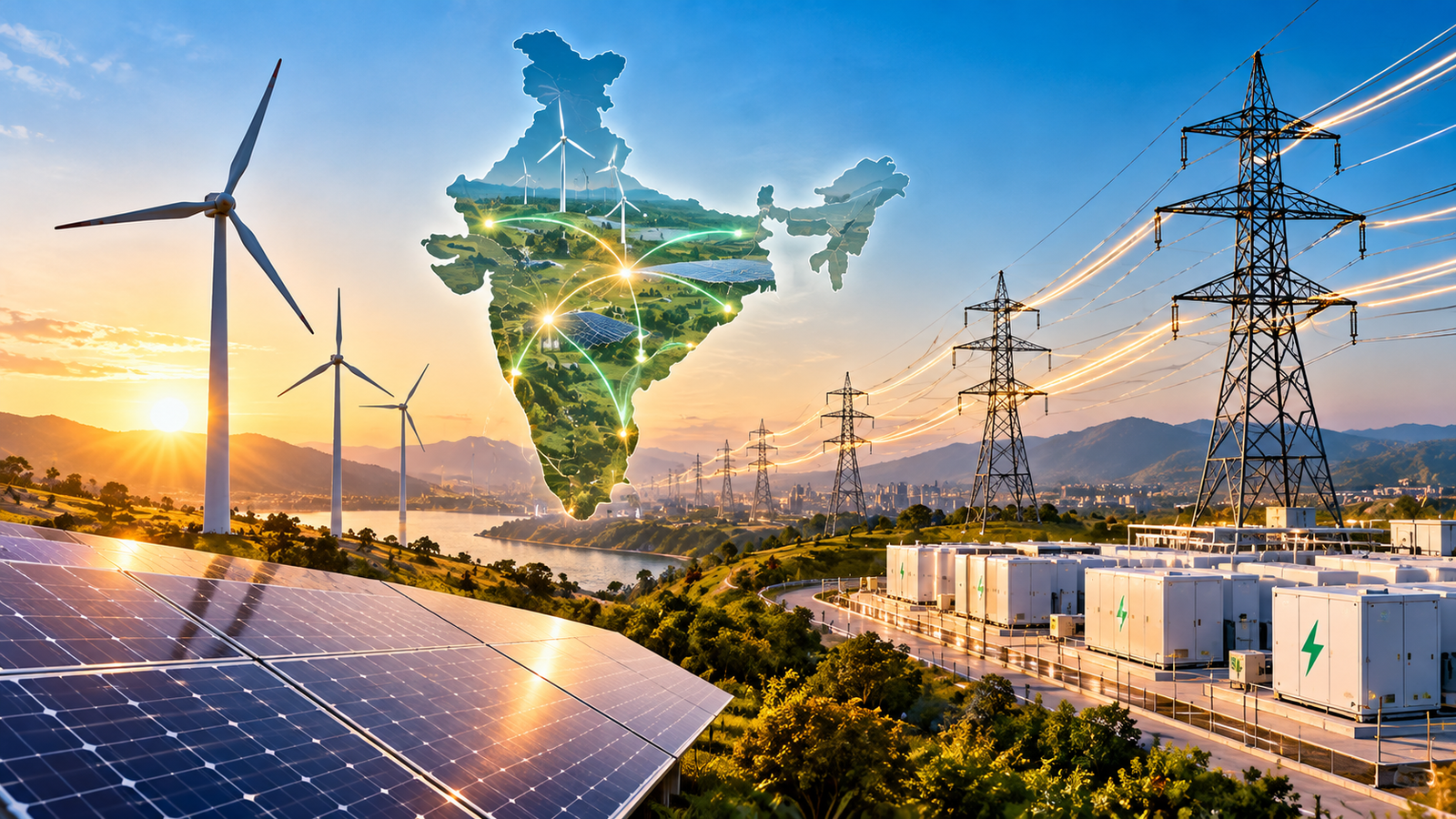
However, the climate benefit of EVs also depends on the electricity mix.
If electricity increasingly comes from renewable sources, the lifecycle climate benefit of electrification can become greater.
This connects CAFE with India’s broader transition towards:
- renewable energy;
- energy storage;
- green hydrogen;
- electric mobility;
- energy efficiency.
CAFE-III and Sustainable Development
CAFE-III has links with several Sustainable Development Goals.
SDG 7 — Affordable and Clean Energy
Promotes energy efficiency and cleaner energy use.
SDG 9 — Industry, Innovation and Infrastructure
Encourages technological innovation in the automobile sector.
SDG 11 — Sustainable Cities and Communities
Cleaner and more efficient mobility can support sustainable urban transport.
SDG 12 — Responsible Consumption and Production
Promotes efficient use of energy and resources.
SDG 13 — Climate Action
Lower fossil-fuel consumption can contribute to greenhouse-gas mitigation.
Himachal Pradesh Connection
CAFE-III is a national regulation, but it has relevance for Himachal Pradesh as well.
Himachal Pradesh has:
- mountainous terrain;
- tourism-related vehicle movement;
- growing urban transport demand;
- long-distance road dependence;
- sensitivity to air pollution in tourist and urban centres.
Cleaner and more fuel-efficient vehicles can therefore support sustainable mobility in hill regions.
For Himachal, the transition also needs attention to:
- EV charging infrastructure;
- road suitability;
- cold-weather battery performance;
- tourist vehicle fleets;
- public transport electrification;
- hydropower-based electricity availability;
- waste management and battery recycling.
HPPSC Angle
A possible HPPSC question could connect:
Electric mobility + Hydropower + Sustainable tourism + Mountain transport
UPSC Prelims Perspective
Remember these facts:
CAFE = Corporate Average Fuel Economy
CAFE-III period = 2027–28 to 2031–32
Effective from = 1 April 2027
Ends = 31 March 2032
Fuel-efficiency improvement = about 16.7%
2027–28 benchmark = 3.996 litres/100 km
2031–32 benchmark = 3.3273 litres/100 km
Reference weight = 1,229 kg
BEV/REEV volume derogation factor = 3
PHEV/flex-fuel strong hybrid = 2.5
Strong hybrid = 1.6
Flex-fuel vehicle = 1.1
Recognised fuel-conservation technologies = 12
Maximum technology concession = 9 g CO₂/km
Testing/reporting = MIDC + WLTP
Very low-volume manufacturers below 1,000 annual sales = exempt from fleet-average obligations, while still required to report actual fleet-average fuel consumption.
Possible UPSC Prelims Question
Consider the following statements regarding India’s CAFE-III norms:
- They will apply from April 2027 to March 2032.
- They regulate the average fuel efficiency of eligible passenger vehicles at the manufacturer level.
- Battery Electric Vehicles receive a volume derogation factor of 3.
- The framework recognises only electric vehicles and does not provide incentives for alternative fuels.
Which of the statements given above are correct?
Answer: 1, 2 and 3 only
Explanation
Statements 1, 2 and 3 are correct.
Statement 4 is incorrect because CAFE-III also recognises alternative and low-carbon fuels through mechanisms such as the Carbon Neutrality Factor.
UPSC Mains Perspective
Possible GS Paper III Question
“India’s CAFE-III norms seek to combine stricter fuel-efficiency requirements with technological flexibility. Examine their significance for energy security, climate mitigation and India’s automobile industry.”
Answer Framework
Introduction
Define CAFE norms and mention the 2027–32 framework.
Body
Explain:
- fleet-average approach;
- progressively tighter efficiency targets;
- EV and hybrid super credits;
- alternative fuels;
- technology credits;
- credit trading.
Then discuss:
Energy security
- lower petroleum consumption;
- reduced import dependence.
Environment
- lower fuel consumption;
- lower CO₂ emissions;
- cleaner mobility.
Economy
- automotive innovation;
- component manufacturing;
- investment;
- technology development.
Challenges
- technology cost;
- charging infrastructure;
- critical minerals;
- battery recycling;
- real-world efficiency gap.
Way Forward
- technology-neutral transition;
- renewable-powered electrification;
- public transport;
- domestic battery and component ecosystem;
- charging infrastructure;
- recycling;
- continuous monitoring.
Conclusion
CAFE-III can form an important part of India’s transition towards more energy-efficient and lower-carbon mobility while retaining technological flexibility.
Geography Optional Perspective
CAFE-III can also be connected with Geography Optional.
Human Geography
Transport Geography
Transport systems influence:
- energy consumption;
- urbanisation;
- economic activity;
- spatial mobility.
Economic Geography
CAFE can influence the spatial distribution of:
- automobile manufacturing;
- battery industries;
- charging infrastructure;
- critical-mineral supply chains.
Environmental Geography
It connects:
Transport → Fossil fuel consumption → CO₂ emissions → Climate change
Regional Geography
Different regions have different mobility requirements.
For example:
- dense metropolitan areas;
- industrial corridors;
- hill regions;
- rural areas;
- tourist regions.
Therefore, sustainable transport policy needs to consider regional geography.
Important Keywords
Corporate Average Fuel Economy
English Definition: A manufacturer-level standard requiring a prescribed average fuel efficiency across eligible vehicles.
Fleet Average
English Definition: The average performance of all eligible vehicles sold by a manufacturer.
Super Credit
English Definition: A regulatory mechanism that gives additional compliance weight to cleaner vehicle technologies.
BEV
English Definition: A Battery Electric Vehicle powered entirely by stored electrical energy.
PHEV
English Definition: A Plug-in Hybrid Electric Vehicle that combines an electric drivetrain with an internal combustion engine and can be externally charged.
Strong Hybrid
English Definition: A hybrid vehicle capable of meaningful electric propulsion using a larger electric system than a conventional mild hybrid.
Carbon Neutrality Factor
English Definition: A regulatory factor recognising the contribution of specified renewable or low-carbon fuels in CAFE calculations.
MIDC
English Definition: Modified Indian Driving Cycle used for standardised vehicle testing in India.
WLTP
English Definition: Worldwide Harmonized Light Vehicles Test Procedure used for globally harmonised vehicle testing.
Fleet Weight
English Definition: The weighted average mass of vehicles in a manufacturer’s eligible fleet.
Energy Efficiency
English Definition: The ability to provide the same service or output using less energy.
CAFE-III: One-Page Revision
CAFE
→ Corporate Average Fuel Economy
Legal/Policy Context
→ Energy Conservation Act, 2001
→ First notified in 2017
Current Phase
→ CAFE-III
Period
→ 2027–28 to 2031–32
Effective
→ 1 April 2027
Target
→ About 16.7% improvement in fuel efficiency
Benchmark
→ 3.996 → 3.3273 litres/100 km
Reference Weight
→ 1,229 kg
Major Technologies Recognised
→ BEV
→ REEV
→ PHEV
→ Strong Hybrid
→ Flex Fuel
BEV Super Credit
→ 3×
Alternative Fuels
→ Ethanol
→ Biofuels
→ CBG
Carbon Neutrality Factor
→ Yes
Technology Credits
→ 12 recognised technologies
Maximum Technology Concession
→ 9 g CO₂/km
Testing
→ MIDC + WLTP
Compliance
→ Credits + Carry-forward + Trading + Buyout mechanism
Institution
→ Bureau of Energy Efficiency
Memory Trick
Remember:
“16 – 3 – 12 – 9 – 2”
16 → 16.7% efficiency improvement
3 → BEV/REEV super credit
12 → recognised fuel-conservation technologies
9 → maximum g CO₂/km technology concession
2 → MIDC + WLTP testing framework
This gives you the core CAFE-III numbers for Prelims.
Final Takeaway
India’s CAFE-III norms for 2027–32 represent a shift towards progressively higher fuel efficiency while allowing automobile manufacturers flexibility in choosing their technology pathway.
The framework does not depend only on EVs. It combines:
Fuel efficiency + EVs + Hybrids + Alternative Fuels + Technology Innovation + Credit Trading
Its importance extends beyond the automobile sector because more efficient mobility can contribute to energy security, lower fossil-fuel consumption, climate mitigation, technological innovation and sustainable transport.
For UPSC, CAFE-III should therefore be studied at the intersection of Environment + Energy Security + Economy + Science & Technology + Sustainable Development.